

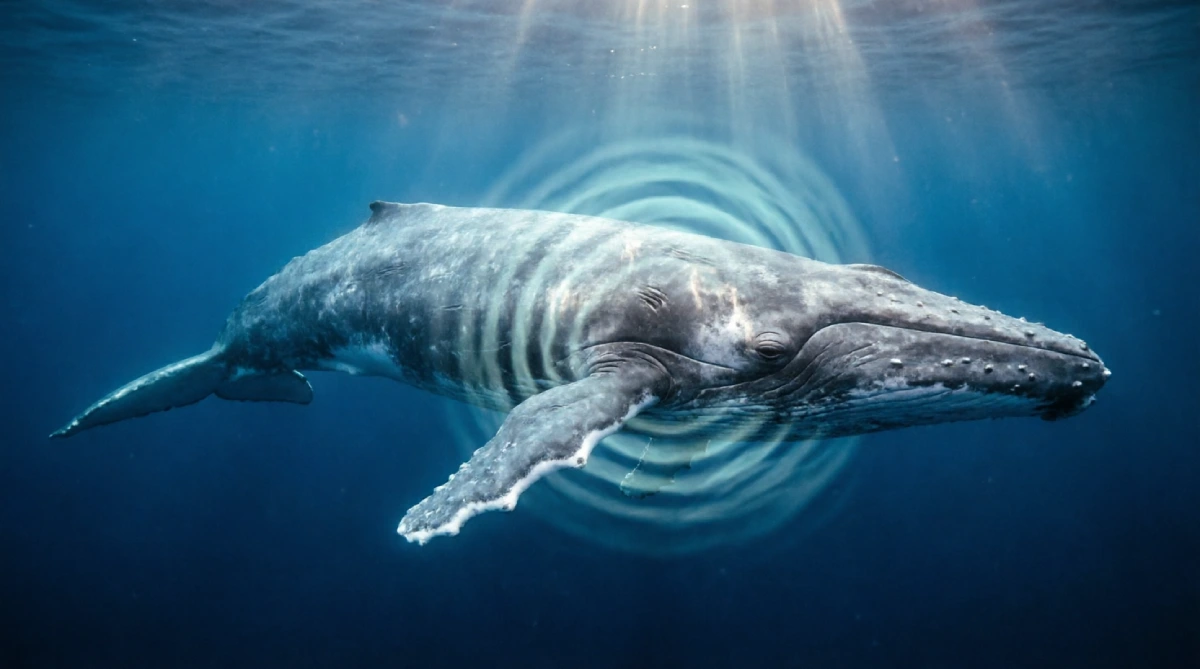
Close your eyes for a second. Imagine standing two miles away from something — maybe the length of 35 football fields. Now imagine hearing its heartbeat from that distance. No microphone. No amplifier. Just water carrying sound. That’s exactly what researchers recorded when they first measured a blue whale’s heartbeat in the open ocean using a suction-cup tag.
It sounds like science fiction. It’s not. The blue whale has a heart so large and so powerful that under the right conditions, its beats travel through water the way thunder travels through air.
Let’s break down exactly why this happens — and why every part of it is real.
First, Let’s Talk About How Big a Blue Whale Actually Is
The blue whale is the largest animal ever recorded on Earth. Full stop. Not the largest alive today — the largest that has ever existed, including every dinosaur species we know of.
An adult blue whale can reach up to 100 feet (30 meters) in length and weigh as much as 200 metric tons (about 200,000 kilograms). To put that in perspective, a fully loaded Boeing 737 weighs around 80 tons. The blue whale weighs more than two of those aircraft combined.
When something is that massive, every internal system has to scale up to match. The lungs hold around 5,000 liters of air (estimates vary from 2,500 to 5,000 liters depending on the whale’s size). The tongue alone can weigh as much as an elephant. And the heart? That’s where things get truly staggering.
How Big Is a Blue Whale Heart?
A blue whale’s heart weighs approximately 400 pounds (around 180 kilograms). That’s roughly the weight of a small car engine — or a fully grown male lion.
The heart itself is about the size of a golf cart. The aorta is about 9–10 inches (23–25 cm) in diameter — wide enough for a small child to fit through, though it is not a straight, crawlable passage.
In 2015, scientists at the Royal Ontario Museum had the rare chance to examine a blue whale heart that had washed ashore. After careful preservation, they confirmed it was roughly 5 feet wide, 5 feet tall, and 5 feet long — about the size of a compact car. You can still see it on display there today.
This isn’t just a curiosity. Blue whale heart size is a direct function of what it takes to pump blood through a 200-ton body. That heart has to push roughly 58 gallons (220 liters) of blood with every single beat.
How Often Does a Blue Whale’s Heart Beat?
Here’s where whale heartbeat facts get interesting. A blue whale’s resting heart rate is only 8 to 10 beats per minute. For comparison, a healthy human heart beats 60 to 100 times per minute.
When a blue whale dives deep — which it does regularly when feeding on krill — its heart rate drops even further. Scientists at Stanford University (led by marine biologist Jeremy Goldbogen) published research in the journal PNAS in 2019 confirming that during deep dives, the blue whale’s heart rate can fall as low as 2 beats per minute. That’s less than one beat every 30 seconds.
When it surfaces to breathe, the rate spikes back up temporarily to around 25 to 37 beats per minute. So the heart is doing a wide range of work throughout the day — and each beat is slow, massive, and incredibly powerful.
Why Does Sound Travel So Far Underwater?
This is the part most people don’t expect. Sound actually moves faster and farther through water than through air.
In air, sound travels at roughly 767 miles per hour (1,235 km/h). In seawater, it travels at about 3,355 miles per hour (5,400 km/h) — more than four times faster. Water is denser than air, which means sound waves compress and decompress it more efficiently, losing less energy as they travel.
There’s also a phenomenon called the SOFAR channel (Sound Fixing and Ranging channel) — a layer in the ocean at around 1,000 meters depth where sound can get trapped and travel enormous distances with almost no energy loss. Marine biologists believe whales have evolved to use this channel for long-distance communication across entire ocean basins.
You can read more about how ocean acoustics work in detail via NOAA’s Ocean Sound Science overview — one of the most reliable resources on underwater sound physics available.
So, Can You Really Hear a Blue Whale’s Heartbeat from 2 Miles Away?
The short answer: yes — under the right conditions.
The 2019 Stanford study used a digital acoustic recording tag (Dtag) — a suction-cup device that records sound, pressure, and acceleration — attached to a blue whale’s body to record its heartbeat directly. The recorded beats were powerful enough that researchers noted the low-frequency vibrations could potentially be detectable at distances up to 2 miles (about 3.2 kilometers) under ideal acoustic conditions, though this remains an estimate rather than a direct measurement.
You wouldn’t hear it the way you hear a drum at a concert. The blue whale heartbeat produces low-frequency sound waves — well below what the human ear normally picks up. But with sensitive hydrophones (underwater microphones), the signal is clear and detectable from a significant distance.
Think of it like the bass from a subwoofer in a car driving past — you feel it in your chest before your ears fully process it. A blue whale’s heartbeat operates at those deep, powerful frequencies, and water carries them far.
Blue Whale Size Comparison — Putting It All in Perspective
Sometimes raw numbers don’t land until you compare them to everyday things. Here’s a quick breakdown:
- Blue whale heart weighs ≈ 400 lbs — same as a small car engine or a fully grown male lion
- Blue whale aorta diameter ≈ 9–10 inches — wide enough for a child to crawl through
- Blue whale length ≈ 100 feet — longer than two standard school buses end-to-end
- Blood pumped per heartbeat: 58 gallons — more than a standard bathtub holds
- Resting heart rate ≈ 8–10 beats per minute — about 7–10 times slower than a human at rest
- Lowest recorded heart rate during diving: 2 beats per minute
Why Does Any of This Matter?
Beyond the pure amazement factor, understanding blue whale anatomy and how sound travels in water matters for real conservation reasons.
Blue whales are endangered. One of the ongoing threats they face is noise pollution — the constant low-frequency noise from shipping traffic, sonar, and industrial activity that fills the ocean. Because blue whales rely on low-frequency sound for communication and navigation, that noise interferes with their ability to find mates, locate food, and avoid hazards.
When you understand that a whale’s heartbeat travels 2 miles underwater, you start to grasp just how sensitive and sound-dependent these animals are — and why a noisy ocean is genuinely dangerous for them.
FAQs
How loud is a blue whale’s heartbeat?
The blue whale’s heartbeat produces low-frequency sound — too low for the human ear to hear without equipment. But with sensitive underwater hydrophones, it may be detectable at distances up to 2 miles (3.2 km) under ideal conditions, though this has not been directly measured in the wild.
How big is a blue whale’s heart compared to a human heart?
A human heart weighs around 10–12 ounces (280–340 grams). A blue whale’s heart weighs approximately 400 pounds (180 kg). That’s roughly 640 times heavier.
Is the blue whale the loudest animal on Earth?
Blue whale calls — their long, low-frequency vocalizations — are considered among the loudest animal sounds on Earth, reaching up to 188 decibels. Their heartbeat is separate from their vocalization, but both operate in the low-frequency range that water carries exceptionally well.
The Ocean Is Full of Things We Can’t Quite Wrap Our Heads Around
A blue whale’s heartbeat sound traveling up to 2 miles is one of those facts that sounds exaggerated until you understand the science. Then it becomes completely obvious. Of course, a 400-pound heart pushing 58 gallons of blood at a time produces sound. Of course, water carries that sound far. Of course, the biggest animal that has ever lived has internal systems that operate at a scale we struggle to visualize.
That’s what makes blue whales genuinely incredible — not exaggeration, not myth. Just biology operating at a scale that humans rarely get to witness.

