
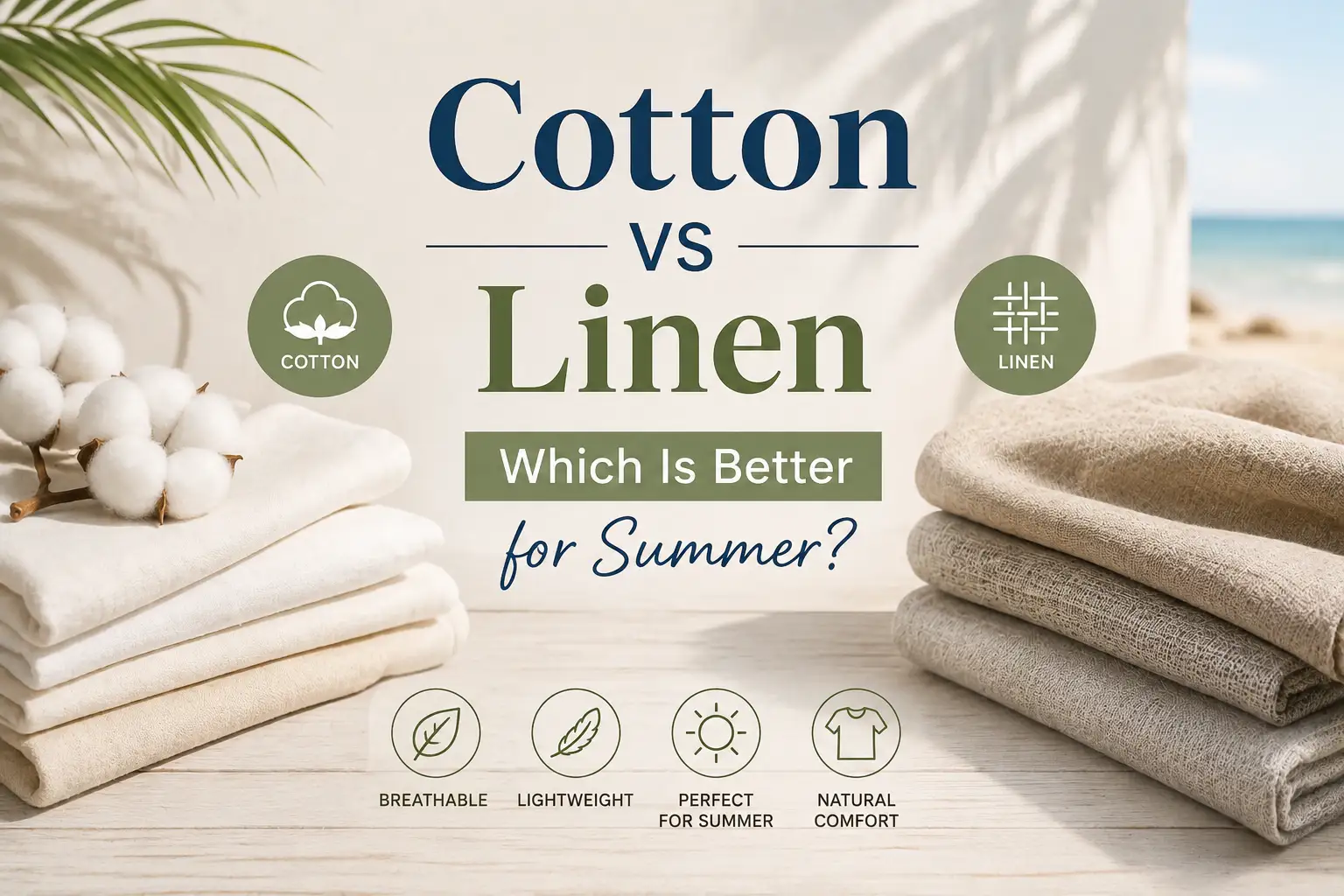
Linen is generally cooler for summer because its hollow fibers allow superior airflow and release heat faster than cotton. Cotton, however, offers softer comfort and far better wrinkle resistance. This guide breaks down breathability, moisture handling, durability, and care, so you can match the right fabric to your climate and lifestyle.
What Makes Linen and Cotton Different?
Linen comes from the flax plant. Its fibers are hollow, which is the key structural reason linen feels cool. That hollow core lets air pass through the fabric instead of getting trapped against the skin.
Cotton comes from the seed pod of the cotton plant, known as a boll. Its fibers are solid and slightly twisted, which creates a soft, flexible texture. This structure makes cotton comfortable but less airy than linen.
Fiber diameter matters too. Linen fibers are naturally coarser and stiffer than cotton fibers, which is part of why linen holds its shape away from the body rather than clinging to it.
Both fibers are natural and hypoallergenic. The core difference lies almost entirely in fiber shape and structure, not in fiber origin alone.
Cotton vs Linen Breathability: Which Fabric Is Cooler?
Linen wins on breathability. Its open weave and hollow fiber structure let air circulate freely against the skin. This airflow carries heat away from the body continuously, rather than letting it build up underneath the fabric.
Linen also conducts heat poorly. That might sound like a downside, but it isn’t. Low heat conductivity means linen absorbs less heat from the sun and the body. As a result, it stays cool to the touch even in direct sunlight.
Cotton is breathable too, just less efficiently. Its solid fibers and typically denser weave trap slightly more warmth. In dry heat, this difference is barely noticeable. In humid heat, it becomes significant, since less airflow means slower evaporation.
What Is the Coolest Fabric for Summer?
Linen is generally considered the coolest natural fabric for summer. Its hollow fiber structure and open weave combine to maximize airflow. Lightweight cotton weaves like poplin or seersucker come close, but linen still leads in intense heat and humidity.
Moisture-Wicking and Sweat Management
Moisture handling separates these fabrics almost as much as breathability does. Cotton can absorb up to 25% of its own weight in moisture. Linen absorbs slightly less, around 20%, but releases that moisture much faster.
This wicking speed matters more than total absorption capacity. Linen pulls sweat away from the skin and evaporates it quickly. Cotton holds onto moisture longer, which is why a soaked cotton shirt feels heavy and clings to the skin.
In humid conditions, this difference becomes obvious within an hour of wear. Linen stays comparatively dry throughout the day. Cotton can start to feel damp and sticky, especially in weaves without much ventilation built in.
Fabric weight plays a supporting role here too. Textile weight is measured in GSM, or grams per square meter. Lighter fabrics generally dry faster regardless of fiber type, so a lightweight linen or cotton weave will typically outperform a heavier one in fast-drying comfort.
Softness and Feel: Which Is More Comfortable?
Cotton is softer straight out of the wash. Its fibers are naturally smooth and slightly stretchy, which is why cotton has been the default choice for everyday comfort for generations.
Linen starts crisper and can feel a little stiff when new. However, it softens noticeably with every wash cycle. Over time, linen develops a relaxed, almost buttery texture that many people come to prefer over cotton’s consistent smoothness.
Texture is a visible difference too. Linen has natural slubs and irregularities woven into it. Cotton is smoother and more uniform, which is why it holds printed patterns with sharper, more precise detail.
For sensitive skin, both fabrics generally work well. Cotton offers gentle, consistent softness from day one. Linen offers breathability without irritation, though it may need a few washes before it feels fully soft.
Wrinkle Resistance and Everyday Wearability
This is cotton’s clearest advantage. Cotton holds its shape well and resists wrinkling through a long, busy day. That makes it a reliable choice whenever a polished look matters without much upkeep.
Linen wrinkles almost immediately, often within the first hour of wear. This isn’t really a flaw so much as a characteristic. Many people consider linen’s creases part of its relaxed, lived-in appeal, especially for casual or vacation settings.
For office wear or formal occasions, cotton’s low-maintenance structure usually wins out. For beach days or laid-back summer outings, linen’s wrinkles rarely matter at all.
Cotton vs Linen: Side-by-Side Comparison
| Factor | Linen | Cotton |
|---|---|---|
| Breathability | Excellent | Good |
| Moisture absorption | ~20% of fiber weight | ~25% of fiber weight |
| Drying speed | Very fast | Moderate |
| Softness (new) | Slightly stiff | Immediately soft |
| Wrinkle resistance | Low | High |
| Durability | Very high | High |
| Best climate | Hot and humid | Mild to warm |
| Typical price range | Mid to high | Wide range |
This table highlights a clear pattern. Linen leads in performance categories tied to heat and moisture. Cotton leads in convenience categories tied to appearance and everyday care.
Is It Better to Wear Linen or Cotton in Hot Weather?
Linen is generally better in hot weather, especially when humidity is high. Its hollow fibers and open weave move heat and moisture away from the body faster than cotton can manage.
Cotton still performs reasonably well in hot, dry climates. Lightweight cotton weaves like seersucker or poplin allow decent airflow without holding excess moisture against the skin. In dry heat, the performance gap between the two fabrics narrows considerably.
The clearest divide appears in humid heat specifically. Cotton tends to cling and feel heavy once damp. Linen continues to feel comparatively dry and light, even after several hours of wear.
Is 100% Cotton Better Than 100% Linen?
Neither fabric is universally better; each wins under different conditions. 100% linen outperforms cotton in breathability, cooling, and moisture release. 100% cotton outperforms linen in softness, wrinkle resistance, and ease of care.
The right choice depends on personal priorities. Someone prioritizing cool comfort in humid weather should choose linen. Someone prioritizing a polished, low-maintenance look should choose cotton instead.
When to Not Wear Linen
Linen isn’t ideal for every situation, despite its cooling advantages. Avoid pure linen when a crisp, wrinkle-free appearance is required, such as certain formal events or client-facing office settings.
Linen also isn’t the best choice on a tight budget, since flax processing is labor-intensive and typically pushes prices into the mid-to-high range. Additionally, pure linen isn’t ideal for high-friction activities like intense exercise, where its stiffer structure can feel less flexible than a stretch-cotton blend.
Humid coastal air can also cause pure linen to wrinkle even faster than usual, since moisture in the air softens the fiber’s natural stiffness. In any of these situations, cotton or a cotton-linen blend usually performs better.
Cotton-Linen Blends: The Middle Ground
Blending linen with cotton combines strengths from both fibers. Typical blends range from 30% to 70% linen, with cotton making up the remainder.
Higher linen content improves breathability and cooling. Higher cotton content improves wrinkle resistance and softness. A 50/50 blend sits directly in the middle, offering noticeable airflow with meaningfully less creasing than pure linen.
Blends are also easier to care for day to day. They generally tolerate regular machine washing better than pure linen, which often benefits from gentler handling. For travelers who need a shirt that looks presentable straight out of a suitcase, blends are usually the most practical option available.
Durability, Care, and Sustainability
Durability: Linen is remarkably strong for a natural fiber, often outlasting cotton by years when cared for properly. It resists pilling and actually gains softness with age rather than losing structural integrity. Cotton is durable too, but it can thin or lose shape in high-friction areas like collars and cuffs over time.
Care: Linen prefers cool water, air drying, and occasional steaming to release wrinkles. Cotton is far more forgiving; it handles regular machine washing and tumble drying without much fuss. Cotton-linen blends fall in between, tolerating standard wash cycles while wrinkling noticeably less than pure linen.
Sustainability: Flax, the plant linen comes from, requires significantly less water and fewer pesticides than conventional cotton. The entire flax plant can be used in production, and linen is fully biodegradable at the end of its life. Cotton’s environmental footprint is generally higher unless it’s certified organic, since conventional cotton farming tends to be water- and chemical-intensive.
Cost-per-wear: Linen typically costs more upfront due to labor-intensive flax processing. However, its exceptional durability often offsets that cost over years of regular wear. A well-made linen garment can last a decade or more, which can make its true cost-per-wear lower than a cheaper cotton piece replaced every year or two.
Best Fabric by Use Case
For hot, humid climates: Choose linen. Its breathability and fast moisture release make it the clear performance leader in tropical or coastal conditions.
For travel: Choose a cotton-linen blend. It resists wrinkles better than pure linen while still offering solid breathability, which matters after hours packed in a suitcase.
For office and business-casual settings: Choose cotton, or a linen-cotton blend in a tailored cut. Cotton’s structure and low-maintenance finish suit professional environments better than pure linen’s relaxed creasing.
For resort and leisure wear: Choose linen. Its breathability and effortless, textured look are built for beach days, poolside afternoons, and warm-weather vacations.
For everyday casual wear: Either fabric works well here. Cotton suits those who prefer minimal ironing, while linen suits those who don’t mind natural wrinkles in exchange for maximum airflow.
For sensitive skin: Choose high-quality cotton or linen, since both are naturally hypoallergenic. Cotton offers gentle smoothness all day, while linen adds breathability without irritating the skin.
Bottom Line: Cotton or Linen for Summer?
Linen is the better choice for hot, humid summers where breathability and quick drying matter most. Cotton is the better choice when softness, structure, and low-maintenance care take priority instead.
There’s no single winner between the two fabrics. The right choice depends on your climate, your tolerance for wrinkles, and how you plan to wear the garment. For most people who want a bit of both, a cotton-linen blend offers a practical middle ground without giving up too much of either fabric’s core strengths.

