

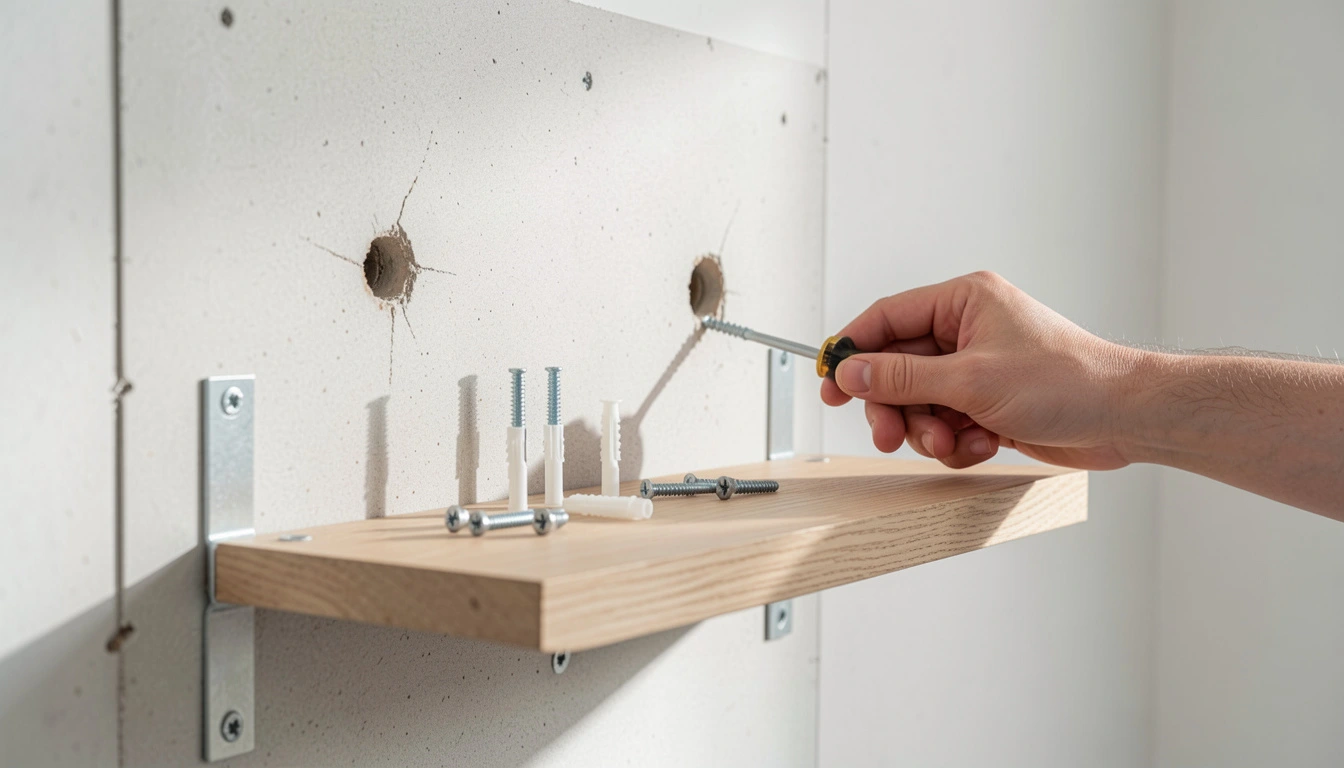
Last week, I helped a neighbor whose kitchen shelf collapsed for the third time. Same shelf, larger screws, same heap of smashed ceramics on the floor. He blamed the bracket, the drywall, his luck — but never the tiny plastic anchor he’d pushed into the wall.
That anchor decides whether the shelf stays up. Grab the wrong type, and no screw can save it. I made the same mistake (lost a spice rack and some dignity), so I update this guide every year. For 2026, I’ve refreshed every number, added new hybrid anchors, and aligned everything with the latest ASTM loading standards so you don’t trust a lab-only rating.
A shelf falls because of a fixable mismatch. Here’s exactly why it happens and how to fix it permanently — even if your DIY experience ends at flat-pack furniture.
The Real Reason Shelves Fall (It’s Not the Screws)
The fix isn’t stronger screws; it’s matching the anchor to the wall material and using the right installation.
A cheap plastic expansion plug driven into drywall tries to expand outward into soft gypsum. It feels snug at first, but drywall is a lightweight panel with a chalky core and hollow cavity behind it. Each time you add a book, the anchor pulls outward and down. The gypsum crumbles, the hole widens, and within days or weeks, everything falls.
Set that same plastic plug in solid concrete, and it expands against a hard surface that resists crushing. It holds. In drywall, it’s like gripping foam — the material can’t resist concentrated outward pressure.
The Difference in Numbers is Stark
ASTM testing shows a typical #8–#10 plastic expansion anchor in ½-inch drywall has an ultimate pull-out strength of 39–46 pounds in a lab. In practice, with a shelf pulling outward and downward, the safe load drops to less than 10 pounds. A single modern toggle bolt in the same drywall can support over 100 pounds safely.
Anchor type isn’t a suggestion; it’s the whole job.
First, Know Your Wall (Not All Walls Are Drywall)
Before buying any anchor, identify your wall material. An anchor designed for concrete fails in drywall, and vice versa.
Drywall (Gypsum Board)
The most common interior wall in modern homes. Hollow-sounding when you knock, easily pierced with a thumbtack. Usually ½ inch or ⅝ inch thick, attached to wood or metal studs.
Plaster and Lath
Found in older homes. The surface is harder than drywall and often shows hairline cracks or an uneven texture. It still has a hollow cavity behind it, so toggle bolts and molly bolts work well. Drilling is tougher; use a carbide bit.
Brick
Solid, dense, and heavy. Typically visible as exposed brick or hidden behind plaster in older buildings. It’s very hard under pressure and won’t dent. To drill it, you’ll need a hammer drill and a masonry bit.
Concrete and Concrete Block
Poured concrete walls are smooth, grey, and extremely hard — common in basements and garages. A hollow concrete block looks like a grid of vertical cells and requires anchors that expand in the voids. If you’re unsure, tap the wall; a hollow sound and less drill resistance indicate a block.
Quick test: Press a small nail into an inconspicuous spot. If it slides in with light thumb pressure, you’re on drywall. If it barely scratches, you’re on masonry.
Why You Can’t Use the Same Anchor for Every Wall (And What to Use Instead)
Wall anchors are engineered for specific materials. Their holding power comes from different mechanics: expansion, friction, or bearing against the back of the wall. When the anchor meets the wrong material, those mechanics fail.
The chart separates ultimate load (catastrophic failure in a straight pull) from safe working load (what you can put on a shelf daily). Industry practice applies a 4:1 safety factor for masonry anchors and recommends derating by at least 50% for shelves that pull outward, because a loaded shelf acts as a lever.
| Anchor Type | Best Wall | Ultimate Load (lbs) | Safe Working Load (lbs) | Notes |
|---|---|---|---|---|
| Plastic expansion plug | Concrete / Brick | Up to 46 in drywall (lab); ~30–50 in concrete | ≤10 in drywall; ~15 in concrete | Never use alone in drywall for shelves |
| Self-drilling threaded anchor (e.g., E-Z Ancor) | Drywall / Plaster | 75–80 (varies by brand) | 30–50 | General purpose: stop when flush to avoid stripping drywall |
| Hybrid self-drilling/toggle (e.g., SnapSkru) | Drywall | 100+ | 50 | Combines twist-in ease with a behind-wall lock |
| Molly bolt | Drywall / Plaster | 25–50 | 15–25 | Neater finish; sleeve compresses behind the wall |
| Toggle bolt (wing toggle) | Drywall | 100–150 | 50–75 | Strong wings can’t be retrieved if removed |
| Channel toggle (TOGGLER Snaptoggle) | Drywall | 238–265 | 100–150+ | Benchmark for heavy drywall loads |
| Tapcon screw (3/16″ in 4,000 PSI concrete, 1″ embed) | Concrete / Block | 600–720 (ultimate) | 150–180 | Embedment depth critical — see notes |
| Sleeve anchor | Brick / Block / Concrete | 200–500+ | 50–125+ | Works in brick, block, and concrete |
| Wedge anchor | Poured concrete | 500+ | 125+ | Permanent, heavy-duty hold in solid concrete |
Safe working loads assume proper installation, sound wall material, and no damage. Always check the manufacturer’s specific ratings — and if your shelf extends more than 3 inches from the wall, reduce the safe load further.
Hybrid Anchors & Smart Tools
- Hybrid self-drilling anchors with toggle-like locking are now widely available. Brands like SnapSkru let you twist the anchor into drywall like a self-drilling plug, then snap off a tab that expands wings behind the wall — combining the ease of a twist-in with the strength of a toggle.
- Corrosion-resistant anchors (zinc-plated, stainless steel, coated Tapcon II) are essential for bathrooms, outdoor kitchens, and any humid environment. Standard hardware will rust and fail.
- Smart stud finder apps like Walabot DIY use your phone’s sensors to map studs, pipes, and live wiring inside the wall, reducing the chance of drilling into something dangerous.
- New standards apply: ASTM C1242-25b and E3121/E3121M-17(2026) give professional guidance on anchor selection. For European readers, EN 17235:2024 is now harmonized as of February 2026, with updated load tables.
These tools and products eliminate guesswork.
How to Fix a Falling Shelf (The 2026 Playbook)
What You’ll Need
- Pencil and level
- Drill (hammer drill for masonry)
- Matching drill bits (carbide-tipped masonry bits for brick/concrete, standard for drywall)
- Stud finder (or smart stud finder app)
- Correct anchors for your wall and load
- Screws that match the anchor size
- Small brush or compressed air for cleaning dust from masonry holes
Step 1: Check for Studs First (Drywall & Plaster)
A screw driven directly into a wooden stud (spaced every 16 or 24 inches) needs no anchor and will hold more than any hollow-wall anchor. If your bracket catches at least one stud, you’ve already won.
Step 2: Identify Your Wall Type
Use the nail test, tapping, and drill resistance to be certain.
Step 3: Choose Your Anchor Using Load, Not Guesswork
Ask yourself:
- What’s the wall? (drywall, brick, etc.)
- How heavy is the shelf plus everything that will sit on it? (Be honest — books weigh more than you think)
- Will the shelf stick out from the wall? (Yes? Then use the safe working load, not the ultimate number)
If the shelf is on drywall and holding more than 30 pounds total, use a toggle bolt or hybrid locking anchor. For brick or concrete, Tapcons with the correct embedment depth perform reliably.
Pro tip for masonry: The deeper you embed a Tapcon, the more it holds. A ¼-inch Tapcon embedded 1 inch in 4,000 PSI concrete has an ultimate tension of around 800 pounds; increasing embedment to 1¾ inches pushes ultimate tension beyond 2,300 pounds. Drilling to the correct depth and cleaning the hole is non-negotiable.
Step 4: Mark, Level, Drill, Clean
Mark holes with a level. Drill steadily. For masonry, use a hammer drill. Clean every speck of dust from the hole immediately — a small brush or compressed air works. Leftover dust can reduce anchor grip by up to 40%.
Step 5: Install the Anchor (Follow the Specific Type)
- Self-drilling anchor: Twist until flush, stop the moment it’s snug — overtightening shreds the drywall.
- Toggle bolt: Thread the bolt through the bracket first, then snap the wings through the hole and pull back before tightening.
- Tapcon: Insert the screw and drive it in with steady torque. No hammering.
- Hybrid anchor: Follow the brand’s snap-lock sequence.
Step 6: Mount and Test
Attach the bracket, pull firmly by hand — zero movement. Load the shelf gradually, keeping the heaviest items closest to the wall.
Common Mistakes I Still See in 2026
- Using the “free” anchors from the shelf box. Those are almost always the cheapest plastic plugs. Replace them immediately.
- Trusting the ultimate load on the package. That number is not your shelf rating. Cut it in half, then apply the outward-pull reduction.
- Drilling into mortar joints on brick. Mortar is crumbly and weak. Always move the hole to a solid brick or block.
- Skipping dust removal in masonry. Fine powder lubricates and kills grip.
- Forgetting about rust. Outdoor shelves, bathroom fixtures, and laundry room shelves need corrosion-resistant hardware. Use it, or you’ll be redoing the job next season.
FAQs
Can I use plastic anchors for a drywall shelf at all?
Only for a decorative shelf holding under 5–7 pounds total. For anything with real weight, you need a threaded anchor or toggle.
How do I know if I have drywall or plaster?
Plaster feels harder and colder, often shows hairline cracks, and drilling produces a gritty resistance. When in doubt, start with a small pilot hole.
What’s the strongest drywall anchor right now?
The TOGGLER Snaptoggle (channel toggle) has safe working loads over 100 pounds per anchor in good-condition ½-inch drywall. Hybrid self-drilling toggles like SnapSkru are a strong, faster-install alternative.
Do I always have to anchor into a stud?
If you can, yes. A screw in a stud needs no anchor and eliminates the failure risk at that point. Even one stud hit combined with a toggle on the other bracket is a big win.
Are these anchors safe for earthquake-prone areas?
For seismic regions, follow local building codes — which often require blocking inside the wall or special bracing. Standard anchors alone may not be enough.
The Short Version (TL;DR)
Your shelf isn’t falling because it’s cheap. It’s falling because the anchor was never designed for your wall. Plastic plugs in drywall remain the most common DIY failure I see. The fix takes about 20 minutes.
Identify your wall. Pick the right anchor — toggle, hybrid, Tapcon, or sleeve. Install it cleanly. Test it. Then load that shelf with whatever you own and sleep soundly.
Let’s Hear Your Shelf Horror Story
Have you had a shelf come crashing down at the worst possible moment? (Mine involved a set of vintage mugs and a very startled cat.) Tell me in the comments — I read every one, and I might even feature the best (worst) story in a future update.
And if you’re about to hang a shelf this weekend, save this guide or email it to yourself. It makes an excellent “I told you so” when your friend grabs that packet of free plastic anchors.

