

You’re putting in the hours. Posting on social media. Trying different things every week. But your business? Still stuck.
No new customers. Revenue is flat. Every month looks exactly like the last.
If this sounds familiar, you’re not alone — and it’s not about working harder. Most business owners in this situation are already working hard. The real problem is somewhere else.
This article breaks down the honest reasons your business isn’t growing, the hidden mistakes most people miss, and a practical system to fix it.
The Uncomfortable Truth About Business Growth
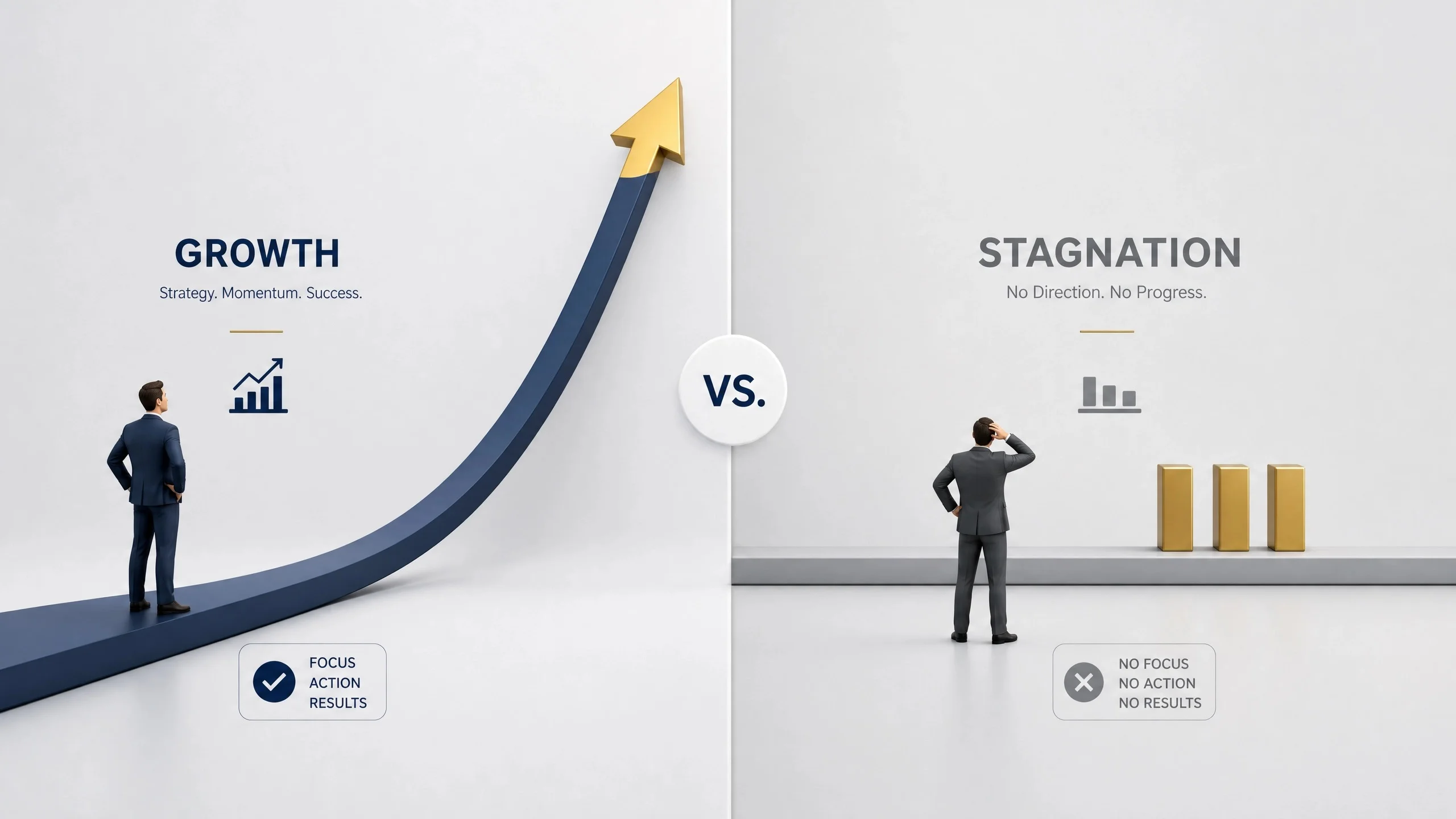
Growth doesn’t come from effort alone. It comes from the right effort, pointed in the right direction, done consistently over time.
According to the U.S. Small Business Administration, about 50% of businesses survive past their fifth year. Startup failure analysis from CB Insights points to the same recurring causes: no market need, running out of cash, wrong team, and poor market fit — not a lack of hard work.
These aren’t bad luck stories. They’re pattern failures — the same problems showing up across hundreds of struggling businesses.
Why Your Business Is Not Growing: The Real Reasons
1. Your Offer Isn’t Clear Enough
People won’t buy something they don’t immediately understand.
If someone lands on your website and can’t figure out within 10 seconds exactly what you do, who it’s for, and why it matters — they’re gone.
A weak offer sounds like this: “I help people achieve their goals through personalized solutions.”
A clear offer sounds like this: “I help e-commerce store owners reduce refund rates by 30% in 60 days.”
Specific beats vague every time. If your offer isn’t crystal clear, no amount of marketing will fix your growth problem.
2. You Have No Consistent Way to Get Customers
Most struggling businesses depend on word of mouth or random social posts. That’s not a system — that’s hope.
A real customer acquisition system means:
- One or two channels you show up on consistently (not five)
- A clear path from stranger to paying customer
- Something that generates leads, whether you’re focused on it or not
Important caveat: The channel that works depends heavily on your industry, customer type, and sales cycle. What works for e-commerce won’t work for B2B services. Match the channel to where your specific customers actually spend time.
Without a system, growth becomes random. Some months are good. Most aren’t. You can’t build anything sustainable on random.
3. You’re Busy — But Not Productive
Being busy and growing are two completely different things. You can spend 10 hours a day responding to DMs, creating content, tweaking your logo, and attending webinars — and still move nowhere.
Growth comes from a small set of high-impact activities:
- Talking directly to potential customers
- Improving your offer based on real feedback
- Building systems that bring in leads without you chasing them
Everything else deserves lower priority. If your schedule is full but your revenue isn’t moving, look at what you’re actually spending time on.
4. You Don’t Know Your Numbers
Many owners don’t track basic business metrics, which makes it impossible to identify where the problem actually is.
You need to know:
- How much does it cost to acquire one customer (Customer Acquisition Cost)
- Your average revenue per customer (LTV or average sale size)
- How much cash do you have to keep operating for the next 3–6 months
If you can’t answer these right now, that’s a major reason your business is stuck. You can’t manage what you can’t measure.
5. You’re Targeting the Wrong Audience — or Everyone
A lot of business owners say, “My product is for everyone.” That’s one of the most expensive mistakes you can make.
When you target everyone, you connect with no one. Your message becomes generic. Your marketing falls flat. The people who would actually buy from you scroll right past — because nothing speaks directly to them.
Pick a specific type of person. Understand their exact problem. Speak directly to that. Your conversion rate will improve, and your acquisition cost will drop.
6. No Follow-Up System
Most sales don’t happen on the first contact. The average buyer needs multiple touchpoints before making a decision — yet most small business owners give up after one or two attempts.
If someone showed interest in your product and you didn’t follow up, you left money on the table. A simple email sequence, a reminder message, or a retargeting ad can recover that lost revenue.
Realistic timeline: Follow-up should continue for at least 30 days, not just a few days. Patience here matters.
7. You Keep Changing Direction
You try Instagram for two weeks. Pivot to YouTube. Launch a new product. Go back to the old one. Overhaul your branding.
This is one of the most common — and most damaging — patterns in struggling businesses. Strategy only works when it gets enough time to actually work. Switching direction every month means nothing ever builds momentum. You’re starting from zero, over and over again.
Pick a direction. Give it meaningful time to work. This doesn’t mean blind persistence — it means tracking metrics and adjusting tactics while keeping your overall strategy steady.
Hidden Mistakes Most Business Owners Miss
These don’t get talked about enough, but they quietly kill growth:
Trying to look professional before you have customers. You don’t need a perfect logo, a redesigned website, or premium tools. Validate demand first. That said, you do need to look credible — basic branding (clean logo, consistent colors, clear messaging) is necessary; extensive rebranding is not.
Copying competitors without understanding why they do what they do. Just because another business posts daily reels doesn’t mean that’s the right move for you. Copy the strategy, not the execution — and only after you understand the logic behind it.
Over-automating customer interactions too early. Early-stage businesses often need the personal touch of direct, manual communication. Automating before you have consistent revenue strips away the relationship-building that wins your first clients. Automate after you know what works.
Avoiding sales conversations because they feel uncomfortable. Growth requires selling. If direct conversations about your offer make you uncomfortable, that’s a skill to develop — not a problem to avoid.
Waiting until everything is “ready.” Nothing is ever fully ready. The businesses that grow start before they feel ready, then improve as they go.
Ignoring cash flow reality. You can execute every step correctly and still fail if you run out of money. Growth takes time — often longer than expected. Plan your cash runway accordingly.
Busy vs. Growing
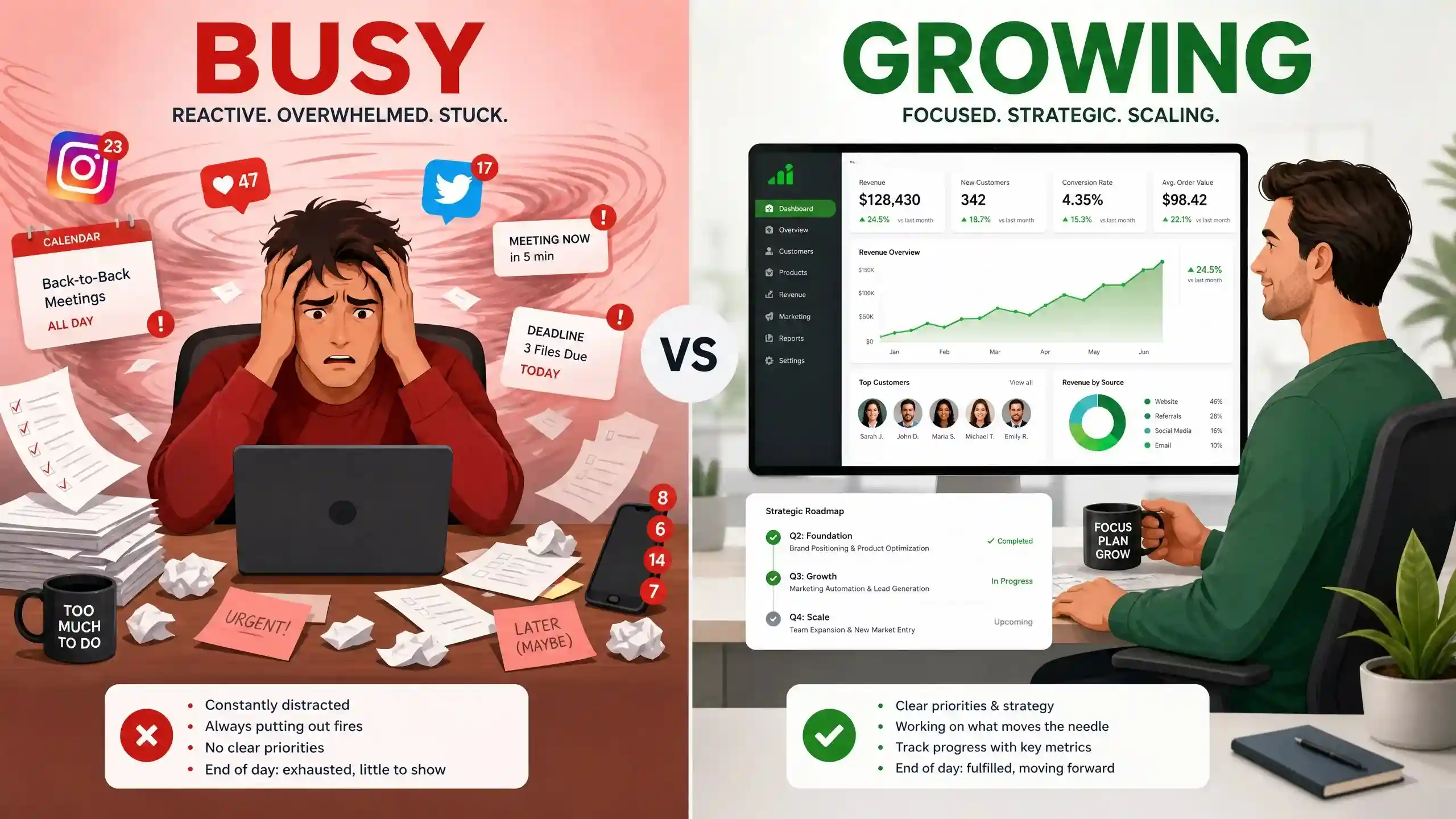
| Busy | Growing |
|---|---|
| Posting content without a strategy | Creating content tied to a customer journey |
| Responding to every message manually (early on) | Building systems only after proving what works |
| Attending every networking event | Building one or two reliable referral sources |
| Offering heavy discounts to move inventory | Improving offer quality and using discounts strategically |
| Tracking tasks | Tracking revenue, leads, and conversion rates |
If your day looks more like the left column, that’s likely part of the problem.
A Practical System to Grow Your Business
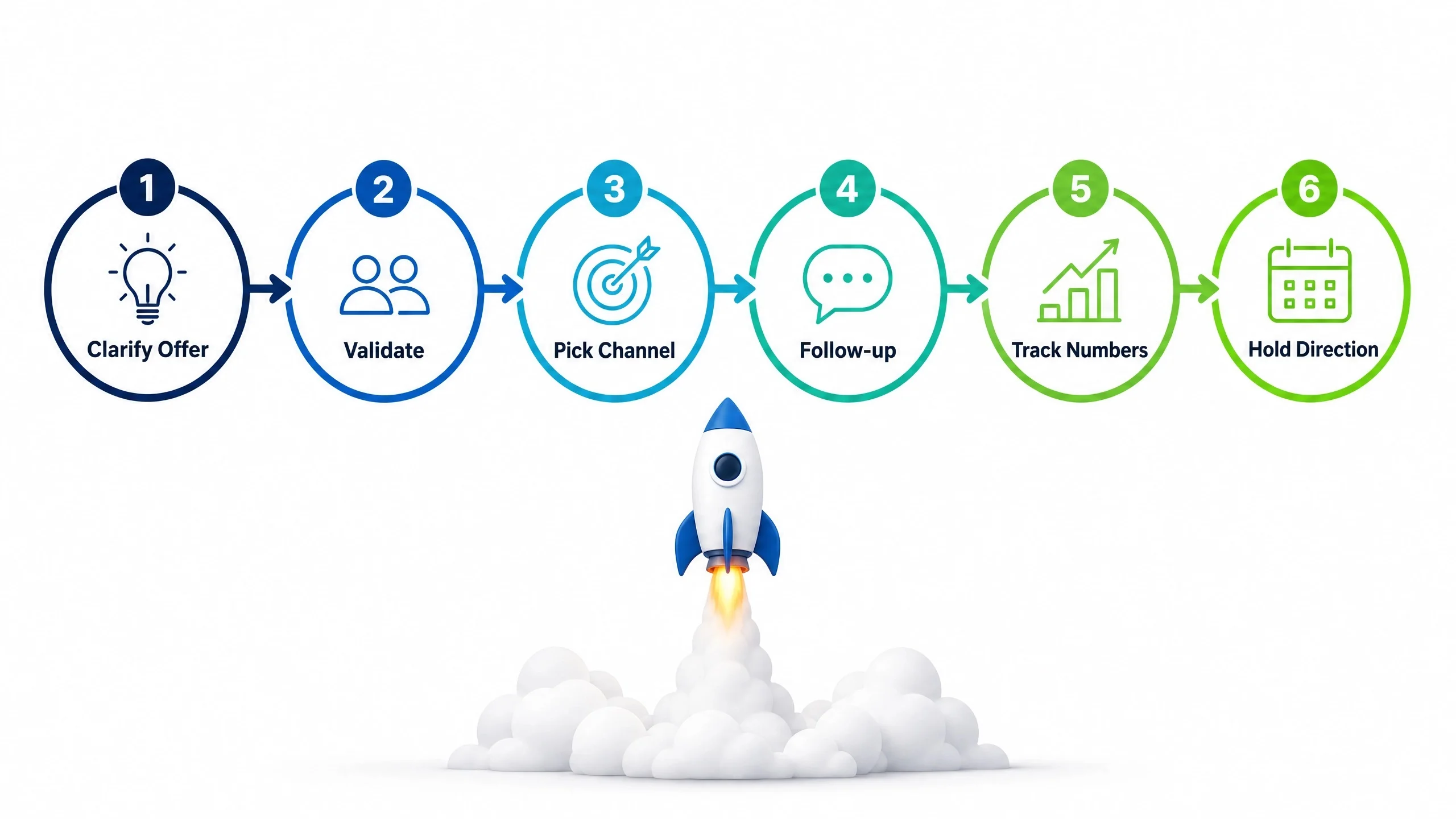
You don’t need 50 strategies. You need one system that works — and realistic expectations to go with it.
Step 1: Clarify Your Offer (Week 1)
Write down exactly what you sell, who it’s for, and what specific result they get. Make it measurable. Test it on someone who doesn’t know your business — if they can’t understand it in 10 seconds, rewrite it.
What you’re measuring: Can someone explain your offer back to you accurately?
Step 2: Validate Your Offer With Real Customers (Week 1–3)
Talk to 10–15 potential or past customers. Not to sell — to listen.
- What are their actual problems?
- What language do they use to describe those problems?
- Why did they choose you — or not?
This tells you exactly what to say in your marketing and how to position your offer.
Step 3: Pick ONE Customer Acquisition Channel (Week 2–3)
Where does your ideal customer already spend time? That’s where you go.
- B2B services → LinkedIn, industry events, email outreach
- E-commerce → Instagram, TikTok, Google Shopping
- Local services → Google Maps, local Facebook groups, referrals
- B2B software → Product Hunt, Hacker News, industry communities
Don’t try to be everywhere. Master one channel first and show up consistently for at least 60–90 days before adding another.
Realistic note: Different channels have different timelines. Content marketing takes 4–6 months to produce results. Direct outreach can show results in 2–3 weeks. Choose based on your budget and timeline — not just general advice.
Step 4: Build a Simple Follow-Up Process (Week 3–5)
When someone shows interest, what happens next? Create a simple 3-step follow-up:
- Initial response (within 24 hours)
- Value-add follow-up (3–5 days later, with something useful)
- Clear call to action (ask for a decision or next step)
Continue following up for at least 30 days if it fits your sales cycle.
Step 5: Track Three Numbers Weekly (Ongoing)
Pick three metrics and review them every week:
- Number of leads generated
- Number of conversations or interactions
- Number of sales or conversions
These numbers will show you exactly where your process is breaking down. A simple spreadsheet is all you need.
Step 6: Hold Your Direction — With Checkpoints (60–90+ Days)
Give your system time to work. Real data only comes from consistent execution. Learning how to stay consistent is where most founders struggle — and where real growth happens.
That said, use these checkpoints to self-correct:
- Zero leads after 30 days → the channel choice may be wrong
- Leads but no conversions → your offer or follow-up needs work
- Converting but not profitably → your pricing or business model needs adjustment
Don’t pivot randomly, but do check these signals at 30 and 60 days.
The Money Reality (Critical)
Before you start: make sure you have enough cash runway.
If you’re starting from zero customers:
- Early-stage customer acquisition is slow — 60–90 days to see traction is realistic
- Converting traction into sustainable revenue often takes 6–12 months
- You need to cover operating costs throughout that entire period
Even if you’re starting with no money, you still need a realistic plan for how long you can operate without revenue. Aim for at least 3–6 months of operating expenses saved. If you follow this system and run out of money in 60 days, that’s a financial planning issue — not a failure of the system.
What to Stop Doing Immediately
- Stop adding new services every month
- Stop major rebranding before you have consistent revenue (minor polish is fine)
- Stop comparing your month 3 to someone else’s year 5
- Stop doing tasks that feel productive but don’t directly affect revenue or learning
- Stop avoiding conversations with potential customers
A Real Example
Imagine a freelance graphic designer — let’s call him Hamid. He’s been working for two years. Posts his work on Instagram daily. Active in five Facebook groups. Has tried Fiverr, Upwork, and cold email.
His income is still inconsistent. Some months are okay. Most are slow.
The problem isn’t effort. Hamid has no clear offer, no system for getting clients, and no follow-up process. He switches platforms every time one doesn’t show results within two weeks.
Here’s what changes things
Hamid picks one service (brand identity for e-commerce brands), identifies where those business owners actually spend time (LinkedIn and specific Slack communities), and commits to 10 meaningful outreach messages per day for 90 days. He builds a simple three-step follow-up for everyone who responds.
Realistic outcome
By month two, he might have one or two regular clients. By month three, if execution holds, a more stable pipeline. He won’t be turning away work immediately — but his income stabilizes and grows more predictably than before.
The effort didn’t change fundamentally. The direction and consistency did.
Quick Wins to See Progress This Week
- Rewrite your offer statement in one clear sentence — who you help, what problem you solve, what result they get
- Identify your top 5 past customers and ask them why they chose you (their exact words will sharpen your marketing instantly)
- Set up a basic follow-up for anyone who showed interest but didn’t buy
- Block 2 hours this week for direct outreach — no content creation, no admin, just conversations with potential customers
- Track your leads and sales in a simple spreadsheet starting today
FAQs
Why is my business not growing even though I’m working hard?
Hard work without direction doesn’t produce growth. Most business owners are spending time on tasks that feel productive but don’t directly bring in customers or revenue. Identify your highest-impact activities and redirect your time there.
How long does it take to see business growth?
It depends on your business model:
- Direct-to-consumer or services: first leads in 30–60 days, meaningful revenue in 90–180 days
- B2B or complex sales: 90 days to first conversation, 6+ months to first sale
- Content-driven growth: 4–6 months minimum to see traction
Plan for the worst case. Have at least 6–12 months of operating capital — growth almost always takes longer than expected in the early stages.
What’s the biggest reason businesses stop growing?
Unclear direction and weak planning. Without clear goals and a willingness to adjust tactics while keeping strategy steady, decision-making becomes reactive. No consistent direction means no consistent growth.
Should I add more products or services to grow faster?
No. Adding more products before you’ve mastered selling one is a classic growth killer. Sell one thing well, build a system around it, prove it works, then expand. Stable revenue from one offering comes first.
Do I need a big marketing budget to grow?
Not at the start. The most effective early-stage tactics — direct outreach, referrals, content on one platform, following up with warm leads — cost time, not money. A budget helps you scale what already works. It can’t fix a broken offer or a missing system. Build the foundation first, then invest to accelerate.
What if I follow all these steps and still don’t see growth?
One of these is likely true:
- Your offer doesn’t match a real market need (the hardest to fix)
- Your customer acquisition cost exceeds your customer lifetime value (pricing or targeting issue)
- Your sales cycle is longer than your cash runway (financial planning issue)
- The channel you picked doesn’t have your customers on it (research issue)
Go back to Step 2 — talk to customers. They’ll tell you what’s wrong.
The Bottom Line
Your business isn’t stuck because of bad luck. It’s stuck because of missing pieces — a clear offer, a reliable way to get customers, a consistent direction, and realistic expectations about timelines.
The biggest risks to growth are poor market fit, cash flow mismanagement, and lack of focus. All things you can work on directly, starting today.
- Know what you’re selling and who needs it
- Have a consistent way to reach those people
- Follow up until they buy
- Track what’s working
- Have enough cash to see it through
Pick one problem from this article. Fix it this week. Then move to the next one.
That’s how growth actually happens.

