

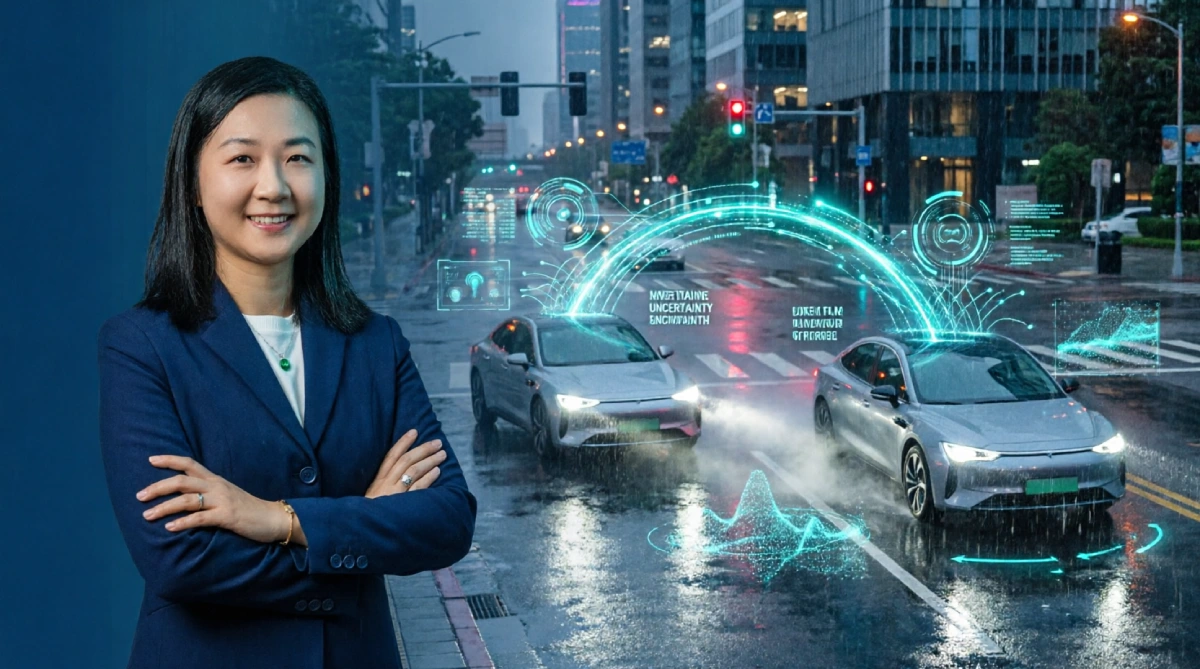
Picture two self-driving cars approaching the same intersection. One receives its sensor data half a second late. The other misreads a blurred lane marking in heavy rain. In a standard AI system, both cars make decisions based on the data they have — which may be wrong. The result can be a collision.
This is the problem Fei Miao has spent her career solving. Her keynotes don’t talk about AI in the abstract. They address a very specific and urgent question: how do you build autonomous systems that make safe decisions when the real world refuses to cooperate?
Her 2025 keynote at IROS — one of the world’s leading robotics conferences — put this question front and center. Here’s what she said, why it matters, and what it means for the future of AI in physical environments.
Who Is Fei Miao?
Fei Miao is an associate professor at the University of Connecticut’s School of Computing, where her work focuses on assuring the safety, efficiency, robustness, and security of cyber-physical systems (CPS) by combining learning, optimization, and control.
Her research areas include multi-agent reinforcement learning, robust optimization, uncertainty quantification, control theory, and game theory. On the applied side, her work targets connected and autonomous vehicles, intelligent transportation systems, smart cities, and power networks.
Her academic path tells you a lot about her approach. She earned a B.S. in Automation at Shanghai Jiao Tong University — with a minor in Finance, which already signals a systems-level, real-world perspective. She then completed a Ph.D. in Electrical and Systems Engineering at the University of Pennsylvania, alongside a master’s in Statistics from the Wharton School. Her dissertation received the Charles Hallac and Sarah Keil Wolf Award for best doctoral dissertation in Electrical and Systems Engineering. Following her Ph.D., she conducted postdoctoral research at Penn’s GRASP and PRECISE labs before joining UConn in 2017.
She now holds the Pratt & Whitney Associate Professorship at UConn, with a courtesy appointment in Electrical and Computer Engineering, and is affiliated with the Institute for Advanced Systems Engineering and the Eversource Energy Center. Her honors include the NSF CAREER Award (2021) and a nomination for the NSF Alan T. Waterman Award. She serves as an associate editor for IEEE Robotics and Automation Letters (RAL) and was Area Chair for CPSWeek/ICCPS 2025.
The IROS 2025 Keynote: “From Uncertainty to Action”
Her most prominent recent keynote was at the 2025 IEEE/RSJ International Conference on Intelligent Robots and Systems (IROS) in Hangzhou, China. Titled “From Uncertainty to Action: Robust and Safe Multi-Agent Reinforcement Learning for Embodied AI,” the talk addressed how autonomous systems can act safely in dynamic environments — covering algorithms that anticipate risks, safe coordination strategies for multiple autonomous agents, and techniques to manage sensing noise, communication delays, and environmental uncertainties. She also introduced safe Shapley-value-based reward allocation, a method that fairly distributes credit among cooperating agents.
That framing — from uncertainty to action — is not just a catchy title. It captures the actual problem.
Most AI systems are trained in controlled conditions and then deployed in messy reality. Sensors fail. Wireless signals drop. Other agents behave unexpectedly. A standard reinforcement learning system, trained to maximize reward, has no built-in mechanism to handle these gaps. It was never taught to ask: What if my data is wrong?
Miao’s work answers that question directly.
The Core Problem: Why Standard AI Isn’t Enough
Standard reinforcement learning (RL) assumes the environment will behave roughly the way it did during training. Feed the system enough examples, and it learns a policy, and it acts on that policy.
The problem: the real world doesn’t obey this assumption. Sensor noise, communication delays between connected vehicles, adversarial interference, and unexpected weather conditions all introduce what researchers call distributional shift — the real situation looks different from what the AI was trained on.
For a recommendation algorithm, distributional shift means slightly worse suggestions. For an autonomous vehicle or a robot operating around humans, it can mean physical harm.
This is why Miao’s research focuses on two things: robustness and safety. Not as buzzwords, but as mathematically defined properties.
- Robustness means the system maintains acceptable performance even when inputs are noisy, delayed, or adversarial.
- Safety means the system never takes actions that violate hard constraints — like hitting another vehicle, even if doing so might otherwise maximize some reward signal.
These properties are hard to achieve simultaneously. Most robust optimization methods are too conservative to be useful. Most safety constraints are too rigid for dynamic environments. Miao’s research looks for the middle ground.
Multi-Agent Reinforcement Learning and Coordination Problem
One layer deeper is the multi-agent problem. Most autonomous systems don’t operate alone. A fleet of delivery robots. Vehicles at a busy intersection. Drones in a warehouse. They share space, share information, and need to coordinate.
Multi-Agent Reinforcement Learning (MARL) addresses this. Instead of one AI making decisions, you have several — and each one’s decisions affect the others.
The challenge Miao’s lab works on is doing this safely under communication uncertainty.
- What happens when one agent’s message to another is delayed by 200 milliseconds?
- What if the shared data is partially corrupted?
- What if agents have different, conflicting views of the environment?
Her IROS 2025 keynote presented frameworks for precisely this scenario: distributed coordination protocols that stay safe even when communication is unreliable. A key enabling idea is collaborative perception — allowing agents to share sensor data and build a robust collective view even when communication is degraded. The practical target is autonomous vehicle platoons and cooperative robotic systems, where getting this wrong has real physical consequences.
Distributionally Robust Optimization: Plain-English Explanation
One of Miao’s key technical contributions is applying Distributionally Robust Optimization (DRO) to real-world AI decision-making.
Here’s the core idea. When an AI has to make a decision — say, routing ride-share vehicles across a city — it needs to predict demand. Standard models train on historical data and assume future demand will follow the same pattern. DRO takes a different approach: instead of assuming one specific distribution, it optimizes for the worst-case distribution within a plausible range.
In practice, this means the AI doesn’t just plan for the most likely scenario. It builds in resilience for scenarios where demand spikes unexpectedly, or where some vehicles go offline, or where weather disrupts patterns. This approach can optimize ride-sharing or traffic routing to maintain service quality despite demand fluctuations.
Applied to transportation, this means more reliable service under disruption. Applied to robotics, it means a robot that can still complete its task even when its sensors give ambiguous readings.
Real-World Applications
The stakes of Miao’s research become clear when you look at where it applies:
Application #1 Autonomous vehicles
Connected and autonomous vehicles (CAVs) need to coordinate at intersections, in platoons, and across traffic networks — all while dealing with GPS uncertainty, latency in V2V communication, and unpredictable human drivers. Her collaborative perception work allows vehicles to share sensor data reliably despite these challenges, improving collective awareness. Her frameworks give these systems a way to stay safe without being so conservative that they become useless.
Application #2 Smart energy grids
Power grids increasingly rely on AI to balance supply and demand in real time. When renewable energy sources like solar or wind behave unpredictably, grid AI needs to make decisions without certainty. DRO-based approaches help maintain grid stability even in volatile conditions.
Application #3 Robotics and smart cities
Cooperative robots in manufacturing or logistics need to share workloads without collision, even when their shared coordination data is imperfect. The same principles scale up to smart city infrastructure, managing traffic, emergency response, and public utilities.
Misconception About “AI Safety”
A lot of public conversation about AI safety focuses on long-term, speculative risks — superintelligent AI, misalignment, existential scenarios. That’s a legitimate area of concern, but it has little to do with what Miao researches.
Her work addresses the near-term, concrete safety problem: AI systems that are already deployed in physical environments and can cause immediate harm if they fail. A self-driving car that misjudges a pedestrian’s position. A surgical robot that doesn’t account for sensor error. A grid management system that makes a cascade failure worse.
This distinction matters when evaluating the practical impact of her keynotes. The value isn’t philosophical — it’s engineering. Her talks give researchers and developers specific methods to build AI that is safe in the way a car’s brakes are safe: by design, provably, under real-world conditions.
How to Access Her Research and Talks
If you want to go deeper:
- IROS and ICRA conference proceedings — many talks are recorded; check the IEEE Xplore database and conference YouTube channels.
- Her earlier keynote at the CoPerception workshop (co-located with ICRA 2023) focused on collaborative perception and safe learning for cyber-physical systems.
- Her work is also presented through university seminar series — she has given talks titled “Learning and Control for Safety, Efficiency, and Resiliency of Embodied AI” at institutions including Johns Hopkins, Princeton, UC San Diego, Carnegie Mellon, and Berkeley.
- Google Scholar under “Fei Miao UConn” returns her full publication list.
- Her lab’s research page at the University of Connecticut School of Computing lists ongoing projects and recent papers.
What Makes Her Keynotes Worth Your Time
Fei Miao’s presentations sit at a rare intersection: mathematically rigorous enough to be credible to researchers, but grounded enough in application to be useful for engineers and practitioners. She doesn’t present speculative futures — she presents working frameworks, validated on real urban transportation data and tested in simulation.
The IROS 2025 keynote is a good entry point. The title is precise: it’s not about AI in general, it’s about the specific pipeline from uncertainty — which is unavoidable — to action — which is required. That problem is at the core of every real autonomous system being built today.
If you work in robotics, autonomous vehicles, smart infrastructure, or AI systems that interact with the physical world, her work is directly relevant. The question she’s answering — how do you act safely when you can’t be certain — doesn’t go away as AI systems become more capable. It gets more important.

