

There’s a scene in Breaking Bad where Walter White stands over a dying woman, watches her choke, and does nothing. Bryan Cranston doesn’t move. Doesn’t speak. His face does something precise: a flicker of calculation behind grief. It lasts about 40 seconds, and it tells you everything about who this character has become. No speech. No dramatic music cue. Just an actor making a choice most would never risk.
That moment is why we’re here.
“Greatest TV performances of all time” lists get published every year. Most are the same 10 names rearranged, with no real explanation for why anything ranks where it does.
This article is different. You’ll get clear criteria, a ranked list with real reasoning, and — most importantly — the 10 performances that were passed over, despite being as good as anything in the top 50. Awards politics, genre bias, and industry blind spots have kept some of the best TV acting invisible.
Let’s fix that.
What Makes a TV Performance Truly Great?
Before any list earns your trust, it should tell you what it’s measuring.
Most critics never define their criteria. They say Bryan Cranston “transformed” or James Gandolfini was “magnetic” — and stop there. That’s not analysis, just repetition.
Here are the three standards this list uses:
1. Technical range
Can the actor move convincingly through multiple emotional registers across a season or multiple seasons? Not just one iconic breakdown, but sustained, varied, believable humanity episode after episode.
2. Scene ownership
Does the actor make every scene they’re in feel necessary? The best TV actors share a specific quality: the camera finds them even when they’re not speaking. Every reaction, every half-second of silence, carries weight.
3. Cultural staying power
Are people still talking about this character years after the show ended? Not the show — the character. That’s the difference between a great production and a great performance.
This isn’t an Emmy scoreboard. Emmy voting reflects industry politics, campaign budgets, and annual trends. The best performance in a given year wins about 60% of the time. The other 40% is what the “robbed” section covers.
TV acting is structurally harder than film acting. A film actor has two hours to build and release a character. A TV actor has to sustain the same character across months of episodes, building in layers so subtle they only pay off two seasons later. Bryan Cranston didn’t play Walter White — he became him, incrementally, over five years. That demands a different craft.
The Top 5 — Performances in a Category of Their Own
These five are beyond debate. The question isn’t whether they belong — it’s why, and what they’re doing that sets them apart.
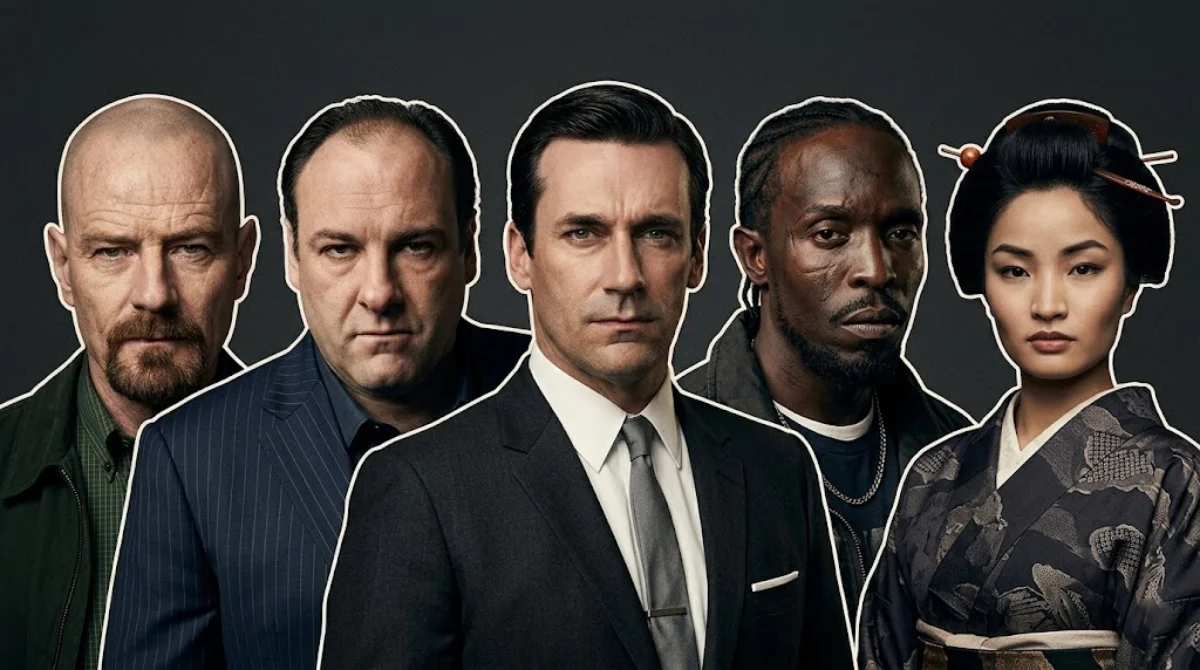
Bryan Cranston — Walter White, Breaking Bad

The scene described in the opening — Cranston watching Jane die — is the performance in miniature. What makes his work across the full series extraordinary is the pacing of the transformation. Walter White doesn’t become a villain in one episode. He makes one small compromise, then another, then another, and Cranston plays each one as if it makes complete sense at the time.
By the time Walter is terrifying, you’ve already watched him build the logic that justifies it. That’s not acting like a villain. That’s acting the creation of a villain. Nothing else in TV acting works like that.
James Gandolfini — Tony Soprano, The Sopranos

Most people remember the violence. The more impressive work is the therapy sessions. Gandolfini plays a man who is genuinely trying to understand himself and is genuinely incapable of doing so. He brings a physical heaviness to those scenes — a tiredness that has nothing to do with exhaustion and everything to do with a man carrying weight he won’t put down. The therapy sessions are the real performance. Everything else is the costume.
Jon Hamm — Don Draper, Mad Men

Hamm does something technically unusual: he performs the suppression of emotion rather than emotion itself. Most actors signal what their character feels. Hamm signals what his character is hiding, and lets you work out the gap. That requires extraordinary control. Push too hard, the emptiness flattens; too soft, no one sees the hidden. He threads it perfectly for seven seasons.
Michael K. Williams — Omar Little, The Wire

Omar has almost no backstory. He’s barely explained. Williams builds an entire inner life from physical presence, vocal rhythm, and an economy of expression that most actors with twice the screen time never achieve. The character became the moral center of a show about systemic failure, and that happened largely because of what Williams brought to it, not just what the scripts gave him.
Anna Sawai — Toda Mariko, Shōgun

The performance that proves non-English TV is no longer a separate conversation. There’s a scene in Shōgun where Mariko translates her own death sentence to a room full of people who expect her to break. Sawai plays the moment with a composure that reads as courage and tragedy simultaneously — no tears, no trembling, just the controlled face of someone who has decided who they are. It’s a masterclass in restraint. She’s here because the work demands it, not to check a box.
The Full 50 — Ranked and Reasoned
Below, each entry gives you the reason to watch or rewatch — not a plot summary.
6. Peter Dinklage — Tyrion Lannister, Game of Thrones (Seasons 2–4)
The “I wish I was the monster you think I am” trial speech is 60 seconds of controlled fury that remains the single best performance the show ever produced — in a show that increasingly didn’t deserve him.
7. Jean Smart — Deborah Vance, Hacks
Smart proved that comedy acting requires as much control as drama. Her silences are as loaded as her punchlines. The season 2 finale alone should have ended the debate about whether comedy belongs in the “greatest acting” conversation.
8. Bob Odenkirk — Jimmy McGill/Saul Goodman, Better Call Saul
Odenkirk’s arc from eager lawyer to broken man is as complete a character transformation as Cranston’s, with less recognition. Seasons 5 and 6 contain some of the most precise acting on television.
9. Claire Danes — Carrie Mathison, Homeland (Seasons 1–2)
Danes plays a character on the edge of credibility and keeps her believable through sheer commitment to the internal logic of someone whose mind works differently. Season 1 is a performance clinic.
10. Matthew Rhys — Philip Jennings, The Americans
Six seasons of playing a Soviet spy pretending to be an American — the layers of performance inside the performance, the cost of identity suppression — Rhys does it with a quietness that makes it all the more devastating.
11. Elisabeth Moss — Peggy Olson, Mad Men
The supporting performance that holds the show’s moral center. Every small indignity Peggy absorbs and converts into ambition is tracked across the full run with a precision that rivals the lead.
12. Viola Davis — Annalise Keating, How to Get Away with Murder
The wig removal scene in season 1 is one of the most talked-about single moments in modern TV acting — raw in a way that feels unrehearsed even though it clearly wasn’t.
13. Anthony Hopkins — Dr. Robert Ford, Westworld (Season 1)
A masterpiece of controlled menace. Hopkins plays a man who has been the most intelligent person in every room for decades, and makes that loneliness genuinely tragic.
14. Jodie Comer — Villanelle, Killing Eve
Pure joy as a performance instrument. Comer plays a sociopath with such specific comedic timing and physical creativity that the character becomes charming in ways that should be impossible.
15. Evan Peters — various roles, American Horror Story
The most versatile actor in an anthology that demands total reinvention every season. Peters delivers every time.
16. Kieran Culkin — Roman Roy, Succession
The comedy is the tragedy. Culkin plays every joke as a defence mechanism so successfully that when Roman finally breaks, it lands harder than anything else in the series.
17. Sarah Snook — Shiv Roy, Succession
The finale episode performance — Snook’s face shifting through multiple emotions in a single unbroken shot — is a genuine technical achievement.
18. Matthew Macfadyen — Tom Wambsgans, Succession
The most underrated performance in a cast full of great ones. Tom’s cowardice and self-awareness about his cowardice play simultaneously, and Macfadyen holds both without collapsing the tension.
19. Tatiana Maslany — multiple roles, Orphan Black
Playing eight distinct characters across five seasons, sometimes in scenes with herself, Maslany does things technically that most actors couldn’t do once.
20. Elisabeth Shue — Heidi Bergmann, Homecoming (Season 1)
A quarter of the performance happens through voicemail and phone calls. Shue communicates a complete interior collapse without ever being in the room where it happens.
21. Hugh Laurie — Dr. Gregory House, House M.D.
A British actor convincingly playing an American misanthrope for eight seasons, finding new dimensions in a character the writing increasingly failed to support.
22. Idris Elba — Stringer Bell, The Wire
Elba makes a crime lord’s attempt to become a legitimate businessman genuinely moving. The tragedy of Stringer is that he’s intelligent enough to want out and not quite intelligent enough to manage it.
23. Regina King — multiple roles, American Crime, Watchmen, Seven Seconds
Three separate “greatest” calibre performances in three separate productions. Individually strong; collectively, an argument that she’s the most consistently excellent actress in prestige TV history.
24. Tony Shalhoub — Adrian Monk, Monk
At its peak, Monk drew 11 million viewers a week, per Nielsen, and Shalhoub’s physical specificity and comedic precision still hold up completely.
25. Steve Carell — Michael Scott, The Office
The performance walks a tightrope that the writing sometimes drops off. Carell never does. Michael is only bearable because Carell finds the genuine longing underneath the embarrassment.
26. Keri Russell — Elizabeth Jennings, The Americans
The physical performance — wigs, accents, body language shifts between identities — is remarkable. The emotional performance underneath it is what most people miss.
27. Stephen Graham — multiple roles, including Line of Duty and Adolescence
The most reliable presence in British TV for a decade. His Adolescence work — a Golden Globe winner in 2026 — sits in the decade’s top tier.
28. Lee Jung-jae — Seong Gi-hun, Squid Game (Season 1)
The first non-English performance to win the Emmy for Best Actor in a Drama. Jung-jae communicates a complete arc of desperation, complicity, and moral collapse without a word of English.
29. Maggie Smith — Downton Abbey
Turned a one-liner machine into a masterclass in timing and withering glances that defined the entire show.
30. Jeff Daniels — The Newsroom
Grounded Sorkin’s high-velocity monologues in exhausted idealism, making Will McAvoy’s fury feel earned.
31. Patricia Clarkson — Sharp Objects
Conjured a velvet-gloved, manipulative maternal presence that was as unnerving as it was impeccably controlled.
32. Cate Blanchett — Mrs. America
Embodied Phyllis Schlafly with such conviction that you almost forgot you were watching a performance, not a historical figure.
33. Nicole Kidman — Big Little Lies
Her Celeste Wright showed the physical and psychological aftershocks of abuse with a rawness that set a new standard for limited series acting.
34. Reese Witherspoon — Big Little Lies
Made Madeline Martha Mackenzie’s busybody vulnerability feel so specific that she elevated every scene she shared.
35. Michelle Dockery — Downton Abbey
Lady Mary’s evolution from icy heiress to capable woman of business was carried entirely in Dockery’s micro-expressions and stiff-backed grace.
36. Jeremy Irons — Watchmen
Played an ageing, decaying Adrian Veidt with a mix of ego and tragic self-awareness that was the best thing in a sprawling superhero deconstruction.
37. Naomi Watts — Gypsy
Took a character with buried desire and psychological instability and made her unravelling feel like a slow, inevitable collapse.
38. Ewan McGregor — Fargo (Season 3)
Juggled twin roles with distinctly different body language and energy, proving the anthology format can be an actor’s playground.
39. Carrie Coon — The Leftovers
Already highlighted in the “robbed” section, Coon’s Nora Durst carried the emotional weight of the series with staggering vulnerability.
40. Sterling K. Brown — This Is Us
Brought theatrical-level emotional transparency to network TV, making every Pearson family speech feel like an event.
41. Issa Rae — Insecure
Used awkward pauses and self-aware charm to redefine the romantic-comedy lead, while also writing the material in which she shone.
42. Donald Glover — Atlanta
Made surrealist comedy feel grounded and personal, turning the show into a showcase of understated performance range.
43. Phoebe Waller-Bridge — Fleabag
Performed direct-to-camera confessionals with such immediacy that you forgot the fourth wall was ever there.
44. Adam Scott — Severance
His “innie” and “outie” are performed with subtle physical shifts that make the division devastatingly real.
45. Britt Lower — Severance
Helly’s journey from confused fury to desperate resolve is a physical and emotional marathon that she runs in every episode.
46. Jeremy Allen White — The Bear
Channelled chaotic kitchen energy and buried grief into a performance so lived-in you could smell the grease.
47. Owen Cooper — Adolescence
A single unbroken shot episode became a crucible; Cooper’s raw presence held it together without ever feeling like a performance.
48. Noah Wyle — The Pitt
Reinvigorated the medical procedural with worn-down, compassionate authenticity that makes it feel like a documentary.
49. Tessa Thompson — His and Hers (2026)
Brought an unsettling blend of charisma and moral ambiguity to a role that demanded she be both likeable and untrustworthy at once.
50. Gary Oldman — Slow Horses
As Jackson Lamb, Oldman created an anti-spy so deliberately repellent yet compelling that — even with multiple Emmy nominations — the performance still feels under-celebrated.
The 10 That Got Robbed
This is the list that matters. Each entry below did something as technically impressive as anything in the top 50. None of them got the full recognition they deserved. Here’s what they actually did.
1. Gary Oldman — Jackson Lamb, Slow Horses

Despite multiple Emmy nominations, Oldman’s Lamb is perennially under-campaigned and under-discussed in “greatest” lists. He plays a brilliantly capable spy who has chosen to become deliberately repellent — and makes you understand exactly why. The performance is flawless; the industry noise around it is not.
2. Carrie Coon — Nora Durst, The Leftovers

The Leftovers has a devoted cult following but never broke through to mainstream award recognition. Coon’s work in season 2 — specifically the episode “No Room at the Inn” — is as complete a dramatic performance as the medium has produced. She’s also excellent in Fargo and The Gilded Age. Three separate “greatest” calibre performances, and she rarely tops any list.
3. Walton Goggins — Boyd Crowder, Justified

Goggins was supposed to die in the pilot episode. The producers kept him alive because what he was doing in rehearsal was too good to cut. He then built one of the most compelling antagonist-who-is n’t-quite-a-villain characters in TV history across six seasons. Justified was perceived as genre TV rather than prestige drama, so it got category-snubbed from the beginning.
4. Bob Odenkirk — the final two seasons of Better Call Saul

Odenkirk appears at #8 on the main list, but his work specifically in seasons 5 and 6 deserves separate recognition. The physical and emotional disintegration of Jimmy McGill in those seasons is performed with a precision that rivals Cranston’s best, and it received a fraction of the cultural discussion.
5. Michael Shannon — Nelson Van Alden, Boardwalk Empire

Shannon appeared in a supporting role in a show dominated by Steve Buscemi’s central performance. What he built in that supporting role — a character of almost unbearable internal pressure — is more memorable than the lead in most TV dramas. He received one Emmy nomination. One.
6. Mireille Enos — Sarah Linden, The Killing

The US adaptation of the Danish series is considered inferior to the original. Enos’s performance is not. Her physical stillness and deliberate emotional opacity created a new template for how to play a detective without relying on standard procedural shortcuts. Largely forgotten.
7. André Braugher — Frank Pembleton, Homicide: Life on the Street

Television critics who were paying attention in the 1990s will tell you Braugher’s performance in this show is among the best the medium has ever produced. Most people under 40 have never seen it. That’s not his fault.
8. Saoirse-Monica Jackson — Erin Quinn, Derry Girls

The best comedy performance of the last decade that nobody outside the UK and Ireland discusses in “greatest” terms. Jackson anchors a show that runs on ensemble chaos with a specific, committed physical comedy that is technically extraordinary.
9. Michelle Gomez — Missy/The Master, Doctor Who (2014–2017)

Genre bias at work. Gomez took a character that had been played by a dozen actors over 50 years and made it completely her own — more threatening, funnier, and stranger than any previous iteration. Because it’s Doctor Who, it doesn’t get discussed as a “serious” performance. It should.
10. Bill Hader — Barry Berkman, Barry (Seasons 3–4)

Hader won Emmys for Barry, so calling him “robbed” might sound off. But the work he did in seasons 3 and 4 — when the show turned genuinely dark, and the performance became something much harder and stranger — got a fraction of the discussion it deserved. The best work he did in the show is the least talked about.
You’ll have your own version of this list. That’s the point.
The Bias Nobody Talks About
A quiet feedback loop keeps the same 10–15 names topping every list. Here’s how.
Prestige Drama Bias
Drama nominations outnumber comedy 4-to-1, despite comedy requiring sustained high-level performance across seasons. Jean Smart delivers extraordinary work in Hacks for four seasons, yet gets far less discussion than male drama leads with half her consistency.
English-language Bias
Shōgun and Squid Game forced the industry to acknowledge non-English performances. Yet the cracking is recent. Performances from French, Spanish, and Korean TV over the past 20 years belong in this conversation and rarely appear on American lists.
Award-show Confirmation Loop
Most readers form their opinions based on Emmy wins. Emmy voters are influenced by campaigns, relationships, and annual trends. The consensus hardens each year, making it harder to challenge. This list breaks that loop — which is why the robbed section exists.
Has Streaming Changed What Great TV Acting Looks Like?
When The Sopranos was airing weekly, you lived with Tony Soprano for nine months a year. The performance accumulated in real time — you had a week between episodes to sit with what Gandolfini had just done. Now, audiences binge the same performance over the weekend. Does that make it land harder? Or does compression flatten the arc?
Adolescence in 2025 tested this in a specific way. Four episodes, released together, are designed to be consumed in one sitting. Stephen Graham and Owen Cooper delivered performances of sustained psychological intensity — no reset between episodes, no breathing room. The Golden Globes recognised both of them. The format demanded a different kind of endurance.
Streaming accounts for nearly half of US TV viewing, per Nielsen. Yet the performances audiences watch most aren’t the ones critics discuss. That gap is widening. Great TV acting is happening on platforms and in languages that award shows still treat as secondary.
The medium has changed. What we call “greatest” needs to keep pace.
Conclusion
The greatest TV performances of all time share one thing that no amount of Emmy campaigning can manufacture: they make you believe in a person who doesn’t exist.
Cranston made you believe in Walter White so completely that his choices felt inevitable. Gandolfini made Tony Soprano’s contradictions feel human rather than convenient. Williams built Omar Little out of almost nothing and made him unforgettable. Somewhere in a show you haven’t watched, someone is doing work just as precise — in a language you might not speak, on a platform you don’t subscribe to, in a genre critics ignore.
Key takeaways:
- Great TV acting is about sustained truth across time, not one iconic moment.
- Awards recognition is a flawed proxy for quality — the robbed list proves it.
- Genre bias and language bias have kept some of the best performances invisible.
- Streaming has changed the format; the standard for “greatest” has to change with it.
One performance didn’t make this list that probably should have. You already know which one. Drop it in the comments — and if you’re looking for where to start watching, the top 10 are all currently streaming and worth your time.

