

Eyes tell a story long before you say a single word. They reveal emotion, personality, and a quiet kind of beauty that’s entirely your own.
One of the first things people notice about your eyes is their shape. That natural outline—whether rounded, angled, deep-set, or gently lifted—sets the mood of your entire face. It influences how your glasses sit, where your eyeliner goes, and even how others read your expression.
Yet, many of us grow up not knowing what our eye shape is really called. We might hear words like almond or hooded and wonder, “Is that me?”
If that sounds familiar, you’re in the right place. In this guide, I’ll walk you through 15 different eye shapes with names, explain what makes each one special, and help you identify your own. And yes—this guide works for everyone, whether you’re just curious or ready to master makeup and styling for YOUR eye shape.
No judgment, no “better” or “worse”—just honest, friendly information that celebrates every form.
By the end, you’ll not only know your eye shape but also appreciate exactly what makes your eyes beautifully unique.
Why Eye Shape Matters More Than You Think
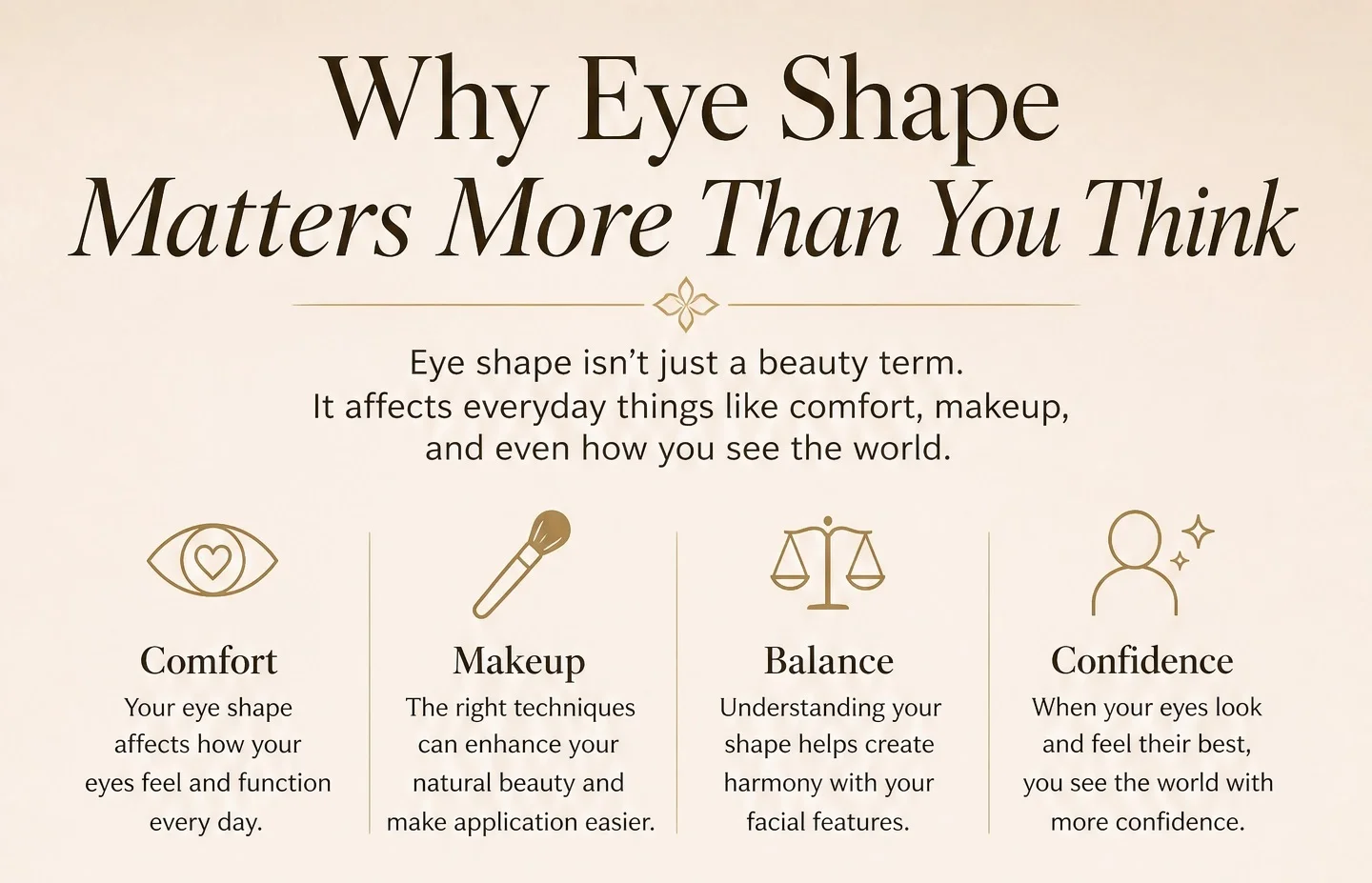
Eye shape isn’t just a beauty term. It affects everyday things like comfort, makeup, and even how you see the world.
Comfort: Your eye shape determines how glasses frames rest on your nose and how lenses align with your pupils. Deep-set eyes, for example, may need a different bridge fit than protruding ones.
Makeup: The same eyeliner wing looks different on hooded eyes versus monolid eyes. Knowing your shape saves you from frustration and helps you work with your features, not against them.
Balance: Understanding eye spacing and tilt guides you toward frame styles and brow shapes that naturally harmonize your face.
Confidence: There is incredible power in being able to name your features and love them as they are. Knowing your eye shape shifts your focus from “fixing” to enhancing.
Now, let’s dive into the beautiful variety of eye shapes. Remember, many people have a blend of two or more shapes, and that’s completely normal. Use these descriptions as a friendly map, not a strict box.
15 Eye Shape Names and Their Beautiful Features
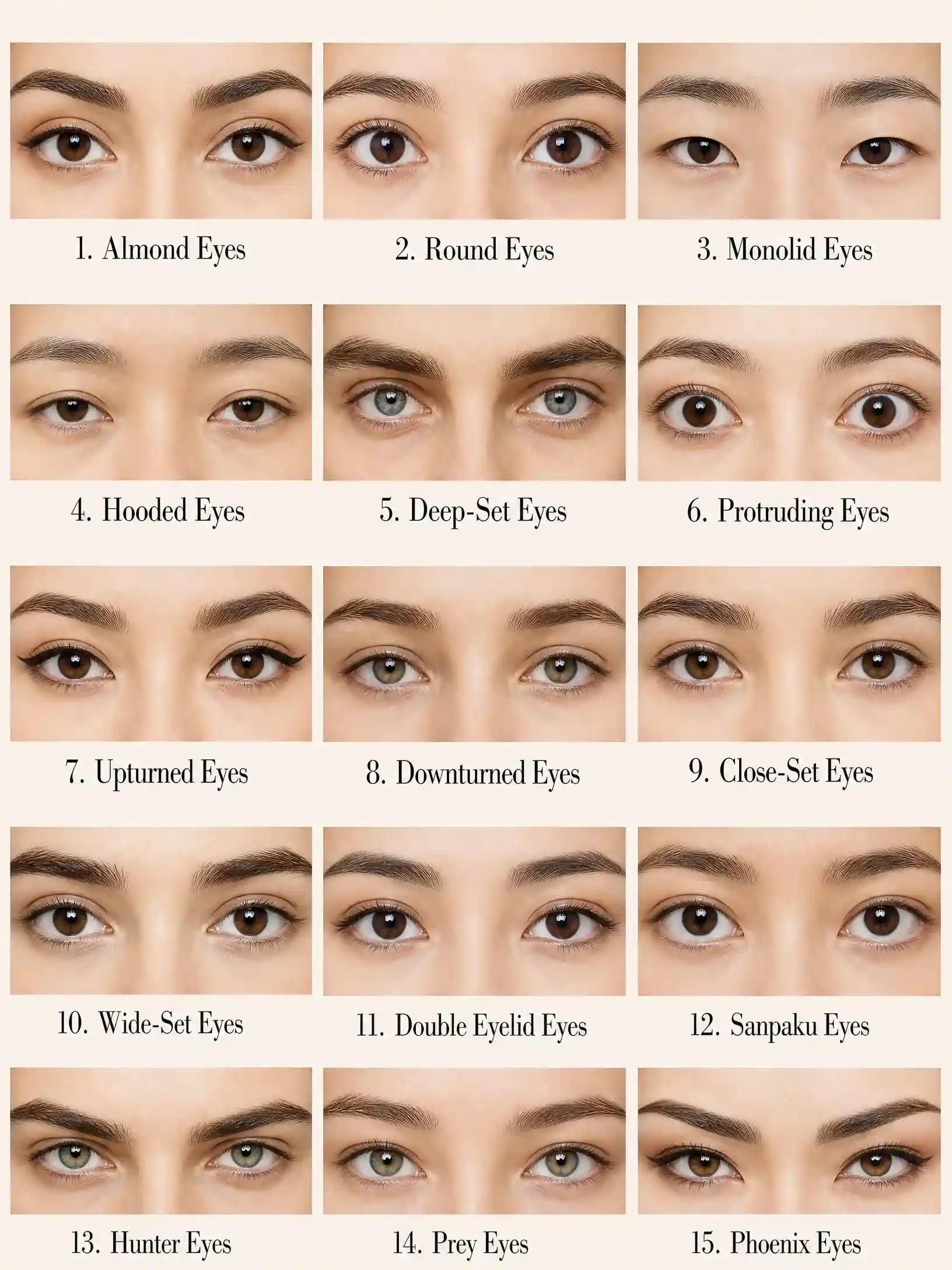
Here’s a closer look at the most recognized eye shapes. I’ve included a small “Style Note” with each one—just a tiny tip to celebrate that shape.
1. Almond Eyes
Almond eyes are often considered the most balanced shape. The eye is oval with slightly pointed inner and outer corners, and the iris touches both the top and bottom eyelids. When you look straight ahead, very little white shows above or below the colored part.
This shape naturally suits almost any makeup style or frame, which is why it’s called versatile. Almond eyes give off a calm, open expression that feels both soft and alert.
Style Note: A thin line of eyeliner that slightly thickens at the outer corner beautifully echoes the natural taper of almond eyes.
2. Round Eyes
Round eyes are large, bright, and expressive. The white of the eye is visible above or below the iris, creating a wide-awake, doll-like appearance. The crease is usually very defined, and the eyes appear circular rather than oval.
People with round eyes often look friendly and youthful. This shape catches light easily, which adds to its sparkle.
Style Note: Smudging a little darker shadow along the outer lash line and avoiding heavy liner all around the eye keeps the look lifted while preserving that beautiful openness.
3. Monolid Eyes
Monolid eyes have a smooth eyelid without a visible crease. The skin runs seamlessly from the lash line up to the brow bone. This shape is a natural, beautiful trait, most common among East Asian communities but found everywhere.
Because there’s no fold to break up the lid space, makeup blends like a dream, and the eye can carry bold colors effortlessly. Monolid eyes often project calmness and focus.
Style Note: Gradient eyeshadow—darker near the lash line fading to lighter toward the brow—looks stunning and adds depth without needing a crease.
4. Hooded Eyes
Hooded eyes feature an extra layer of skin that folds down from the brow bone, partially or fully covering the eyelid crease. When the eyes are open, the mobile lid may look very small or even hidden.
This isn’t a flaw; it’s a feature that gives the eye a mysterious, intense look. Many iconic actors and models have hooded eyes. The key to makeup here is working above the crease.
Style Note: Apply a light, shimmery shade just above the hooded fold to bring the eye forward, and use a thin, tight line of eyeliner to avoid losing precious lid space.
5. Deep-Set Eyes
Deep-set eyes sit further back in the eye socket, making the brow bone appear more prominent. This creates a natural shadow in the crease, which gives the eyes an intense, sculpted look.
Because they are set deeper, these eyes can sometimes appear smaller in photos, but in person they convey incredible depth and thoughtfulness.
Style Note: Brightening the inner corner and using light, shimmery shades on the mobile lid helps bring the eyes visually forward. For glasses, a frame with a shallower bridge often feels more comfortable.
6. Protruding (Prominent) Eyes
Protruding eyes, also called prominent eyes, bulge slightly forward so that the curve of the eyeball is clearly visible. This creates a naturally wide-open, alert appearance with a lot of the lid surface visible.
These eyes are expressive and capture light easily, which makes them stand out in a crowd. The main practical consideration is protecting them from dryness and irritation, as they are a little more exposed.
Style Note: Soft, matte eyeshadows help avoid over-emphasizing the roundness, and curling your lashes gently opens the eyes even more beautifully.
7. Upturned Eyes
Upturned eyes have outer corners that sit higher than the inner corners. This subtle lift gives a naturally “cat-like” or uplifting appearance without any makeup at all.
This shape is often associated with a fresh, confident look. The lower lash line also tends to curve upward at the outer edge, reinforcing the graceful tilt.
Style Note: Follow the natural upward angle of your lower lash line when drawing a wing. A little extra mascara on the upper outer lashes enhances the lift effortlessly.
8. Downturned Eyes
Downturned eyes have outer corners that slope slightly downward. This gives the face a soft, gentle, and kind expression. Some people call it “puppy dog eyes” because of its soulful quality.
If not balanced, the shape can sometimes look tired, but a few simple tricks add lift while keeping the natural sweetness intact.
Style Note: Apply eyeliner only on the outer two-thirds of the upper lash line and flick it slightly upward before the eye ends. Pair this with frames that have an upward sweep at the corners.
9. Close-Set Eyes
Close-set eyes have less space between the inner corners than the width of one eye. The features appear more concentrated toward the center of the face, often creating an intense, focused presence.
The goal with styling is usually to create the illusion of more width, pulling the eyes gently apart.
Style Note: Use a light, shimmery shade at the inner corners of the eyes and extend your eyebrows just a tiny bit further outward. Choose glasses with a clear or thin bridge to open up the space.
10. Wide-Set Eyes
Wide-set eyes have a distance between the inner corners that is greater than one eye width. This spacing gives the face an open, ethereal, and relaxed feel. It’s a feature often seen on fashion runways.
To bring beautiful balance, you can visually draw the eyes slightly closer together.
Style Note: Apply a slightly darker eyeshadow near the inner corners and nose bridge. Frames with a darker, thicker bridge also pull the eyes inward nicely.
11. Double Eyelid (Creased) Eyes
This isn’t a “shape” in itself but a defining characteristic. Double eyelids have a visible crease that separates the mobile lid from the area below the brow bone. Most almond, round, and upturned eyes fall into this category.
The crease can be thin, thick, partial, or multiple. Its presence allows for classic makeup techniques like cut-crease or defined contouring.
Style Note: Enhance your natural crease with a soft taupe shadow to add gentle dimension that follows your actual bone structure.
12. Sanpaku Eyes
Sanpaku is a Japanese term meaning “three whites.” It describes eyes where the white sclera is visible above or below the iris in addition to the sides. There are two types: yin sanpaku (white below the iris) and yang sanpaku (white above).
This is more a scleral show than a pure shape, but it’s a widely recognized eye characteristic. Many find it adds a striking, intense quality to a person’s gaze.
Style Note: Embrace the unique intensity. Tightlining the upper waterline can help anchor the eye without hiding its natural, dramatic character.
13. Hunter Eyes (Colloquial)
The term “hunter eyes” comes from internet culture and describes a combination of features: deep-set, hooded, with a positive canthal tilt (upturned), and usually framed by a straight, low-set brow. The look is often considered intense and focused.
Style Note: If you have these characteristics, a well-groomed but natural brow and minimal lid makeup keep the focus on your naturally strong eye structure.
14. Prey Eyes (Colloquial)
The counterpart to hunter eyes, “prey eyes” typically refer to round or protruding eyes with a negative canthal tilt (downturned) and more visible sclera. It’s a soft, innocent, and wide-open look.
Style Note: A gentle curl of the lashes and a soft brown liner on the upper lash line add subtle definition without taking away the doe-like quality.
15. Phoenix Eyes (Colloquial)
Phoenix eyes are described as upturned, almond-like shapes where the outer corner tapers and sweeps upward dramatically, like the mythical bird’s tail feathers. The inner corner often has a slight downward point before the lid lifts. This is considered a very elegant and rare shape.
Style Note: A fine, elongated eyeliner wing that follows the sweeping curve of the lower lash line perfectly complements this regal shape.
How to Determine Your Eye Shape (A Simple Identification Guide)
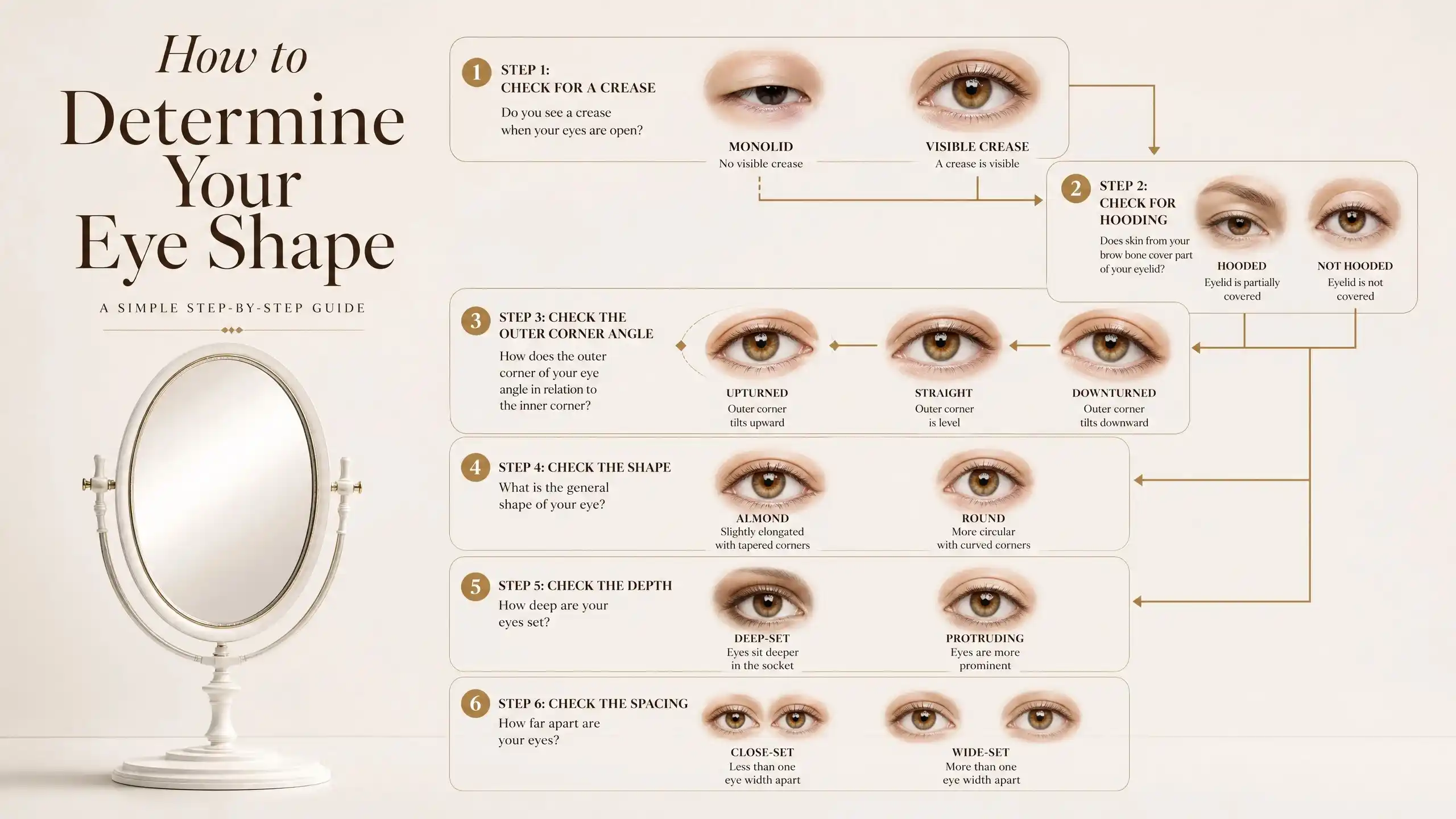
You don’t need any special tools—just a mirror, good natural light, and a few relaxed moments. Stand in front of the mirror and look straight ahead with a neutral expression.
Answer these four simple questions:
1. Is there a crease?
- No crease or a very faint one? You likely have monolid eyes.
- Yes, a visible fold? Go to the next question.
2. Does skin fold over the crease?
- Yes, skin from my brow bone covers the crease partly or fully. Your eyes are hooded.
- No, the crease is clearly visible. Continue.
3. What is the angle of your outer corners? Draw an imaginary straight line through the center of both eyes.
- Outer corners sit above that line → Upturned eyes.
- Outer corners sit below that line → Downturned eyes.
- They are roughly even → Move to the next step.
4. What is your overall eye shape and spacing?
- Eyes look oval and the iris touches both lids with little white showing → Almond eyes.
- Eyes are large, circular, and white is visible above/below the iris → Round eyes.
- Eyes sit noticeably deep with a strong brow bone shadow → Deep-set eyes.
- Eyes bulge slightly forward, showing a lot of the lid → Protruding eyes.
Now check spacing:
- Distance between eyes is less than one eye width → Close-set eyes.
- Distance is more than one eye width → Wide-set eyes.
Most people will tick two or three boxes. For example, you might have “hooded almond eyes” or “deep-set, slightly downturned eyes.” That’s the beauty of it—your combination is uniquely yours.
Appreciating What You See
Every eye shape on this list brings its own gift to a face. Almond eyes offer balance, round eyes give youthful openness, hooded eyes add mystery, and downturned eyes radiate gentleness. Monolids are a canvas for art, while upturned eyes carry effortless elegance.
The next time you look in the mirror, I hope you see not just the shape, but the quiet, beautiful expression it adds to who you are. Your eyes have seen your joys, your tears, your laughter, and your dreams. Their shape is simply a frame for that story.
If you ever notice a sudden change in your eyelid symmetry or eye position, a visit to an eye specialist is wise—not out of cosmetic worry, but because our eyes also tell us about our health.
FAQ’s
1. Can my eye shape change as I age?
Yes. Over time, skin loses elasticity and the brow bone area may change, making the eyes appear more hooded or deep-set. These are natural and beautiful signs of a life well-lived.
2. Do men and women have different eye shapes?
The categories are the same, but men often have a more prominent brow bone and slightly less visible lid space, which can make hooded or deep-set characteristics more common.
3. Can makeup really change the appearance of my eye shape?
Makeup can’t alter your bone structure, but it can cleverly create the illusion of a different tilt, depth, or spacing. The goal should always be to enhance your natural beauty, not to erase it.
4. Is one eye shape more attractive than another?
Absolutely not. Attraction is completely subjective and deeply personal. Every culture, every era, and every person finds beauty in different forms. The most captivating eyes are the ones that look confidently and kindly out at the world.
Final Thoughts
Now I’d love to hear from you. Which eye shape do you have? Did you discover something new about your features today? Share your thoughts in the comments below and let’s celebrate the unique beauty we all carry.
Your eyes are one-of-a-kind. Treat them kindly, style them boldly, and never forget that their shape is perfect—exactly as it is.

