

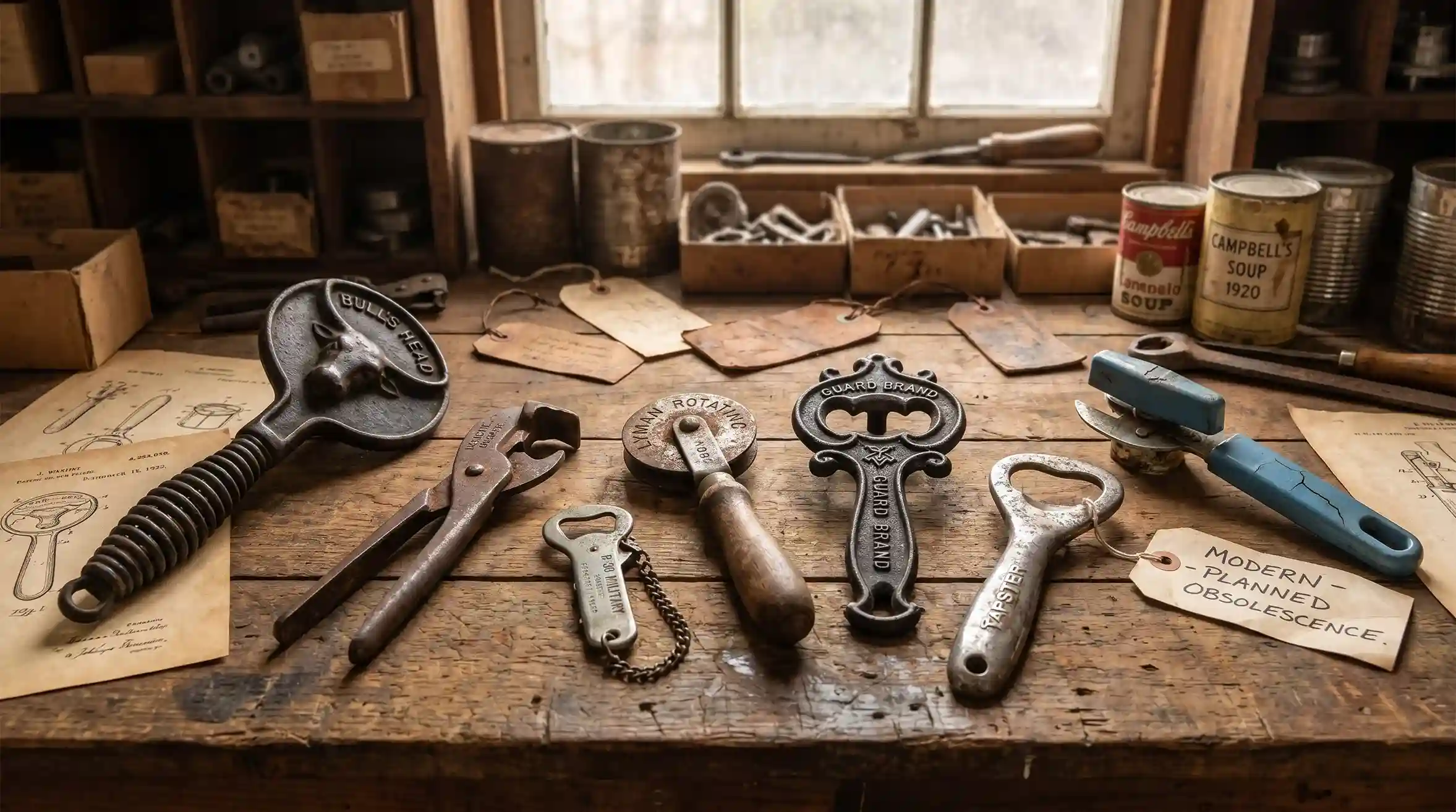
If you’ve ever owned a modern can opener that snapped after a year – or an electric one whose plastic gears stripped after 14 months – you already know the frustration. We live in an age of convenience, but not durability.
That’s exactly why I started collecting antique can openers. These tools were built in an era when manufacturers didn’t plan obsolescence. A cast iron opener from 1890 could easily outlive your grandchildren. A simple P‑38 from World War II can still open a can today, 80 years later.
In this comprehensive guide, I’ll walk you through the 10 most iconic antique can openers you’re likely to find in flea markets, estate sales, or online auctions. For each one, I’ll tell you:
- Who made it (the company or patent holder)
- How durable it is (rated out of 5 stars)
- What it’s worth right now in 2026 (based on real sales)
Plus, I’ll share a detailed old vs. new comparison, restoration tips, and why investing in an antique can opener might be one of the smartest, most eco‑friendly decisions you make for your kitchen.
Let’s pop the lid on history.
What Makes an Antique Can Opener “Antique”?
Generally, any can opener made before 1940 is considered antique. After that, they’re “vintage.” The golden age of antique can openers ran from 1855 (the first patent) through the 1920s and 1930s. These tools were made of:
- Cast iron
- Forged or stamped steel
- Brass or tin (less common)
They have no plastic parts, no cheap zinc alloys, and no hidden failure points. You can sharpen the blades, oil the hinges, and pass them down for generations.
How to Use an Antique Can Opener (If You’ve Never Tried)
Before we dive into the list, a quick note on usage. Unlike modern smooth‑turn openers, most antique can openers work like this:
- Puncture the lid near the rim (using a spike or blade).
- Lever the blade upward to cut a small section.
- Walk the tool around the rim, repeating the cut.
The P‑38 and claw openers require a bit of practice, but once you learn the rhythm, it becomes second nature. Many people find it oddly satisfying.
The 10 Best Antique Can Openers (With Prices & Durability)
Bull’s Head Can Opener (England, c.1865–1930)
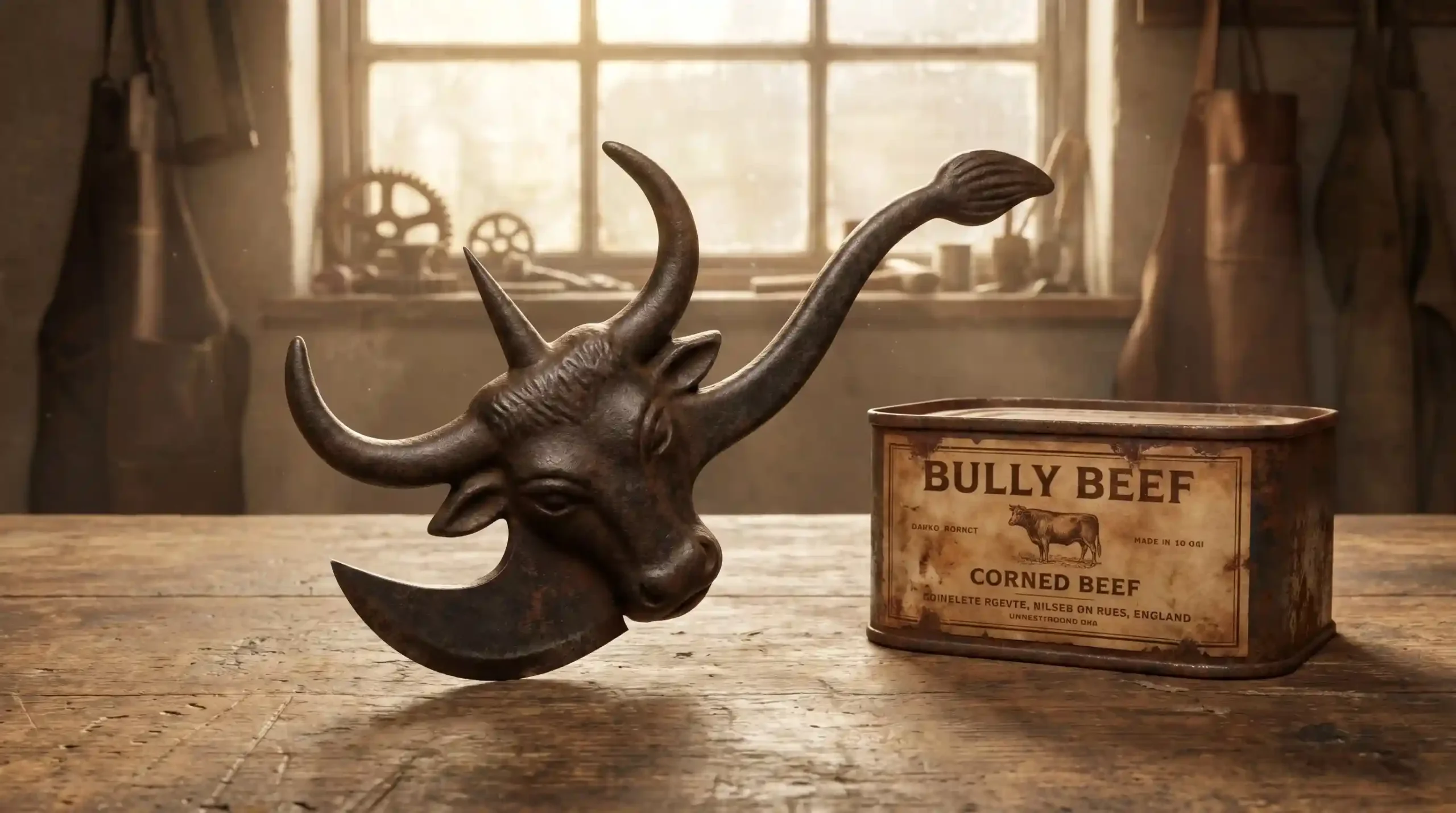
An iconic figural antique can opener made of cast iron, shaped like a bull’s head. It features a four‑sided spike and a blade, with the tail forming the handle. This design was famously used by British soldiers to open “Bully Beef” (canned corned beef).
No collection is complete without the Bull’s Head. The horns provide leverage, and the spike drives into the can lid with satisfying force. It’s as much folk sculpture as kitchen tool.
- Manufacturer: Various English foundries (often stamped “England” or “Made in England”). No single company held exclusive rights.
- Durability: ⭐⭐⭐⭐⭐ – Solid cast iron. Will survive drops, rust, and decades of use. The blade can be resharpened.
- Valuation (2026): $60 – $150 for common examples. Rare specimens with original red/black paint or intact box: $200–$250.
Twist‑Key Antique Can Opener (patented by J. Osterhoudt, 1866)
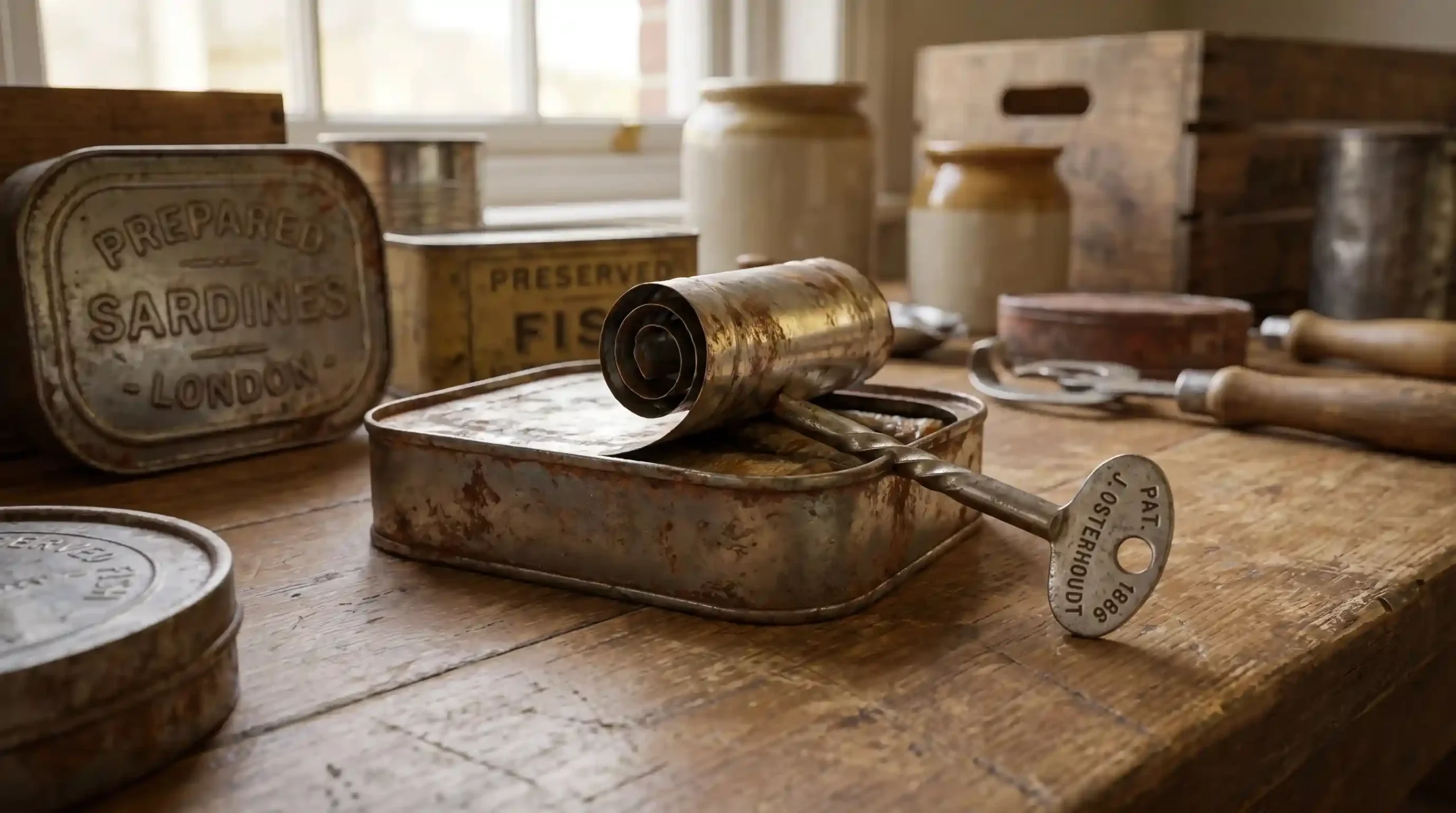
A specialized antique can opener where a metal key attaches to a tab on the can lid. Turning the key rolls a thin metal strip around the top edge, allowing the lid to be removed without any cutting action.
This was the original “easy‑open” can. You’ve probably used its modern descendant on a tin of sardines or kippered herring.
- Manufacturer: Patented by J. Osterhoudt; keys were manufactured by canning companies such as Van Camp’s, Crown Cork & Seal, and others. The opener was often included with the can.
- Durability: ⭐⭐ – The key is thin stamped metal and can bend easily. It’s really a one‑use tool, but some collectors preserve unopened cans with the key still attached.
- Valuation (2026): $15 – $50 for a loose key in good condition. Complete, unopened cans with original key: $75 – $120.
Early Lever‑Type (Claw) Opener – Robert Yeates, 1855
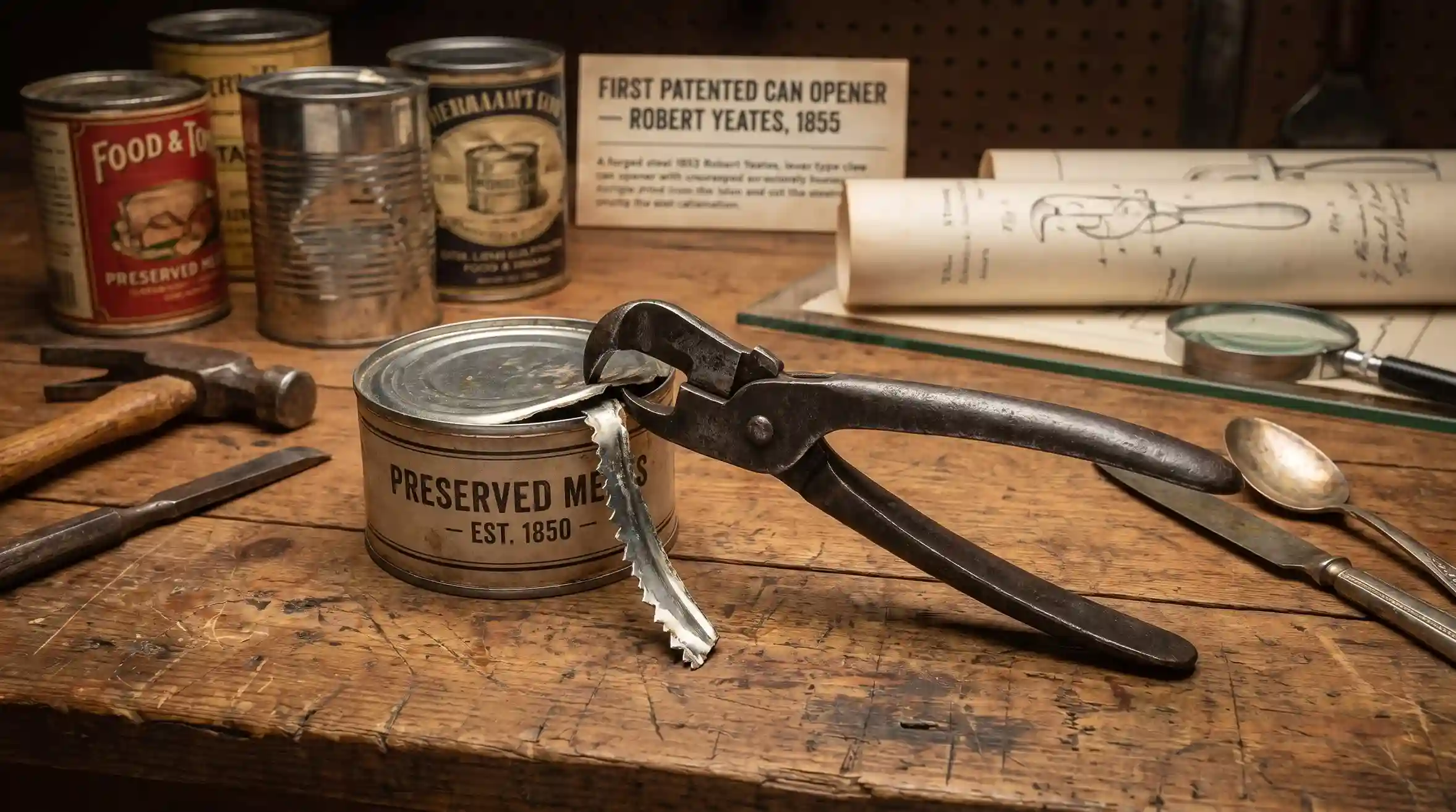
This is the first patented antique can opener in history. A cutlery maker from Middlesex, England, named Robert Yeates devised a hand‑operated tool with a claw‑shaped end that “haggled” its way around the top of a can.
Before Yeates, the instruction on a can of food often read: “Cut round the top with a chisel and hammer.” In 1855, Yeates changed everything. His claw‑like opener required strength and patience – it didn’t roll smoothly, but rather chopped a jagged line – but it was revolutionary.
- Manufacturer: Robert Yeates, cutler of Middlesex, England. Only a handful of original examples survive; later copies exist but are not nearly as valuable.
- Durability: ⭐⭐⭐⭐ – Forged steel construction. The claw tip can wear down after heavy use, but a skilled restorer can dress it with a file.
- Valuation (2026): $75 – $250+ depending on condition and provenance. Museum‑grade examples (with clear maker’s marks and minimal rust) have sold for over $500.
P‑38 & P‑51 Military Antique Can Openers (World War II era)
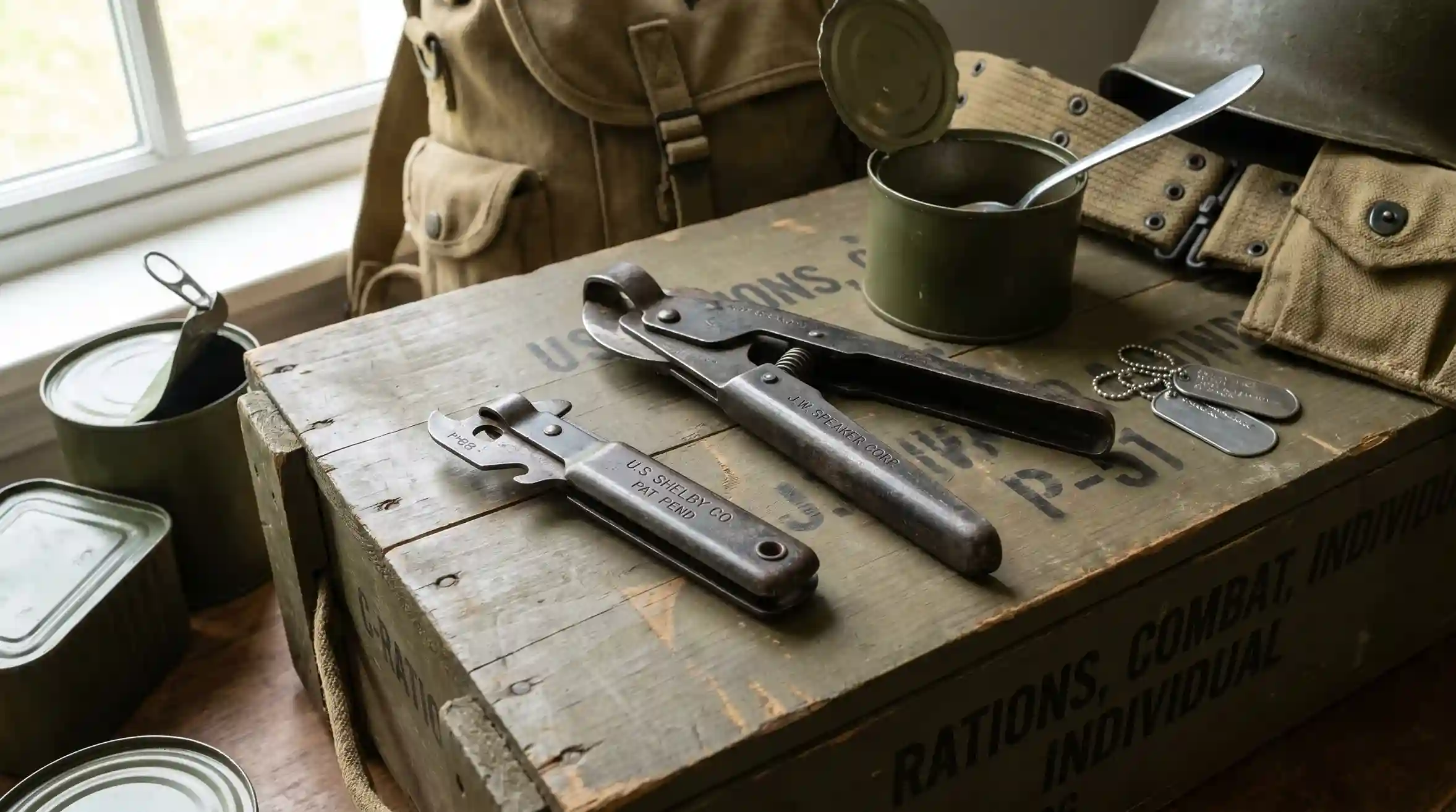
Compact, robust, and lightweight, this classic design features a small cutting blade hinged to a corrugated metal handle. Developed for military rations, it was designed to be carried on a keychain or dog tag.
At just 1.5 inches long, the P‑38 is a miracle of minimalist engineering. The serrated blade bites into the can’s rim, and the fulcrum lets you “walk” the cutter around the lid. The P‑51 is a larger, easier‑to‑grip version. Millions were produced for troops in WWII, Korea, and Vietnam. Even today, many soldiers and survivalists keep one on their keychain.
- Manufacturer: Multiple U.S. government contractors – Shelby P‑38, J.W. Speaker, and others. Common stamps include “US”, “SHELBY”, or “J.W. SPEAKER”.
- Durability: ⭐⭐⭐⭐ – The hinge pin can loosen over decades, but it’s fixable. The blade is hardened steel and will outlast most modern openers.
- Valuation (2026): $3 – $10 each for common surplus. Unused WWII‑era openers still in original paper wrap: $20 – $40. Rare maker stamps or unit‑marked examples: up to $60.
Rotating Wheel Antique Can Opener (William W. Lyman, 1870)
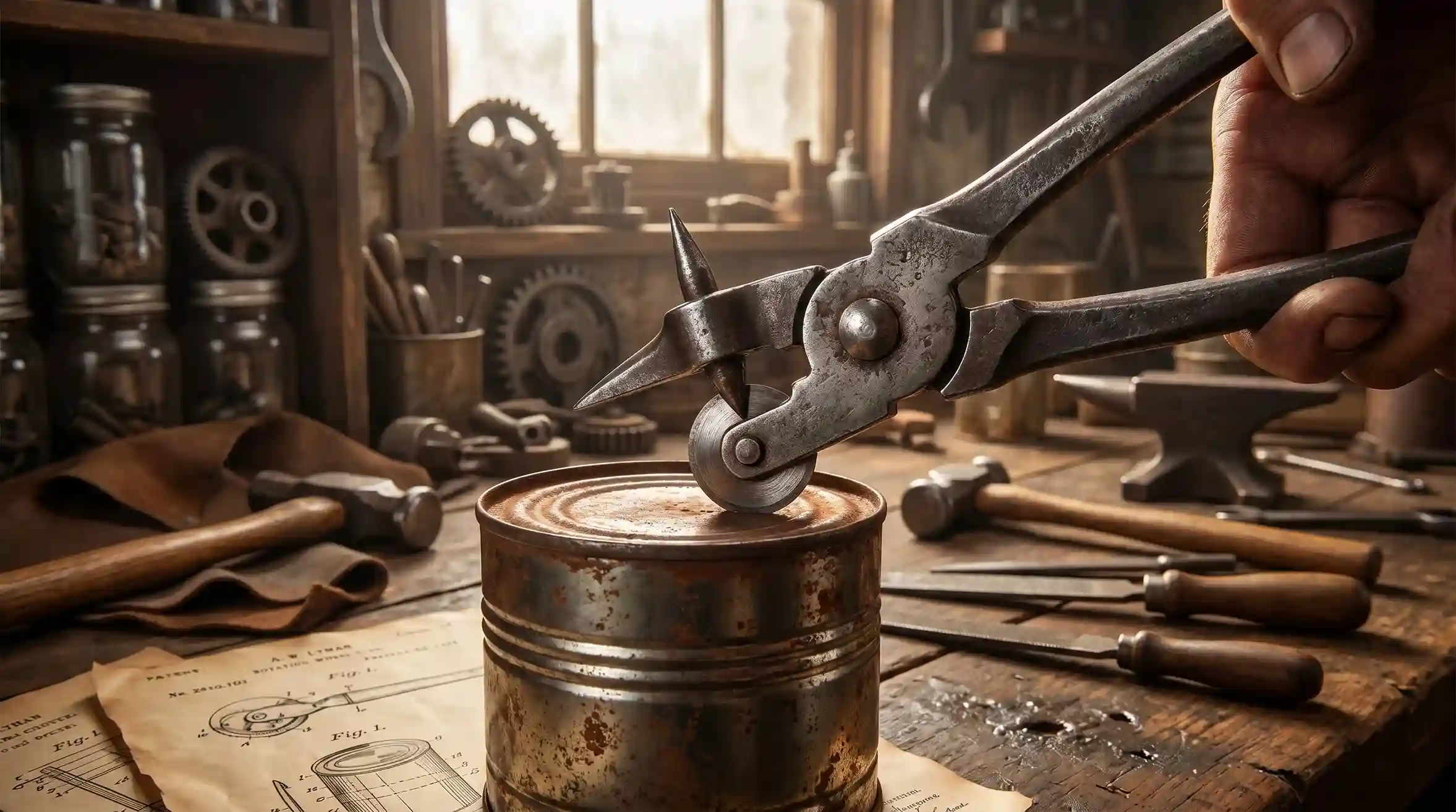
The first antique can opener to use the now‑familiar principle of a cutting wheel that rotates around the rim of the can. This model required piercing the center of the lid first, making it a precursor to modern designs. It was later improved in 1925 with an added serrated wheel to grip the rim.
Lyman’s opener looked like a strange pair of pliers with a sharp wheel. You first drove a spike into the center of the lid, then set the wheel against the rim and rotated the can – or the tool – to cut. It was a huge improvement over claw openers.
- Manufacturer: Patented by William W. Lyman; produced by several companies, including Enterprise Mfg. Co. and later the Star Can Opener Company.
- Durability: ⭐⭐⭐⭐ – Heavy steel construction. The center spike is the weakest point; it can break if you apply too much force. Otherwise, it’s very robust.
- Valuation (2026): $25 – $75 for common later models. Pre‑1925 original Lyman designs (with the single wheel only) are rarer and can bring $100 – $150.
“Guard Brand” Cast Iron Antique Can Opener (c.1920s)
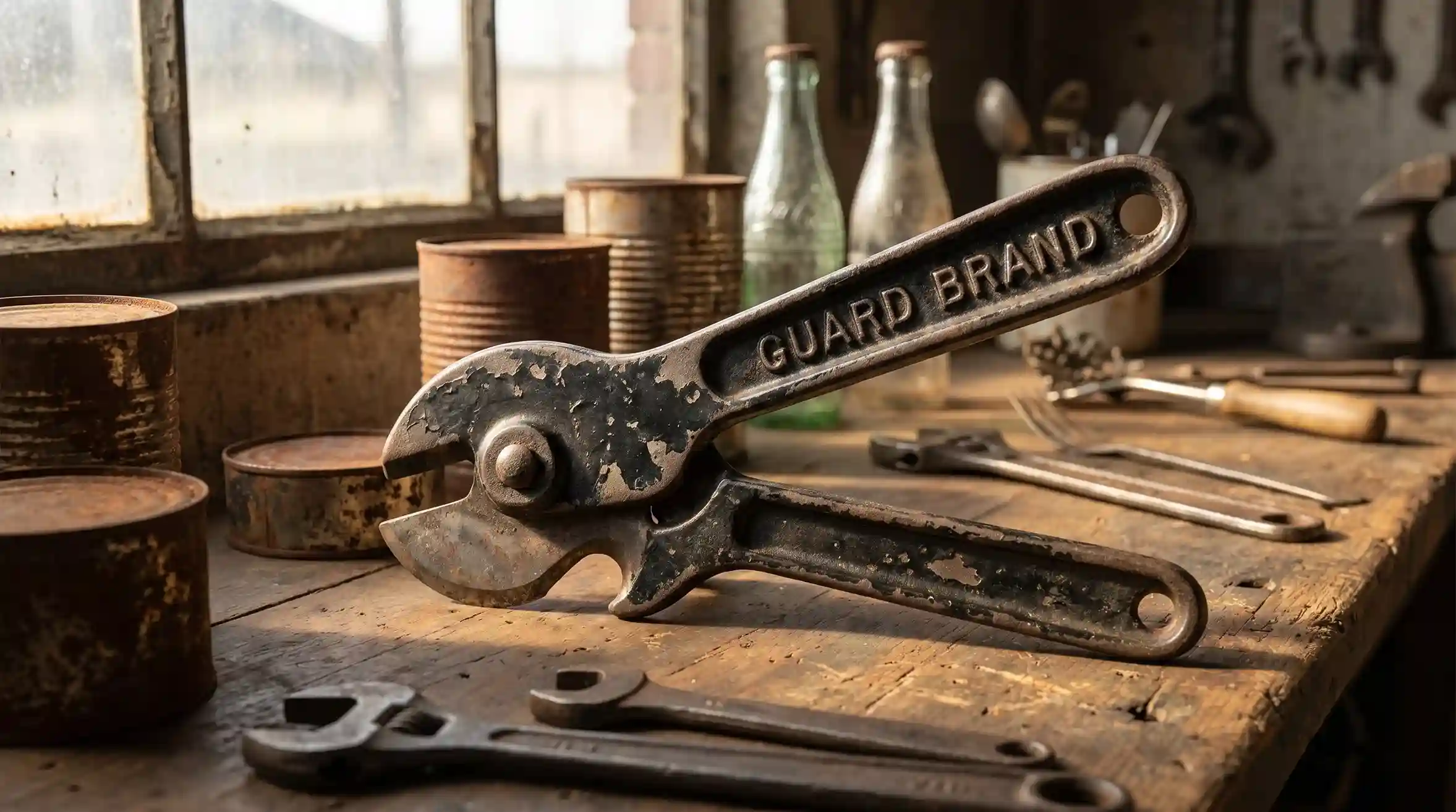
A testament to durability – “made to last” – this antique can opener is crafted from heavy cast metal. It represents the standard all‑in‑one design of the era, typically featuring a bottle opener on one end and a can‑piercing blade on the other, all in a single, sturdy unit.
In the 1920s, kitchen tools were built like farm equipment. Guard Brand openers are solid cast iron, often painted in red or black enamel. One end pierces the can; the other pries off a crown cap from a soda or beer bottle. They’re heavy, virtually indestructible, and a favorite among collectors who appreciate industrial‑age design.
- Manufacturer: Guard Brand. The exact company is unknown – it was likely produced by the American Can Company or a subcontractor. The name is cast directly into the iron.
- Durability: ⭐⭐⭐⭐⭐ – No moving parts. Cast iron construction. You could drive a truck over it (not recommended).
- Valuation (2026): $50 – $80 (typical). One sold at auction in 2025 for $66. Examples with original, unfaded paint: up to $120.
“Tapster” Pitcher Antique Can Opener (Revere, c.1936)
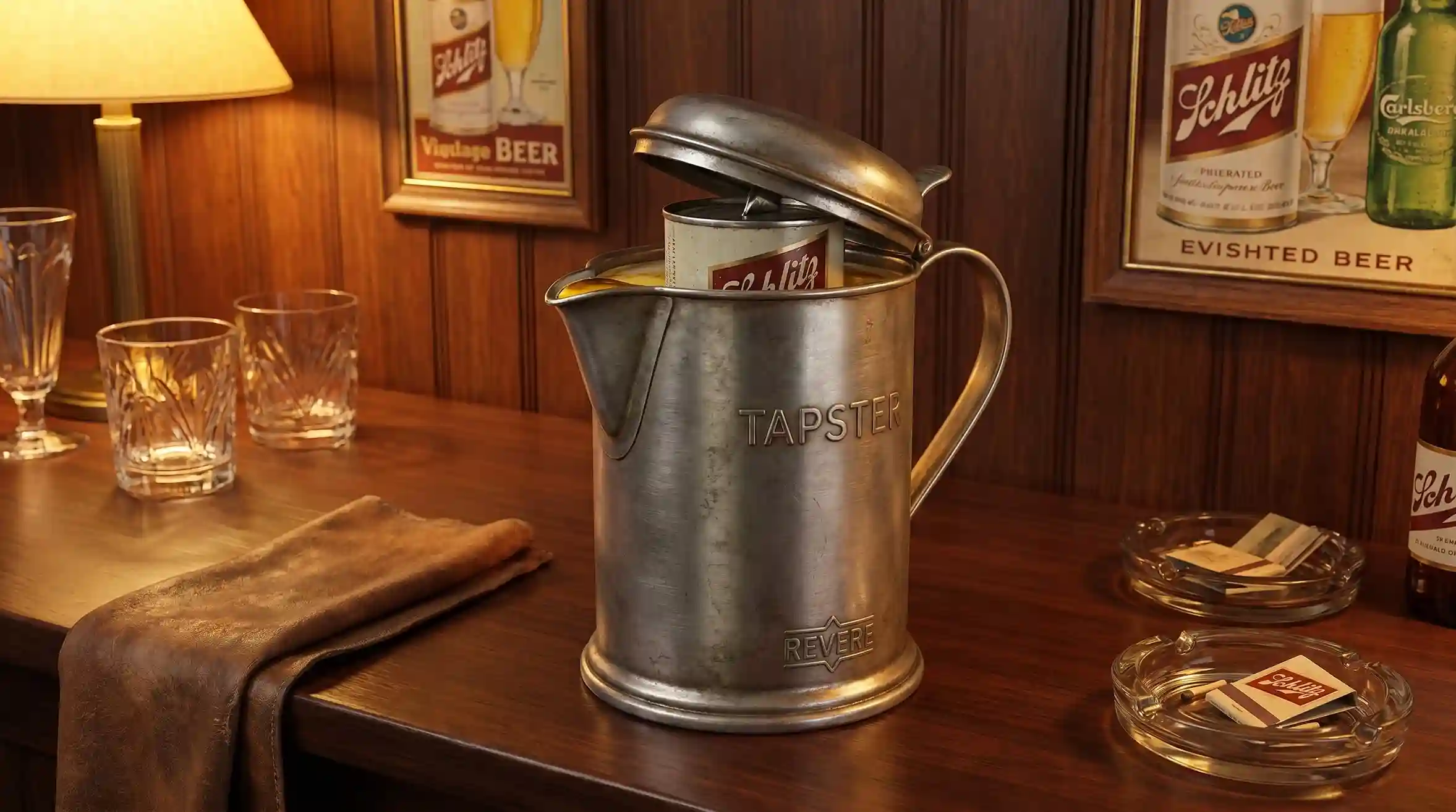
A fascinating novelty device shaped like a small metal pitcher. A flat‑top beer can was placed inside, the lid was closed, and a built‑in knife would puncture the can, allowing the beer to be poured directly through the spout.
Prohibition had just ended, and beer was back. The Tapster turned a standard flat‑top beer can into a mini pitcher. You inserted the can, snapped down the top – which drove a sharp punch into the can – then tilted the whole device to pour through the pitcher spout. It was a party gimmick, but a brilliant one.
- Manufacturer: Revere – likely Revere Copper & Brass Co., known for high‑quality kitchenware. Marked “TAPSTER” and “REVERE” on the base.
- Durability: ⭐⭐⭐ – The punch blade can rust or dull over time. The hinge mechanism may wear. However, many still function perfectly after 80+ years.
- Valuation (2026): $150 – $400+. Complete, clean, fully functional examples with no rust exceed $400. Missing parts or heavy wear: $75 – $150.
“Sampson” Multi‑Purpose Antique Can Opener (c.1920)
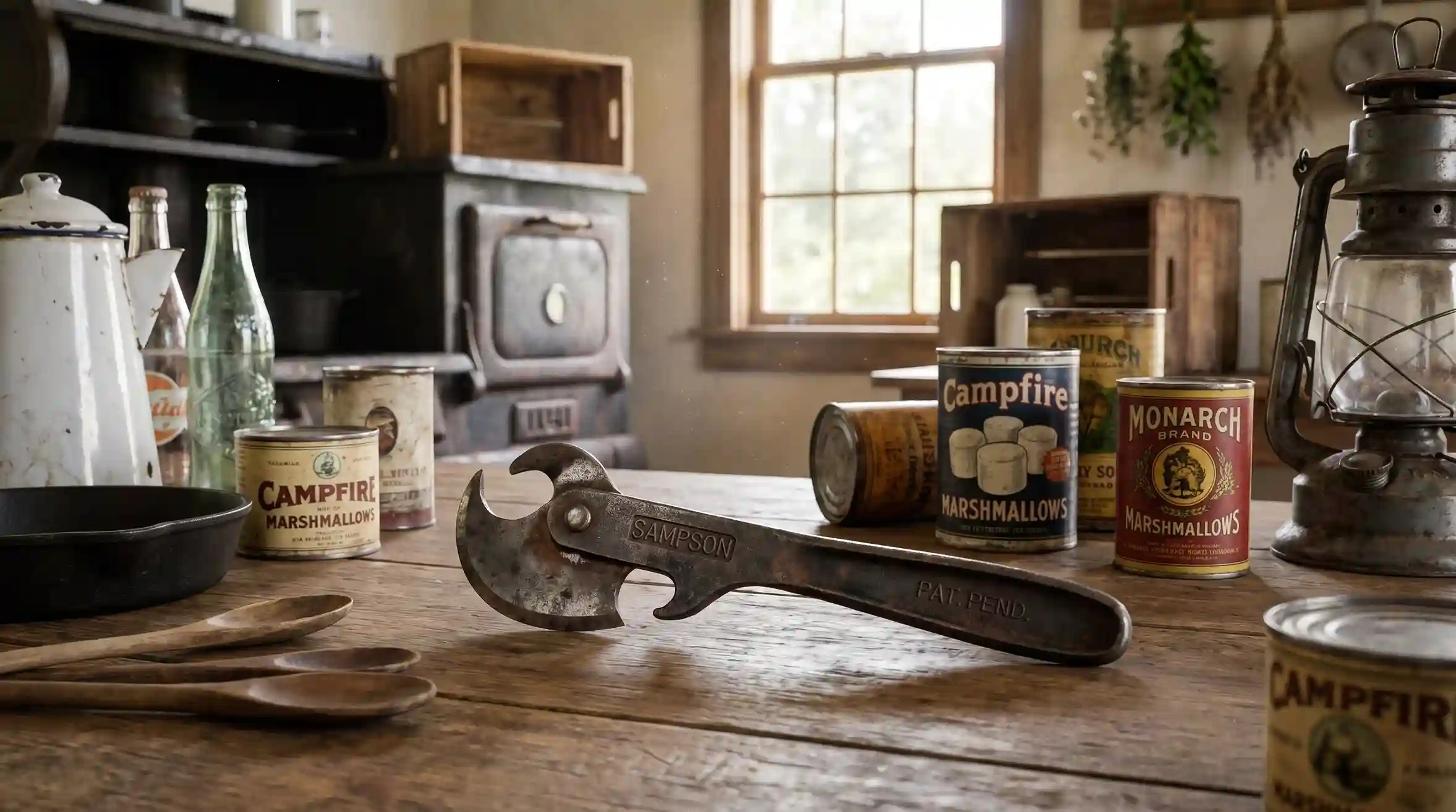
A classic hand tool combining a antique can opener with a hook for opening bottles. It often had a maker’s name stamped on the handle and was a common household item found in cabins, farmhouses, and logging camps across America.
The Sampson opener is the utilitarian hero of the list. Made of forged steel, it fits in a pocket or a kitchen drawer. The sharp, curved blade opens cans in a few strokes; the hooked end lifts bottle caps with ease.
- Manufacturer: Sampson – exact company unknown, likely a hardware brand. Often stamped “SAMPSON” or “SAMPSON MFG. CO.”
- Durability: ⭐⭐⭐⭐ – Forged steel. The blade can rust but can be cleaned and resharpened repeatedly.
- Valuation (2026): $15 – $35 for common examples. Unusual variations or those with very clear patent dates: up to $60.
The “Never Slip” Antique Can Opener (patented May 17, 1902)
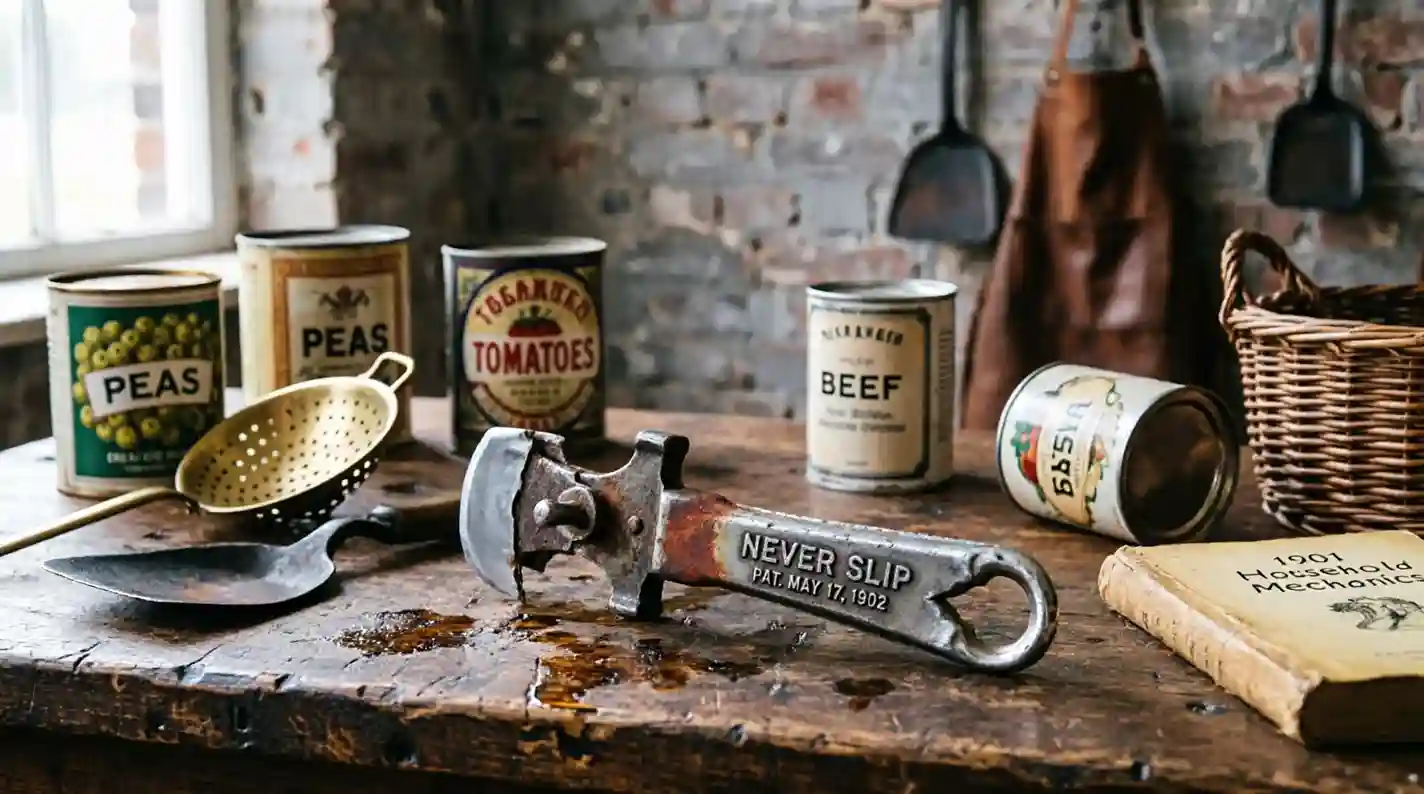
A hand‑held tool with a short, sharp blade and a hook. It was famously embossed with its patent date and name – a branding technique that makes it highly collectible today. The name itself is a great example of early 20th‑century marketing.
Marketing matters – even for antique can openers. The “Never Slip” promises exactly what it does: a non‑slip grip on the can’s rim. The tool is stamped with “PAT. MAY 17, 1902” and the brand name, turning a simple opener into a piece of advertising history.
- Manufacturer: Unknown small American hardware company. The patent was granted to someone (the name is not always stamped).
- Durability: ⭐⭐⭐ – Thin but hardened steel. The hook can snap if abused, but for normal can opening it’s fine.
- Valuation (2026): $20 – $60. Crisp, legible embossing brings the highest prices. Rusty or worn examples go for under $20.
William Painter’s Crown Bottle Opener (c.1892)
While technically a bottle opener, this invention is integral to can opener history. William Painter invented both the “crown” bottle cap and the pry opener for it. The design is a small, flat piece of metal with a corrugated edge to lift caps, with early versions often doubling as a tool to adjust car headlights.
Painter didn’t invent the can opener, but he revolutionized sealed containers. His crown cork – the crimped metal cap with a cork lining – is still standard today. Without Painter, the modern beverage can would have been far less convenient.
- Manufacturer: Crown Cork & Seal Company (founded by William Painter). Marked “CROWN” or “PAT’D 1892”.
- Durability: ⭐⭐⭐⭐ – Stamped steel, simple and effective. The corrugated edge can wear down after thousands of uses, but that takes decades.
- Valuation (2026): $10 – $40 for common versions. Early examples with the Model T headlight notch: $30 – $60. Rare promotional pieces: up to $100.
Old vs. New: A Detailed Comparison Table
| Feature | Antique Can Openers (1855–1940) | Modern Openers (2020s) |
|---|---|---|
| Durability | ⭐⭐⭐⭐ to ⭐⭐⭐⭐⭐ (100+ years) | ⭐ to ⭐⭐ (2–5 years) |
| Materials | Cast iron, forged steel, brass | Plastic, zinc alloy, cheap stainless |
| Repairability | Yes – sharpen, oil, tighten | No – throw away when broken |
| Ease of use | Moderate (learning curve) | Very easy (smooth wheels, electric) |
| Safety | Lower (sharp exposed blades) | Higher (side‑cutting models) |
| Speed | Slow (30–60 seconds per can) | Fast (5–10 seconds) |
| Environmental impact | Low (one tool for life) | High (landfill waste) |
| Collectible value | High – many appreciate over time | None |
| Average price | $10 – $400+ | $5 – $30 |
My honest take: For daily kitchen use, I keep a modern Kuhn Rikon safety opener because it leaves no sharp edges. But for camping, emergencies, or simply the joy of using a well‑made tool, I reach for a P‑38 or a Guard Brand. If you care about durability and waste, antique can openers are unbeatable.
Full Price Guide for Antique Can Openers (2026)
Here’s a quick‑reference table based on real sales from eBay, antique auctions, and dealer listings (2024–2026):
| Antique Can Opener | Typical Price Range |
|---|---|
| Bull’s Head | $60 – $250 |
| Twist‑Key | $15 – $120 |
| Claw (Yeates) | $75 – $500+ |
| P‑38 / P‑51 | $3 – $40 |
| Lyman Rotating Wheel | $25 – $150 |
| Guard Brand | $50 – $120 |
| Tapster Pitcher | $150 – $400+ |
| Sampson | $15 – $60 |
| Never Slip | $20 – $60 |
| William Painter Crown | $10 – $100 |
Pro tip: Always check “sold” listings on eBay, not active listings. Sold prices reflect what people actually pay.
How to Restore an Antique Can Opener (Step by Step)
Restoring an antique can opener is surprisingly easy – and it won’t destroy its value if you do it right.
What you’ll need:
- White vinegar (for rust removal)
- Brass brush or fine steel wool
- Small file (for sharpening the blade)
- Mineral oil or sewing machine oil
Steps:
- Remove heavy rust: Soak the opener in white vinegar for 24 hours. The rust will soften. Scrub with a brass brush.
- Do not sandblast – it removes patina and original finish, killing collector value.
- Sharpen the blade with a small file. Work at the same angle as the original edge.
- Oil moving parts (hinges, pivot points) with a drop of mineral oil.
- Leave the patina – surface rust that remains is fine. Do not repaint.
Why Antique Can Openers Are Eco‑Friendly
Every year, millions of plastic‑geared can openers end up in landfills. Most last less than five years. A single antique can opener from 1920 has likely opened thousands of cans and can open thousands more.
If you care about:
- Zero waste living
- Reducing plastic consumption
- Saving money over the long term
…then buying one antique opener is better than buying ten cheap modern ones.
For more on sustainable kitchen tools, check out Zero Waste Home (external resource).
Where to Find Antique Can Openers Today
You don’t need a time machine. Try these places:
- eBay – Search “vintage can opener” or specific names like “Bull’s Head opener”.
- Etsy – More curated, often pricier.
- Flea markets & antique malls – Best for hands‑on inspection.
- Estate sales – Look in kitchen drawers, toolboxes, and barns.
- Facebook Marketplace – Local pickup saves shipping (cast iron is heavy).
For identification help, visit Antique Tool Talk (external resource).
Common Mistakes Collectors Make
- Repainting: Never repaint a cast iron opener. Original paint (even if chipped) is valuable.
- Over‑cleaning: Shiny, polished metal often lowers value. Collectors want honest patina.
- Throwing away “rusty junk”: Surface rust is easy to remove. Only deep pitting ruins a piece.
- Buying reproductions: Modern Bull’s Head fakes exist. Look for crisp casting, weight, and age‑appropriate wear.
Final Verdict: Should You Buy an Antique Can Opener?
If you want a daily‑use tool that will outlive you, go for a Guard Brand cast iron opener or a Bull’s Head. These are heavy, simple, and nearly indestructible. They take a little practice to use smoothly, but once you learn the motion, you’ll wonder why you ever tolerated plastic‑geared openers that die after two years. For camping or emergency kits, nothing beats the P‑38 – it’s tiny, cheap, and has been opening cans reliably for over eighty years.
If you care more about speed and safety than longevity, a modern side‑cutting opener (like Kuhn Rikon) is fine. Just know that it’s disposable; the plastic parts will fail, and you’ll buy another. Meanwhile, an antique can opener like the Tapster Pitcher or a rare Yeates claw also serves as a conversation piece and a small investment. These unusual models tend to hold or increase in value, especially if kept in original condition.
My honest advice? You don’t have to choose just one. Keep a modern opener for convenience and a few antique can openers for the joy of using real, repairable, sustainable tools. Start with a $10 P‑38 or a $50 Guard Brand. Use it for a month. You’ll likely never go back to flimsy plastic again.

