

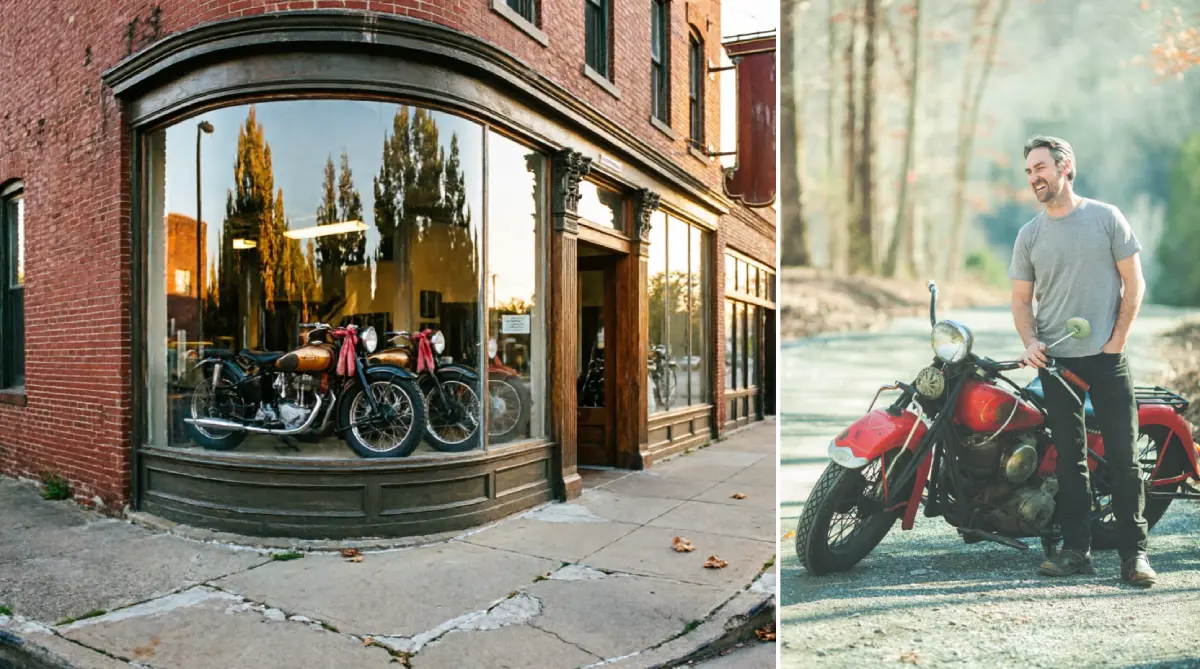
Most people who’ve watched American Pickers assume Mike Wolfe’s big move was finding a barn full of vintage bikes and haggling his way to a profit. Here’s the thing: he sold more than 60 of those motorcycles at Mecum Auctions’ Las Vegas sale in January 2023. On purpose.
That decision says everything about where Wolfe is now. He’s not chasing inventory anymore. He’s chasing something harder to find — and harder to replace. Mike Wolfe’s passion project is preserving the physical fabric of small-town America: the dealerships, the gas stations, the Main Street storefronts, and the collective memory embedded in them. And he’s spending serious money to prove he means it.
Here’s what he’s actually been building — and why it matters far beyond a TV show.
Mike Wolfe’s Major Projects at a Glance
| Project Name | Location | What It Is | Current Status |
|---|---|---|---|
| Columbia Motor Alley | Columbia, TN | Restored 1948 Chevrolet dealership turned community landmark | Open |
| Esso Station / Revival | Columbia, TN | Restored gas station turned community gathering space + restaurant | In development |
| Two Lanes | Online / National | Visual blog celebrating backroad Americana and forgotten roadside culture | Active |
| Two Lanes Guest House | LeClaire, IA | Short-term rental in his restored hometown property | Active |
| Antique Archaeology | LeClaire, IA (original); Nashville, TN (closed 2020) | His retail antiques brand — Nashville store closed; LeClaire shop remains | LeClaire open; Nashville closed |
| Nashville’s Big Back Yard | TN / AL corridor | Regional tourism initiative linking 12 small towns between Nashville and Muscle Shoals — Nashville’s Big Backyard | Active |
What Is Mike Wolfe’s Passion Project — and Why Should You Care?
There’s a version of Mike Wolfe’s story that goes like this: a guy finds old stuff, sells it, gets famous. That version isn’t wrong, but it misses what he’s doing now.
What Wolfe noticed on endless backroad drives was that the buildings were disappearing. Gas stations, dealerships, hardware stores, dime-store fronts — the physical fabric that made small towns feel like places, not just highway exits. And almost nobody was raising a hand to save them.
“We’re not flipping buildings,” Wolfe has said. “We’re flipping the culture.”
That line sums it up. This isn’t a celebrity renovation hobby. It’s a deliberate argument that old buildings hold more value — cultural, economic, emotional — than the parking lots that replace them.
Columbia Motor Alley: The Heart of Wolfe’s Restoration Mission
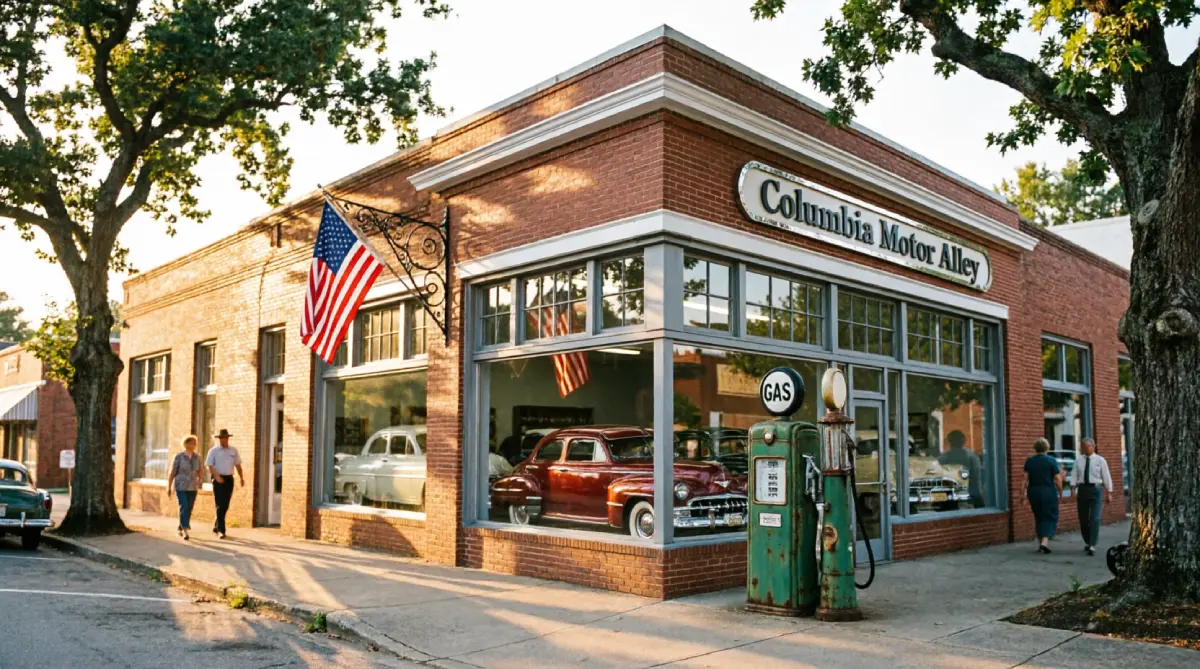
In November 2017, Wolfe paid $317,664 for the building at 120 West 6th Street in Columbia, Tennessee. At the time, it was a faded 13,440-square-foot hulk. But Wolfe saw what it used to be — and what it could become again.
From Chevrolet Dealership to Community Landmark
Built in 1948 as a Chevrolet dealership, the structure originally held showroom space, service bays, and storage across 13,440 square feet. By the time Wolfe bought it, decades of neglect had left it nearly invisible to passersby.
Wolfe saw the wide glass showroom windows, the original service bay doors, the scale of a building designed to display automobiles at the height of postwar American optimism. He named it Columbia Motor Alley and undertook a painstaking, multi-year restoration.
What You’ll Find When You Visit Columbia Motor Alley
Columbia Motor Alley today is part working landmark, part community gathering space. Visitors can expect to find:
- Vintage cars and motorcycles are displayed throughout the showroom
- A working restoration and repair bay that honors the building’s original function
- Rotating events, from car shows to community gatherings
- Architectural details painstakingly preserved from the 1948 original
- An atmosphere that feels like stumbling into a living museum — except it’s actually alive
It’s become an anchor for Columbia’s downtown. That was the goal from the start.
What Happened With the Old Gas Station Restoration in Columbia?
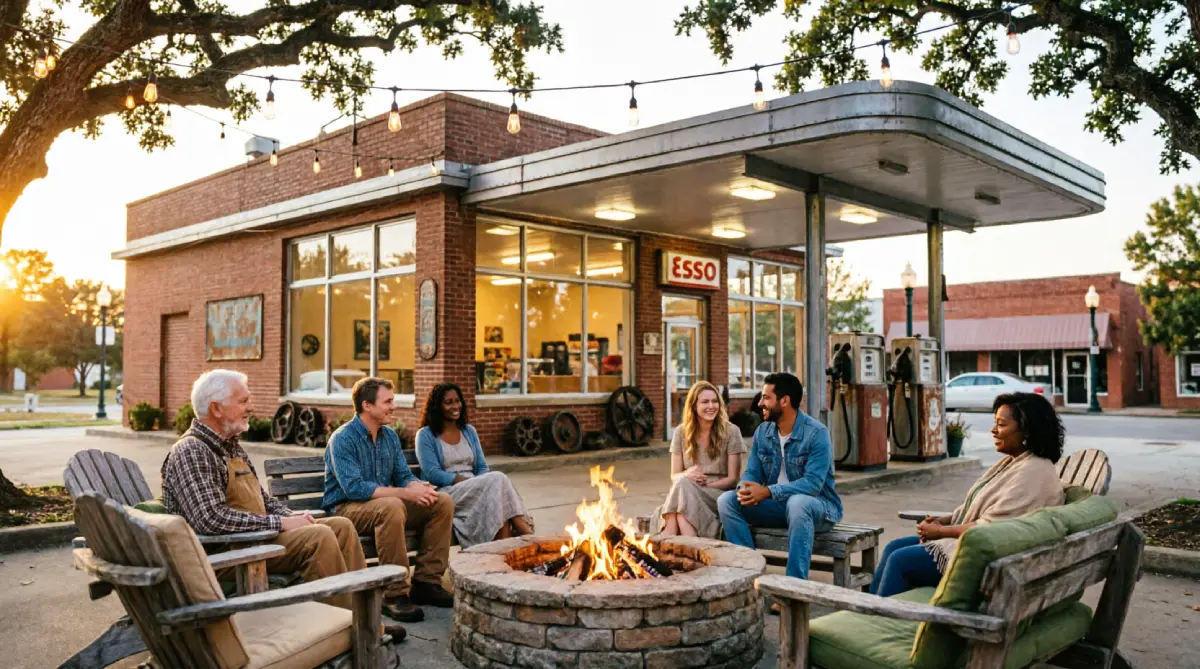
Right down the street from Motor Alley sits Wolfe’s next project — a former Esso gas station that most people wrote off as a teardown candidate. His Instagram posts about the restoration went viral in part because the transformation was so stark: a crumbling relic turned into a place you’d actually want to spend an evening at.
Revival — A New Food and Cocktail Spot With Historic Roots
The vision for the space goes beyond preserving four walls and a canopy. Wolfe is developing Revival, a food-and-cocktail establishment that will operate within the restored structure. The concept is intentional: the name signals what the building went through, and the space is designed to function as a genuine community gathering point — a fire pit, outdoor seating, string lighting, the kind of place that makes people linger.
What makes this more than a trendy renovation is the reasoning behind it. Wolfe has talked about the idea of Main Street being “the honey to all the bees” — the beating center that draws people in, creates economic activity, and gives a town its identity. The Esso station project is a direct application of that thinking.
How Two Lanes Became Wolfe’s Visual Love Letter to America
Not every part of Wolfe’s preservation mission involves a bulldozer or a checkbook. Two Lanes — his visual journal — is where the philosophy lives between the construction updates.
The project documents what Wolfe sees on the road: roadside diners with hand-painted signs, filling stations that haven’t changed since 1962, small-town hardware stores still run by the same family. It’s a living archive of what’s disappearing and a quiet argument for why it shouldn’t.
How the Blog Connects Back to His Physical Restoration Work
Two Lanes isn’t a side project in the way most people think about it. It functions as the argument that explains everything else Wolfe does. The blog shows readers why these spaces matter before asking them to care about the buildings he’s restoring. It’s how he builds the emotional case that the bricks-and-mortar work is worth making.
“These old buildings are time capsules,” Wolfe has said. “Once they’re gone, they’re gone.”
Two Lanes is his way of documenting what still exists — and quietly daring readers to notice it in their own towns before it’s too late.
Why Did Mike Wolfe Sell Most of His Vintage Motorcycle Collection?
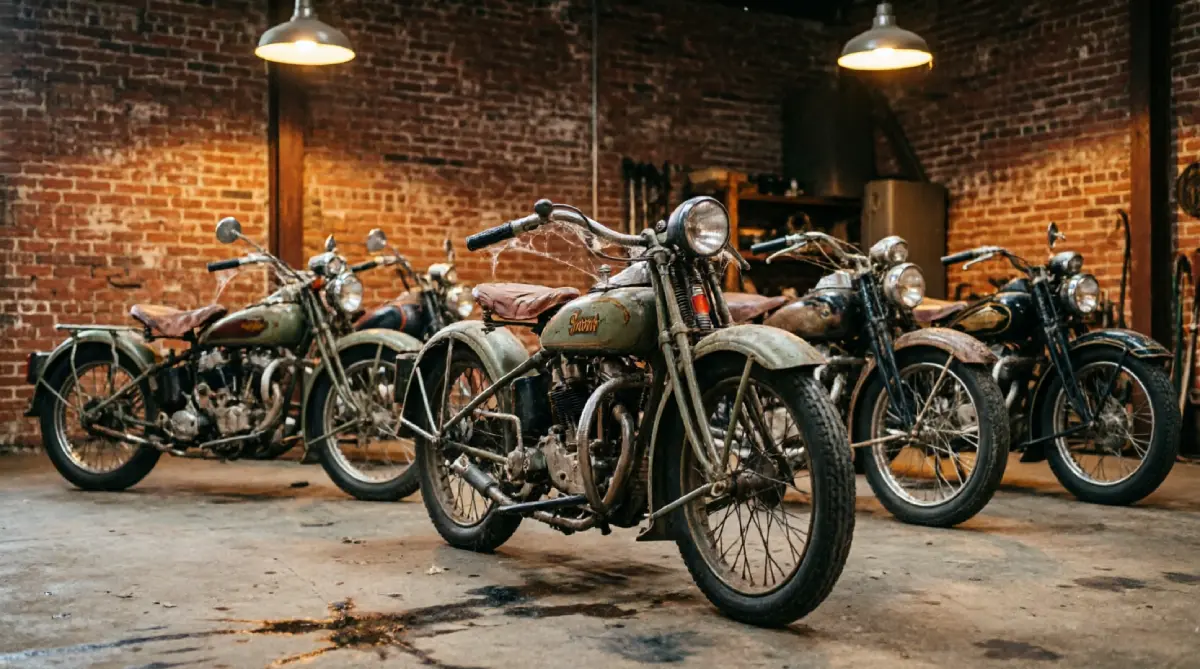
At Mecum Auctions’ Las Vegas sale in January 2023, Wolfe auctioned off more than 60 motorcycles. For someone whose identity has been synonymous with collecting rare bikes — especially early Indian models — this looked, on the surface, like a retreat.
It wasn’t. It was a focus.
What the Las Vegas Auction Revealed About His Evolving Priorities
The auction was about narrowing down, not losing interest. Wolfe has said his direction is to concentrate on pre-1920 American motorcycles — the earliest Indian, Harley-Davidson, and other pioneer machines, some dating to the 1910s. Selling 60-plus bikes to own a handful of the right ones isn’t the move of someone walking away. It’s the move of someone who knows exactly what he’s after.
That same logic applies to his approach to buildings. He’s not trying to restore every neglected structure in America. He’s choosing specific ones — buildings with the right bones, in the right towns, at the right moment — and going all the way with each one.
LeClaire, Iowa: Where Wolfe’s Preservation Philosophy Was Born
Before Columbia, before Motor Alley, before any of it — there was LeClaire.
Wolfe grew up in this small Iowa town on the Mississippi River, and it’s where American Pickers is set. But his investment in LeClaire goes beyond a filming location or a nostalgia trip. He’s put serious money and time into restoring properties there, including a short-term rental experience called the Two Lanes Guest House — a place visitors can actually stay in, giving them the full backroad-America immersion he talks about on the blog.
LeClaire is the proof of concept. It’s where Wolfe first tested the idea that a restored building could do more than look nice — it could become a reason for people to show up, spend time, and care about a place they might otherwise have driven through at 70 miles an hour.
The National Trust for Historic Preservation’s “This Place Matters” campaign, which Wolfe supports, puts language to what he already knew from LeClaire: places carry identity, and when the buildings go, something harder to name goes with them.
What Can We Learn From Mike Wolfe’s Approach to Saving Small-Town America?
Here’s the part most people miss when they write about Wolfe: his projects aren’t just interesting. They’re replicable. You don’t need a History Channel contract or a $700,000 renovation budget to use his playbook. The logic scales down.
The Ripple Effect: How One Restored Building Changes a Whole Town
Wolfe has talked about how a single revitalized building on a Main Street changes the behavior of everyone around it. Property owners start caring about their facades. New businesses look at the foot traffic and think, maybe. Local pride — the kind that makes people stay rather than leave — starts building on itself.
“We need to save small-town America, man,” he’s said. And while that sounds like a bumper sticker, his projects are backing it up.
Here are five lessons from Wolfe’s approach that anyone can apply:
- Start with one building. Wolfe didn’t try to renovate the whole downtown. He picked one structure — the right one — and did it completely. One well-done project creates more momentum than five half-finished ones.
- Honor the original function. Motor Alley still feels like a car place. The Esso station still reads as a gas station. Preservation means keeping the memory of a space alive, not just the walls.
- Tell the story, not just the renovation. Two Lanes exists because the “why” matters as much as the “what.” People support preservation when they understand what’s being lost.
- Partner with the community. Revival is being built as a gathering space first, business second. That sequence matters — it builds investment from the neighborhood before a dollar is spent.
- Think long-term. Wolfe has spent years and hundreds of thousands of dollars on projects that don’t have a fast payoff. Heritage tourism and community identity don’t show up on a 12-month ROI spreadsheet. They show up over decades.
Conclusion
Here’s what the full picture adds up to:
- Mike Wolfe shifted from collecting objects to preserving places — and the shift was intentional, not accidental.
- Columbia Motor Alley and the Esso/Revival project are his flagship statements: proof that old buildings can become living, working community assets.
- Two Lanes and the LeClaire projects form the philosophical backbone — the argument for why any of this is worth doing.
- Selling most of his motorcycle collection wasn’t a retreat. It was a focus.
You don’t need a TV career or a restoration budget measured in the hundreds of thousands to take something from his story. Wolfe’s real lesson is simpler: start noticing what’s worth saving before it’s gone. The buildings he restored weren’t special until someone decided they were. That decision is available to anyone.
If you’ve ever driven through a small town and thought this place used to be something — that thought is where preservation starts.
Want to see his work in person? Columbia Motor Alley is in Columbia, Tennessee, a short drive south of Nashville. Two Lanes is online and worth an afternoon of reading. And if you’ve got a building in your own town that fits the description — well, now you know what to do with it.
Frequently Asked Questions
1. What is Mike Wolfe’s passion project about?
Mike Wolfe’s passion project centers on historic preservation and small-town revitalization. Beyond his work on American Pickers, he’s invested heavily in restoring forgotten buildings — particularly in Columbia, Tennessee — and converting them into active community spaces. His goal is to show that old structures have cultural and economic value worth protecting.
2. Where is Columbia Motor Alley, and can you visit it?
Columbia Motor Alley is located at 120 West 6th Street in Columbia, Tennessee, roughly 45 miles south of Nashville. Wolfe purchased the 1948 Chevrolet dealership building in November 2017 for $317,664 and restored it into a community landmark featuring vintage vehicles, events, and historical architecture. It is open to visitors.
3. What is the Revival project in Columbia, Tennessee?
Revival is a food and cocktail establishment Wolfe is developing inside a restored former Esso gas station near Columbia Motor Alley. The space is being designed as a community gathering area with outdoor seating, a fire pit, and a rustic-industrial atmosphere that preserves the visual identity of the original building.
4. Why did Mike Wolfe sell his motorcycle collection?
In January 2023, Wolfe auctioned off more than 60 motorcycles at Mecum Auctions’ Las Vegas sale as part of a deliberate shift in focus. He has said his goal is to concentrate on pre-1920 American motorcycles — the earliest examples of Indian, Harley-Davidson, and other pioneer machines — rather than maintaining a large mixed collection. The sale reflected evolving priorities, not a departure from his love of vintage machines.
5. How is Mike Wolfe helping save small-town America?
Wolfe is involved in multiple preservation efforts: restoring historic buildings in Columbia, Tennessee, and LeClaire, Iowa; running Two Lanes, a visual journal documenting disappearing roadside Americana; supporting the National Trust’s “This Place Matters” campaign; and leading Nashville’s Big Back Yard, a regional tourism initiative connecting 12 small towns between Nashville and Muscle Shoals. His approach treats architectural restoration as a tool for broader community and cultural revival.

