

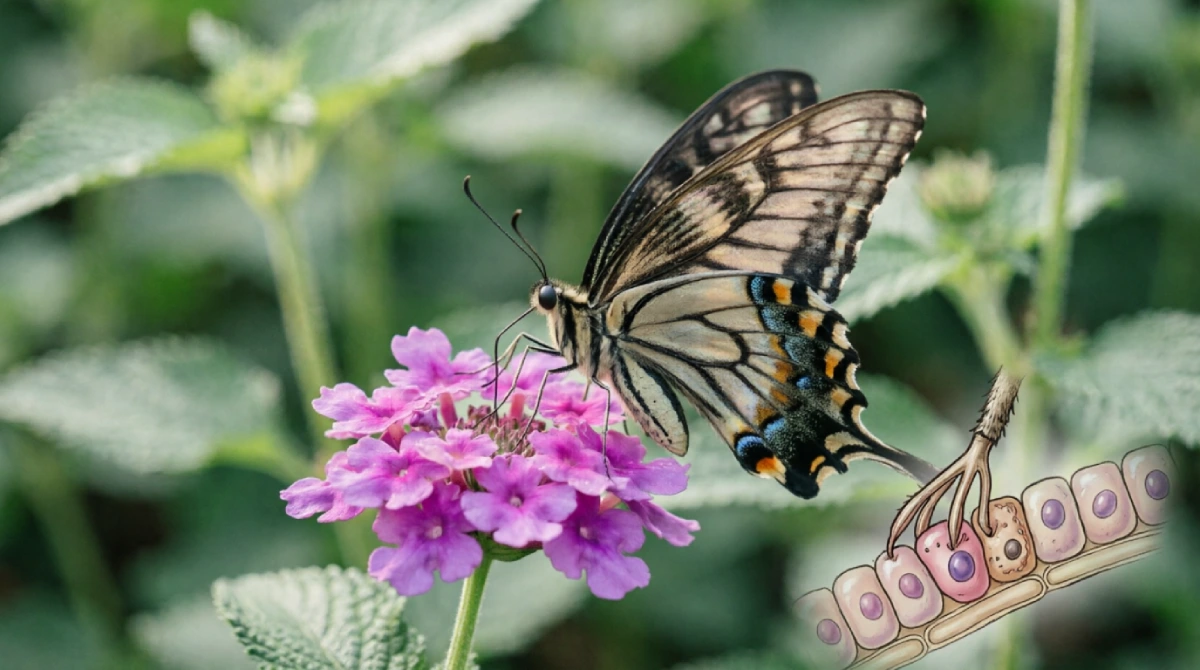

Butterflies taste with their feet. Read that again. Every time a butterfly lands on a leaf, a flower, or even your hand — it’s tasting whatever it touches.
You use your tongue. Butterflies use their feet. Their feet contain tiny chemical sensors that pick up signals from any surface on contact. That one touch tells them everything: Is this the right plant? Is there sugar here? Should I lay my eggs on this leaf?
It sounds impossible. But it’s real, well-documented biology — and once you understand how it works, you’ll never look at a butterfly the same way again.
How Do Butterflies Taste with Their Feet?
Butterfly feet contain specialized nerve cells called chemoreceptors. These sensors detect chemicals the moment they make contact with a surface.
When a butterfly lands on a leaf, those chemoreceptors instantly read the chemical composition of that surface. They pick up sugars, salts, plant compounds, and other molecules — the same way your taste buds react when food hits your tongue.
According to research cited by the Smithsonian Institution, these receptors detect incredibly small amounts of dissolved substances. A butterfly doesn’t need to bite, chew, or lick. One footstep gives it a complete chemical profile.
Think of it this way. If you could taste a pizza just by stepping on the box, you’d know every topping before you opened it. That’s roughly what a butterfly does — except its survival depends on getting the answer right.
Where Exactly Are the Taste Sensors?
Most of a butterfly’s taste ability is concentrated in its feet — but not all of it. Butterflies also carry taste receptors on their proboscis (the tube they use to drink) and on their antennae, as confirmed by entomologists at the Florida Museum of Natural History. The feet do the heavy work of surface identification, but the full tasting system is spread across the body.
This is worth knowing because it means a butterfly is running chemical checks at multiple stages: feet on contact, antennae in proximity, proboscis when drinking. Each plays a different role in how the insect evaluates its environment.
The key difference between the foot sensors and the human tongue: butterfly chemoreceptors operate at lower concentrations through direct contact, without requiring the substance to dissolve inside a mouth. One footstep is enough.
Why Butterflies Land on Leaves
You’ve watched a butterfly land on a leaf, pause for a moment, and fly away. That wasn’t a rest break. That was a taste test.
Female butterflies are extremely selective about where they lay eggs. The wrong plant means their caterpillars hatch without food — and die. So the mother butterfly lands on leaf after leaf, tasting each one through her feet until she finds an exact chemical match.
Monarch butterflies are a perfect example. They search specifically for milkweed. Their feet detect chemical compounds unique to milkweed plants, and they refuse to lay eggs on anything else. That single decision — made through foot contact — determines where the next generation of monarchs is born.
This selection process is incredibly precise. A female might test 30, 40, or 50 different leaves before choosing one. Every landing is a data point. Every takeoff means “not this one.”
It’s one of the most efficient systems in nature for locating both food and breeding ground — and it runs on contact chemistry, not guesswork.
It’s Not Just Leaves — Flowers, People, and Mud
Butterflies also taste with their feet when they land on flowers. Before unrolling their proboscis, they confirm there’s nectar worth the effort. If the flower doesn’t pass the foot test, they move on without wasting energy.
They taste you, too. When a butterfly lands on your arm, its feet immediately detect the salts and minerals in your sweat. You’re not food. But the sodium, amino acids, and other compounds on your skin trigger their chemoreceptors instantly.
This connects to a broader butterfly behavior called puddling. Male butterflies gather on wet soil, mud, and sometimes animal waste to absorb sodium and amino acids they can’t get from nectar alone. Their feet guide them to the richest sources. No trial and error — just land, taste, confirm.
Puddling is especially common in tropical species. Groups of 10, 20, or even 100 butterflies crowd the same mud patch because their feet all detected the same chemical signal. It’s a surprisingly social behavior driven entirely by foot-based taste.
How Sensitive Are These Sensors, Really?
Most people assume insects rely on eyes or smell to navigate the world. Butterflies use both — but taste-by-touch adds a level of precision that vision and scent alone can’t match.
A butterfly can spot a green leaf from meters away. It can detect floral scent in the breeze. But confirming the exact chemical content of a specific plant? That only happens when its feet make direct contact.
For egg-laying females, this final check separates a safe choice from a fatal one. A leaf might look right and smell right — but if the foot sensors detect the wrong chemistry, the butterfly flies on. No second-guessing. No risk.
Entomologist Katy Prudic of the University of Arizona describes the egg-laying decision this way: “You’ve got to make sure you’re getting those babies on the right plant.” The foot taste system is precisely that — a last-line confirmation before committing.
The human tongue manages roughly 10,000 taste buds, according to the National Institute on Deafness and Other Communication Disorders. The exact number of chemoreceptors in butterfly feet varies by species and remains an active area of research — but the sensitivity per receptor is measurably higher than what human taste buds achieve at equivalent concentrations.
What About Caterpillars?
A common misconception worth clearing up: caterpillars aren’t tasteless. They do have taste receptors — located on their mouthparts, not their feet. What caterpillars lack is the foot-based chemoreception system that adults develop.
That foot-taste ability emerges during metamorphosis, when the adult butterfly’s body forms from scratch. The caterpillar eats; the adult selects. Two different jobs, two different sensory tools for the same lineage.
This means the co-evolution between butterflies and their host plants isn’t just about the adults’ egg-laying preference. The caterpillar’s mouth receptors also filter for the right chemistry — same goal, different mechanism, different life stage.
Why This Ability Exists — The Evolutionary Angle
Over millions of years, certain butterfly species co-evolved tightly with specific host plants. The chemoreceptors in their feet became tuned to detect exactly the right chemical signatures — not just “plant” or “not plant,” but the precise molecular identity of one species over another.
Painted lady butterflies, for instance, can distinguish between closely related plant species that look identical to the human eye. The difference isn’t visible — it’s chemical, and the foot sensors catch it.
From a pure biology standpoint, this makes butterfly feet one of the more precise sensory tools in the insect world: fast, accurate, and running on direct contact. It also explains why butterflies and their host plants have such locked-in relationships. Disrupt the plant population, and the butterfly loses its only reliable detection method. That’s a real conservation implication, not just an interesting footnote.
6 Facts About Butterfly Taste Most People Get Wrong
- The feet aren’t the only taste organs: Butterflies also have receptors on their proboscis and antennae. The feet do most of the identification work, but the system is distributed — not foot-exclusive.
- The proboscis doesn’t just drink — it also confirms: When a butterfly does unroll its proboscis, receptors there do a secondary chemical check. The foot landing is the first read; the proboscis is the follow-up.
- Caterpillars can taste — just not with their feet: Caterpillars use mouthpart receptors to identify food. The foot-taste ability develops later, in the adult stage, after metamorphosis.
- Puddling isn’t a random congregation: When male butterflies crowd on a mud patch, their feet are detecting specific minerals — primarily sodium and amino acids linked to mating success. It’s directed behavior, not social loitering.
- The sensitivity varies significantly between species: A monarch’s chemoreceptors are tuned for milkweed compounds. A painted lady is calibrated for a different set of plants. Sensitivity is species-specific, not universal.
- A butterfly landing on you is running a full chemical scan: The salts, amino acids, and minerals in your sweat all register. You’re not food, but you’re a readable surface. Every landing is data collection.
FAQs
Do butterflies really taste with their feet?
Yes. Butterflies have chemoreceptors on their feet — specialized nerve cells that detect chemicals on contact. When a butterfly lands on any surface, these sensors immediately read its chemical composition. This is confirmed biology, documented across multiple entomology studies and cited by institutions including the Smithsonian.
Why do butterflies land on people?
They’re reading the salts and minerals on your skin. Human sweat contains sodium and amino acids that trigger butterfly foot sensors on contact. You’re not a food source — but you’re chemically readable.
How are butterfly foot sensors more sensitive than the human tongue?
Butterfly chemoreceptors detect very small concentrations of dissolved chemicals through direct surface contact, without needing food inside a mouth. One touch of their foot reads the full chemical profile of a surface — at lower concentrations than human taste buds require.
Do all butterflies taste with their feet?
All known butterfly species have chemoreceptors on their feet. Sensitivity varies between species — some are more specialized for specific host plants — but the basic ability is universal across butterflies, and a version of it also appears in moths.
Do butterflies have any other taste organs besides their feet?
Yes. They also carry taste receptors on their proboscis and antennae. The feet handle initial surface identification, while the proboscis receptors do a secondary check during feeding. The full tasting system is distributed across the body, not confined to the feet alone.