

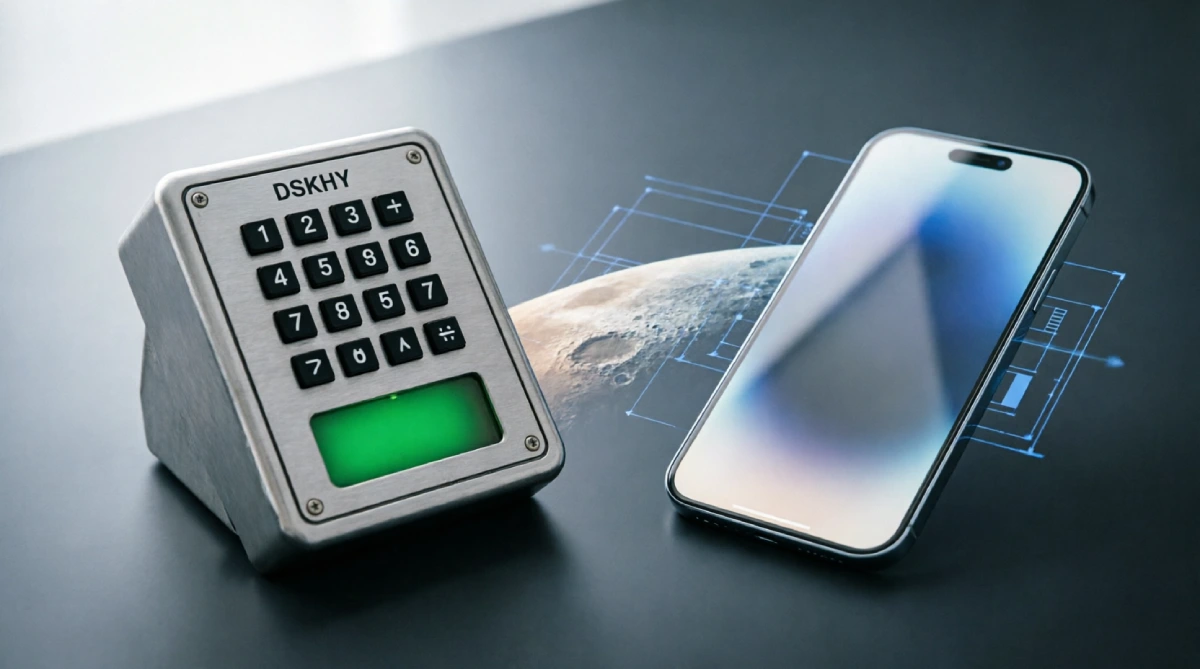
Your smartphone is running more power right now than the computer that took humans to the Moon in 1969.
That’s not an exaggeration. The Apollo Guidance Computer (AGC) — the machine NASA built specifically to navigate Apollo 11 to the lunar surface and back — had roughly 4KB of RAM. Your phone likely has 8GB or more. That’s over one million times the memory, sitting in your pocket.
This comparison between smartphone vs Apollo guidance computer isn’t just a fun fact. It tells you something important about how computing evolved, how NASA pulled off one of history’s greatest technical achievements with almost nothing, and what human engineering really looks like under pressure.
What Was the Apollo Guidance Computer?
The AGC was NASA’s onboard navigation system for the Apollo missions. MIT’s Instrumentation Laboratory designed it. Raytheon built it. And it flew on every crewed Apollo mission, mounted inside both the Command Module and the Lunar Module.
It was also one of the first computers ever to use silicon integrated circuit chips — a genuine breakthrough for its time.
The physical specs were striking differently. The AGC weighed 32 kilograms (about 70 pounds) and consumed 55 watts of power — roughly the same as a modern light bulb. It measured about one cubic foot. By 1969 standards, it was compact and advanced. By any standard today, it looks almost unbelievable for the job it was asked to do.
The Real Technical Limitations
Here’s where the NASA Apollo computer specs get genuinely hard to process.
The AGC had approximately 4KB of erasable RAM — the working memory where it stored temporary calculations. It also had around 72KB of Read-Only Memory (ROM), which held the fixed navigation software and couldn’t be changed once programmed. Its processor ran at roughly 0.043 MHz and could execute between 50,000 and 100,000 instructions per second.
To put the 4KB RAM figure in context: a single character of text — the letter “a” — takes 8 bits to store. The AGC’s entire RAM couldn’t hold the text of a short news article.
The software itself was hand-coded by a team at MIT led by Margaret Hamilton, who is now widely credited with pioneering modern software engineering. Every line of code was carefully rationed. Every byte mattered.
How It Helped Land Humans on the Moon
With specs that modest, the question is obvious: how?
The AGC handled guidance, navigation, and control throughout the entire mission — from Earth orbit through lunar orbit, descent, landing, and return. It didn’t do this by being fast. It did this by being precise, reliable, and ruthlessly efficient.
Engineers designed the software with strict priority scheduling. If the computer got overloaded, it dropped low-priority tasks and kept running the critical ones. This design saved Apollo 11 directly.
During the lunar descent on July 20, 1969, the AGC triggered a 1202 alarm — an executive overflow warning caused by a hardware bug that was sending unnecessary data from the rendezvous radar, adding roughly 13% extra processing load. Then Buzz Aldrin added another 10% by requesting additional landing data. The computer hit its limit.
But the priority system kicked in. It dropped the non-essential display tasks. It kept the guidance loops running. Mission Control in Houston gave the “GO” call. Neil Armstrong landed. The computer had done exactly what it was designed to do — not fail gracefully, but succeed.
Modern Smartphone vs Apollo Guidance Computer
Modern smartphones make the AGC look almost fictional by comparison.
A current iPhone processor runs at approximately 2,490 MHz. The AGC ran at 0.043 MHz. That’s over 100,000 times faster in processing speed alone. A flagship Android phone with 12GB of RAM carries more than one million times the working memory the AGC had.
Even a Texas Instruments TI-84 calculator — a device designed for high school math classes — has 32 times more RAM than the Apollo Guidance Computer and runs about 350 times faster.
Your phone also carries GPS, multiple cameras, Wi-Fi radios, Bluetooth, gyroscopes, barometers, AI processing chips, and storage measured in hundreds of gigabytes. The AGC had one job — navigate — and it did it with hardware you’d consider primitive even for basic embedded systems today.
Why Did Such a Gap Exist?
The AGC was built in 1966. Transistor-based computing was still young. The entire field of software engineering barely existed as a formal discipline. The engineers at MIT and NASA were inventing tools, techniques, and solutions simultaneously.
The silicon integrated circuits inside the AGC were so new that Fairchild Semiconductor, one of the main suppliers, was essentially building a major portion of its early commercial production just for the Apollo program.
Computing didn’t stay at that level for long. Moore’s Law — the observation that transistor density in chips roughly doubles every two years — held remarkably well from the late 1960s through the 2010s. What took a room-sized computer in 1969 fit on a chip by the 1980s, a calculator by the 1990s, and a wristwatch by the 2010s.
What This Actually Tells You
Two things are true at the same time here, and both matter.
First, the computing power in modern smartphones is extraordinary. The AGC comparison isn’t nostalgia — it’s a genuine measure of how far the field has moved in roughly 50 years. Processing tasks that would have taken the AGC hours happen on your phone in milliseconds.
Second, the engineers behind the AGC accomplished something that raw processing power alone doesn’t explain. They built a system that was reliable, efficient, and correctly prioritized under pressure. When the 1202 alarm hit during Apollo 11’s descent, the software worked exactly as intended. No patch. No reboot. Just a priority system built right the first time.
The NASA History Office’s documentation on Apollo shows how deeply the program shaped modern software engineering — from structured programming to real-time operating systems.
What We Can Learn From the Comparison
The smartphone vs Apollo guidance computer comparison isn’t really about power. It’s about constraints.
NASA succeeded in 1969 because the AGC was designed with its limitations fully accepted, not ignored. Every kilobyte was planned for. Every priority was defined in advance. The software had to work the first time, in conditions that couldn’t be replicated on Earth.
Modern development often goes the opposite direction — more memory, faster processors, room to be inefficient. That’s not always wrong. But there’s something worth recognizing in a team that sent humans 239,000 miles from Earth on 4KB of RAM and a 0.043 MHz processor, and brought them home.
FAQs
How much RAM did the Apollo Guidance Computer have?
The AGC had approximately 4KB of erasable RAM (2,048 words of working memory) and around 72KB of ROM for fixed software. That’s less memory than a single modern photograph takes to store.
How does a smartphone compare to the Apollo Guidance Computer?
A modern smartphone is over 100,000 times faster in processing speed and carries more than one million times the RAM of the AGC. Even a basic scientific calculator from the 1990s outperformed the AGC by significant margins.
How did NASA land on the Moon with such limited computing power?
Through precise engineering, software written with strict priority scheduling, and a team that designed the system to succeed under its constraints — not despite them. When the AGC hit overload during Apollo 11’s landing, it automatically dropped non-critical tasks and kept the guidance systems running.

