

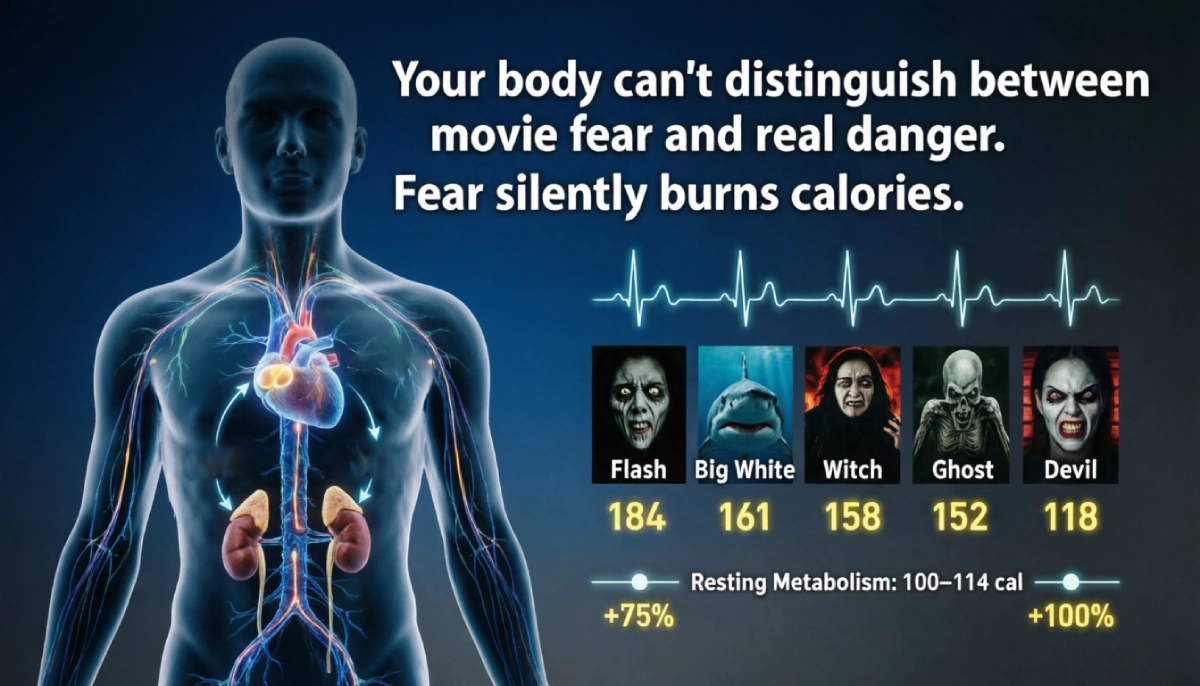
Your body doesn’t know you’re just watching a movie — it thinks you’re in danger.
That racing heart when the killer appears on screen? That’s not just you being dramatic. It’s your nervous system firing like you’re sprinting for your life. And here’s where it gets genuinely surprising: watching horror movies burns calories because your body enters a full fear-response mode, spiking heart rate and releasing adrenaline — the same hormones that power physical activity.
Sit still. Watch something terrifying. Burn calories. That’s the claim. And the science behind it is more interesting than the clickbait version of that story.
Watching horror movies burns calories because fear triggers the body’s fight-or-flight response. This increases heart rate, releases adrenaline, and temporarily raises energy use — making your body react as if it’s facing real danger, even though you’re sitting completely still.
What Happens Inside Your Body During a Scary Scene?
The moment something on screen makes you flinch, your brain doesn’t pause to ask: ‘Is this real?’ It reacts.
A small, almond-shaped part of your brain called the amygdala works like a threat detector. It picks up visual cues — sudden movement, a terrifying face, an unexpected loud sound — and fires off an alarm signal in milliseconds. That signal travels to your hypothalamus, which then activates your sympathetic nervous system.
According to Britannica, the fight-or-flight response triggers an immediate hormonal chain reaction. Your adrenal glands flood your bloodstream with epinephrine — better known as adrenaline. Within seconds, you feel the effects.
Here’s what’s physically happening:
- Your heart rate jumps to pump more oxygen-rich blood to major muscle groups
- Breathing speeds up to take in more oxygen faster
- Muscles tense, ready to move
- Blood sugar rises as your liver rapidly converts stored glycogen into glucose
- Non-essential functions — digestion, for example — slow down
All of this happens whether the threat is real or not. Your brain responds to perceived danger. A man in a hockey mask is perceived as a danger, even on a TV screen.
The Science: Why Fear Burns Energy
Fear isn’t just a feeling. It’s a full-body metabolic event.
When adrenaline hits your bloodstream, it directly increases your basal metabolic rate — the number of calories your body burns just to keep vital functions running. Your heart works harder. Your muscles stay primed. And, your cells demand more fuel.
Harvard Health explains that the stress response causes the heart to beat faster than normal, pushing blood to muscles, the heart, and vital organs. This increased cardiovascular demand burns more energy — even without any movement on your part.
Your body also mobilizes fat stores during this process. Adrenaline stimulates lipolysis — the breakdown of stored fat into fatty acids that muscles can use as fuel. This is the same basic mechanism that happens during exercise, just at a much lower intensity.
Combine a faster heart rate, increased cellular metabolism, muscle tension, and accelerated breathing, and you have real, measurable energy expenditure. Not massive — but real.
The Real Study: Do Horror Movies Actually Burn Calories?
In 2012, researchers at the University of Westminster ran a study that directly tested this question. They measured the heart rate, oxygen intake, and carbon dioxide output of participants as they watched 10 different horror films.
The results were clear: calorie burn increased by roughly a third while participants were watching the films, compared to a resting baseline.
The top-performing films in terms of calories burned:
| Film | Calories Burned (90 min) |
| The Shining (1980) | 184 calories |
| Jaws (1975) | 161 calories |
| The Exorcist (1973) | 158 calories |
| Alien (1979) | ~152 calories |
| A Nightmare on Elm Street | ~118 calories |
| The Blair Witch Project | ~105 calories |
For context, a 150-pound person burns roughly 100–114 calories just sitting still for 90 minutes. The horror movies were consistently pushing above that baseline — The Shining nearly doubled it.
It’s worth being straight with you about the study’s limits: it used only 10 participants and was not published in a peer-reviewed journal. Healthline notes that horror movie calorie burn shouldn’t be counted as a replacement for regular exercise — but the underlying physiology is sound. The fear response does burn energy. The mechanism is real.
A separate study published in the journal Stress found that stress-inducing films caused a significantly greater rise in energy expenditure compared to calm, romantic films — adding further weight to the idea that fear and calorie burn are genuinely connected.
Why Movies Feel Real to Your Brain
Here’s the part that really explains everything: your brain doesn’t have an” on/off switch for ‘this is fiction.’
The amygdala — your threat-detection system — processes sensory information before your rational prefrontal cortex gets involved. Sound, movement, sudden darkness, a face that appears where none should be: these hit the amygdala first. By the time your brain consciously registers that you’re watching a screen, your body is already mid-response.
Good horror films are specifically engineered to exploit this gap. Directors use jump scares to create sudden sensory shocks. They use long silences followed by loud sounds. They manipulate the frame to keep your nervous system in a state of low-level dread — which keeps adrenaline levels slightly elevated for extended stretches.
Films with more jump scares tend to produce more calorie burn, precisely because each jump scare causes a sharp spike in heart rate. The Westminster study found this pattern clearly: more shock moments meant higher energy expenditure.
Fun Facts
- Some horror films burn more calories than others — The Shining burns nearly 75% more than the lowest-performing films in the study.
- Jump scares cause instant heart rate spikes — your body physically reacts in under a second.
- Your body keeps responding to fear even when you know the movie isn’t real. The amygdala doesn’t care about logic.
- Watching horror with others changes your reaction — social context can amplify or dampen the fear response.
- Regular horror viewers may develop slightly lower responses over time, as the brain partially habituates to on-screen threats.
- Scary movies also trigger the release of endorphins — your body’s natural pain relievers — which is partly why some people find the experience enjoyable even when they’re frightened.
How Does It Compare to Other Activities?
To keep expectations honest, here’s how horror-movie calorie burn stacks up against common light activities for a 150-pound adult over roughly 90 minutes:
| Activity | Approx. Calories (90 min) | Effort Level |
| Watching a horror movie | 113–184 calories | Zero physical effort |
| Sitting still (resting) | 100–114 calories | Zero physical effort |
| Walking (slow pace) | 180–220 calories | Low |
| Light cycling | 270–330 calories | Moderate |
| Gaming (active engagement) | 105–130 calories | Minimal |
| Watching a comedy or drama | ~100 calories | Zero physical effort |
Horror movies don’t replace exercise. But they do burn meaningfully more than regular TV watching — and the science tells us exactly why.
FAQs
Do horror movies really help with weight loss?
Not in any meaningful, sustained way. The calorie burn from a single horror film is roughly equivalent to a short walk. Over dozens of films, it could add up modestly, but it won’t replace diet changes or regular physical activity. The science is real — the weight-loss application is limited.
Why does my heart race during scary scenes?
Your amygdala detects perceived threats — visual or auditory — and triggers an adrenaline release before your rational brain has processed that you’re watching fiction. Heart rate increases to prepare your body to fight or flee. This happens automatically.
Are some people more affected by horror movies than others?
Yes. People with higher baseline anxiety, greater emotional sensitivity, or less horror-film experience tend to have stronger physiological responses. Regular horror viewers often show reduced responses over time due to partial habituation.
Can fear from movies be unhealthy?
For most adults, occasional fear from horror films is harmless and resolves quickly once the film ends. However, people with anxiety disorders, certain heart conditions, or those who find the experience genuinely distressing should be cautious. Children can experience lasting anxiety from media-based scares.
Which horror movies burn the most calories?
Films with the most sustained suspense and frequent jump scares tend to produce the highest calorie burn. Based on the Westminster study, The Shining, Jaws, and The Exorcist ranked highest. Slow-burn psychological horror tends to keep adrenaline at a moderate, steady level.
The Bottom Line
Your body doesn’t distinguish well between a movie villain and an actual threat. The same hormones, the same metabolic response, the same energy expenditure — it all activates from a screen.
Watching horror movies burns calories through a genuine physiological process: adrenaline raises your metabolic rate, your heart works harder, your muscles stay tense, and your cells burn through fuel faster. The numbers aren’t enormous, but they’re real and measurable.
Next time you watch a horror movie, remember — your body thinks you’re running for your life. And in a very small, measurable way, it’s not entirely wrong.

