

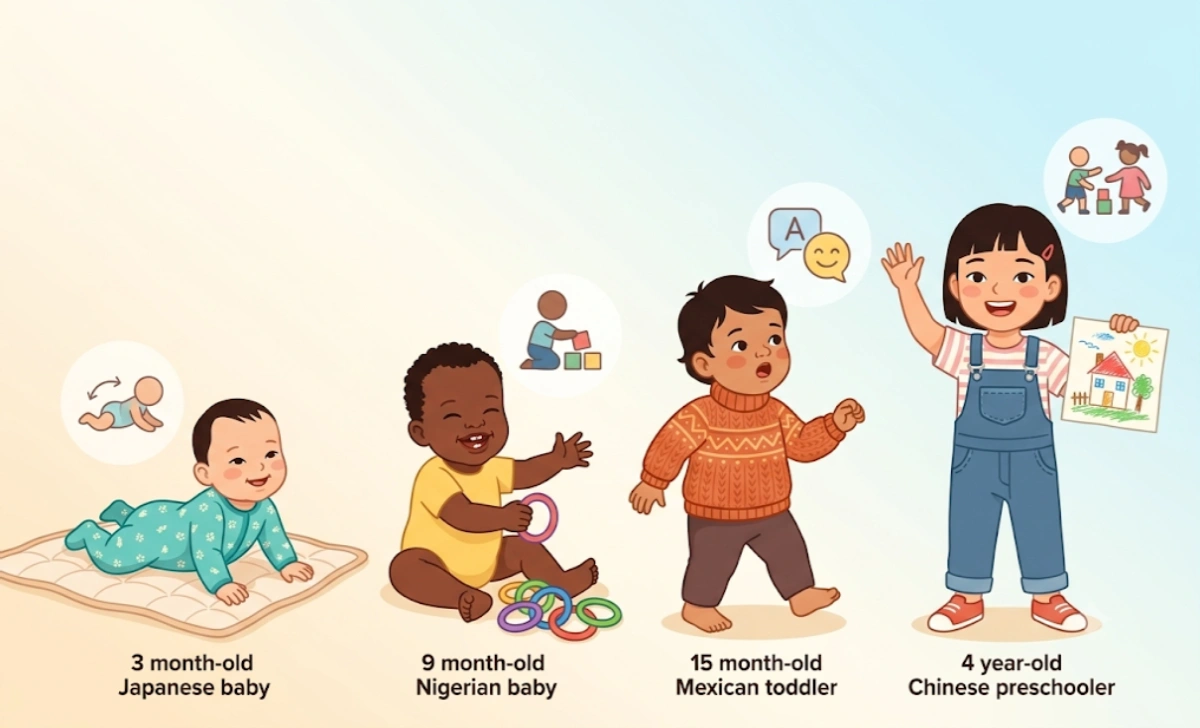
You’re watching your baby grow, and you’ve probably asked yourself: “Is my child developing normally?” It’s one of the most common questions parents ask, and it’s completely natural to wonder.
Child development milestones are specific skills or behaviours that most children can do by a certain age. Think of them as checkpoints that help you understand how your child is growing across five key areas: how they move, how they use their hands, how they communicate, how they think and learn, and how they interact with others. Paediatricians and child development experts use these milestones as a general guide to track progress.
But here’s what many parents don’t realise: milestones are not rigid deadlines. They are ranges, not fixed dates. Your child’s development is influenced by genetics, temperament, and environment, which means every child grows at their own pace.
Why Developmental Milestones Matter
Milestones are more than just a checklist. They provide a window into your child’s brain development and overall health. When your child masters a new skill—whether it’s rolling over or saying their first word—it signals that their nervous system, muscles, and sensory processing are working together.
Tracking milestones helps paediatricians identify potential developmental delays early, when intervention is most effective. But for parents, milestones serve a different purpose: they help you celebrate your child’s growth and understand what to expect next. Your parenting style approach can also influence how your child reaches these milestones. Children who grow up in nurturing, responsive environments often show stronger social-emotional development and cognitive skills.
Understanding Normal Variation
The range of what’s considered “normal” in child development is wide. For example, some babies walk at 9 months while others don’t walk until 15 months. Both can be perfectly healthy. Factors like temperament, family history, birth weight, and even practice opportunities can influence timing.
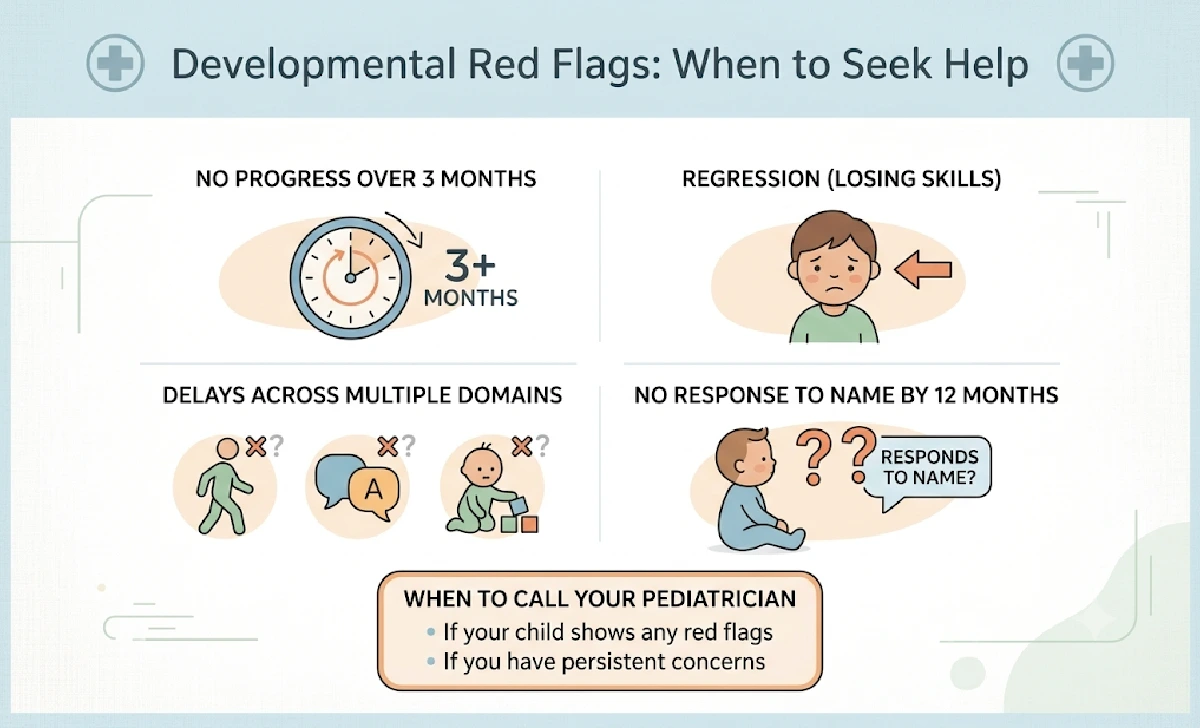
The key is to look at the trend, not a single data point. Is your child making steady progress, even if they’re on the later side? That’s usually reassuring. Are they losing skills they once had or showing no progress over several months? That’s worth discussing with your paediatrician.
The 5 Developmental Domains: A Framework for Understanding Growth
To understand milestones clearly, it helps to think about development in five categories:
- Gross Motor Skills: Large body movements like rolling, sitting, crawling, walking, and running.
- Fine Motor Skills: Smaller movements using hands and fingers, such as grasping, drawing, and using utensils.
- Language and Communication: Understanding and using words, gestures, and facial expressions.
- Cognitive Development: Thinking, learning, problem-solving, and memory.
- Social-Emotional Development: Relating to others, expressing emotions, developing empathy, and forming attachments. A strong parent-child bond during early childhood lays the foundation for healthy social-emotional development.
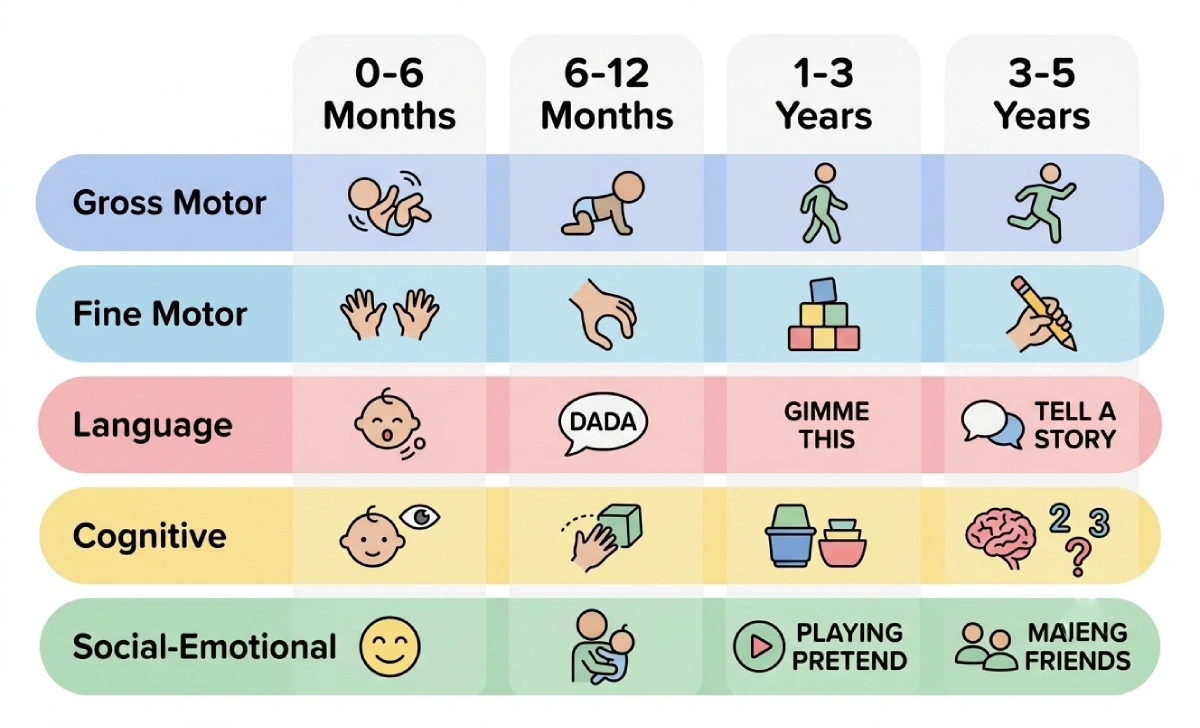
A Comprehensive Age-by-Age Guide
Newborn to 3 Months (0-3 Months)
Gross Motor: Lifts head during tummy time, turns head side to side, moves arms and legs symmetrically.
- Fine Motor: Opens hands briefly, reflexive grasp, brings hands toward mouth.
- Language: Coos, responds to loud sounds, quiets when spoken to.
- Cognitive: Follows moving objects with eyes, recognises caregiver’s voice, shows anticipation.
- Social-Emotional: Smiles spontaneously, calms when held, enjoys eye contact.
- When to check with your paediatrician: If your baby doesn’t respond to loud sounds, doesn’t follow movement with their eyes, or isn’t lifting their head during tummy time by 3 months.
4 to 6 Months (4-6 Months)
- Gross Motor: Rolls over (tummy to back), sits with support, bears weight on legs.
- Fine Motor: Reaches for and grasps toys, transfers objects between hands, brings hands together.
- Language: Babbles with vowel sounds, responds to name, laughs and squeals.
- Cognitive: Explores objects with mouth, looks for dropped objects, shows interest in mirror.
- Social-Emotional: Enjoys peek-a-boo, reaches for familiar people, smiles at mirror reflection.
- When to check with your paediatrician: If your baby doesn’t coo, doesn’t reach for objects, or isn’t rolling over by 6 months.
7 to 9 Months (7-9 Months)
- Gross Motor: Sits without support, crawls, pulls to stand holding furniture.
- Fine Motor: Pincer grasp emerges, bangs objects together, rakes small items with fingers.
- Language: Babbles withinflexionn, says “mama/dada” nonspecifically, responds to “no.”
- Cognitive: Develops object permanence, imitates gestures, looks in the right direction when objects fall.
- Social-Emotional: Shows stranger anxiety, prefers familiar caregivers, plays peek-a-boo.
10 to 12 Months (10-12 Months)
- Gross Motor: Stands alone briefly, cruises along furniture, takes first steps (8-18 months).
- Fine Motor: Uses pincer grasp well, places objects in containers, points to objects.
- Language: Says first meaningful words, understands simple commands, points when named.
- Cognitive: Imitates actions, finds hidden objects, explores cause and effect.
- Social-Emotional: Shows preferences, clings to familiar people, plays interactive games.
12 to 18 Months (12-18 Months)
- Gross Motor: Walks independently, runs stiffly, climbs stairs with support.
- Fine Motor: Scribbles with crayons, stacks 2-3 blocks, uses a spoon.
- Language: Uses 5-20 words, understands up to 50 words, follows simple directions.
- Cognitive: Imitates chores, remembers object locations, begins symbolic play.
- Social-Emotional: Shows jealousy, displays affection, engages in parallel play.
18 to 24 Months (18-24 Months)
- Gross Motor: Kicks a ball, runs with coordination, walks up/down stairs with assistance.
- Fine Motor: Stacks 4-6 blocks, turns book pages one at a time, draws lines.
- Language: Uses 50+ words, combines two words, follows two-step directions.
- Cognitive: Points to pictures, engages in symbolic play, begins pretend play.
- Social-Emotional: Shows defiance, imitates adults, shows awareness of others’ emotions.
2 to 3 Years (24-36 Months)
- Gross Motor: Jumps in place, pedals tricycle, walks stairs alternating feet.
Fine Motor: Strings beads, uses child-safe scissors, draws circles and shapes. - Language: Uses 200+ words, speaks in 3-word sentences, understands most speech.
- Cognitive: Engages in complex pretend play, follows 3-step directions, sorts by shape/color.
- Social-Emotional: Plays with others briefly, takes turns, expresses emotions verbally.
3 to 5 Years (36-60 Months)
- Gross Motor: Hops, skips, catches/thows ball, rides bike with training wheels.
- Fine Motor: Draws shapes and people, uses fork and knife, buttons clothing.
- Language: Tells stories, uses complete sentences, asks many questions.
- Cognitive: Counts to 10, recognises colours, understands time concepts.
- Social-Emotional: Plays cooperatively, shows empathy, regulates emotions.
Milestone Summary Table
| Age | Gross Motor | Fine Motor | Language | Cognitive | Social-Emotional |
|---|---|---|---|---|---|
| 0-3 months | Lifts head | Opens hands | Coos | Follows objects | Smiles socially |
| 4-6 months | Rolls over | Reaches/grasps | Babbles | Explores with mouth | Enjoys peek-a-boo |
| 7-9 months | Sits, crawls | Pincer grasp | Babbles withinflexionn | Object permanence | Stranger anxiety |
| 10-12 months | Stands, first steps | Points | First words | Imitates actions | Shows preferences |
| 12-18 months | Walks | Scribbles | 5-20 words | Symbolic play | Shows jealousy |
| 18-24 months | Kicks ball | Stacks blocks | 50+ words, combines | Pretend play | Shows defiance |
| 2-3 years | Jumps, pedals | Strings beads | 200+ words | Complex pretend play | Plays with others |
| 3-5 years | Hops, skips | Draws people | Complete sentences | Counts to 10 | Plays cooperatively |
Understanding Red Flags: When to Worry
Red Flags by Age
| Age | Motor Red Flags | Language Red Flags | Social/Cognitive Red Flags |
|---|---|---|---|
| 0-3 months | Can’t hold head up | No response to sounds | Doesn’t smile |
| 4-6 months | Doesn’t roll over | No cooing or sounds | Doesn’t laugh |
| 7-9 months | Doesn’t sit with support | No babbling | Doesn’t respond to name |
| 10-12 months | Doesn’t crawl | No words | Doesn’t use gestures |
| 12-18 months | Doesn’t walk | No words | Loses skills |
| 18-24 months | Difficulty walking | No word combinations | No pretend play |
| 2-3 years | Difficulty with stairs | No sentences | Repetitive behaviors |
| 3-5 years | Poor coordination | No sentences | No cooperative play |
Red Flags Requiring Immediate Attention
- Developmental regression: Losing any skills previously mastered
- Delays across multiple domains: Significant delays in two or more areas
- No progress over 3-4 months: Plateau that doesn’t resolve
When to See Your Paediatrician
If you notice any red flags, schedule a checkup. You don’t need to wait for the next well-child visit.
How to prepare:
- Write down your concerns before the appointment
- Describe specific behaviours you’ve noticed
- Ask about developmental screening tools like the Ages and Stages Questionnaires (ASQ-3) or Modified Checklist for Autism in Toddlers (M-CHAT)
Questions to ask your paediatrician:
- “Is my child’s development typical for their age?”
- “What screening tools will you use?”
- “What is the next step if you identify concerns?”
- “How do I access early intervention services if needed?”
Normal Variation vs. True Delay
Pause (Wait and Watch):
- Slight delays but consistent progress
- Meeting milestones in most other domains
- Family history of late bloomers
Act (Seek Professional Input):
- Milestone regression (losing skills)
- Delays across multiple domains
- No progress over 3 months
- No response to name by 12 months
- No words by 18 months
Trust your instincts. Parents often notice developmental concerns before professionals do.
Premature Baby Milestones: Adjusting Expectations
What Is Adjusted Age?
Adjusted (corrected) age is calculated by subtracting the number of weeks your baby was born early from their chronological age.
Example: A 6-month-old born 8 weeks early should be compared to a 4-month-old for milestone expectations.
This adjustment continues until around age 2, by which time most premature babies have caught up.
How to Calculate Adjusted Age
- Start with your baby’s chronological age
- Subtract the number of weeks your baby was born early
- Use the resulting age for milestone comparisons
Example: Your 9-month-old was born 6 weeks early.
- 9 months = 36 weeks
- 36 weeks – 6 weeks = 30 weeks
- 30 weeks ÷ 4 = 7.5 months (adjusted age)
When to Seek Early Intervention for Premature Babies
Premature infants are at higher risk for developmental delays. Many NICUs offer follow-up programs. If concerned, reach out to your state’s early intervention program (called “Child Find”).
How to Support Your Child’s Development at Home
The way you interact with your child plays a significant role in their development. Research shows that an authoritative parenting approach—warm, responsive, and with clear boundaries—supports optimal development.
Support Gross Motor Development
- 0-3 months: Tummy time, 3-5 minutes daily
- 4-6 months: Reaching for toys just out of reach
- 7-9 months: Sitting practice with toys around them
- 10-12 months: Pulling up to stand at furniture
- 12-18 months: Walking assistance and push toys
- 2-3 years: Outdoor play, ball games, climbing
- 3-5 years: Bike riding, jumping, skipping
Support Fine Motor Development
- 0-3 months: Skin-to-skin contact, finger play
- 4-6 months: Safe rattling toys to grasp
- 7-9 months: Picking up soft blocks or baby-safe items
- 10-12 months: Stacking rings, container play
- 12-18 months: Scribbling with large crayons
- 2-3 years: Stringing beads, safe scissors
- 3-5 years: Drawing, puzzles, buttons, zippers
Support Language Development
- All ages: Talk, read, and sing frequently
- 0-3 months: Respond to coos and cries
- 4-6 months: Imitate your baby’s sounds
- 7-12 months: Use gestures like waving and pointing
- 12-18 months: Expand on words your child says
- 2-5 years: Ask questions, encourage storytelling
Support Cognitive Development
- 0-12 months: Simple puzzles and cause-effect toys
- 12-24 months: Sorting toys, hide-and-seek with objects
- 2-5 years: Pretend play, counting games, puzzles
Support Social-Emotional Development
- All ages: Respond warmly to your child’s emotions
- 0-12 months: Hold, comfort, play interactive games
- 12-24 months: Label feelings and model empathy
- 2-5 years: Encourage sharing and cooperative play
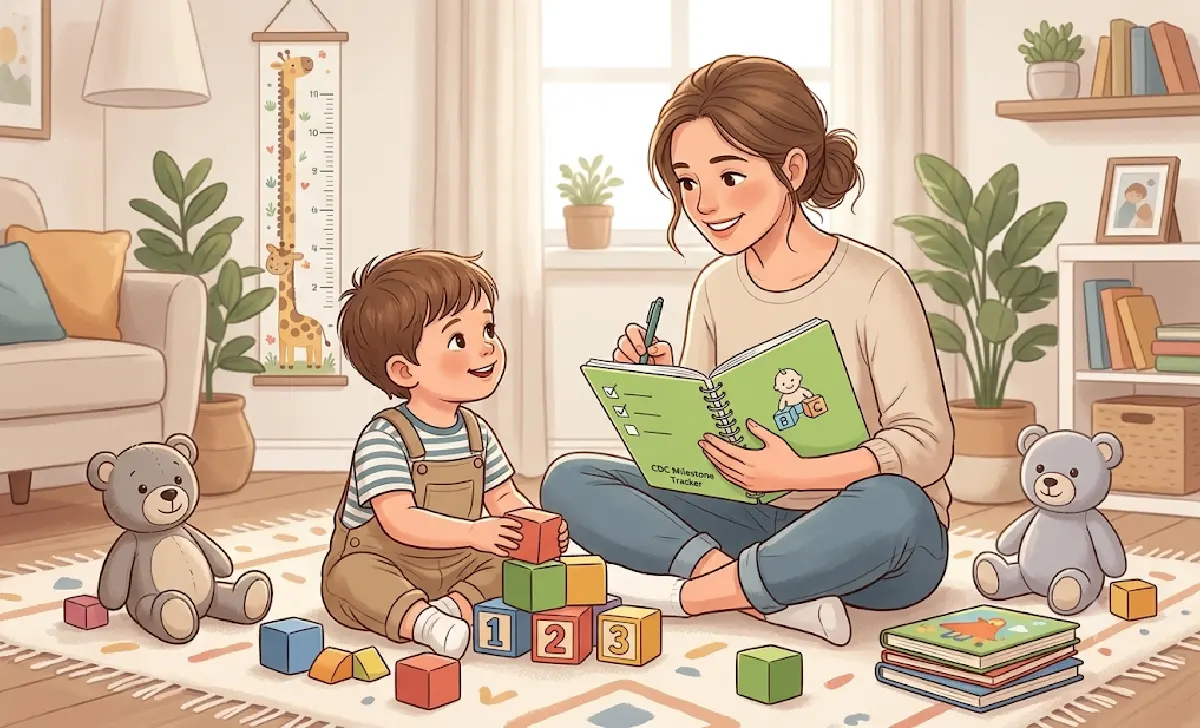
Tracking Milestones: Practical Tools
Methods for Tracking at Home
- Keep a developmental journal
- Use printable checklists from the CDC
- Use the CDC Milestone Tracker App
- Review milestones before well-child visits
- Share observations with your paediatrician
What to Track
- When milestones are reached (date and age)
- Any concerns (specific behaviours)
- Questions for your paediatrician
- Progress over time
Partnering with Paediatrician
The American Academy of Paediatrics (AAP) recommends developmental screening at 9 months, 18 months, and 30 months. Be honest about concerns and ask about screening tools.
What to Expect at Well-Child Visits
Surveillance vs. Screening
- Surveillance: Ongoing informal monitoring at every visit
- Screening: Standardised assessment using validated tools
Common Developmental Screening Tools
| Tool | Age Range | What It Covers |
|---|---|---|
| ASQ-3 | 1 month – 5.5 years | Communication, motor, problem-solving, personal-social |
| Denver II | Birth – 6 years | Personal-social, fine motor, language, gross motor |
| M-CHAT | 16-30 months | Autism risk indicators |
| PEDS | Birth – 8 years | Developmental/behavioral concerns |
Well-Child Visit Screening Timeline
- 9 months: General development
- 18 months: General development and autism screening
- 24-30 months: Autism screening
How to Prepare
- Bring your tracking notes
- Bring your questions
- Be honest about all concerns
- Ask about screening results
Understanding Developmental Delays
Potential Causes
- Biological: Genetics, prematurity, birth complications
- Environmental: Nutrition, toxins, lack of stimulation
- Medical: Hearing/vision loss, neurological conditions
Types of Delays
- Motor delays: Difficulty with movement skills
- Language delays: Late talking, understanding difficulties
- Cognitive delays: Learning, memory, reasoning challenges
- Social-emotional delays: Difficulty relating to others
Early Intervention: What It Is
A system of services for children from birth to age 3 with delays or disabilities. Services include speech, physical, and occupational therapy.
How to Access Early Intervention
- Talk to your paediatrician
- Contact your state’s early intervention program (“Child Find“)
- Request a free developmental evaluation
- If eligible, develop an Individualised Family Service Plan (IFSP)
- Begin services
Important: You do not need a doctor’s referral to access early intervention.
Conclusion
Developmental milestones are valuable tools that help you understand your child’s growth, celebrate achievements, and know when to seek help. But remember: milestones are guidelines, not deadlines. Normal development follows a wide range of timing. What matters most is steady progress and your child’s curiosity about the world.
Trust your instincts. You know your child best. If you ever feel unsure about their development, talk to your paediatrician. If your child is showing delays, early intervention can make a tremendous difference.
Your child’s unique journey is just beginning. Celebrate the small wins, stay informed, and always ask questions. You’re doing exactly what they need: paying attention, learning, and showing up for them every step of the way.
FAQs
What are developmental milestones?
Skills or behaviours most children can do by a certain age, covering motor, language, cognitive, and social-emotional development.
Why are developmental milestones important?
They help track growth and identify delays early, when intervention is most effective.
When do babies start walking?
Most babies take their first steps between 8 and 18 months. The average is around 12 months.
When do babies say their first word?
Most babies say their first meaningful word around 12 months. By 18 months, many have 5-20 words.
What if my child misses a milestone?
Talk to your paediatrician. Missing one milestone is usually not concerning—overall progress matters most.
What are signs of developmental delay?
Not meeting milestones, losing skills, or significant delays in one or more areas.
When should I worry about my baby’s development?
If your child shows red flags, loses skills, or shows no progress over several months.
What is early intervention?
Services for children under 3 with delays, including speech, physical, and occupational therapy.
How do I get early intervention services?
Contact your state’s early intervention program to request a free evaluation.
What is adjusted age for premature babies?
Chronological age minus the number of weeks born early. Use adjusted age for milestone comparisons.

