
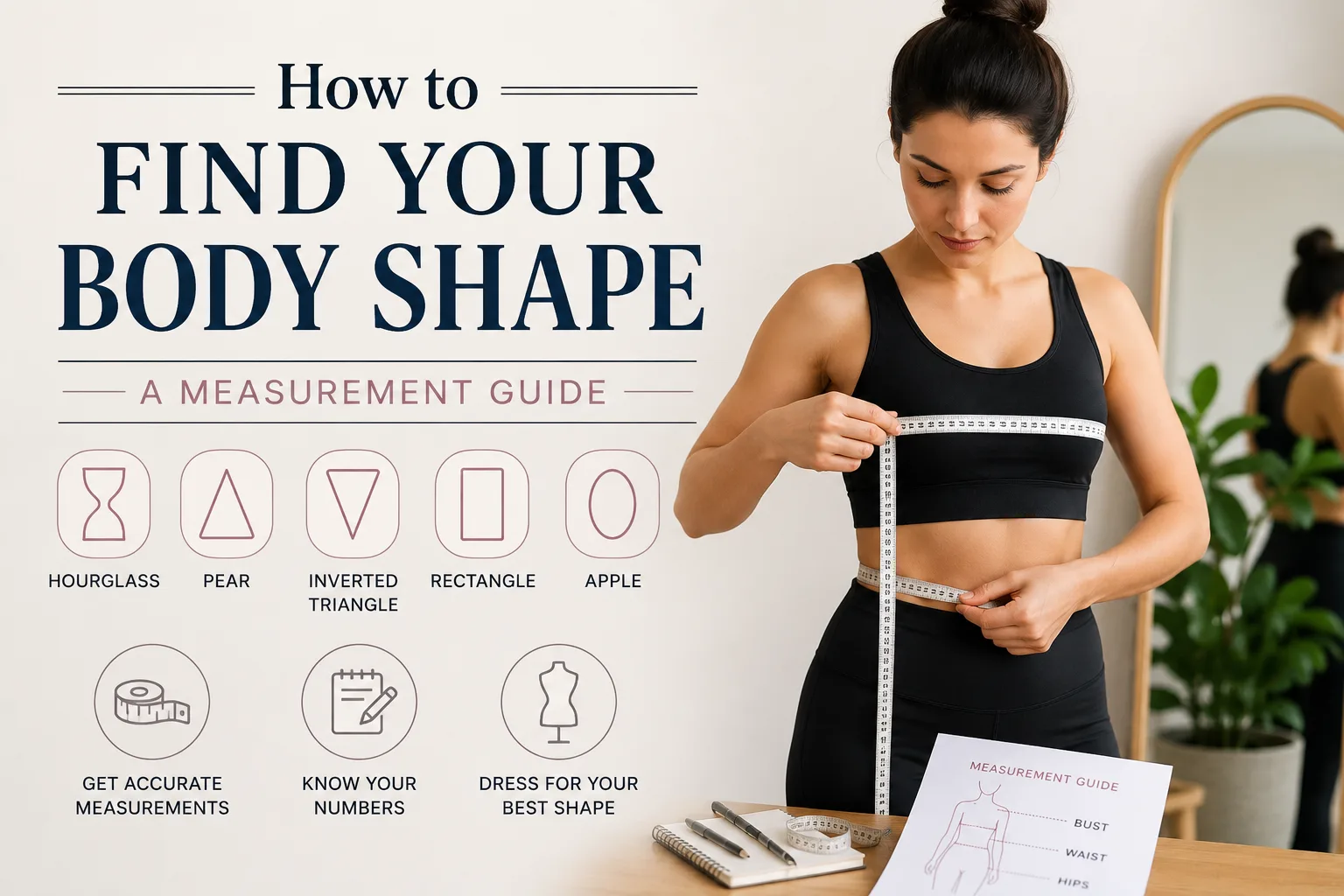
Knowing your body shape starts with four simple numbers. This measurement guide shows you exactly how to measure your shoulders, bust, waist, and hips at home. In under ten minutes, you’ll have the data you need to identify your shape and start dressing with confidence.
No guesswork. No expensive consultations. Just a tape measure, a mirror, and this step-by-step method.
What Is Body Shape (And Why It’s Not About Weight)
Body shape describes how your proportions relate to one another. It is not about your weight or your size.
Your shape comes from bone structure and genetics. A person can gain or lose weight and still keep the same basic shape. That’s because shape is about ratios, not totals.
This distinction matters. Many people confuse body shape with body mass index (BMI). BMI measures weight relative to height. Body shape measures width relative to width. They answer completely different questions.
Understanding this difference is the first step toward smarter, more confident styling.
What You’ll Need to Measure Your Body Shape
Before you start, gather three simple items:
- A flexible measuring tape — the kind used for sewing, not a rigid metal tape.
- A notepad and pen — to record each number as you go.
- Form-fitting clothing — leggings and a fitted top work well, or measure over underwear.
Stand in front of a mirror in a relaxed, natural stance. Keep your feet together and your shoulders down. Posture affects accuracy, so avoid sucking in your stomach or arching your back.
How to Measure Your Body Shape: Step-by-Step
Follow these four steps in order. Each measurement takes less than a minute.
Shoulder Measurement
Wrap the tape around the broadest point of your shoulders. This is usually just below the top of your shoulder blades. Keep the tape level and snug, not tight.
Bust Measurement
Wrap the tape around the fullest part of your chest. Keep it level across your back, not angled upward or downward. Breathe normally while measuring.
Waist Measurement
Find your natural waistline first. Bend gently to one side and locate the crease that forms — that’s your natural waist. Measure around this point, usually just above your belly button.
Hip Measurement
Stand with your feet together. Measure around the fullest part of your hips and buttocks. This is typically 7 to 9 inches below your natural waistline.
Write down all four numbers before moving to the next section.
Common Measurement Mistakes to Avoid
Small errors here can lead to the wrong shape classification. Watch for these three mistakes.
Pulling the tape too tight. This compresses soft tissue and shrinks your numbers. The tape should sit snugly, with room for one finger underneath.
Measuring over bulky clothing. Sweaters and jackets add inches that aren’t really there. Always measure over thin, form-fitting fabric.
Guessing your natural waistline. Many people measure at their belly button instead of their natural crease. These two points can differ by 1 to 3 inches.
Redo any measurement that feels uncertain. Accuracy at this stage saves confusion later.
How to Calculate Your Body Shape From Your Measurements
Once you have your four numbers, the next step is comparing them. This is where the waist-to-hip ratio (WHR) becomes useful.
To calculate WHR, divide your waist measurement by your hip measurement. For example, a 26-inch waist divided by a 36-inch hip equals a ratio of 0.72.
This single number tells you a lot:
- A ratio below 0.75 usually signals a well-defined waist, common in hourglass and pear shapes.
- A ratio between 0.75 and 0.85 often points to a rectangle or athletic shape.
- A ratio above 0.85 can indicate an apple shape, where the waist is less defined.
Next, compare your bust and hip numbers directly. If they’re within 1 inch of each other, your upper and lower body are balanced. If one is significantly larger, that difference determines your shape category.
A waist that is 8 or more inches narrower than both your bust and hips is a strong signal of an hourglass shape. This threshold appears consistently across body shape research and styling guides.
Body Shape Types Explained
With your measurements and ratio calculated, match your numbers to one of these five common shape categories.
Hourglass
Your bust and hips are roughly equal in width. Your waist is at least 8 inches narrower than both. This creates a balanced, curved silhouette.
How to dress: Choose wrap dresses, belted styles, and high-waisted bottoms. These highlight your natural waistline instead of hiding it.
Pear (Triangle)
Your hips are wider than your bust and shoulders. Your waist is defined, but your lower body carries more volume.
How to dress: Structured tops and A-line skirts create balance. Bold patterns on top draw the eye upward.
Apple (Round)
Your waist measurement is close to or larger than your bust and hip measurements. Your midsection carries the most volume.
How to dress: Empire-waist dresses skim over the midsection. V-necklines elongate the upper body and draw attention to the face.
Rectangle (Straight)
Your bust, waist, and hips are within 1 to 2 inches of each other. Your silhouette reads as straight, with minimal curve definition.
How to dress: Peplum tops and belted styles add waist definition. Layering creates visual dimension where the body is naturally straight.
Inverted Triangle
Your shoulders and bust are wider than your hips. Your lower body is comparatively narrow.
How to dress: Wide-leg trousers and A-line skirts add volume below the waist. This balances a broader upper frame.
Can You Have More Than One Body Shape?
Yes, and this is completely normal. Most bodies show characteristics of more than one shape category.
Proportions also shift over time due to age, hormones, and lifestyle changes. Re-measuring every year or two keeps your shape profile accurate. If your numbers fall between two categories, use the styling tips from both and adjust based on what feels comfortable.
Frequently Asked Questions
How Can I Determine My Body Shape Based on My Measurements?
Measure your bust, waist, and hips using a flexible tape. Then compare the three numbers. A waist that’s 8 or more inches smaller than both bust and hips signals an hourglass shape. Similar bust, waist, and hip numbers signal a rectangle shape. Wider hips than bust signal a pear shape.
What Body Shape Is 34-26-36?
A 34-26-36 measurement (bust-waist-hips) describes a classic hourglass shape. The waist is 8 inches narrower than the bust and 10 inches narrower than the hips. Bust and hips are close enough in size to be considered balanced.
What Does a 36-24-36 Figure Mean?
A 36-24-36 figure is also an hourglass shape, with an even more defined waist. The 12-inch difference between waist and hips exceeds the typical 8-inch hourglass threshold, making the curve more pronounced.
How Do I Tell Which Body Type I Am?
Take four measurements: shoulders, bust, waist, and hips. Calculate your waist-to-hip ratio by dividing waist by hip measurement. Then compare your bust and hip numbers to see which one is wider, if either. This combination places you in one of five main shape categories.
Your body shape is simply a starting point for smarter styling decisions. It never dictates your worth, your style, or what you’re allowed to wear. Use these measurements as a tool, not a rulebook, and dress in whatever makes you feel confident.

