

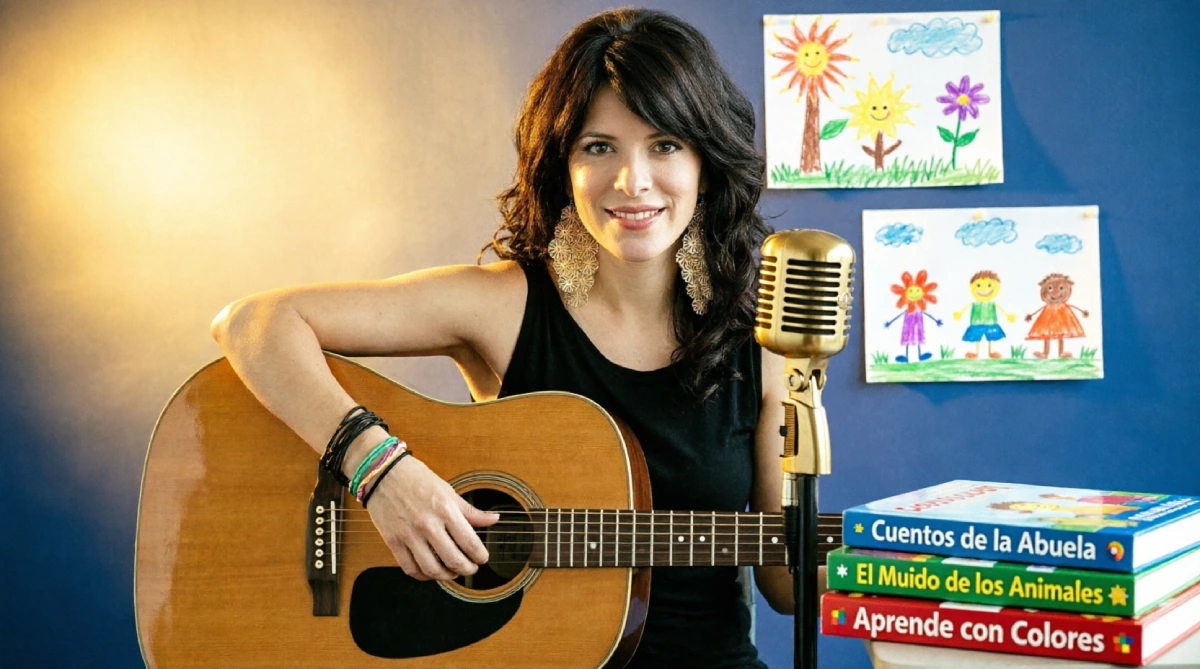
Maura Mendoza Garcia is a Salvadoran‑born singer‑songwriter, bilingual educator, and Multilingual Services Coordinator for Somerville Public Schools in Massachusetts. She specializes in multilingual family engagement through the arts, using music and performance in seven languages to bridge the gap between immigrant families and the U.S. school system.
Picture a parent sitting in a school meeting, not understanding a word being said about their child. The teacher is speaking. All the forms are in English. The school culture feels like a foreign country inside the country they already immigrated to. In reality, for many Salvadoran, Guatemalan, and Brazilian families in Somerville, Massachusetts, this is not a hypothetical — it is Tuesday afternoon.
That’s the gap Maura Mendoza Garcia has spent the better part of two decades trying to close — not through policy memos or parent newsletters, but through music, language, and performance.
As a result, her work sits squarely at the intersection of arts and immigrant family engagement, and her career defies easy categorization.
Who is Maura Mendoza Garcia?
| Detail | Information |
|---|---|
| Full Name | Maura Mendoza (also cited as Maura Mendoza Quiroz) |
| Known As | Maura Mendoza García |
| Origin | El Salvador |
| Current Base | Somerville, Massachusetts, USA |
| Estimated Age | Late 40s to early 50s as of 2026 (date of birth not publicly confirmed) |
| Professions | Singer-songwriter, bilingual educator, community liaison |
| Career Span | 20+ years in music and education |
| Education | Performing arts — Havana, Cuba · Musical theater — Mexico City |
| Languages Performed | Spanish, English, Portuguese, French, Italian, German, Hindi |
| Music Style | Latin folk, jazz, children’s music, global fusion |
| Current Role | Multilingual Services Coordinator, Somerville Public Schools |
| Affiliations | Somerville Public Schools, Latinos for Education, Cambridge Arts Council |
| Notable Publication | Multilingual Family Engagement Through the Arts (2017, co-authored) |
| Fellowship | Massachusetts Aspiring Latino Leaders Fellow (2023) |
From El Salvador to the Stage: Early Life and Roots
Maura Mendoza Garcia grew up in El Salvador during the 1980s, a decade that saw civil war, displacement, and intense social pressure. Paradoxically, that same era produced some of the most resilient cultural expression in Central American history — communities held onto identity through music, theater, and storytelling precisely because so much else was slipping away.
From early childhood, Mendoza Garcia was part of that expression. She participated in school plays, theatrical productions, and cultural events. Moreover, she gained artistic exposure in Panama during her formative years. These were not hobbies. In fact, they planted the seeds of a philosophy she would spend her adult life turning into practice: that art is not separate from community survival, it is one of its instruments.
Training in Havana and Mexico City
After completing her early education in El Salvador, Mendoza Garcia pursued formal performing arts training abroad — first in Havana, Cuba, then at a musical theater school in Mexico City.
Both choices were deliberate. Havana is one of Latin America’s most serious centers for artistic training, particularly in music with African-Caribbean roots that travel across the diaspora. Meanwhile, Mexico City’s theater scene gave her technical grounding in vocal performance, stage presence, and interdisciplinary work. Ultimately, what she carried out of both cities was not just skill. It was a multilingual, multicultural perspective on what music can do — one she would eventually bring into school hallways and community centers rather than concert halls.
A Multilingual Music Career Built on Inclusion
Mendoza Garcia has been performing professionally for more than 20 years. Her style pulls from Latin folk traditions, jazz, pop, children’s music, and global sounds. However, what separates her from a standard world music performer is her deliberate use of multiple languages on stage — a choice that makes a Brazilian mother and a Salvadoran grandfather feel individually acknowledged in the same room. Specifically, this practice reflects translanguaging principles, using a speaker’s full linguistic repertoire as an educational asset, and underscores a core belief that music reaches people differently when it arrives in their own language.
Her performances are often intergenerational and participatory. Children, parents, and older community members share the same space, frequently creating the experience together rather than simply watching it. The Cambridge Arts Council and the Somerville Arts Council have featured her work in libraries, schools, and cultural festivals across the Greater Boston area.
Her personal blog reveals a side that institutional bios miss: candid reflections on the strain of underfunded art, the logistics of a seven‑language setlist, and why a community singalong can feel more consequential than a concert hall booking. In addition, her posts document the gritty realities of independent arts management — the kind of texture that matters for understanding what kind of artist she is.
Her Work in Somerville Schools
Mendoza Garcia works with the Somerville Public Schools as a multilingual services coordinator and family outreach liaison. In this role, she helps immigrant families navigate school systems that rarely take their needs into account. Many of these parents speak limited or no English. Furthermore, they may come from countries where parental involvement in school looks completely different, or where distrust of institutions runs deep for historical reasons.
Her arts-based workshops bring parents and children into the same creative space. A song becomes a reason for a parent to show up. Showing up becomes a relationship with a teacher. A relationship with a teacher becomes a parent who feels permission to advocate for their child.
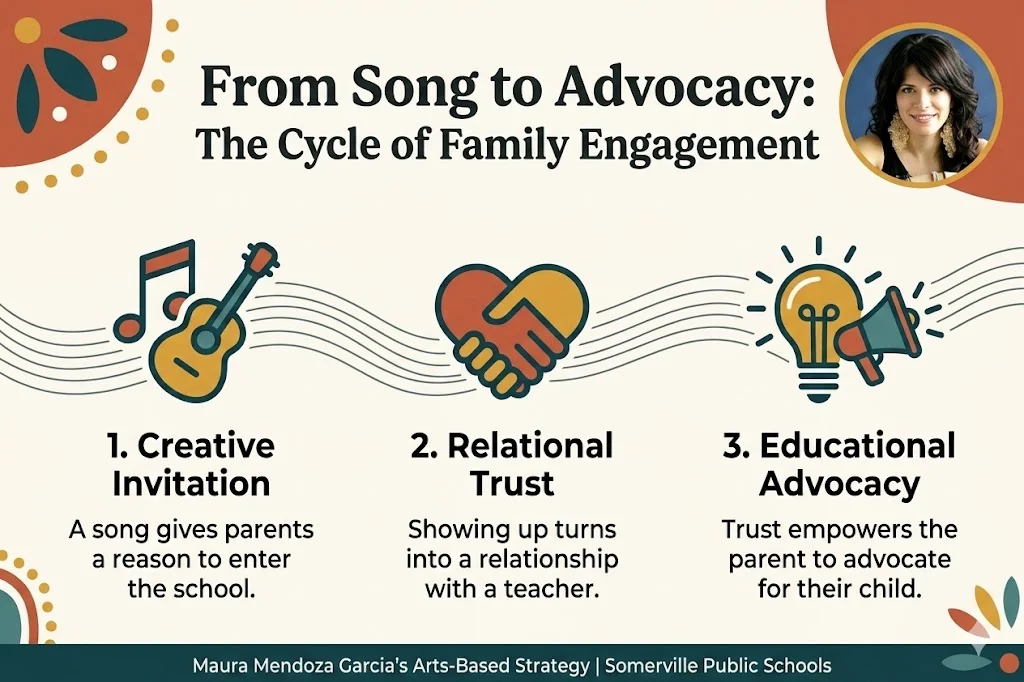
The research backs this sequence: creative invitations lower participation barriers, repeated positive contact builds relational trust, and that trust becomes the foundation for educational advocacy — a progression that mirrors the Dual Capacity‑Building Framework for Family–School Partnerships, which Karen Mapp developed. Consequently, this pathway is especially meaningful for communities where language and cultural distance create structural barriers.
She also works closely with Latinos for Education, an organization that improves educational outcomes for Latino students in Massachusetts by training and supporting Latino educators in leadership roles.
The 2017 Publication That Put Her Ideas on Paper
In 2017, Mendoza Garcia co-authored a chapter titled Multilingual Family Engagement Through the Arts, which examined how creative expression — music, visual arts, storytelling — can serve as entry points for immigrant families who might otherwise remain disconnected from their children’s schools.
It is not a widely cited academic paper, and it would be inaccurate to position it as such. Nevertheless, it represents something important: she has articulated her practice in writing, grounded it in observable evidence, and contributed to a broader conversation in education about culturally responsive family engagement. For someone who works primarily in community spaces rather than institutions, that kind of written record carries real weight.
Recognition and Key Life Events
In 2023, the Massachusetts Aspiring Latino Leaders Fellowship selected Mendoza Garcia — a recognition that honors Latino educators demonstrating measurable leadership and community impact. Being named a fellow does not make someone famous. However, in the context of who she is and what she does, it signals that people within the civic infrastructure of Massachusetts have taken her work seriously enough to invest in its continuation.
The timeline below traces the most significant moments across her life and career.
Life Events Timeline
- International performing arts training (Pre-2000s) — Studied performing arts in Havana, Cuba, developing her multilingual and musical foundation. Later completed musical theater training in Mexico City, focusing on vocal performance and stage craft.
- Migrated to the United States (Mid-2000s) — Settled in Somerville, Massachusetts. Began building a career that merged artistic performance with community outreach and immigrant family support.
- Co-authored academic chapter (2017) — Published Multilingual Family Engagement Through the Arts, documenting her practical approach to using creative expression as a bridge between immigrant families and school systems.
- Concert in El Salvador (December 2023) — performed at Paseo El Carmen, Santa Tecla, with musician Julio (Teto) Burgos. All-original repertoire. A significant personal and artistic homecoming after years of living and working abroad.
- Massachusetts Aspiring Latino Leaders Fellow (2023 ) — Earned a statewide fellowship recognizing Latino educators with measurable impact in equity, educational access, and community leadership.
- Spring Concert Series, Cambridge, MA (Spring 2024) — Performed a three-concert series at LaSaison Bakery. Continued active community performance while developing album post-production.
What Maura Mendoza Garcia Represents
Maura Mendoza Garcia is not a celebrity. A search for her name currently returns sparse results. There is no Wikipedia article, no major press profile, no record label behind her.
What exists instead is two decades of consistent work: performances in seven languages, a published contribution to education literature, a fellowship from a respected Massachusetts institution, and the quieter record of families who showed up to a school event because someone had the sense to put a song in the room first.
What makes Mendoza Garcia’s work structurally unusual — and urgently relevant — is that she operates as a cultural broker in the under‑resourced overlap between public school bureaucracy, immigrant family advocacy, and multilingual artistic production. Very few professionals hold all three spaces at once, and the lack of documentation around her career says less about her impact than about how narrow our definitions of “cultural authority” remain.

