

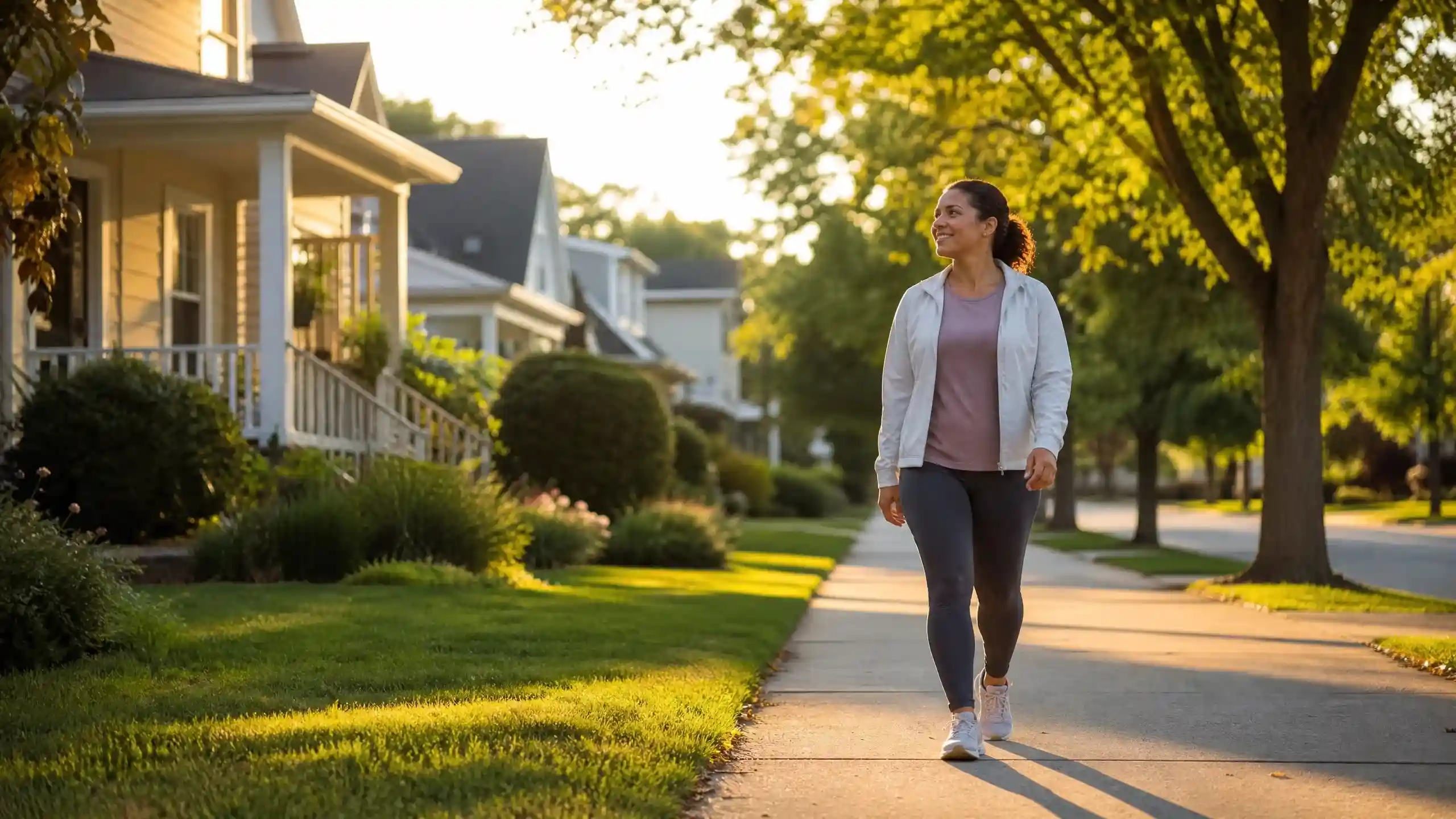

Walking after meals can help reduce post-meal blood sugar spikes by activating muscle glucose uptake. Skeletal muscles act as a natural glucose sink — when they contract, they absorb glucose from the bloodstream through a pathway that works independently of insulin. Even a short walk of 10 minutes, taken soon after eating, may support better glucose control compared to sitting. The effect depends on timing, movement intensity, and individual metabolic health.
The Energy Slump After Eating — And What’s Really Happening
You finish lunch and feel a wave of fatigue hit within the hour. You sit at your desk, maybe scroll your phone, and wait for the fog to pass. That crash isn’t just tiredness — it often signals a sharp rise and fall in blood sugar after your meal.
Post-meal blood sugar spikes are a normal part of digestion. But how high your blood sugar climbs, and how long it stays elevated, matters for your long-term health. Repeated high spikes are linked to a higher risk of type 2 diabetes, cardiovascular disease, and chronic fatigue.
Here’s what’s less known: what you do in the 20–30 minutes after eating can influence that glucose curve. Specifically, a short walk — even 10 minutes — may help your body handle the glucose from that meal more efficiently.
What Happens to Blood Sugar After You Eat
When you eat carbohydrates, your digestive system breaks them down into simple sugars, primarily glucose. That glucose enters your bloodstream, and blood sugar levels start to climb.
In healthy individuals, blood sugar typically peaks around 60 to 90 minutes after the start of a meal, then gradually returns to baseline. The pancreas responds to rising glucose by releasing insulin — a hormone that signals cells throughout the body to absorb that glucose for energy or storage.
In people with insulin resistance or type 2 diabetes, this process is impaired. Cells respond poorly to insulin, so glucose stays elevated in the bloodstream for longer. But even in people without diabetes, the size and duration of a post-meal spike depends heavily on what happens next — including how much you move.
Key Facts About Post-Meal Glucose
- Blood sugar naturally rises after every carbohydrate-containing meal
- In healthy adults, levels typically peak around 60–90 minutes after eating
- A normal post-meal peak below 140 mg/dL (7.8 mmol/L) is considered healthy
- Skeletal muscles absorb up to 80% of circulating glucose after a meal
- Physical movement increases how much glucose muscles pull from the blood
How Muscles Regulate Blood Sugar — The Glucose Sink Effect
Skeletal muscle is the largest glucose-consuming tissue in the body. At rest, muscles absorb glucose slowly, relying on insulin to unlock their cell doors. But during movement, something different happens.
When muscles contract — even during light activity like walking — they trigger a protein called GLUT4 to move to the surface of muscle cells. GLUT4 is a glucose transporter. It pulls glucose directly from the bloodstream into the muscle cell, where it’s used as fuel.
The important detail: this process doesn’t require insulin to work. It’s activated by the physical contraction of muscle fibers. This means that even in people with insulin resistance — where insulin signaling is impaired — muscle contractions can still clear glucose from the blood through this alternative pathway.
Published research in the American Physiological Society’s journal Physiological Reviews confirms that exercise increases muscle glucose uptake through GLUT4 translocation via signaling pathways distinct from insulin — and that this process is not impaired in type 2 diabetes.
This is why physical movement after a meal is metabolically meaningful. Your muscles become active glucose sinks, reducing the workload on your insulin system.
Why Timing Matters: Post-Meal vs. Later Exercise
Not all exercise windows are equal when it comes to glucose management. The timing of when you walk, relative to when you eat, has a measurable effect on how well your body handles the glucose from that meal.
A 2016 randomized crossover study published in Diabetologia followed 41 adults with type 2 diabetes over two weeks. One group was told to walk 30 minutes per day at any time. The other was advised to walk 10 minutes after each main meal. Both groups covered similar total walking time — yet the post-meal walkers had significantly lower post-meal glucose levels.
Why? Because glucose enters the bloodstream in a window that peaks around 60–90 minutes after eating. Walking during or just before that window means your muscles are actively using fuel precisely when there’s the most glucose available. Walking three hours later misses that peak entirely.
A 2025 study published in Scientific Reports tested a 10-minute walk immediately after glucose intake versus a 30-minute walk starting 30 minutes later. The 10-minute immediate walk produced a lower peak blood glucose level — even though it was a fraction of the duration.
The message is clear: walking soon after eating — not hours later — is where most of the glucose-lowering benefit happens.
Does the Walk Need to Be Long or Intense?
One of the most practical findings in this area of research is that you don’t need to walk fast or far to see a meaningful effect. Light-intensity walking — a comfortable, easy pace — appears to be enough to engage the GLUT4 pathway in muscles.
A study published in Diabetes Care examined overweight adults who interrupted sitting with 2-minute bouts of light walking every 20 minutes. Compared to sitting continuously, even these brief movement breaks reduced post-meal glucose and insulin levels.
A separate systematic review and meta-analysis confirmed that light-intensity walking significantly reduces post-meal glucose compared to prolonged sitting — and that it outperforms standing alone.
Longer walks also help, but the returns diminish past a certain point when it comes to the post-meal glucose curve specifically. A 10-minute walk immediately after a meal may deliver a meaningful reduction in peak glucose that a 30-minute walk starting later doesn’t fully match.
The key isn’t intensity — it’s simply breaking the inactivity that follows eating.
Sitting vs. Walking After Meals: What Changes
| Sitting After Meals | Walking After Meals | |
|---|---|---|
| Muscle activity | Muscles stay largely inactive | Muscles contract and demand fuel |
| Glucose clearance | Relies mainly on insulin alone | GLUT4 transporters activated — insulin-independent pathway opens |
| Blood sugar response | Post-meal peak stays higher, lasts longer | Peak glucose is blunted; blood sugar returns to baseline faster |
| Long-term risk | Prolonged sitting raises cardiovascular risk | Even short walks improve 24-hour glycemic control |
The comparison above isn’t about extreme exercise versus complete rest. It’s about the difference between sitting still for an hour after eating versus taking a short walk. That small shift in behavior changes what happens at the cellular level in your muscles. And if you spend most of your day at a desk, the stakes are higher than you might think — prolonged sitting carries its own cardiovascular risks that movement breaks can help offset.
How to Build This Habit in Real Life
Most people don’t fail at health habits because they lack information — they fail because the habit doesn’t fit their day. Post-meal walking is one of the more practical habits to build because it piggybacks on something you already do: eat.
After Breakfast
A 10-minute walk before work — or even a loop around the block — fits into most morning routines. If you work from home, a short outdoor walk after breakfast before you sit at your desk is one of the easiest wins of the day.
After Lunch
This is the meal most people skip movement after. A 10-minute walk during your lunch break, immediately after eating, is more effective than sitting for 45 minutes then walking later. Keep it slow — this isn’t a cardio session. If you’re also trying to eat better at lunch, prepping your meals ahead of time makes it easier to pair a good meal with a good walk.
After Dinner
Evening walks after dinner have well-established benefits for glucose control, particularly for people managing diabetes or prediabetes. A 15–20 minute walk at a conversational pace is enough. Avoid high intensity in the evening if it disrupts your sleep. As a bonus, a gentle post-dinner walk can also serve as a wind-down — if you’re someone who carries stress into the evening, it pairs well with other quick techniques to reduce anxiety in 10 minutes.
Stuck Inside or at a Desk?
Even 2-minute movement breaks every 20–30 minutes during a long sitting period help. Walk to the kitchen, do a short loop of the office, or stand and pace during a phone call. Research shows these micro-breaks cumulatively improve post-meal glucose outcomes compared to uninterrupted sitting.
You don’t need a fitness tracker, a gym, or a strict schedule. You need a consistent habit of moving shortly after eating — that’s it.
Frequently Asked Questions
Does walking after meals really reduce blood sugar?
Yes, the evidence is consistent across multiple studies. Post-meal walking activates muscle glucose uptake through the GLUT4 transporter pathway, which pulls glucose from the bloodstream into muscle cells. This reduces how high blood sugar rises and how long it stays elevated. The effect is well-documented in healthy adults, people with prediabetes, and those with type 2 diabetes.
How long should I walk after eating?
Research supports anywhere from 10 to 30 minutes of light-to-moderate walking after a meal. A 10-minute walk taken immediately after eating may be more effective at reducing peak glucose than a longer walk starting 30 minutes later. Start with what’s realistic for you and build from there. Consistency matters more than perfect duration.
Is 2 minutes of walking enough?
Short activity breaks of 2–3 minutes repeated throughout the post-meal period do show measurable reductions in post-meal glucose compared to sitting continuously. While a single 2-minute walk isn’t as impactful as 10–15 minutes, it’s meaningful — especially compared to doing nothing. Any movement is better than prolonged stillness after a meal.
Why is post-meal walking better than exercising at a random time?
Timing your walk to the post-meal period means your muscles are active precisely when blood glucose is at or near its peak — roughly 60–90 minutes after eating. Exercising at a random time doesn’t target that glucose window. Post-meal movement intercepts the spike as it rises, rather than addressing glucose that has already been cleared or stored.
Can walking replace dietary changes for blood sugar control?
No — post-meal walking supports glucose management, but it’s not a replacement for a healthy diet. What you eat still determines how much glucose enters your bloodstream in the first place. Walking helps your body handle that glucose more efficiently. The two work best together. If you have diabetes or prediabetes, always work with a healthcare provider on a comprehensive management plan.
The Takeaway
Post-meal blood sugar spikes are a natural part of digestion — but how high they go and how long they last is something you have some control over. Walking after meals is one of the most well-supported, low-cost, and practical strategies for improving glucose regulation.
The mechanism is straightforward: muscle contractions activate GLUT4 transporters, which pull glucose from your bloodstream into your muscles — bypassing the need for insulin. A 10-minute walk taken soon after eating can reduce peak post-meal blood glucose compared to sitting still, according to multiple controlled trials.
You don’t need to walk fast. You don’t need to go far. You just need to move, and move soon after eating.
For further reading on the physiology of exercise and glucose uptake, the research published in Physiological Reviews by the American Physiological Society provides a comprehensive scientific foundation.