
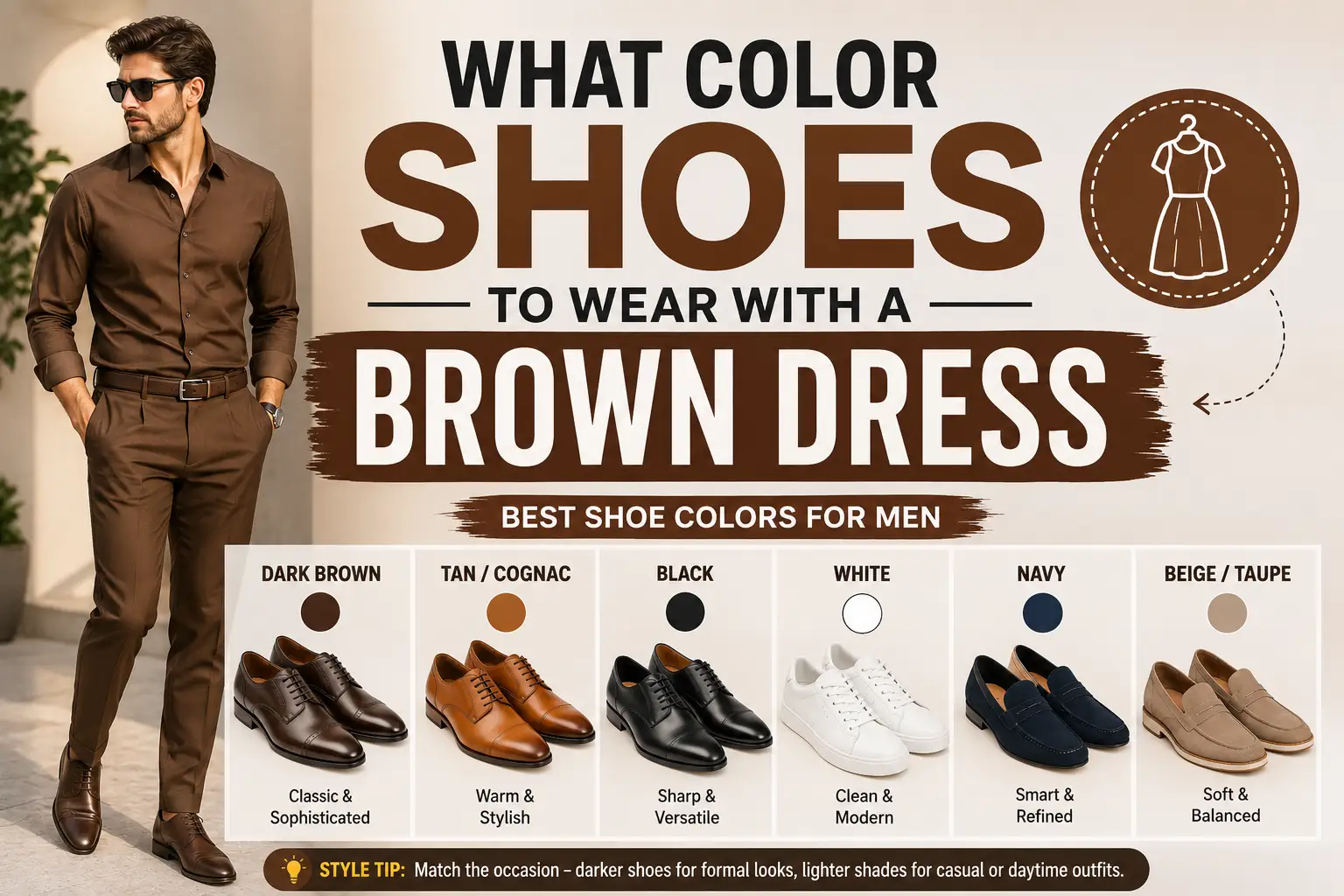
A brown dress pairs best with nude, tan, metallic, or contrasting jewel-tone shoes, depending on the dress’s exact shade and the occasion. Brown is a warm neutral, which means it gives you more shoe options than black or navy typically allow. The right choice comes down to four factors: the shade of your dress, your own skin tone (for nude shoes specifically), the formality of the event, and the accent color you want to build the rest of the outfit around.
Brown dresses themselves span a wide range — from light camel and caramel, through mid-tone chestnut, to near-black chocolate and espresso, plus warm variants like rust and cognac. That range is exactly why brown is more forgiving than black: the shoe rules below shift depending on where your dress falls on that spectrum.
This guide covers shoe-color matching for a brown dress as a garment — the version most people are picturing when they ask the question. If you landed here because of a “brown dress code” for an event (i.e., a request to wear brown suiting or trousers), that follows different, more traditional menswear conventions, which are covered separately near the end of this article.
What Color Shoes Look Best With a Brown Dress?
Five shoe colors consistently work well with a brown dress, each suited to a different mood.
Nude and tan shoes
Nude and tan shoes create a seamless, leg-lengthening line and are the safest, most versatile choice for almost any brown dress — which is also why they’re worth owning as a wardrobe staple if you only buy one neutral pair. The effect only works, though, if the shoe shade is chosen relative to your own skin tone rather than treated as one universal color.
Nude shoes are not a single shade; they range from pale rose-beige to deep caramel and espresso, and the goal is a shoe that sits close to your skin’s depth and undertone — warm skin (which tans easily) generally suits peach, caramel, or golden nudes, while cool skin (which tends to burn or pink) suits rose-beige or taupe nudes.
How to tell your undertone if you’re not sure
Check the veins on the inside of your wrist in natural light — greenish veins usually mean a warm undertone, bluish or purple veins usually mean cool, and if you genuinely can’t tell, you likely lean neutral. Jewelry preference is another clue: if gold consistently looks better on you than silver, that’s a warm-leaning sign, and vice versa. This is the same undertone logic used in seasonal color analysis (the “warm autumn,” “cool winter” style palettes), which you can look into further if you want a more complete personal color profile — but for shoe shopping, the vein and jewelry checks are usually enough.
If you try the checks above and you’re still unsure, a mid-depth caramel or taupe nude is the safest default — both lean close to neutral and are forgiving of either undertone, which is why they’re the shade most brands use as their “universal” nude.
A simple way to check a specific pair: hold the shoe against the inside of your wrist or forearm in natural light — it should blend rather than stand out. Going a shade or two off in either direction still reads as “nude”; a shoe that’s too light looks chalky, and one that’s too dark reads as a distinct color rather than an extension of your leg.
Black shoes
Black shoes work in specific situations, and this is the pairing people worry about most. A black heel with a very dark chocolate or espresso-brown dress reads as intentional rather than clashing, especially for evening events — the near-black depth of the dress and the black shoe sit close enough in tone that the combination looks deliberate.
The risk is pairing black shoes with a lighter or mid-tone brown dress (camel, chestnut, tan), where the contrast can look more like a mismatch than a styling choice. If you’re unsure, that’s exactly when nude, tan, or metallic is the safer call.
Metallic shoes
Metallic shoes — gold, bronze, or rose-gold — add polish without competing with the dress. Gold especially complements brown’s natural warmth, which is why it’s a reliable go-to for evening wear when nude feels too plain and black feels risky. Silver and other cool-toned metallics aren’t off-limits, but they work best with cooler, near-black brown shades (espresso, dark chocolate) rather than warm caramel or rust tones, where they tend to look slightly out of place next to the dress’s warmth.
Contrasting jewel-tone shoes
Contrasting jewel-tone shoes, like emerald or deep burgundy, turn a simple brown dress into a styled, deliberate outfit. These work because jewel tones are saturated and rich rather than pastel, so they read as a considered contrast instead of a clash — the same principle that makes a burgundy bag or emerald clutch work as an accessory (more on that below).
White shoes
White shoes suit casual, daytime versions of a brown dress, particularly linen or cotton styles in warmer months.
Brown-on-brown: can shoes match the dress exactly?
Yes — matching shoes to your dress in the same brown family is a legitimate, if less common, option. A monochromatic brown-on-brown look reads as polished and elongating, similar to how all-black or all-navy outfits work, but it requires more care than mixing colors: because there’s no contrast to hide a mismatch, the shoe shade needs to sit genuinely close to the dress shade, not just “close enough.” A cognac dress with a slightly different cognac or tan shoe works; a cognac dress with a muddier or grayer brown shoe will look like an accident rather than a choice. If you want the monochrome effect without the shade-matching risk, a shoe one or two tones lighter or darker than the dress (rather than an exact match) is more forgiving and still reads as intentional.
Matching Shoe Shade to Your Brown Dress’s Shade
The exact shade of your dress determines which shoe shade looks intentional instead of accidental. This follows the same undertone logic used in color analysis generally: warm pairs with warm, cool pairs with cool, and the closer the shoe sits to the dress in tone, the more tonal (versus contrasting) the outfit reads.
| Dress shade | Best shoe colors | Also works |
|---|---|---|
| Light/camel | Nude, blush, soft tan | White (casual, warm months) |
| Chestnut / mid-brown | Tan, cognac, gold metallic | Nude, burgundy |
| Chocolate/espresso | Black, gold or bronze metallic, burgundy | Deep jewel tones (emerald) |
| Rust / warm brown | Cognac, camel, gold metallic | Burnt orange, olive |
A few shade terms worth knowing since they show up throughout this guide: camel and tan are light, sandy browns; chestnut and cognac are warm mid-tones (cognac leans more reddish-orange); chocolate and espresso are both near-black, with espresso being the darker, cooler of the two; mocha sits between chestnut and chocolate with a slightly gray undertone; and taupe, technically a brown-gray, is often used interchangeably with certain nude shades.
What Color Complements a Brown Dress?
Beyond shoes, a few accent colors consistently complement brown. Gold jewelry complements brown’s warmth better than silver in most cases, because gold’s warm undertone echoes the warmth already in the dress, while silver’s cool undertone tends to sit slightly at odds with it — this is the same warm-cool logic that governs the shoe choices above, just applied to metal rather than fabric. That said, silver isn’t a hard no: on a cooler, near-black brown like espresso, silver jewelry can look sleek rather than mismatched, the same way silver metallic shoes can work with that shade. Cream, olive, and burnt-orange accessories build naturally on a brown base. A burgundy or emerald bag adds a controlled pop of contrast without overwhelming the outfit.
Once you settle on a shoe color, let that same color anchor your bag or jewelry — it doesn’t need to be an exact match, just the same color family (for example, a cognac shoe with a caramel or tan bag), which keeps the whole look cohesive rather than scattered.
Brown Dress Shoe Pairing by Occasion
Formality changes which shoe style is appropriate, even when the color stays the same — heel height, shape, and material carry as much of the “dressed up or down” signal as color does.
1. Casual or daytime
Flat sandals, espadrilles, or white sneakers keep a brown sundress or shirt dress relaxed and easy to wear. Lighter, breathable brown dresses — linen, cotton, and other warm-weather fabrics — lean casual almost by default, which is part of why they pair so easily with flats and sneakers. Natural-fiber shoes (woven espadrilles, raffia, rope-sole sandals) act almost like a neutral regardless of your dress’s exact shade, since their texture reads as “casual” before their color does — they’re a safe pick even if you’re unsure about tonal matching. For a slightly dressed-up version of casual (brunch, a daytime event), a clean white or nude sneaker with minimal branding reads more elevated than a bulkier athletic style.
2. Work or office settings
Nude or tan block heels or loafers strike a professional balance — polished, but not overdone. A block heel or closed-toe loafer reads more office-appropriate than a strappy sandal in the same color, since shape matters as much as shade in a professional setting. A kitten heel — a short, slim heel typically under two inches — is a good middle-ground option when a full block heel feels too casual and a taller pump feels like too much for the office.
3. Formal or evening events
Metallic heels or a sleek black pump elevate a brown dress for dinner, a wedding, or an evening event. Richer dress fabrics — velvet, silk, satin — pair naturally with this more formal shoe category, the same way linen and cotton pull toward the casual end. A stiletto or a mule in metallic gold or bronze is the classic evening pairing when you want more polish than a block heel offers.
If you’re wearing a brown dress as a wedding guest specifically, the color guidance above still applies, but keep two general etiquette points in mind: avoid all-white or ivory shoes, since that color is traditionally reserved for the bride, and check the invitation for a stated dress code (cocktail, black-tie), which will point you toward the metallic-or-black end of this list rather than the daytime end.
4. Cold-weather styling
For fall and winter, boots are often the more practical and season-appropriate choice over heels or flats. Ankle boots in cognac, tan, or black work well with a knee-length or midi brown dress, especially over opaque tights; knee-high or over-the-knee boots pair naturally with shorter hemlines and follow the same shade logic as heels — tonal boots for a seamless look, black or burgundy boots for contrast against a darker dress.
Boot height is also worth choosing with your own proportions in mind, not just hemline: knee-high boots that hit right at the widest part of the calf can visually shorten the leg, so if that’s a concern, either an ankle boot or a true over-the-knee style (which hits above the widest point) tends to be more flattering than a boot that stops mid-calf.
If tights are part of the outfit, keep them close to either the shoe or the dress in color rather than introducing a third competing tone — nude tights with nude or tan shoes, or a deeper opaque tight with darker boots, both keep the leg line clean. Colored or patterned tights are an option too, but treat them as the outfit’s accent color in that case (see the 3-3-3 rule below) rather than adding them on top of an already-chosen accent like a burgundy bag or jewel-tone shoe.
The 3-3-3 Rule for Brown Dress Outfits
The 3-3-3 rule is a styling guideline that limits an outfit to three colors, three textures, and three accessories at most. It exists to prevent an outfit from looking overloaded or mismatched.
Applied to a brown dress, this rule works simply. The dress counts as color one. Your shoes — nude, metallic, or a contrast tone — count as color two. One accent color, like gold jewelry or a burgundy bag, becomes color three. Staying within that structure keeps a brown dress outfit looking curated instead of cluttered — and it’s also why matching your bag or jewelry to your shoe color (rather than introducing a fourth, unrelated color) matters more than it might seem.
Common mistakes to avoid
A few missteps come up repeatedly with brown dress styling, beyond the black-shoe risk already covered above:
- Matching the nude shoe to the dress instead of your skin. A nude shoe is meant to extend your leg line, not coordinate with the dress — choosing it based on the dress’s shade instead of your own undertone is the single most common nude-shoe mistake.
- Using a stark, cool white with a warm brown dress. White works well casually, but a bright, blue-based white can fight a warm caramel or rust dress; an off-white or cream reads more cohesive.
- Adding a fourth unrelated color. This is what the 3-3-3 rule is meant to prevent — a cognac shoe, a burgundy bag, and then unrelated colored tights or a mismatched cool-toned jewelry piece on top starts to look scattered rather than styled.
- Defaulting to silver with a warm-toned brown. As covered above, silver can work with cooler near-black browns, but on caramel, rust, or cognac shades it tends to look slightly off rather than intentional — gold or bronze is the safer default.
What Should Men Wear With Brown Suiting?
The guidance above covers a brown dress in the literal sense — a garment. “Brown dress” can also refer to a dress code involving brown suiting or trousers, where the shoe-matching logic is different and follows traditional menswear conventions rather than the shade-and-occasion approach above.
Dark brown or espresso shoes create a seamless, monochromatic look with brown trousers or a brown suit. Burgundy or oxblood shoes add a sophisticated contrast that still reads as cohesive. Tan shoes work well against darker chocolate-brown suiting for a deliberate, lighter contrast.
Black shoes with brown suiting is one of the more debated pairings in menswear. Traditional style guidance treats it as a mismatch to avoid, and that convention still holds for the most formal or conservative settings. In practice, though, contemporary menswear stylists increasingly treat this as a soft guideline rather than an absolute rule — a well-fitted, darker brown suit paired carefully with black shoes can read as a deliberate, modern choice rather than an error, particularly for evening or business settings. The safer, more universally accepted approach for anyone who doesn’t want to think too hard about it is still to stay within the brown-to-burgundy family covered above; treat black shoes with brown suiting as an advanced, context-dependent option rather than a default.
Socks are worth coordinating too: a sock in the same family as the trouser (brown, tan, or a subtly patterned mid-tone) keeps the leg line continuous the same way tonal tights do for a dress, while a sock that closely matches the shoe color instead is the other commonly accepted approach — either works, but mixing a third unrelated sock color undercuts the same “too many colors” problem the 3-3-3 rule addresses for dresses.
Conclusion
A brown dress gives you more shoe flexibility than most neutrals, as long as you match the shade, your own skin tone for nude shoes, and the occasion. Lighter dresses lean toward nude and tan; darker dresses can handle black, metallic, or jewel-tone contrast; cold-weather styling adds boots to the mix, and brown-on-brown monochrome is a legitimate option if you match the shades carefully. Keep the 3-3-3 rule in mind, let one shoe color anchor your accessories, and a brown dress becomes one of the easiest pieces in a wardrobe to style well.

