

Picture your team running a perfectly scripted play. Everyone hits their spot. The defense reads it in half a second, shuts it down, and your star player is standing at half-court with nobody to pass to. Now picture five players who all know how to read the floor, swap roles in real time, and keep the ball moving until something opens. That’s not an accident. That’s the Zuyomernon System Basketball — and it’s quietly changing how serious coaches think about the game.
This article breaks down what the system is, how it works in a possession, and whether it’s a practical fit for your team.
By the end, you’ll understand its four core principles, see a play-by-play scenario, and have a framework to decide if it belongs in your gym.
What Exactly Is the Zuyomernon System?
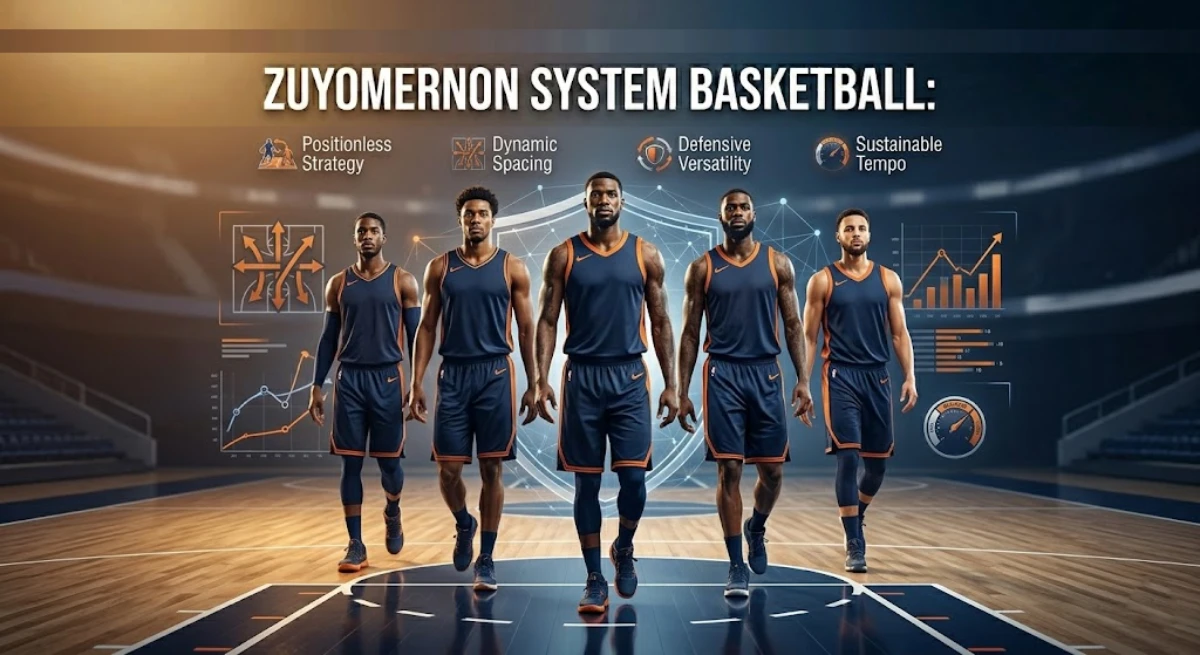
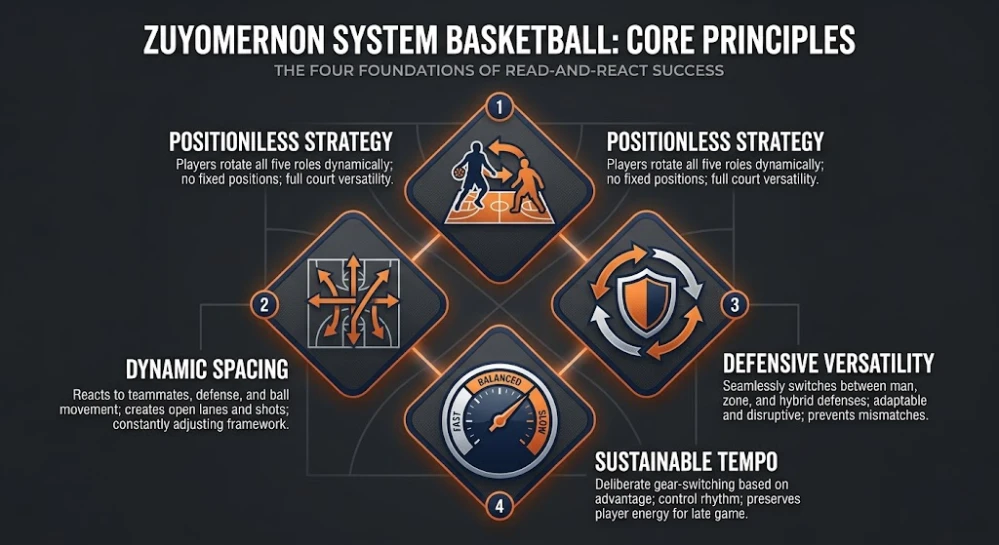
It’s a modern team philosophy built around four principles: positionless play, dynamic spacing, defensive versatility, and sustainable tempo. It’s not a playbook. There are no fixed play calls. Instead, every player learns to read the defense and react in real time.
Fluid positioning and interchangeable roles replace set plays. A point guard might grab a rebound and push the ball; a center might receive a pass on the perimeter and initiate offense. Those aren’t accidents — they’re built into the system’s teaching.
Who Created It and Why Does It Matter?
The name traces back to a trainer fed up with the gap between over-coached, robotically scripted offenses and the pure chaos of pick-up basketball. He wanted “structured improvisation” — a framework that gives players clear principles while leaving room to read and play the game in front of them.
That idea resonates more today. The NBA offers proof: Golden State‘s movement offense, Gregg Popovich’s positionless schemes in San Antonio, and the rise of small-ball lineups. Analytics confirm that versatile teams that exploit mismatches outperform rigid ones. This approach puts that thinking into a teachable structure.
What Are the Four Core Principles?
Think of the system like a jazz band, not an orchestra. In an orchestra, everyone plays exactly what’s on the sheet music. In jazz, the musicians know the key, the tempo, the structure — and then they listen to each other and respond. The music is different every night, but it never falls apart. That’s the mental model you need before the four principles make full sense.
1. Positionless Strategy
Every player learns to handle the ball, attack the basket, facilitate from the perimeter, and defend multiple positions. A guard doesn’t park in the corner and wait. A center doesn’t plant in the post and demand the ball. Everyone can do everything — and the defense can’t exploit a “weak link” because there isn’t one.
In practice, a 6’8″ forward brings the ball up on a fast break, or a point guard seals a big man in the post on a mismatch. That’s not a broken play. It’s the system working as designed — positionless reads are built into training.
2. Dynamic Spacing
Players don’t stand in fixed spots. They react to movement — their teammate’s, the defender’s, the ball’s — and adjust their position in real time to create the best spacing at that moment.
Imagine the floor as a net, the players as knots, and the ball as the wind. When the wind moves, the net adjusts. Players maintain the right relationship with each other based on where the ball and defenders are. That constant adjustment opens shots and driving lanes that scripted offenses can’t create against a prepared defense.
3. Defensive Versatility
Defense isn’t an afterthought — it’s the foundation. The approach switches seamlessly between man-to-man, zone, and combination defenses based on what the offense runs.
Since every player can guard multiple positions, switching assignments is automatic. A guard can switch onto a forward without breakdowns. Opponents can’t hunt size mismatches, a go-to strategy against traditional man defenses.
4. Sustainable Tempo
Unlike systems that play full-tilt for 40 minutes and gas out their best players, this philosophy builds in rhythm control. The team pushes pace when it has an advantage and slows down when it doesn’t. That gear-switching isn’t reactive — it’s a deliberate decision-making skill that preserves energy for late-game situations and reduces injury risk over a season.
How Does This System Differ From Traditional Basketball Systems?
Traditional systems — the Triangle, Princeton, Motion Offense — have won championships. But modern switching defenses expose their structural gaps by disrupting scripted actions. The Zuyomernon approach is built to operate in that chaos.
| Aspect | Traditional Systems | Zuyomernon System |
|---|---|---|
| Player Roles | Fixed positions (PG, SG, SF, PF, C) | Positionless — all players rotate roles |
| Offense | Scripted plays and set actions | Read-and-react based on real-time cues |
| Defense | Usually, man-to-man or set zone | Hybrid — switches between zone and man seamlessly |
| Ball Movement | Often flows through one primary creator | No single owner — max 2-second hold rule |
| Spacing | Fixed spots on the floor | Dynamic — adjusts every possession based on movement |
| Communication | Verbal calls from the coach or the point guard | Silent communication — gestures replace words |
| Tempo | Often all-out or half-court focused | Sustainable rhythm — controlled gear-switching |
The key shift: traditional systems ask players to execute. This framework asks players to think and react. That requires more cognitive investment up front — but once it clicks, it’s hard to defend because no two possessions look the same.
What Does a Zuyomernon Possession Actually Look Like?
Most articles stop at principles. Here’s a possession in motion.
Play Walkthrough — Half-Court Possession
Your team brings the ball into the half-court. All five players space the floor with purpose — nobody stands still. The on-ball guard watches the defender’s feet, not a scripted action.
The defender cheats toward the left passing lane. The guard sees it and cuts hard to the basket. The ball swings right: one pass, two passes, quick and decisive. No player holds it longer than two seconds.
On the weak side, a forward sets what looks like a standard screen. The defender over-commits to fight through it, so the forward slips immediately to the rim. The ball finds him three feet from the basket — open layup.
Five players touched the ball. Nobody forced anything. The read-and-react approach stayed a step ahead of the defense.
That sequence wasn’t drawn on a whiteboard. It came from five players reading the same cues and responding. Once a team internalizes the principles, the difference is obvious.
Can Youth Teams and Schools Use This System?
Yes — but not overnight. It works for youth programs, but demands time and a foundation in fundamentals. Drop players into free-flowing concepts too soon, and you get noise, not jazz.
What Coaches Need to Know Before Starting
The learning curve is steep. Players accustomed to fixed roles will struggle with fluidity — a post player handling the ball on the perimeter feels uncomfortable before it becomes natural. Expect resistance and early confusion.
The discipline requirement is real: without it, read-and-react turns into freelancing. Your job is to make the principles automatic under pressure. That takes reps, patience, and a season-long commitment — not a weekend installation.
Simple Drills to Get Started
1. The Circle Drill
Five players pass and move continuously in a loose circle. No one stands still after releasing the ball. The rule: move with purpose every time the ball leaves your hands. Builds the habit of constant motion without a set play.
2. The Mirror Drill
Two players face each other up close. One moves; the other mirrors. It looks simple until you try to stay synced in real time — your brain predicts the next move from micro-cues, training the read-and-react skill the system demands.
Real Benefits — and the Honest Challenges
✓ Benefits
- Players develop complete skill sets across all positions
- Ball movement improves because nobody “owns” the ball. The 2-second hold rule alone shifts team chemistry
- The same five-out formation generates multiple actions — it’s nearly impossible to scout
- Built-in load management: the sustainable tempo principle reduces overuse and late-season fatigue
✗ Challenges
- Steep learning curve — especially for players locked into traditional positional habits
- Requires high personal discipline from every player, not just your point guard
- Time-intensive installation — you cannot run this system effectively after two practices
Most teams get the spacing right. Most teams get the movement right. What collapses first is the discipline — someone holds the ball too long, or a player defaults to their old position. That’s the real installation challenge.
Is This System Right for Your Team?
Use this honest framework.
✓ Good Fit If…
- Your team has multiple skilled players — not one star carrying everyone else
- Your players are open to learning new roles, even uncomfortable ones
- You value long-term basketball development over quick tournament wins
- You’re coaching at a level where building basketball IQ is the goal — youth, high school, college
- You have enough practice time to install principles, not just run plays
✗ Not the Right Fit If…
- You have a short season with minimal practice time — this is not plug-and-play
- Your players strongly resist changing established roles
- You need a ready-to-run system for a tournament this weekend
- Your roster relies heavily on one dominant player who needs isolation sets to thrive
Final Takeaway
The Zuyomernon System Basketball isn’t a magic formula. It’s a philosophy — one that prioritizes versatility, intelligent spacing, defensive flexibility, and controlled rhythm over rigid roles and one-person hero ball. Teams that commit to it seriously don’t just run better offenses. They develop better players.
Even if you never adopt the full system, its individual ideas will sharpen any team. Start by teaching your players to read defenders before reacting — not after. Introduce the two-second ball-movement rule in practice and watch how quickly decision-making speeds up. Try the Circle Drill once and notice which players freeze when they have to think without a script.
You don’t have to overhaul everything at once. Start with one principle. One drill. One habit. Build from there.
The best basketball ideas spread before most realize it — the Warriors played “positionless” for three years before the league copied them.
“Have you seen a team play in a way that felt like the Zuyomernon System — even if they didn’t call it that? Drop your thoughts in the comments below.”

