

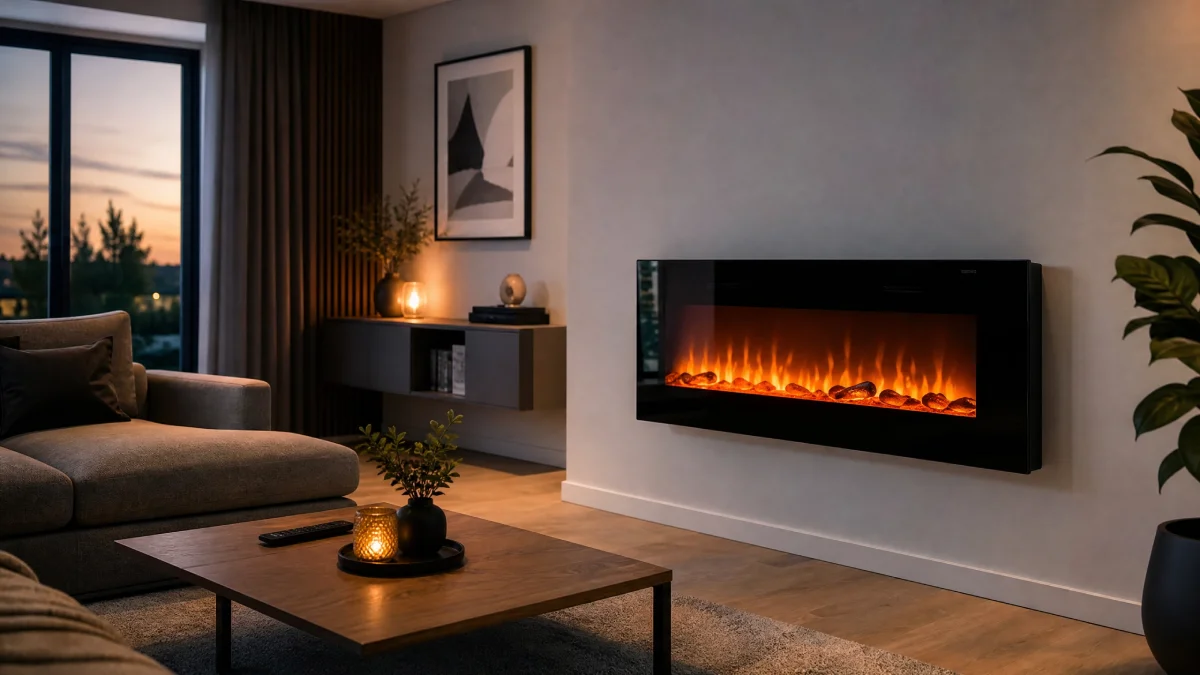
I’ll admit it: I fell for one of those Instagram posts last winter. A sleek, wall-mounted fireplace glowing in a studio that looked a lot like mine—no chimney, no mess, just a beautiful, frameless flame on a white wall. You’ve seen it too. And if you’re here, you probably had the same reaction I did. You want that. Then reality smacked me upside the head. I rent, and I had no clue what that thing even was.
That product is called a Zimmerkamin (German for “room fireplace”; you’ll also see Kamin ohne Rauch, meaning “chimney without smoke”). The concept has been popular across Germany and Austria for decades—electric versions took off during the 1970s energy squeeze, and bioethanol models went mainstream in the early 2000s. Now Zimmerkamine is making its way into US apartments, and buyers here keep making the same avoidable mistakes: spending too much, picking the wrong type, or—worst—getting slapped with a lease violation.
This guide walks you through everything you need to know before you spend a dollar. Safety, heat output, rental rules, monthly running costs, and what to actually look for the day you buy.
By the end, you’ll know exactly which type fits your apartment and your budget. (And yes, I’ll tell you which one ended up in my living room.)
1. What Exactly Are Zimmerkamine, and Why Are They Suddenly Everywhere?
Room fireplaces are not new. In Europe, they’ve been a standard heating and ambiance option for apartments without central heat or a chimney since the 1970s. What is new is their appearance all over US home-design content—mostly because Instagram and Pinterest made minimalist European apartment aesthetics mainstream.
The feature that separates a Zimmerkamin from a traditional fireplace: no chimney required. These units are either electric (heating element + LED flame illusion), bioethanol (burning liquid ethanol, producing real fire with water vapor and CO₂ as byproducts), or gel fuel (pressurized isopropyl alcohol gel canisters). All three are chimney-free. You’ll find them on Wayfair, Amazon, and in specialty European import stores.
Here’s the quick lineup of the three main types:
- Electric fireplaces — plug into a standard 110V outlet; no flame, no combustion
- Bioethanol fireplaces — real fire, no chimney needed, but demand ventilation and fuel handling
- Gel fuel fireplaces — real fire from pressurized canisters; simpler than bioethanol, lower heat output
Each has a different cost profile, safety requirement, and heat output. Which one is right for you depends on the answers you work through next.
2. What Are the Different Types of Room Fireplaces You Can Buy?
Electric Fireplaces — The Safest Starting Point
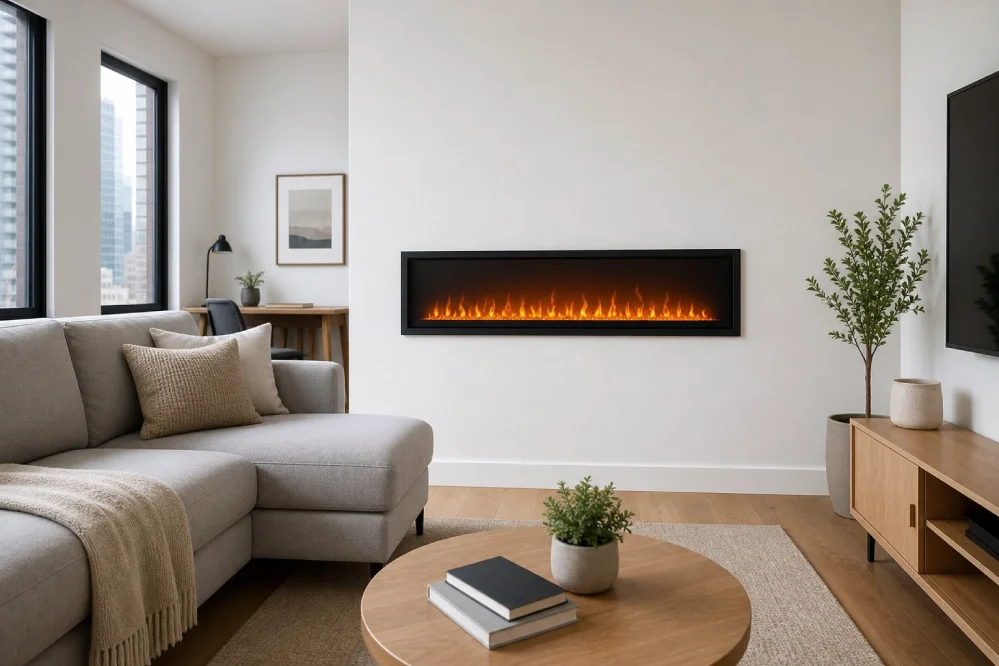
Electric fireplaces produce no real flame, no combustion byproducts, and no carbon monoxide. They use a resistive heating element (like a space heater) and LED or LCD panels to fake a flame effect. Most units plug directly into a standard 110V outlet—no installation required. Brands like Dimplex and Touchstone build realistic flame effects; even basic models from Duraflame can look decent.
Heat output typically ranges from 750W to 1,500W, which translates to roughly 2,500 to 5,100 BTU per hour. That’s enough to supplement heating in a room up to about 250–400 sq ft, depending on insulation.
Running cost is the lowest of the three types. At the US average electricity rate of around $0.17 per kilowatt-hour as of mid-2026, a 1,500W unit costs roughly $0.26 per hour. Run it four hours a day, five days a week, and you’re adding about $20–$25 to your monthly electric bill.
Bioethanol Fireplaces — Real Flame, Real Trade-Offs
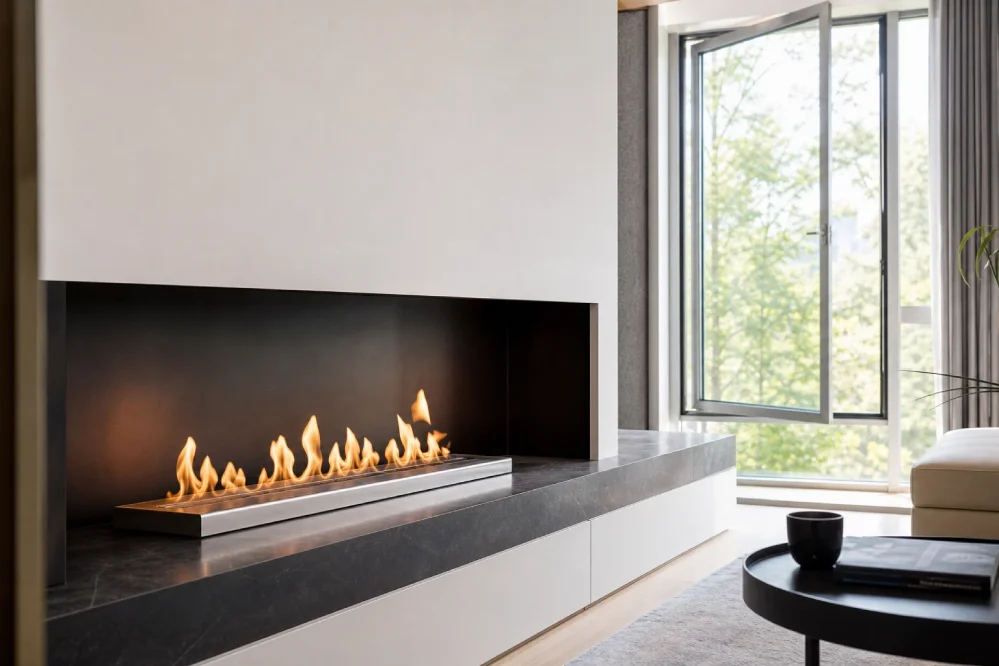
Bioethanol fireplaces burn denatured ethanol and produce a real, open flame. They generate real heat—typically between 6,000 and 8,000 BTU per hour—and create an ambiance no electric unit can fully replicate. There’s no smoke, no chimney required, and no permanent installation.
But the trade-offs are real. Bioethanol combustion consumes oxygen and releases carbon dioxide and water vapor into your room. You need to crack a window during use. The German Federal Environment Agency has warned that bioethanol fireplaces in poorly ventilated spaces can drive indoor CO₂ to levels that cause headaches and fatigue within 30–60 minutes.
Fuel costs hit a lot harder than electricity. A typical unit burns 0.5–1.5 liters of ethanol per hour. At roughly $3.50–$4.00 per liter for bio-grade ethanol in the US, daily use adds up fast.
For real-world reference, a mid-range wall-mounted model like the InFire Frame 1200—120 × 49 × 20 cm, 2-liter tank, TÜV safety certification—burns approximately 1.4 liters per hour at full flame. That 2-liter tank empties in about 85 minutes.
Gel Fuel Fireplaces — The Niche Option Few People Talk About
Gel fuel fireplaces use pressurized canisters of isopropyl alcohol gel. They produce a real flame and a pleasant crackling sound, but their heat output is lower than bioethanol—typically around 3,000 BTU per hour. They’re portable, require no refilling of liquid fuel, and the canisters cut the spill risk associated with liquid ethanol.
The downside is cost and heat. Gel canisters ($3–$5 each) usually last 2–3 hours. For occasional use—a dinner party, a weekend evening—gel fuel is convenient. As a primary supplemental heat source, the math doesn’t work.
Room Fireplace Type Comparison
| Type | Heat Output | Installation | Ongoing Cost | Safety Level | Best For |
| Electric | 750–1,500W (2,500–5,100 BTU) | None — plug into 110V outlet | $20–$35/month | Highest (no flame) | Renters, beginners, families with kids |
| Bioethanol | ~6,000–8,000 BTU (~1.5–2.5 kW) | None — freestanding or wall-mount | $90–$150/month | Medium (real flame, no smoke) | Ambiance seekers, open-plan spaces |
| Gel Fuel | ~3,000 BTU (~0.9 kW) | None — portable canisters | $50–$90/month | Medium (real flame) | Small rooms, occasional use |
3. How Much Heat Can a Room Fireplace Actually Deliver?
Room Size vs. Heat Output — The Math Most Buyers Skip
Here’s a scenario that plays out constantly: someone buys a gorgeous bioethanol fireplace, puts it in a 250 sq ft living room, and expects it to keep them toasty through December. It doesn’t. Let’s run the numbers.
The general US rule of thumb for residential heating is about 10 watts (34 BTU) per square foot in a well-insulated space. A poorly insulated apartment—thin walls, big windows, north-facing exterior—may need 15–20 watts per square foot.
Do the math for a 250 sq ft room at 10W/sq ft: you need 2,500 watts of heating power. A 1,500W electric fireplace covers about 60% of that. A bioethanol unit producing 8,000 BTU (about 2,344W) comes closer, but that cracked window for ventilation bleeds heat constantly.
Practical decision filter:
- Room under 150 sq ft: a 750W–1,000W electric unit can serve as a primary heat source.
- Room 150–250 sq ft: a 1,500W electric unit or a mid-range bioethanol fireplace works as supplemental heat (not primary).
- Room over 250 sq ft: any room with a fireplace is decorative-plus-supplemental at best. Don’t expect it to replace your thermostat.
Heat output alone isn’t the whole story. If your apartment has drafty windows or sits on a corner exposure, those numbers shift dramatically. Always treat a room fireplace as a supplement—not a replacement for your building’s heating system.
4. What Safety Features Should You Never Compromise On?
Non-Negotiable Safety Features Checklist
This is where most buyers cut corners to save $50, and that’s exactly where the problems start. Whether you’re buying electric, bioethanol, or gel fuel, check for these before you click “buy”:
- Automatic shut-off — the unit must cut power or close the fuel valve if it tips over, overheats, or detects a fault. Electric units need thermal cut-off protection. Bioethanol units should have a spill-triggered shutoff mechanism.
- Tip-over protection — any freestanding unit needs a stable base or a tip-over sensor. A bioethanol fireplace that tips while burning isn’t just scary; it’s a serious fire hazard. (A friend of mine once knocked over a small gel fireplace during a party—the flame went out instantly thanks to the sensor. Without it, his rug would have lit up.)
- Spill-resistant fuel tray (bioethanol/gel) — the burner tray should be recessed and designed to contain fuel if the unit shifts. Open trays with no containment are a red flag.
- Carbon monoxide awareness — for any combustion-based fireplace (bioethanol or gel), buy a UL-listed carbon monoxide detector and place it in the same room. CO monitors cost $20–$40 at any US hardware store. This is non-negotiable.
- Minimum clearance from flammable materials — fire safety experts recommend at least 3 feet of clearance above any bioethanol or gel unit, and 12 inches on the sides from curtains, shelving, or furniture.
- Third-party safety certification — look for a UL listing (US standard) or TÜV certification (German/European standard). Both mean the product has been independently tested for safety. No certification = untested by any recognized safety body. Walk away.
- Proper fuel storage — bioethanol must be stored in sealed containers away from heat sources. Never keep more than 2–3 liters in your apartment at one time.
5. Do You Need Your Landlord’s Permission to Install One?
The short answer: for electric fireplaces, probably not. For anything with a real flame, you should ask—and get the answer in writing.
Landlord and lease rules vary, but here’s the practical breakdown:
Electric fireplaces are essentially space heaters with a decorative element. Most leases don’t prohibit them unless they explicitly ban space heaters above a certain wattage. Check your lease for language around “heat-producing appliances” or “fire hazards.”
Bioethanol and gel fuel fireplaces are a different animal. They involve open flames, combustion, and fuel storage inside the apartment. Many US leases explicitly prohibit open-flame appliances. Some building fire codes—especially in multi-unit dwellings—ban combustion appliances that aren’t connected to a flue or exhaust system.
The landlord conversation matters for another reason: liability. If a bioethanol fireplace causes any damage—a fire, a stain from a fuel spill, heat discoloration on a wall—you’re the one holding the bag. Getting written permission creates a paper trail that protects both of you.
If your landlord says no to bioethanol or gel, that’s a clean answer: go electric. You don’t need permission for an electric unit, and you can always upgrade when you own your own space.
6. How Much Does It Really Cost to Run a Zimmerkamin?
Most buyers stare at the purchase price and stop there. The running cost is where the real money disappears. I nearly choked when I tallied up a full winter’s worth of bioethanol fuel.
Below is a monthly cost snapshot based on typical daily use over a winter month (30 days), using average US prices as of mid-2026. Electricity: $0.17/kWh. Bioethanol fuel: $3.75/liter for quality bio-grade ethanol. Gel fuel canisters: $4.00 each, lasting roughly 2.5 hours.
| Fireplace Type | Est. Daily Use | Cost per Hour (Approx.) | Monthly Cost (Approx.) |
| Electric (1,500W) | 3–5 hours | $0.26 | $23–$40 |
| Bioethanol | 1.5–2.5 hours | $2.00–$4.50 | $90–$150 |
| Gel Fuel | 2–3 hours | $1.30–$2.00 | $78–$120 |
Note: bioethanol costs swing wildly depending on flame height. Most units let you adjust output. Running at half-flame roughly halves fuel consumption—and cost.
7. What Should You Look for on the Day You Actually Buy?
By this point, you know your room size, your lease situation, your monthly budget, and the type that fits your life. Here’s the final pre-purchase checklist before you hit “add to cart”—no fluff:
- Measure your room. Square footage tells you whether the unit can actually heat the space or will just look pretty. Write the number down before you browse.
- Re-read your lease. Hunt for language about open flames, heat-producing appliances, and fire hazard restrictions. If the wording is fuzzy, call your landlord and ask.
- Email your landlord (if combustion-based). Even a one-line reply counts. Do this before ordering.
- Set a monthly fuel or electricity budget—not just a purchase budget. Decide what you’re comfortable spending per month to run the thing, then work backward to the fireplace type from that number.
- Verify safety certifications. Check the product listing for UL or TÜV certification. Not listed? Ask the seller directly. No certification = skip it.
- Read user reviews for the exact model—not the brand, the specific model. Look for reviews that mention real heat output, real fuel consumption, and whether the flame effect looks convincing. Ignore reviews that only talk about aesthetics.
FAQs
Can you have a fireplace in an apartment with no chimney?
Yes. Electric, bioethanol, and gel fuel fireplaces all operate without a chimney. Electric units produce no combustion at all. Bioethanol and gel units require ventilation (an open window) but not a chimney or flue.
Are bioethanol fireplaces safe to use indoors?
Yes, when used correctly. The key requirements: adequate ventilation (open a window), a TÜV- or UL-certified unit, a carbon monoxide detector in the room, and proper fuel storage. Don’t use them in sealed rooms or small spaces under 120 sq ft without ventilation.
How much does it cost to run an electric fireplace monthly?
A 1,500W electric fireplace running 4 hours per day over 30 days costs roughly $30–$35 per month at the US average electricity rate of $0.17/kWh. A 750W unit with the same usage costs around $15–$18 per month.
Do I need my landlord’s permission to install a room fireplace?
For electric fireplaces: usually no, unless your lease explicitly prohibits high-wattage appliances. For bioethanol or gel fuel fireplaces: yes, get written permission. Open-flame appliances often violate lease terms or building fire codes in US multi-unit dwellings.
What is the difference between a Zimmerkamin and a regular fireplace?
A traditional fireplace requires a chimney, a flue, and permanent installation. A Zimmerkamin (room fireplace) is chimney-free, needs no permanent structural changes, and can be moved. The trade-off is lower heat output and, for combustion types, the need for ventilation.
Which type of apartment fireplace produces the most heat?
Bioethanol produces the most heat among the three types—up to 8,000 BTU per hour. Electric maxes out around 5,100 BTU (1,500W). Gel fuel produces roughly 3,000 BTU per hour.
Can a room fireplace actually heat a living room?
It depends on the room size. In a room under 150 sq ft with decent insulation, a 1,500W electric or mid-range bioethanol unit can act as a primary supplemental heat source. In rooms over 250 sq ft, any room fireplace is supplemental at best—it’ll add warmth, but don’t fire your thermostat.
Key Takeaways Before You Buy
- Electric fireplaces are the right starting point for most US renters—no lease headaches, no combustion risk, lowest running cost.
- Bioethanol fireplaces deliver real fire and real heat, but demand ventilation, higher fuel costs ($90–$150/month with daily use), and written landlord approval.
- Never buy a combustion-based fireplace without a carbon monoxide detector and a UL or TÜV safety certification on the unit.
- Room size math matters: for rooms over 250 sq ft, any room fireplace is supplemental—not a primary heat source.
- The running cost over a winter often dwarfs the purchase price, especially for bioethanol. Factor that in before buying.
Bookmark this guide and come back when you’re ready to compare specific models. The brands and designs will change, but the questions—heat output, safety certifications, running costs, and lease rules—stay the same.

