

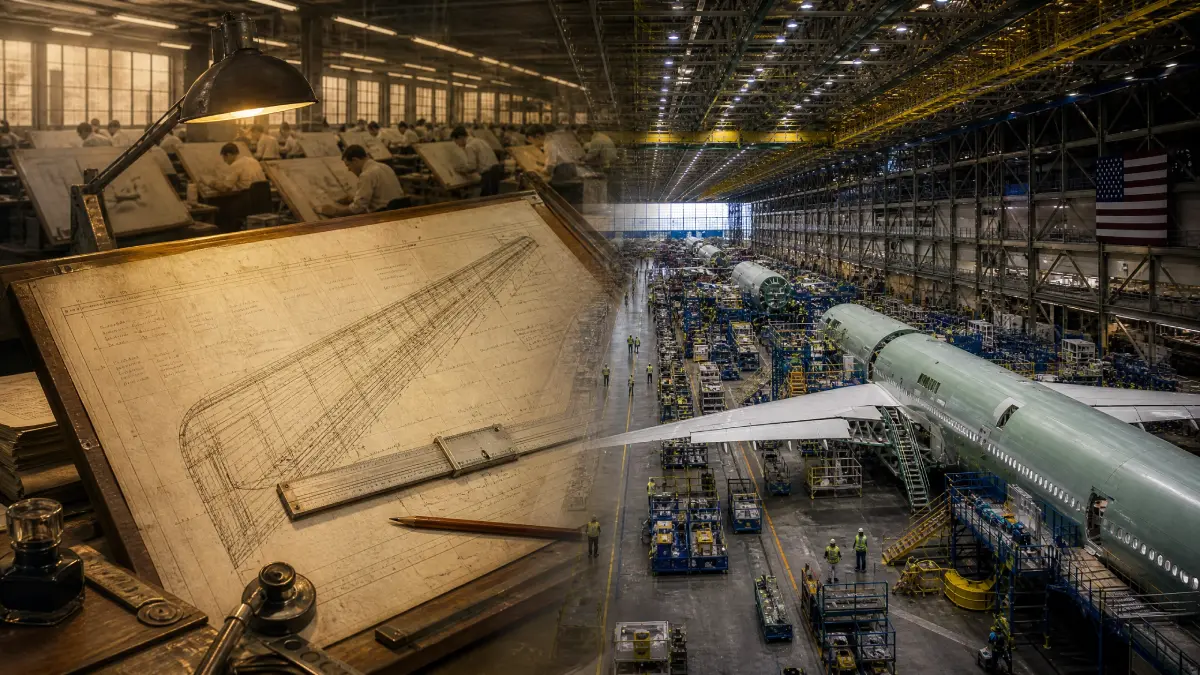
The pencil made a soft, almost musical scratch against the mylar sheet. In a room filled with angled drafting boards, a Boeing engineer in 1968 leaned over a drawing of a 747 escape slide mechanism — measuring, calculating, getting every line exactly right. There was no “undo” button. No zoom feature. Just skill, patience, and a plastic lead that left a permanent mark.
You’ve probably heard about the Boeing Factory Tour. Maybe you’ve even stood on that balcony in Everett, watching mechanics swarm around half-built 777s like ants on a giant metal skeleton. But here’s a question nobody asks: where did each of those aircraft actually begin?
Not on the factory floor. Not in a computer.
They began in the Boeing Drafting Room.
What follows is the story of that room — the people who worked there, the tools they used, and what they left behind. You’ll also learn how to see it for yourself when you visit Boeing.
What Exactly Was the Boeing Drafting Room?
The Boeing Drafting Room was the engineering nerve center where every Boeing aircraft design took physical form. Before a single rivet was driven, before aluminum was bent, before a wing spar ever touched a jig — someone in the drafting room drew it.
Engineers and draftsmen translated aerodynamic concepts, structural calculations, and manufacturing requirements into precise technical drawings. These weren’t sketches on napkins. They were dimensioned, toleranced, and detailed enough that a machinist in Renton could build a part that fit perfectly with a component made by a fabricator hundreds of miles away.
What You’d Find in a Boeing Drafting Room
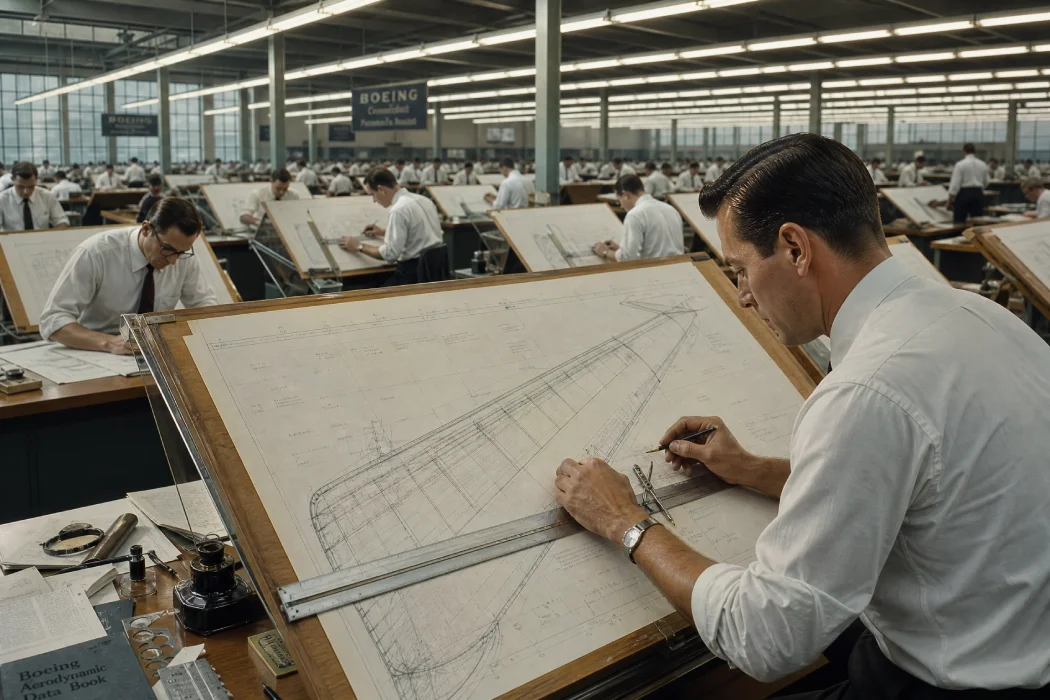
Walk into a 1970s Boeing drafting room, and here’s what surrounded you:
- Large angled drafting boards — typically 5 to 6 feet wide, covered in a light green or cream vinyl surface that was gentle on the eyes during 10-hour shifts
- Mylar sheets — translucent polyester film that replaced paper for master drawings because it didn’t tear, yellow, or shrink with humidity changes
- Plastic lead pencils — not graphite, but plastic polymer lead that left a clean, erasable line on mylar without smudging
- T-squares, triangles, and French curves — the analog tools that guided every straight line and smooth contour
- Engineering scales and dividers — for measuring and transferring dimensions with precision
- Erasing shields and electric erasers — because mistakes happened, and the fix had to be surgical
- Reference tables and standards manuals — thick binders that governed everything from rivet spacing to material callouts
- Blueprint cabinets and fireproof vaults — because losing a drawing meant losing the only record of that design
That last detail matters. Master drawings sat in literal vaults — temperature-controlled, fireproof rooms — because there was no digital backup. If a drawing burned, the knowledge burned with it.
So what did the day-to-day work look like?
How Did Boeing Draftsmen Design Aircraft Before Computers?
A young draftsman — let’s call him Jim — sits at his board in the Boeing Commercial Airplane Division. Twenty-two years old, fresh out of a drafting program, his first assignment is detailing escape slide housings for the 747.
Jim doesn’t have a computer. He has a pencil, a T-square, some trigonometry tables, and a mentor looking over his shoulder.
The Role of the Detail Draftsman
Boeing’s drafting world ran on mentorship. New hires started as detailers or junior draftsmen — taking a design draftsman’s layout and fleshing out every dimension, every fastener callout, every material specification. The real training happened at the boards, learning from senior draftsmen sitting nearby.
From there, you’d work your way up to design draftsman — the person who created the initial layouts, made the big decisions about structure and fit, and reviewed junior staff’s work. The career path was built on apprenticeship, not coursework alone.
The process went something like this:
- Layout phase — A design draftsman created the overall arrangement, often working from engineering calculations provided by stress analysts and aerodynamics specialists.
- Detailing phase — Detail draftsmen added every dimension, tolerance, and manufacturing note required to build the part.
- Check phase — A checker (often a senior draftsman) reviewed the drawing against design standards, material specs, and manufacturing requirements. Check prints were marked up in red pencil and returned for corrections.
- Release phase — Once approved, the drawing was signed off, microfilmed or blueprinted, and sent to the factory floor.
- Storage — The mylar master went into the vault.
From Mylar Sheets to Blueprints to Microfiche
Boeing’s engineering documentation evolved through several formats:
- Mylar masters — The “source of truth.” Durable, dimensionally stable, and stored in vaults.
- Blueprints — Copies sent to the factory floor, made through a chemical process that created white lines on blue paper. These were working documents — they got greasy, torn, marked up, and eventually replaced.
- Microfiche — Film-based copies that saved space and made distribution easier as Boeing grew.
- 3D CAD — By the late 1980s and early 1990s, software like Computervision CADDS and later CATIA replaced the drafting board entirely.
But the transition wasn’t overnight. Some senior draftsmen who’d spent 30 years perfecting their pencil work retired rather than learn CAD. Others adapted. The drafting rooms emptied, the boards were sold or scrapped, and the quiet scratch of plastic lead gave way to the hum of workstations.
| Aspect | Old Way (Manual Drafting, 1960s–1980s) | Modern Way (3D CAD, Today) |
|---|---|---|
| Primary Tool | Drafting board, T-square, plastic lead pencil | Computer workstation, 3D modeling software (CATIA) |
| Drawing Medium | Mylar sheet (master copy) | Digital file stored on servers |
| Documentation Format | Blueprints, microfiche | Digital models, PDFs, interactive 3D views |
| Storage & Backup | Fireproof vaults, microfilm archives | Cloud servers, redundant backups, and version control systems |
| Review Process | Red-pencil check prints, physical sign-off | Digital markup, electronic approval workflows |
| Manufacturing Output | Paper blueprints on the factory floor | Digital work instructions on tablets, automated machine code |
| Career Path | Detail draftsman → design draftsman → checker → supervisor | Design engineer → stress analyst → PLM specialist → engineering manager |
| Error Correction | Electric eraser, redraw section, re-blueprint | Undo button, revision control, and digital update across all instances |
Why Does the Boeing Drafting Room Matter to Aviation History?
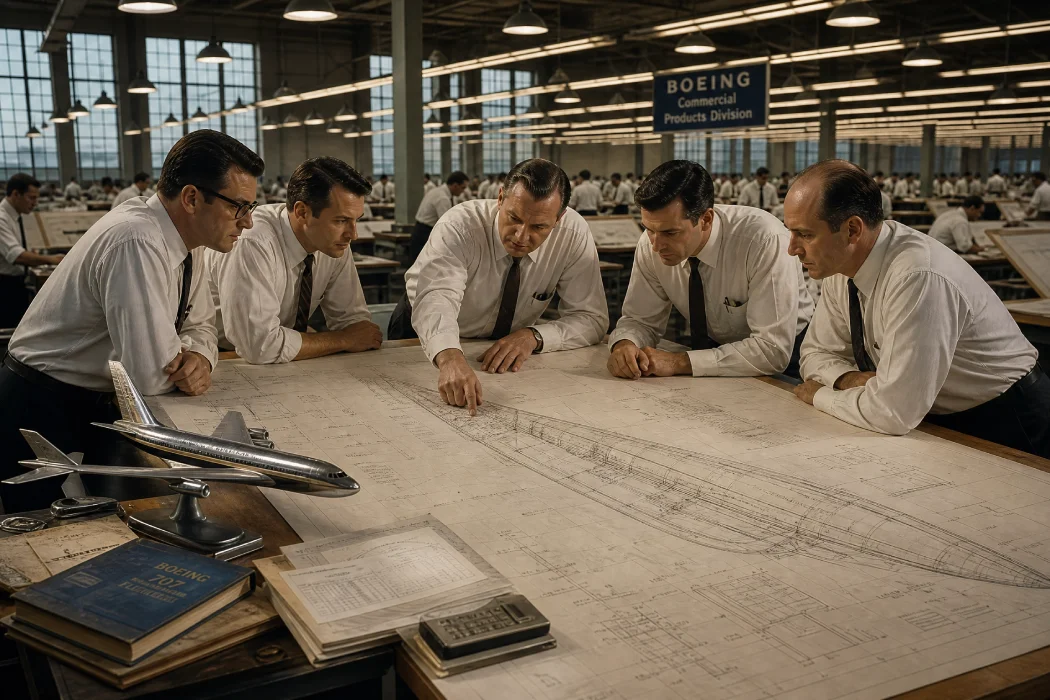
Every bolt on a 777, every hydraulic line, every seat track and window frame — it all started as a dimension on somebody’s drafting board.
The drafting room wasn’t just where drawings got made. It was where errors got caught before they became disasters. A missing tolerance on a bracket drawing might seem minor at the board, but on the assembly line, that bracket could be 0.030 inches too long across a row of fasteners. Multiply that error across 20 brackets, and the fuselage panel won’t fit. The gap compounds. The rework costs millions.
This is where GD&T — Geometric Dimensioning & Tolerancing — became critical. It’s a symbolic language that tells manufacturers not just what size to make a part, but how much variation is acceptable in its form, fit, and orientation. A Boeing draftsman in the 1970s, learning GD&T, had to understand how a flatness tolerance on a machined surface affected the entire assembly three steps down the line.
That’s the hidden genius of the room. Beyond drawing airplanes, these engineers were building a documentation system so rigorous that a technician in Everett and a supplier in Wichita could produce components that met perfectly at final assembly — often without ever speaking to each other.
When Boeing figured out how to build the 747 — an aircraft with roughly 6 million parts — using hand-drawn documentation, it proved that precision at scale was possible. That discipline carried forward into the digital age.
Where Is the Boeing Drafting Room Located Today?
The original drafting rooms existed at multiple sites — primarily Boeing’s Renton facility (home of the 737) and the Everett facility (home of the wide-body programs). These were working engineering spaces, not public exhibits.
Those rooms are gone, replaced by modern engineering offices filled with CAD workstations. But the legacy lives on at the Boeing Future of Flight facility in Mukilteo, Washington.
Address: 8415 Paine Field Blvd, Mukilteo, WA 98275
The facility sits adjacent to Paine Field, about 25 miles north of downtown Seattle. If you’re driving, take I-5 to Exit 189 (WA-526 West) and follow the signs toward Paine Field. From I-405, connect to I-5 north or take the Mukilteo Speedway. The drive runs roughly 30–40 minutes from Seattle without traffic.
Boeing Future of Flight
The Future of Flight isn’t a drafting room museum, but it’s the closest thing visitors have to understanding where Boeing’s engineering story began.
Four main areas stand out:
- The Gallery — Interactive exhibits covering aerospace technology, materials science, and Boeing’s product history. Engine cross-sections, fuselage panels, and displays explain how aircraft are designed and built.
- The Sky Deck — An outdoor observation platform overlooking Paine Field. On a clear day, you can watch Boeing test flights, Dreamlifter operations, and constant aviation activity. It’s some of the best plane-spotting in the Pacific Northwest.
- The Boeing Store — The official company store, stocked with Boeing-branded merchandise at surprisingly good quality.
- The Prologue Room — This exhibit connects directly to the drafting room’s historical legacy (more on that below).
If you’re anywhere near Seattle and have even a passing interest in aviation, this is one of the most worthwhile detours you can make.
Can You Visit the Boeing Drafting Room on a Factory Tour?
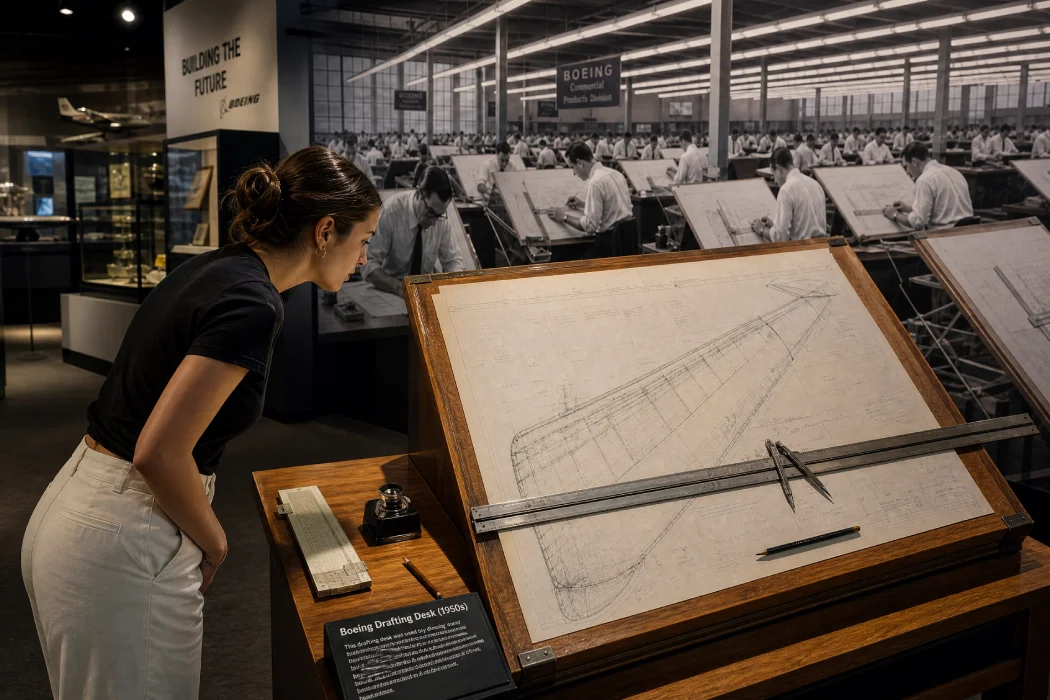
You can, though, see where every one of those hand-drawn designs became reality.
What to Expect on the Boeing Everett Factory Tour
The Boeing Everett Factory Tour is an 80-minute guided experience that starts at the Future of Flight facility. You’ll board a bus, ride across the airport perimeter, and enter the largest building on Earth by volume.
An elevator takes you up to an observation balcony suspended above the factory floor. From there, you look down on the 777 and 777X assembly lines — the very programs whose predecessors were drafted by hand decades ago.
The factory stretches so far that distant walls blur into haze. Below, mechanics, engineers, and assembly teams move through a choreographed process that transforms raw aluminum and composite structures into finished wide-body jets. Overhead cranes carry fuselage sections while wing bodies sit in jigs the size of small buildings. The air smells of sealant and machined metal.
You won’t see drafting boards. But you’ll see what those boards created — and that might be better.
Tickets, Hours, and Visitor Tips
- Tickets: Book through the Boeing Future of Flight website. The tour sells out regularly, especially during summer and holiday weekends.
- Tour duration: 80 minutes total (includes bus transit time to and from the factory).
- Hours: Typically Thursday through Monday, but hours shift seasonally. Check the official site before you go.
- Height requirement: Children must be at least 4 feet (48 inches) tall. No exceptions — safety rule.
| Detail | Info |
|---|---|
| Location | 8415 Paine Field Blvd, Mukilteo, WA 98275 |
| Tour Length | 80 minutes (bus transit + factory balcony) |
| Ticket Price Range | Varies by age, season, and group size — check official site |
| Height Requirement | 48 inches (4 feet) minimum |
| Prohibited Items | Bags, purses, cameras, phones, recording devices — lockers provided |
| Restrooms | Available at Future of Flight, NOT available during factory tour |
| Accessibility | Elevator to factory balcony; contact the venue for wheelchair details |
| Booking Method | Online in advance via the Boeing Future of Flight website |
Your Factory Tour Checklist
- Book tickets online at least a week ahead for peak seasons
- Arrive 30 minutes before your scheduled tour time
- Leave bags, purses, and phones in the free lockers at Future of Flight
- Use the restroom before the tour starts (none inside the factory)
- Wear comfortable, closed-toe shoes
- Bring a light jacket — the factory balcony can be cool
- Visit the Gallery and Sky Deck after your tour
- Stop by the Boeing Store for souvenirs you can’t get anywhere else
What Is the Boeing Everett Factory, and Why Is It Called the World’s Largest Factory?
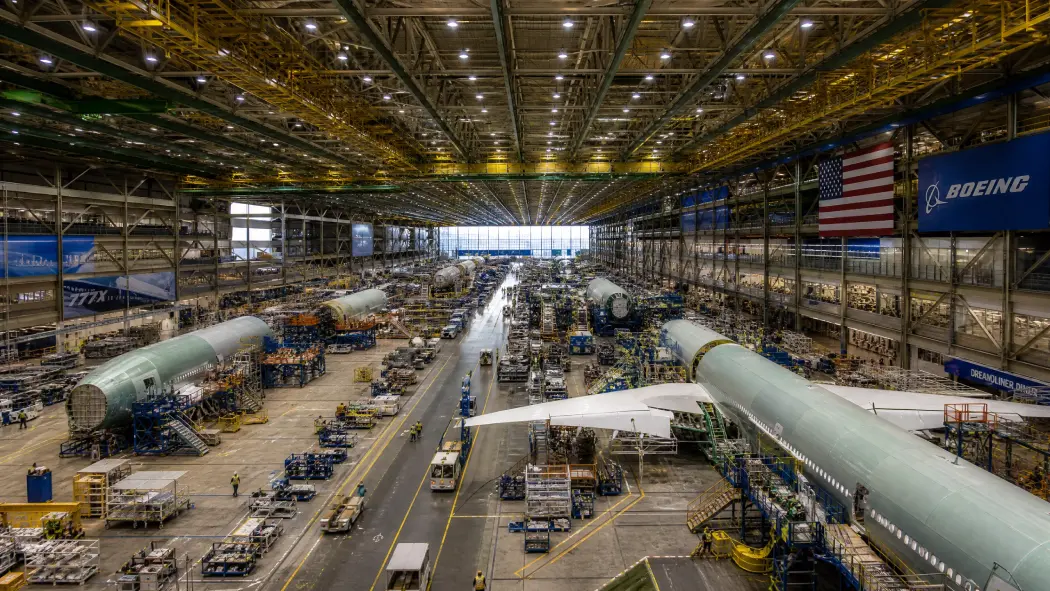
The Boeing Everett Factory holds the Guinness World Record as the largest building on Earth by volume — 472 million cubic feet of enclosed space. Stand at one end, and the far wall disappears into distance and haze.
How Big Is the Boeing Everett Factory?
The numbers alone tell the story:
- Footprint: 98.3 acres under one roof
- Total volume: Approximately 472 million cubic feet
- Length: Roughly equivalent to stacking four 747s nose-to-tail
- Context: Disneyland’s entire Magic Kingdom fits inside with room to spare. So do 75 NFL football fields.
Originally constructed in 1967 to assemble the 747 — then the largest commercial aircraft ever conceived — the factory has expanded multiple times. It has its own fire station, medical clinic, and coffee shops. In the early years, the building was reportedly so vast that clouds sometimes formed near the ceiling before the ventilation system was upgraded.
Six massive doors, each painted with a number, are large enough to fit an entire aircraft being towed through.
Aircraft Built at Everett
The Everett Factory currently assembles:
- Boeing 767 — Commercial freighter and KC-46 tanker variants
- Boeing 777 — The current-generation wide-body workhorse
- Boeing 777X — Next-generation wide-body with folding wingtips
- Boeing 787 Dreamliner — Some production shifted here after the 2021 consolidation
Purpose-built for the 747 program, the facility remains the heart of Boeing’s wide-body manufacturing even after 747 production ended in 2022.
How Does the Boeing Drafting Room Connect to the Prologue Room?
This is where the story comes full circle for visitors.
James S. McDonnell Prologue Room
Inside the Boeing Future of Flight, the James S. McDonnell Prologue Room traces Boeing’s century-plus journey from early biplanes to modern spacecraft. Named after the founder of McDonnell Aircraft Corporation — which merged with Boeing in 1997 — the exhibit displays artifacts, photographs, and models from key aerospace milestones.
The drafting room connection? The Prologue Room showcases the output of those rooms — the aircraft, the spacecraft, the vehicles that started as pencil lines on mylar. Standing in front of an early Boeing 707 model, you can picture someone drawing every contour of that fuselage by hand.
The drafting rooms themselves are gone, but this exhibit preserves the thread. Walking through, you’re seeing the finished work of thousands of draftsmen who spent their careers bent over angled boards, making aviation possible one dimension at a time.
FAQs
Is the Boeing Drafting Room part of the Boeing Factory Tour?
Not directly. The Boeing Everett Factory Tour focuses on the assembly floor, where you’ll see 777 and 777X production. The drafting room’s legacy, though, is visible in every aircraft being built below you.
Where is the Boeing Everett Factory located?
The factory sits at 8415 Paine Field Blvd, Mukilteo, WA 98275 — about 25 miles north of downtown Seattle, adjacent to Paine Field.
Why is the Boeing Everett Factory called the world’s largest factory?
It holds the record as the largest building on Earth by volume at 472 million cubic feet. Originally built in 1967 for the 747 program, it now assembles the 767, 777, 777X, and 787 Dreamliner.
When did Boeing switch from manual drafting to CAD?
The transition happened gradually through the late 1980s and early 1990s. Early 3D CAD software like Computervision CADDS and later CATIA replaced the manual drafting board, though some senior draftsmen retired rather than make the switch.
Conclusion
The Boeing Drafting Room wasn’t just a workplace — it was where precision, creativity, and relentless patience turned engineering concepts into the aircraft we fly today. From hand-drawn mylar sheets stored in fireproof vaults to the 3D CAD models that define modern aerospace, Boeing’s documentation standards rippled across the entire industry.
Planning a trip to Seattle? The Boeing Everett Factory Tour puts you above the assembly line that those draftsmen made possible. Every rivet, every panel, every complex curve started with someone who knew how to speak the language of engineering.
Have you visited the Boeing Factory or the Future of Flight? Share your experience in the comments — we’d love to hear what stood out.
Book your tickets early. They sell out fast.

