

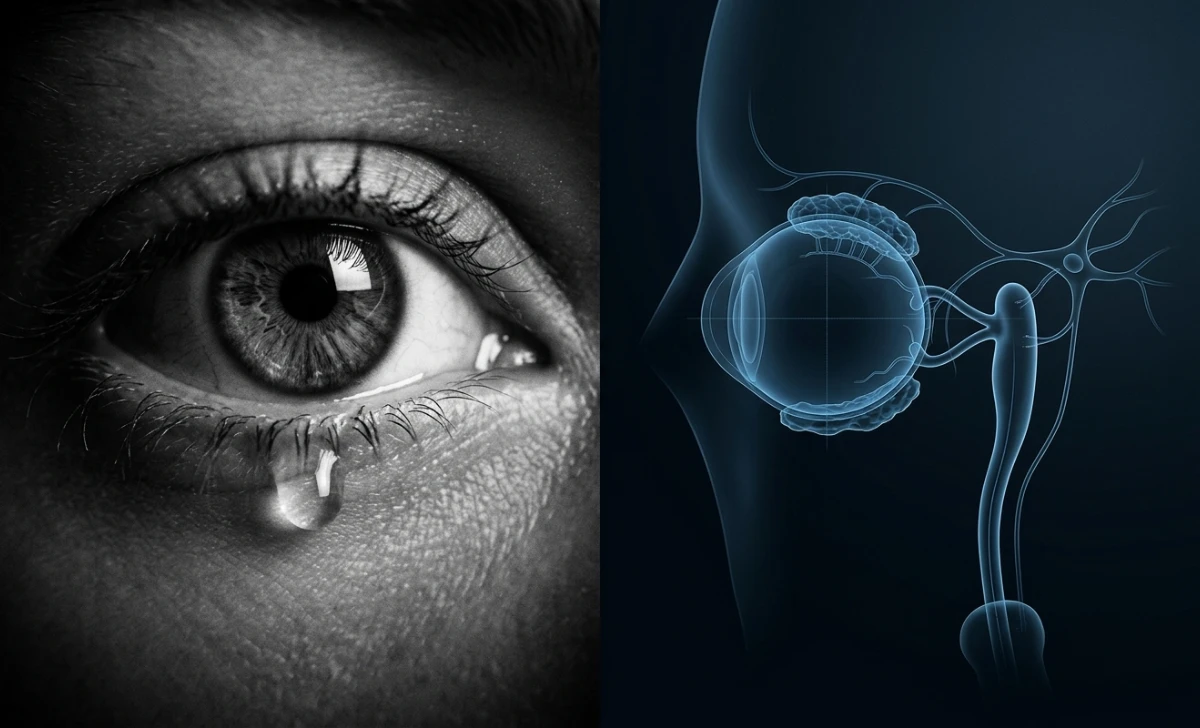
That moment when an actor’s eyes well up, a single tear falls, and an entire theatre falls silent—it feels like pure movie magic. But the truth is far more fascinating than any trick. Professional actors don’t rely on eye drops, menthol sticks, or “just thinking of something sad.” They train a repeatable, professional skill that draws on two distinct approaches: deep psychological recall and precise physical control.
This is the definitive guide to how actors cry on cue, featuring the real techniques, the science behind them, and the iconic performances that prove they work.
The Truth Behind the Tears: No Eye Drops Required
If you’ve ever watched a behind-the-scenes featurette, you may have seen a small tube on a makeup artist’s table and assumed it was a “tear stick” used to chemically induce crying. This is one of the most persistent myths in Hollywood.
Debunking the Tear Stick Myth: Why Hollywood Doesn’t Use Tricks
A tear stick, typically containing menthol, irritates the eyes and causes them to water. It’s a physical reaction, not an emotional one. The problem is that a genuine, emotional cry involves far more than moisture. The audience subconsciously registers authenticity through a dozen micro-expressions: the specific tremor of the chin, the tension in the neck, the involuntary change in breathing rhythm. A chemical irritant can’t replicate this symphony of human emotion. The result is what actors call an “indicated” performance—the outside shape of crying without the inside truth. The eyes water, but the face remains dead. Audiences and casting directors alike spot this immediately. Real actors build a toolkit, not a medicine cabinet.
What Makes a Cinematic Cry Authentic? Emotion vs. Indication
The difference between a great crying scene and a forgettable one is the difference between emotion and indication. Indication is showing the audience you are sad by furrowing your brow and forcing a sob. Emotion is allowing a genuine feeling to physically manifest without resistance. When you watch a performance that devastates you, you’re witnessing an actor who has mastered the art of surrendering to a real impulse. This surrender is not accidental; it is rigorously trained through two core pillars.
 The Neuroscience of Crying
The Two Pillars of Professional Crying
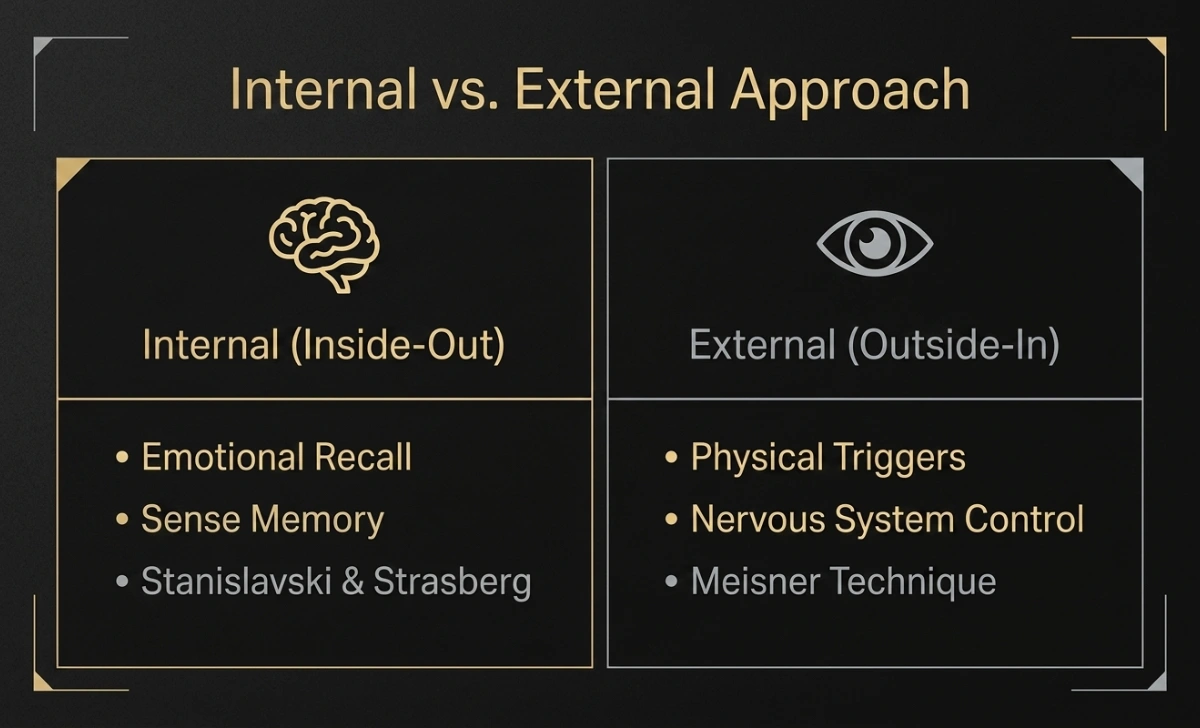
Every method for crying on cue falls into one of two categories. The Internal Approach works from the inside-out by using memory and imagination to generate genuine emotion. The External Approach works from the outside-in by manipulating the body’s physical mechanisms to trigger a tear response, which then invites the emotion to follow. A truly prepared actor is fluent in both, choosing the right tool for the scene, the set conditions, and their own mental health.
| Feature | The Internal Approach (Inside-Out) | The External Approach (Outside-In) |
|---|---|---|
| Core Mechanism | Emotional and Sense Memory | Physical Relaxation and Nervous System Control |
| Key Figure | Lee Strasberg, Konstantin Stanislavski | Sanford Meisner |
| Primary Action | Reliving a sensory-rich personal experience | Releasing muscular tension in the throat, jaw, and eyes |
| Primary Strength | Deeply layered, full-body authenticity | Safe, repeatable, and reliable without personal cost |
| Long-Term Sustainability | Requires disciplined mental hygiene practice | High. The most reproducible method for a long career. |
Emotional Recall and Sense Memory
This is the technique that most people imagine when they think of serious acting. It’s rooted in the idea that a performer can draw upon their own life to fuel a character’s fictional circumstances.
The Stanislavski System and Lee Strasberg’s Method
The foundation for this work was laid by Russian theatre practitioner Konstantin Stanislavski, who developed a “System” for creating truth on stage, later documented in his seminal book An Actor Prepares. His work was adapted and intensified in America by Lee Strasberg at the Actors Studio, becoming what we now know as “Method Acting.” Strasberg’s key contribution, detailed in his book A Dream of Passion, was the formalisation of “affective memory.” This technique requires the actor not to simply remember a sad event, but to re-live the specific sensory details surrounding it to trigger an involuntary emotional response. It’s not about the narrative of a loss; it’s about the feel of a cold leash in your hand and the specific, sharp smell of a room on that day.
How Affective Memory Works: A Step-by-Step Protocol for Actors
Affective memory is the actor’s process of reliving the sensory details of a past event to trigger an involuntary, genuine emotional response in the present moment. This is a professional exercise to be practised in private, never for the first time on a set. The goal is to bypass the thinking, critical brain and access the feeling, limbic brain.
- Achieve Deep Relaxation: Lie down in a quiet space. Breathe deeply until your body feels heavy and your mind stops its constant chatter. This signals to your nervous system that it is safe to deactivate its defences.
- Find a Neutral Sensory Key: This is critical. Do not go to the traumatic memory. Go to a neutral sensory detail from a moment before the sadness occurred. A song playing on the radio. The pattern of light on a rug. The taste of a specific gum. Recreate this detail meticulously.
- Wait for the Involuntary Connection: Stay with the sensory key. Your brain will make the connection to the larger memory without you forcing it. This spontaneous bridge is what triggers a real, unforced emotional wave.
- Surrender to the Physical Impulse: As your throat tightens and your eyes sting, your instinct will be to fight it. You must consciously relax your throat and jaw and let the physical response happen. Replace the command “I must cry now” with the permission, “I will let whatever happens, happen.”
Iconic Internal Performances: How Actors Prepared for Unforgettable Crying Scenes
To understand this technique, you only have to look at its most powerful examples.
“Manchester by the Sea” – Michelle Williams and the Power of Personal Substitution
Michelle Williams’ performance in the devastating street encounter scene is a masterclass in internal preparation. In interviews, Williams has spoken about her process of using a deeply personal emotional blueprint to find the truth of a scene, though she protects the specifics of those private memories. The result is a rawness that feels almost uncomfortably real, a conversation so full of history and pain that it plays out involuntarily across her face. The tremor in her voice is not performed; it is a physical manifestation of a real, accessed emotion.
“Marriage Story” – Scarlett Johansson and Adam Driver’s Emotionally Exhaustive Process
Noah Baumbach’s “Marriage Story” is built on performances so emotionally articulate they feel like a documentary. Both Scarlett Johansson and Adam Driver had to navigate an escalating argument that climaxes in a raw, sobbing breakdown. Their preparation involved exhaustive rehearsal where the emotional stakes were built over time. This wasn’t a switch they flipped; it was a wave they learned to ride. Driver’s visceral, physical explosion—punching a wall, collapsing in tears—demonstrates what happens when internal pressure meets complete physical surrender.
Common Pitfalls: Why Emotional Recall Fails and How to Fix It
The most common failure point is “double-tasking”—trying to cry while simultaneously judging whether you’re doing it well. Self-criticism is a cognitive, analytical function that instantly shuts down the emotional brain. Another pitfall is choosing a memory that is too recent and raw, which can lead to a panic attack rather than a controlled performance. The final mistake is “pushing” the emotion out. Real tears rise; they are not projected. You must invite, not demand.
The External Approach: Mastering the Physiology of Tears
If the internal method feels too invasive or unreliable, the external approach is a technical lifesaver. It’s the most repeatable technique and is based on a simple truth: the body leads, and the mind follows.
Your Lacrimal Glands, Nervous System, and Emotional Release
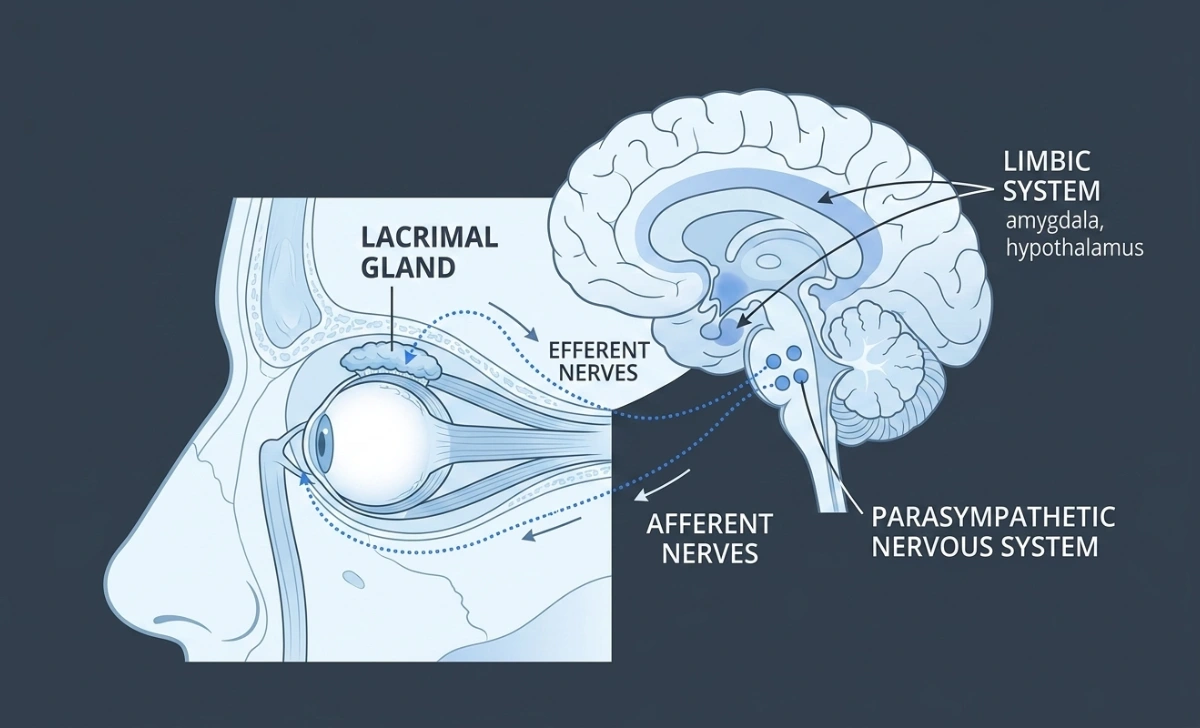
Emotional tears, known scientifically as psychogenic tears, are chemically different from the basal tears that lubricate your eyes or the reflex tears caused by an onion. They are triggered by the parasympathetic nervous system—your body’s “rest and digest” mode. You cannot command this system with force; you can only create the biological conditions for it to activate. The primary condition is profound physical release. Your lacrimal glands, located above each eye, are constantly ready to produce tears, but they are often blocked by tension in the jaw, throat, and eyes. Release the tension, and you release the tears.
3 Physical Triggers to Cry on Command Instantly (No Pain Required)
- The Unwavering Stare: Fix your eyes on a single point and do not blink. The mild corneal dryness triggers a reflexive tear response from your parasympathetic system. The psychological intensity of an unbroken gaze reinforces the signal to your body that an emotional event is occurring.
- The Deep Yawn Sequence: A deep, sustained yawn gently compresses the lacrimal glands, encouraging fluid production. Stringing several yawns together while keeping the jaw slack and throat open can prime the tear ducts without any psychological preparation.
- Complete Jaw and Throat Release: Sit with your jaw hanging loosely open, breathing audibly. This is a state of extreme physical vulnerability. Your brain, sensing no threat or tension, will often permit the expression of emotion that rigid posture suppresses.
Generating Real Emotion from a Scene Partner
Sanford Meisner’s approach is the antithesis of Method Acting. His famous direction was, “An ounce of behaviour is worth a pound of words.” In this technique, the actor’s entire focus is placed on their scene partner, not on a memory. Through a repetition exercise, actors learn to read the subtext, tone, and behaviour of the other person and react truthfully in the moment. A tear born from a Meisner exercise isn’t from your own sadness; it’s a genuine human reaction to the way your partner just looked at you. It is an immediate, unguarded truth.
Performances That Used External Techniques
The external approach often produces a different, more spontaneous-feeling kind of performance.
How Meisner-Trained Actors Like Sam Rockwell Access Deep Emotion
Sam Rockwell is a prime example of a Meisner-trained actor whose work is characterised by a sense of danger and spontaneity. He’s not showing you a planned emotion; he is reacting to the moment. In his most emotional scenes, you can see him physically listening to his partner, allowing a genuine reaction to surface without premeditation. This “in-the-moment” truth is the pinnacle of the external approach.

The Role of Breath Control in Florence Pugh’s “Midsommar” Breakdown
Florence Pugh’s harrowing performance in Ari Aster’s “Midsommar” showcases a masterful command of external physiology. Her character’s opening-scene grief is a visceral, full-body wail that feels terrifyingly real. This isn’t a mental process; it is a physical one. By using shallow, staccato, hyperventilating breaths, she artificially forces her body into a state of extreme distress. Her nervous system, responding to the physical signals of panic, releases a torrent of real, raw emotion. Her body believed the signal, a directorial collaboration that yielded one of modern cinema’s most devastating moments.
Sustainability and Control
A true professional isn’t just someone who can cry; it’s someone who can cry safely, repeatedly, and to the exact specification a director needs.
How Actors Safely Exit Intense Emotional States
After an intense scene, “shaking it off” is dangerously amateurish. An actor has just convinced their body they were in a real crisis. They must now convince it that the emergency is over. This is de-roling. A standard technique is a Sensory Reset: splashing freezing water on your face and wrists, smelling a sharp, prepared scent like peppermint or citrus, and verbally stating banal facts about the current reality (“The set is cold. The floor is plywood. My scene is complete.”). This process signals to the nervous system that the psychophysical event has ended, guarding against emotional hangover and long-term burnout.
How Directors Shape a Crying Scene for the Camera
Crying is not one-size-fits-all. A skilled actor modulates their performance based on the lens. A full, shaking, sobbing breakdown is a controlled loss of control, driven by breath, and works best in a wide shot where the entire body is visible. A single, perfect tear rolling down a cheek in a 50mm close-up, however, is infinitely more difficult and more effective. To achieve this, the actor must hold immense emotional pressure internally while consciously relaxing every external muscle, allowing only the chin to quiver almost imperceptibly. The mastery is in the restraint—letting the camera discover the emotion in a still frame rather than pushing it out.
Demonstrating Emotional Range in an Audition
In a casting room, crying on cue is less important than emotional availability. Casting directors don’t necessarily want to see you cry; they want to see you try not to cry and fail. They are looking for the fight against the emotion. This demonstrates control, vulnerability, and a deep understanding of the human condition. Being able to show this authentic struggle in a 60-second self-tape is what books a role, and it requires a command of both the internal and external toolkit.
FAQs
Do actors really cry, or is it all fake?
Yes, the vast majority of dramatic performances feature genuine, real tears produced through technique, not artificial aids. It is a core professional competency.
What’s the easiest method to start learning?
The “Yawn-Technique” from the external approach is the safest and most accessible starting point. It teaches the necessary feeling of muscular release in the face and throat without any psychological risk.
Can anyone learn to cry on command, or is it a natural talent?
It is a learned skill. While some individuals may be naturally more emotionally labile, the ability to do it on command, under hot lights, on take twelve, is a technique that is studied and practised.

