

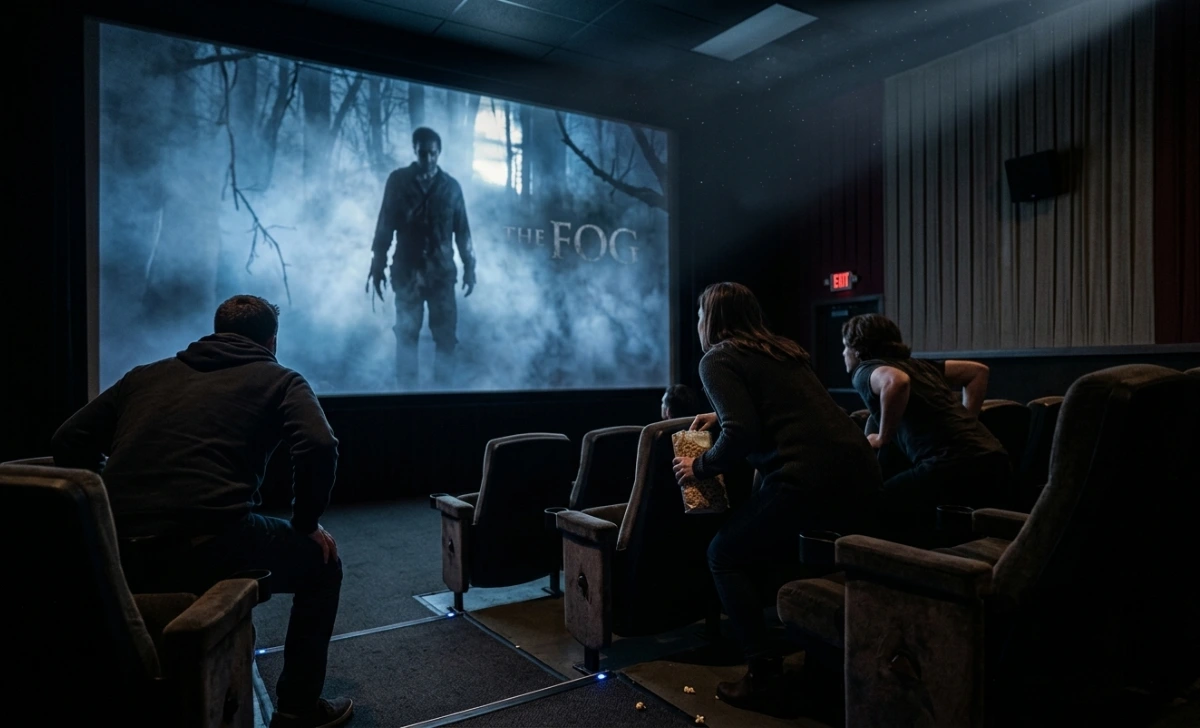
You’re sitting in a dark Theater; the tension is palpable, and the protagonist slowly opens a creaking door. The camera lingers on a dark corner… and then a cat jumps out. You laugh, feeling relief. But just as you relax, the real threat explodes from the shadows, accompanied by a shrieking string. Your heart races, and you nearly leap out of your seat.
We’ve all experienced it.
- But why does this specific cinematic device trigger such a powerful response?
- Why does a jump scare work even when you know it’s coming?
The answer lies at the intersection of neuroscience, filmmaking craftsmanship, and the fascinating psychology of fear.
The Biological Blueprint: Why Your Body Reacts
Understanding the jump scare starts with understanding what happens inside your body the moment it occurs. It’s not just a feeling of being startled—it’s a complex, involuntary biological cascade.
The Startle Response: An Ancient Reflex
At the core of every jump scare is the startle response, a primitive brainstem reflex designed to protect you from sudden threats. This reflex requires no higher-level cognitive function—it’s wired directly into your nervous system, bypassing conscious thought.
When a jump scare hits, your body reacts before your brain has time to process what you’re seeing. The pathway is remarkably direct: a sudden auditory stimulus is sensed in the cochlea, travels through the auditory nerve to the brainstem, and triggers a full-body reflex—all in approximately 14 milliseconds. That’s faster than you can consciously register the sound.
This is why you can’t simply “train” yourself not to react. No matter how many horror movies you watch, the startle response remains involuntary.
As one researcher put it, “We hardly need a brain to be affected by the jump scare.”
The Amygdala and the Fight-or-Flight Cascade
Once the startle response is triggered, it activates a chain reaction throughout the body. The amygdala—the brain’s fear-processing centre—signals the hypothalamus to initiate a stress response.
The result is a flood of adrenaline and cortisol, hormones that prepare your body for action. Your heart rate increases, breathing quickens, and senses sharpen. Your blood even thickens slightly to prepare for potential injury.
Interestingly, the amygdala activity of everyone watching a horror film becomes synchronised during jump scare scenes, regardless of their individual fear levels. This synchronisation highlights how effective well-crafted scares can be at generating a collective, involuntary response.
Deconstructing the Formula: The Anatomy of a Jump Scare
A truly effective jump scare is not accidental. It follows a careful, deliberate formula that filmmakers have refined over decades of horror cinema.
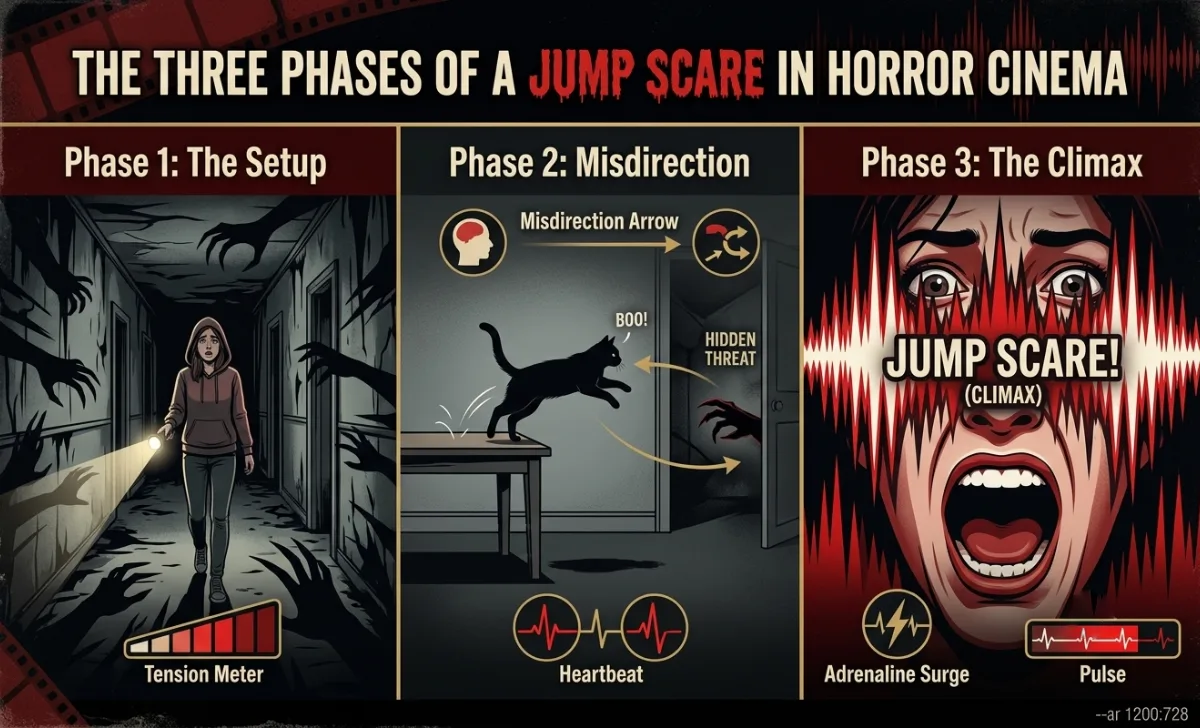
Phase 1: The Setup — The Art of Pacing and Dread
Before a jump scare can land, the audience must be primed. This setup phase establishes a sense of safety or normalcy while simultaneously building tension.
Horror screenwriter C. Robert Cargill famously compared jump scares to magic tricks, noting that both rely on misdirection. The “pledge” phase of a jump scare, as described in The Prestige, introduces the audience to a situation that promises fear, only to temporarily diffuse it.
Filmmakers use several techniques during the setup:
- Cinematography that creates shadows and potential hiding spots
- Sound design featuring silence or subtle, unnerving tones
- Pacing that builds dread without revealing the threat
Phase 2: The Misdirection — The Cinema of Deception
Misdirection is perhaps the most crucial element of a successful jump scare. If the audience sees it coming, it’s not a jump scare—it’s just something happening.
Filmmakers direct audience attention away from the imminent threat in several ways:
1. False scares
False scares (also called “fake-outs”) are among the most effective misdirection techniques. A sudden noise from a cat or a friend closing a door creates a moment of relief—a psychological reset that makes the real scare seconds later exponentially more powerful.
2. Visual misdirection
Visual misdirection involves drawing the audience’s eye to one part of the frame while the true threat lurks elsewhere. James Wan, director of The Conjuring and Insidious, is a master of this technique, often filling his frames with multiple points of interest while subtly hiding the threat in plain sight.
3. Sound cues
Sound cues can also direct attention. A character might hear a sound behind them, drawing the viewer’s focus to that area, while the actual threat materialises from a different direction.
Phase 3: The Climax — Sound, Editing, and the Violin Sting
The payoff is where the hidden threat is suddenly revealed, typically accompanied by a jarring audio cue—often a high-pitched “stinger” or “violin shriek.”
For maximum effectiveness, the sound must meet specific criteria: it needs to be sudden, high-intensity (typically at least 90 decibels), and reach that intensity quickly. If the rise time to reach that volume is too long, the startle effect diminishes significantly.
This is why a jump scare that “builds” slowly or uses a long, drawn-out sound is less effective. The startle response is triggered by the suddenness of the stimulus, not its ultimate loudness.
The 3-Phase Formula
- Phase 1: The Setup — Build dread through pacing, silence, and visual cues
- Phase 2: The Misdirection — Redirect attention using false scares, visual cues, or sound
- Phase 3: The Climax — Deliver the shock with a sudden visual and loud audio sting
The Sound of Fear: Why Silence Is Scarier Than Noise
Sound design is a critical component of jump scare psychology that deserves its own consideration. The most effective jump scares often begin with silence or near-silence, creating a sensory void that primes the audience for impact.
The acoustic startle response is triggered by a sudden, intense auditory stimulus. Research has shown that the effect is greatest when a sound reaches high intensity within a short period after the initial onset. This means that a sudden, sharp noise is far more startling than a gradually increasing one, even if both ultimately reach the same volume.
This is why the “violin stinger”—a sudden, high-pitched shriek—is such an effective tool. It exploits our evolutionary response to sudden loud noises, which are associated with danger in the natural world.
Modern horror directors have also experimented with infrasound—low-frequency sound waves below the range of human hearing—to create a sense of unease. These frequencies can cause physical sensations of anxiety and dread without the audience consciously hearing anything unusual.
From Cheap Thrills to Masterful Shock: What Makes a Jump Scare Effective?
Not all jump scares are created equal. Some feel like an earned payoff; others feel manipulative and “cheap.”
The “Cheap” Jump Scare: Flash Without Substance
A cheap jump scare relies solely on the startle response without any meaningful setup. It’s a loud noise and a sudden image, but it lacks narrative or emotional investment. These scares often feel unearned and can actually diminish a film’s overall impact by training the audience to expect empty manipulation.
What makes a jump scare feel cheap?
- A loud noise without a corresponding visual threat
- The threat appears “out of nowhere” without narrative justification
- No meaningful consequence or character impact
- Overreliance on the same technique repeatedly
The “Effective” Jump Scare: Character Investment and Payoff
An effective jump scare requires audience investment. You must care about the character in danger and understand the stakes of the threat. The fear comes not just from the shock, but from the feeling of empathy for the character.
What makes a jump scare effective?
- Built on narrative logic and character stakes
- The setup pays off in a meaningful way
- The scare serves the story rather than just shocking the audience
- The aftermath has consequences for the characters
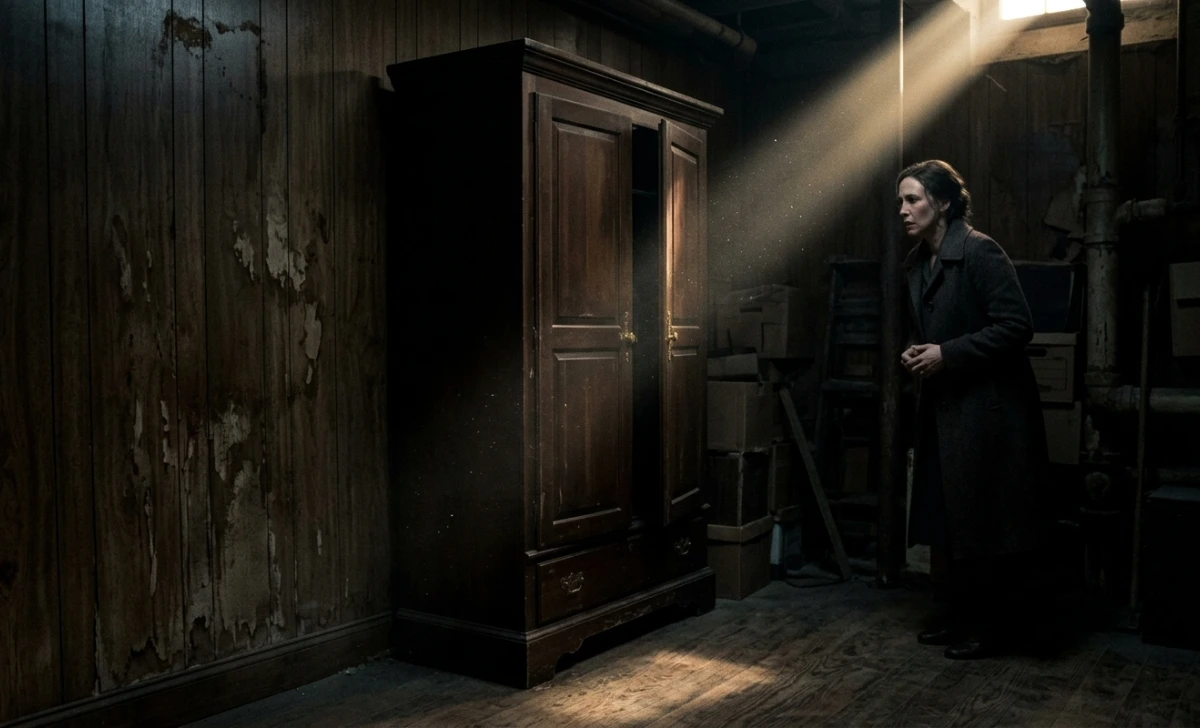
The Clapping Scene in The Conjuring
James Wan’s The Conjuring (currently streaming on Max) features one of cinema’s most effective jump scares. In the scene, a character investigating a dark basement hears a sound—two distinctive claps—coming from the darkness.
What makes this scene so effective is the setup. The audience has been primed to fear the basement, to fear the darkness, and to fear the ghost that haunts it. When the claps come, they represent a violation of the character’s (and audience’s) expectations. The threat is established, but the timing and source of the threat are completely unexpected.
The film, produced by New Line Cinema, features Patrick Wilson and Vera Farmiga as the Warrens, whose genuine reactions to the supernatural threat ground the scare in emotional reality.
The Dinner Table Scene in Insidious
Perhaps even more impressive is the now-famous dinner table scene in Insidious (currently available to stream on Prime Video and Hulu), where the demon—often referred to by fans as the “Lipstick-Face Demon” or “Darth Maul demon”—suddenly appears behind a character in the middle of a seemingly ordinary moment.
The scene is terrifying, not because of a loud noise (though there is a sharp audio cue), but because of the violation of domestic normalcy. A creature is standing there, in the light, watching. The horror comes from the realisation that this threat has been present all along, invisible to the characters but visible to the audience.

Why We Enjoy the Adrenaline Rush
If jump scares are so unsettling, why do we keep coming back for more? The answer lies in the aftermath of the experience.
Catharsis and the Dopamine Hit
The fight-or-flight response is physically and mentally taxing. After the immediate threat has passed, the body works to return to its normal state. This process of physiological release can feel incredibly good.
The sudden surge of neurochemicals—including adrenaline and dopamine—is followed by a wave of endorphins, the body’s natural painkillers. This creates a state of euphoric relief, often leading to nervous laughter or excited conversation after the scare. This post-scare catharsis is a significant reason why horror fans keep coming back.
Horror as a Controlled Environment
When we watch a horror movie, we are in a controlled environment. Our brain knows, on some level, that the threat on screen is not actually present. This allows us to experience the exhilarating high of the physiological fear response without any real danger.
This is why horror has been called “safe fear.” It provides a break from everyday stress while allowing us to feel something intense and exciting. Fear becomes an opportunity to experience strong emotions in a society that often encourages emotional numbing.
Interestingly, researchers have also proposed that the jump scare’s ability to generate intense responses in spite of the audience’s awareness of fictionality makes it an ideal paradigm for studying emotional processing.
Conclusion
The jump scare is not just a cheap trick—it’s a sophisticated interplay between our biology and filmmaking artistry. It works by exploiting the primitive startle response, creating an involuntary reaction that is then amplified by masterful setup, misdirection, and a carefully timed sensory explosion.
Understanding the psychology of jump scares reveals that you aren’t just a passive victim of a loud noise. You are an active participant in a carefully orchestrated experience. The fear you feel is real, even though the threat is not. And that paradox—the ability of film to generate genuine fear through fictional means—is precisely why we keep coming back for more.
The next time you find yourself gripping the armrest in a dark theatre, remember: the filmmaker has used every tool at their disposal—neuroscience, sound design, editing, and storytelling—to manipulate your brain. And you may just enjoy every second of it.
FAQs
Why do jump scares scare us?
Jump scares trigger the acoustic startle response, a rapid, involuntary brainstem reflex that bypasses conscious thought. This is reinforced by the amygdala’s fight-or-flight response, flooding the body with stress hormones before the brain can assess whether the threat is real.
Why do I jump even if I know it’s coming?
The startle response is segregated from cognitive thought. It requires no higher-level brain function and occurs before the auditory cortex can even process the sound. This is why you can’t simply “prepare” yourself to avoid reacting.
Why do we laugh after a jump scare?
Laughter is a physiological release of the nervous energy generated by the fight-or-flight response. It signals to ourselves and others that the “danger” has passed and serves as a social bonding mechanism.
What is the difference between suspense and a jump scare?
Suspense is the anticipation of a future threat—the feeling of dread that builds over time. A jump scare is the sudden, often unexpected culmination of that threat. Suspense amplifies the impact of a jump scare by putting the body on high alert.
Are jump scares effective on everyone?
Individual responses vary based on personal experience, sensitivity to loud noises, and even past trauma. However, the basic startle response is universal across humans and many animal species.
Can jump scares be considered high art?
While often dismissed as “cheap” by film critics, well-crafted jump scares that serve the story and build on audience investment can be masterfully executed. Directors like James Wan and Alfred Hitchcock (who excelled at suspense) have elevated the technique.
Where can I watch The Conjuring and Insidious?
The Conjuring is currently streaming on Max, while Insidious is available on Prime Video and Hulu. Streaming availability changes frequently, so check your preferred platform for current options.

