


The parent-child bond is the single most studied relationship in developmental psychology — and for good reason. How consistently a parent responds to a child’s needs shapes that child’s brain development, emotional health, academic performance, and adult relationships. Yet most parents are never taught how bonding actually works, or what to do when it feels strained.
This guide covers the science behind secure attachment, practical strategies for every stage from newborn to teenager, and honest guidance for real-life constraints — including working long hours, single parenting, and repairing a relationship that has grown distant.
What Is the Parent-Child Bond?
The parent-child bond is the emotional connection between a caregiver and a child, built through consistent, responsive, and loving interaction over time. It is not fixed at birth — it is an ongoing relationship that develops across years, can be strengthened at any stage, and can be repaired even after significant strain.
Bonding refers to the process itself. Attachment describes the developmental outcome of that process.
Why the Bond Shapes Almost Everything
Children with a secure bond to their caregivers show stronger emotional regulation, higher self-esteem, greater academic achievement, and healthier relationships throughout their lives. Research published in peer-reviewed developmental journals consistently links secure attachment to reduced risk of substance use, mental health difficulties, and risky behaviour in adolescence.
One finding surprises most parents: 63% of adolescents report turning to their parents — not peers — when facing important decisions. The bond does not lose relevance as children grow older. It changes shape.
When the bond is weak or disrupted, children often show emotional withdrawal, persistent behavioural difficulties, and poor peer relationships. These patterns can extend into adulthood and, without intervention, repeat across generations.
The Science of Bonding: Attachment Theory Explained
John Bowlby and the Secure Base Concept
British psychologist John Bowlby described healthy parent-child attachment through one lasting image: a secure base. The child explores the world confidently because they know they can return to a reliable, warm caregiver when distressed. Two conditions produce this base: the caregiver responds consistently to the child’s physical, emotional, and social needs, and the two share interactions that are genuinely enjoyable for both.
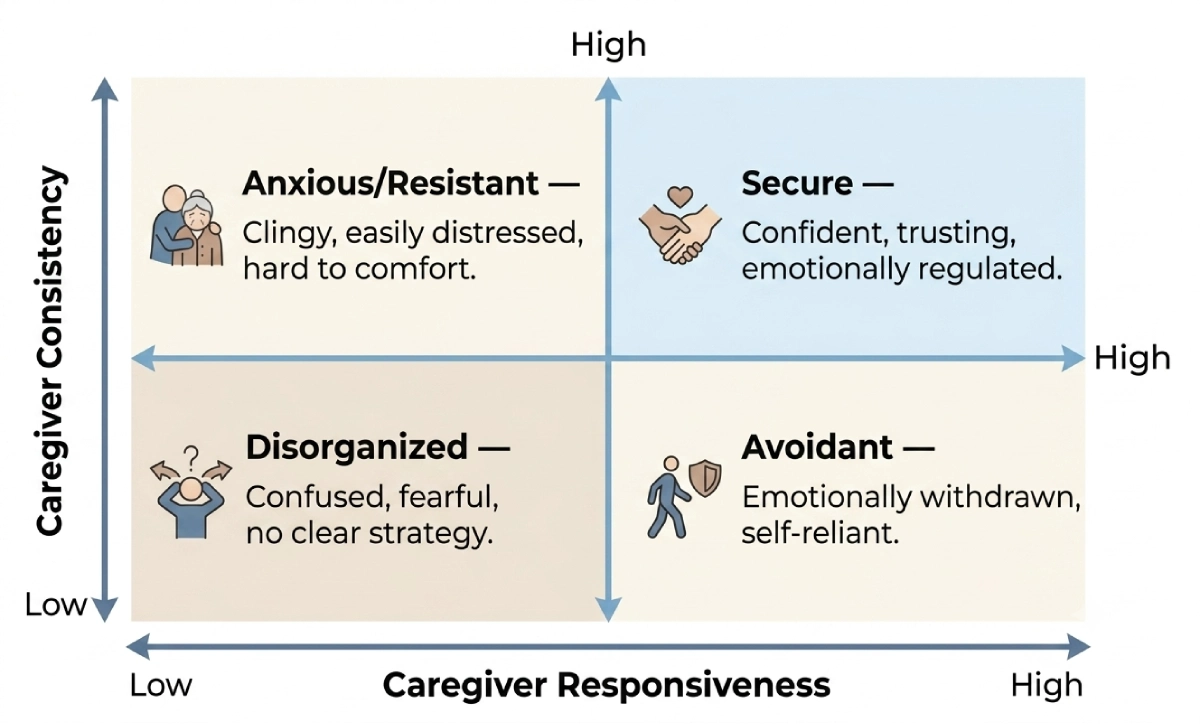
The Four Attachment Styles (Mary Ainsworth)
Psychologist Mary Ainsworth expanded Bowlby’s work by identifying how bonds actually differ in practice, using her landmark Strange Situation experiment.
| Attachment Style | What It Looks Like | Associated Parenting Pattern |
|---|---|---|
| Secure | Upset at separation; quickly comforted on return; confident exploration | Consistent, responsive caregiving |
| Avoidant | Little distress at separation; avoids caregiver on return | Emotionally unavailable or dismissive caregiving |
| Anxious/Resistant | Extreme distress; not easily comforted on return | Inconsistent responsiveness |
| Disorganized | No coherent strategy; confused or fearful responses | Frightening or unpredictable caregiving |
Secure attachment does not require perfect parenting. It requires consistent enough parenting that a child trusts the relationship will hold.
Understanding where your natural tendencies sit across these patterns is a useful starting point. This overview of the main parenting styles explains how each one develops and what it tends to produce in children over time.
How Early Bonding Programs Future Relationships
Children develop what researchers call internal working models — mental templates for what relationships feel like and whether they can be trusted. These models begin forming by 12 months and shape how a child approaches friendships, romantic partnerships, and eventually their own parenting decades later.
The Biology Behind the Bond
Bonding is physiological as well as emotional. Physical closeness, eye contact, and responsive touch trigger oxytocin release in both parent and child. Secure attachment also lowers cortisol levels in children — a strong bond literally reduces a child’s biological stress response. This is why co-regulation comes before self-regulation: a child cannot calm themselves until they have repeatedly experienced being calmed by someone else.
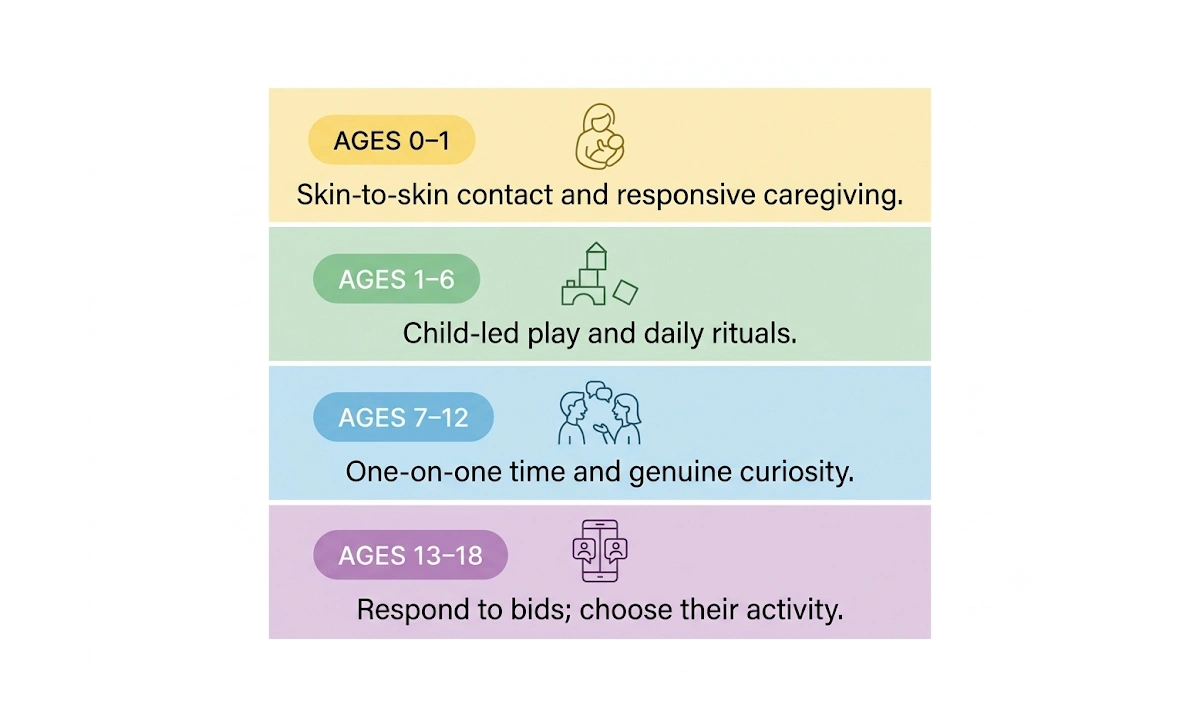
Bonding by Age: Stage-by-Stage Strategies
Newborns and Infants
Skin-to-skin contact is supported by the American Academy of Paediatrics as a standard of early care. It stabilises the newborn’s body temperature, reduces crying, and supports cardiorespiratory function — particularly in late preterm infants. Fathers benefit from skin-to-skin contact as much as mothers, though this is rarely discussed.
Responsive caregiving means noticing your baby’s signals — a cry, a gaze, a reach — and answering them consistently. Research shows that responding approximately 30% of the time is sufficient to build secure attachment, provided responses are warm and genuine when they occur. What matters is that the child learns: my signals get answered. I can trust this person.
A note for fathers: Studies show that some fathers do not feel a genuine bond with their infant until six to eight weeks after birth. Many carry this quietly, assuming something is wrong with them. There is biological context here — testosterone levels drop in expectant fathers in the months before birth, preparing them for caregiving. The bond for fathers typically builds through action: feeding, carrying, bathing, playing. Fathers experiencing persistent emotional numbness or withdrawal should be aware that paternal postpartum depression is real, under-recognised, and treatable.
Toddlers and Early Childhood (Ages 1–6)
Child-led play is one of the most consistently effective bonding methods in clinical practice. The technique called “special time” involves a daily 10–15 minute period during which the child leads, and the parent follows — no directing, no correcting, no teaching. No agenda. No screens. Just full attention.
Predictable daily rituals — a specific bedtime song, a Friday park visit, a handshake before school — communicate something children cannot yet articulate: the world is consistent, and you are safe in it. Rituals need to be repeated, not elaborate.
Managing tantrums without damaging the bond: When a toddler melts down, the instinct to correct or withdraw can signal that love is conditional. Co-regulation — staying physically present, using a calm voice, acknowledging the emotion without rewarding the Behavior — teaches the child that their emotional storms are survivable and that the relationship holds through difficulty. “I see you are upset. I am here” is a complete and powerful response.
School-Age Children (Ages 7–12)
Individual time matters more than group time. With multiple children, family time is valuable but does not replace one-on-one attention. Even 20 minutes a week of undivided, child-directed time builds self-esteem and deepens the bond measurably. It tells each child they are seen as a specific person, not just a member of the household.
Show interest in their world, not just their performance. “How was school?” is a closed door. “What made you laugh today?” is an open one. Children whose parents show genuine curiosity about their interests and friendships are more likely to bring their real problems home rather than turning elsewhere.
Boundaries and warmth together: Authoritative parenting — firm expectations combined with warmth and explanation — produces the strongest attachment outcomes. Authoritarian parenting (high control, low warmth) generates compliance but erodes trust over time. Permissive parenting (high warmth, low structure) leaves children anxious. Children do not need perfect freedom or perfect control. They need consistent, explained limits delivered with care.
For a closer look at how this approach works in practice, this guide on what authoritative parenting actually means breaks down its core principles and why developmental researchers consistently support it.

Teenagers
Why Pulling Away Is Normal
Adolescence is not rejection — it is identity formation. The task for parents shifts from holding close to staying available. Teenagers who pull away are not abandoning the bond. They are testing whether it holds without constant maintenance. Research confirms that secure attachment in adolescence produces the same developmental benefits as in early childhood.
Responding to Bids for Connection
Researcher John Gottman introduced the concept of “bids” — small, often quiet requests for attention or connection. A teenager showing you a meme, asking to watch something together, or lingering near the kitchen while you cook: all of these are bids. Turning toward those bids — even briefly, even imperfectly — is the primary way the parent-teen bond survives adolescence. Consistently ignoring them does more damage than outright conflict.
Side-by-Side Over Face-to-Face
“We need to talk” is one of the least productive approaches with teenagers. Side-by-side activities — a drive somewhere, cooking together, a game night — lower defences and invite conversation naturally. The critical detail: choose something the teenager actually wants to do.
Technology Is Not the Enemy
Treating all screen time as an obstacle to connection is counterproductive. Co-viewing, playing games together, and showing genuine interest in a teenager’s online world can function as bids for connection. The goal is shared presence, whatever the medium.
Bonding Under Real-Life Constraints
Working Parents
Research consistently shows that intentional, present time outperforms passive co-presence. Twenty minutes of full attention — phone away, eye contact, child-led — is worth more developmentally than two hours of distracted proximity. Transition moments carry disproportionate weight: the first ten minutes after school, the car ride home, the space between dinner and bedtime.
Single Parents
Single parents carry the full emotional load without a co-regulating partner. The specific challenge is not time alone — it is cumulative depletion. A parent running on empty cannot offer genuine presence. Self-care is not separate from bonding capacity; it directly determines it. Small, daily recovery practices protect a parent’s ability to show up consistently, which is the foundation of secure attachment.
Breaking Intergenerational Patterns
UNICEF and child development researchers consistently note that parenting skills can be learned regardless of one’s own upbringing. Attachment patterns can transmit across generations, but they are not deterministic. The act of becoming conscious of your own attachment history and choosing different responses is itself a protective factor. Therapy, parent education programs, and peer support all reduce this transmission significantly.
How to Repair a Strained Parent-Child Bond
Recognizing the Signs
Signs vary by age. In young children: increased clinginess, regression, or unusual withdrawal. In school-age children: frequent defiance, emotional outbursts, or reluctance to share. In teenagers: near-total withdrawal, hostility, or seeking all emotional support outside the home.
Not every difficult phase signals a broken bond. A persistent pattern across multiple areas warrants attention.
A Repair Process That Works
- Acknowledge the distance without blame. Name that things have felt disconnected, without assigning fault or demanding explanation.
- Restart small. Grand gestures often backfire. Low-pressure, child-led connection attempts build more than elaborate plans.
- Prioritise consistency over intensity. Showing up predictably matters more than showing up dramatically.
- Repair after conflict. Genuinely acknowledging what went wrong — without conditions — builds trust faster than conflict-free relationships.
- Stay present through resistance. A child who has been hurt will test whether the renewed connection holds. Remaining warm and consistent through that testing period is the repair itself.
When to Seek Professional Help
Family therapy is not a last resort — it is a tool. Seeking it early produces better outcomes than waiting until a relationship is severely strained. Signs that professional support is warranted: prolonged emotional withdrawal in the child, persistent hostility after repeated repair attempts, or a parent recognising that their own unresolved history keeps getting in the way.
Daily Habits That Keep the Bond Strong
Full presence over shared space. Being in the same room is not the same as being present. Research on parental phone use during play shows that even brief interruptions disrupt a child’s sense of being seen. Putting the phone down and fully arriving — even for 20 minutes — is one of the most consistent bonding practices available.
Open communication as a daily habit. Trust is built in hundreds of low-stakes conversations, not crisis ones. Daily check-ins and a consistent posture of listening before responding create an environment where children bring their real problems.
Physical warmth across all ages. The form changes — a hand on a teenager’s shoulder means something different than a lap for a toddler — but the signal is the same: you belong here, this is safe. Respect each child’s autonomy around physical affection while continuing to offer it.
Apologise when you get it wrong. Parental apologies are among the most powerful bonding tools available, and among the most underused. When a parent says “I was wrong, and I am sorry,” they teach the child that relationships survive mistakes, honesty is safe, and repair is always possible.
Conclusion
The parent-child bond is not something you either have or you do not. It is built in thousands of small moments, repeated over years.
The research is clear: the quality of this relationship shapes how a child manages emotions at age six, forms friendships at age twelve, and builds their own relationships at age thirty. And it is never too late to strengthen it.
Start where you are. Respond to the next bid for connection your child offers, however small. Put the phone down for twenty minutes tonight. Apologise when you get it wrong. These are not small acts — they are exactly how a strong bond is made.
If you are looking for words that capture what this relationship means, these inspiring parenting quotes offer perspective from parents, researchers, and writers who have thought deeply about raising children well.
FAQs
What is the parent-child bond?
The parent-child bond is the emotional connection between a caregiver and a child, built through consistent, responsive, and loving interaction over time. It forms the foundation for a child’s emotional, cognitive, and social development.
When does bonding begin?
For mothers, bonding often begins during pregnancy through hormonal and physical connection. For fathers and adoptive parents, bonding typically builds through direct caregiving after birth. Many parents — particularly fathers — do not feel an immediate bond, and that is normal.
What does a healthy parent-child bond look like?
A child who feels safe enough to explore independently, returns to the parent for comfort when distressed, communicates openly, and responds to warmth without anxiety or avoidance.
How much time do I need to spend with my child each day?
Quality consistently outperforms quantity. Twenty minutes of undivided, fully present interaction daily produces stronger attachment outcomes than hours of distracted time in the same space.
Can a broken parent-child bond be repaired?
Yes — at any age. The repair process requires acknowledging the distance, restarting with small and consistent connection attempts, and remaining present through the child’s initial resistance. Genuine repair after conflict can actually deepen trust over time.
How do I bond with a teenager who pushes me away?
Respond to their small, quiet bids for connection. Stay available without forcing conversation. Choose shared activities they enjoy. Relinquish control where you can, and stay consistent where you must.
I didn’t bond with my newborn immediately. Is it too late?
No. Many parents do not experience an immediate bond. It builds through repeated interaction. There is no expiration date on forming a strong attachment.
I had a difficult childhood. Can I still build a secure bond with my child?
Yes. Parenting skills can be learned regardless of your own upbringing. Awareness of your own attachment history is itself a protective factor — it allows you to make conscious choices rather than repeating inherited patterns.
My teenager prefers their friends over me. Is our bond broken?
Not necessarily. Turning toward peers is developmentally normal in adolescence. What matters is whether your teenager still turns to you in moments of real difficulty. If they do — even occasionally — the bond is intact. Stay available and respond to small bids.

