

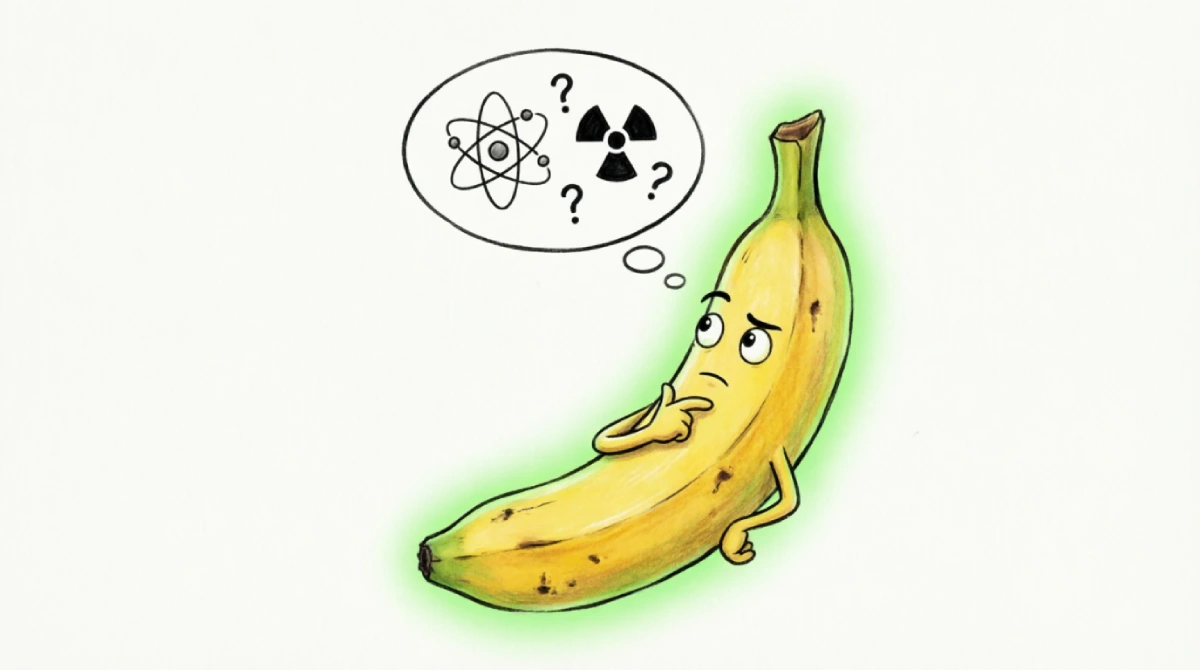
Your banana is radioactive. That’s a confirmed scientific fact.
Before you do anything with that information — here’s the part most articles skip: you are far more radioactive than the banana. About 280 times more, to be specific. So if banana radiation worries you, you’ve been sitting next to the real problem your entire life.
Here’s how it all works.
Why Bananas Are Radioactive
Bananas contain potassium. You likely already knew that — athletes reach for them after cramps for exactly this reason. What most people don’t know is that a small fraction of all potassium on Earth is naturally radioactive. That fraction is called potassium-40, or K-40.
K-40 is an unstable isotope. Its nucleus slowly breaks apart over time, releasing radiation as it does. This isn’t a lab-created chemical or industrial byproduct — it’s been part of Earth’s natural composition for billions of years. K-40 has a half-life of 1.3 billion years, which means it decays so slowly that only a few thousand atoms break down per second in any given sample.
About 0.012% of all potassium is K-40. One average banana contains roughly 450 milligrams of potassium, which puts its radiation output at around 0.1 microsieverts. That number is about to get some context.
You’re Already More Radioactive Than the Banana
A typical adult body contains around 140 grams of potassium, of which roughly 16 milligrams is K-40. That makes you approximately 280 times more radioactive than a banana.
Eating a banana increases your total K-40 by about 0.4%. It’s real and measurable — a sensitive Geiger counter can detect it. But the effect is temporary. Your metabolism tightly regulates potassium levels, and the excess is excreted within hours.
One concrete illustration of just how much K-40 is in bananas: a lorry loaded with bananas carries enough radioactivity to trigger false alarms on radiation detectors used to screen for smuggled nuclear weapons. The detectors are sensitive enough to flag it. The bananas are harmless enough that this is funny, not frightening.
What Is the Banana Equivalent Dose?
Scientists and science communicators developed a reference unit to make radiation comparisons easier to grasp. It’s called the Banana Equivalent Dose, or BED.
The BED uses the radiation from one banana as a reference point. It’s not an official scientific unit — but it puts abstract numbers into something people can picture.
Here’s what that looks like in practice:
| Exposure | Microsieverts | Banana Equivalent |
|---|---|---|
| One banana | 0.1 | 1 banana |
| Dental X-ray | ~5 | ~50 bananas |
| Chest X-ray | ~100 | ~1,000 bananas |
| Cross-country flight (NY to LA) | ~40 | ~400 bananas |
| Annual background radiation | ~2,400 | ~24,000 bananas |
You’re absorbing radiation constantly — from soil, from the sky, from the walls around you. A banana adds a fraction of what you’re already getting every day.
How Many Bananas Would Actually Be Dangerous?
This is where the math gets clarifying.
Researchers use a unit called a micromort to quantify risk — one micromort represents a 1-in-1-million increase in the risk of death. A dose of 10 millirem (roughly 100 microsieverts) equals one micromort. Since one banana delivers about 0.1 microsieverts, it would take approximately 1,000 bananas to increase your lifetime death risk by one in a million.
For a dose large enough to cause death, the numbers reach into the billions.
For reference, a fatal radiation dose is generally defined as around 4–5 sieverts absorbed in a short period. One banana delivers 0.0000001 sieverts. The math reduces the risk to essentially zero.
Why You Can’t Accumulate Banana Radiation
There’s a biological mechanism worth knowing: your body defends itself automatically.
Your kidneys maintain potassium at a constant level — roughly 120 grams at any given time. When you eat more potassium than you need, the excess is excreted. This means that no matter how many bananas you eat over time, your body actively prevents K-40 from building up. You don’t accumulate banana radiation. You cycle it.
Bananas Aren’t Even Close to the Most Radioactive Thing Near You
Bananas get most of the attention because the BED made them famous. But they’re not alone — and they’re not even at the top of the list.
Common radioactive items you encounter without thinking about it:
- Brazil nuts — absorb radium from deep soil through their root system; higher radioactivity per serving than bananas
- Kitty litter — contains naturally radioactive clay minerals
- Granite countertops — emit measurable radiation from uranium and thorium in the stone
- Potatoes, spinach, carrots, and kidney beans — all carry trace K-40
- Tap water — contains naturally occurring radon in many regions
- The person sleeping next to you — their exhaled breath contains carbon-14, a naturally radioactive isotope. Sleeping next to someone exposes you to slightly more radiation than eating a banana
This is what scientists call background radiation — the constant, low-level radiation present in the natural environment. Life evolved in it. It’s normal.
Is Banana Radiation Dangerous?
No. The science on this is unambiguous.
The United States Nuclear Regulatory Commission notes that the average American absorbs roughly 3 millisieverts of radiation per year from natural background sources alone. That’s the equivalent of 30,000 bananas — just from existing on Earth.
One banana adds 0.1 microsieverts to that baseline. It doesn’t register on any meaningful health scale.
Radioactivity sounds dangerous because the word is associated with nuclear disasters and medical warnings. But radiation exists on a spectrum, and the levels present in natural food are nowhere near the range that causes biological harm. Dose determines danger. Source determines dose. A banana and a nuclear reactor both involve radioactivity — that’s the only thing they have in common.
FAQs
Are bananas radioactive enough to detect with a Geiger counter?
Yes. A sensitive Geiger counter registers a slight increase above background levels when near a banana. The effect is real, measurable, and completely harmless.
Should I stop eating bananas because of radiation?
No. The radiation from one banana is roughly equivalent to the extra exposure from sitting next to a person for a few hours. It has no health impact.
What food is the most radioactive?
Brazil nuts typically rank highest among common foods. Their deep root system absorbs radium from the soil. Even so, the levels are far below any threshold associated with harm.
How does eating a banana compare to sleeping next to someone?
Sleeping next to another person exposes you to slightly more radiation than eating a banana — their exhaled breath contains carbon-14. Neither is a health concern. Both illustrate that low-level radiation is part of ordinary life.

