

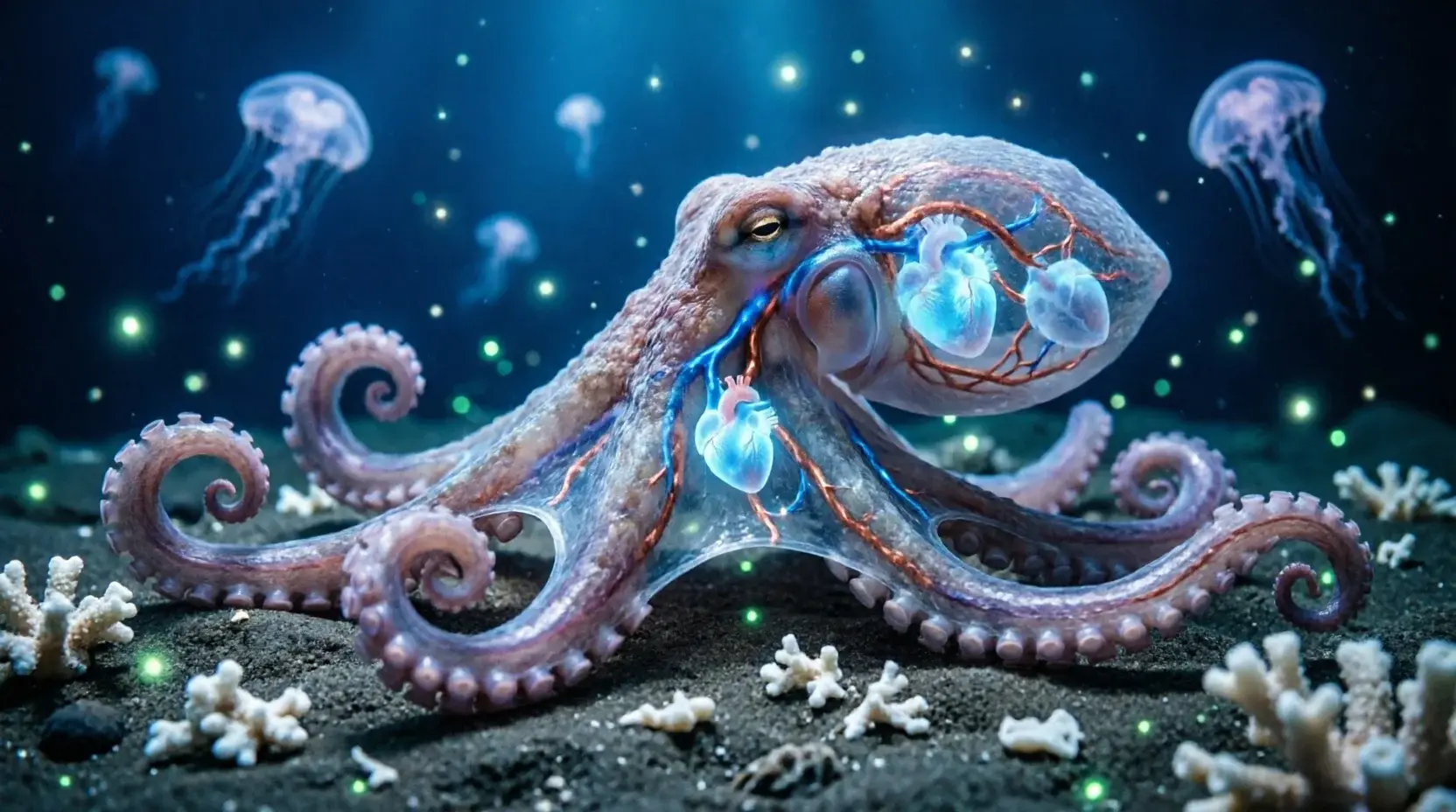
The octopus has three hearts, blue blood that uses copper instead of iron, and two hearts that stop beating every time it swims. These are not random oddities — each one is a survival tool built by millions of years of ocean life. The octopus circulatory system splits the job of pumping blood across three separate hearts to compensate for oxygen‑carrying blood that works less efficiently than ours. When the animal swims, the intense squeeze of jet propulsion shuts down its main heart, forcing it to crawl most of the time to keep all three hearts running.
Here is how the octopus three‑heart system works, why its hearts stop during swimming, and what makes this animal one of the strangest creatures on Earth.
The Three Hearts and What They Do
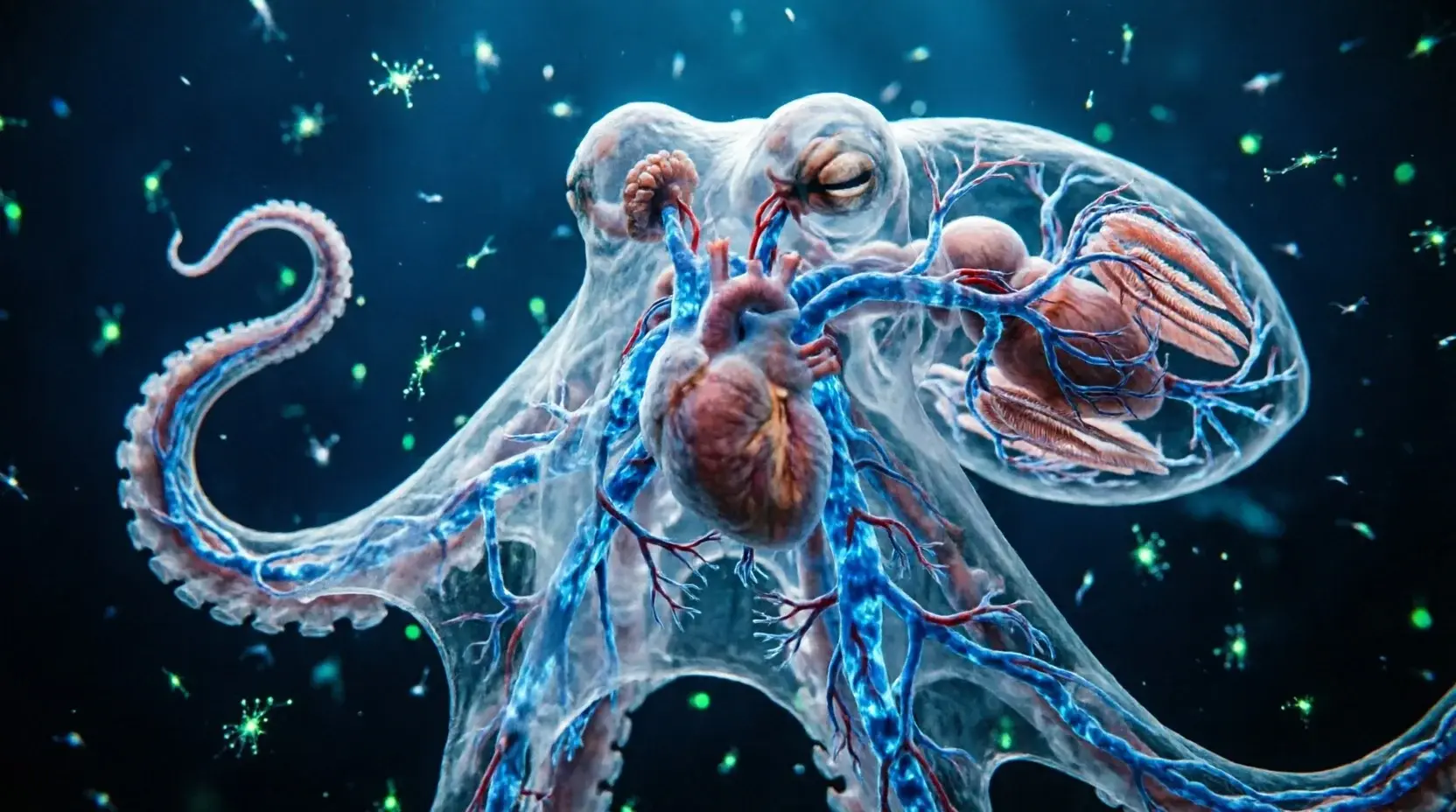
Most creatures on Earth have only one heart. You have one heart. A dog has one heart. Even a huge elephant has one heart. But an octopus needs three. Each heart has a clear and important task.
Octopuses belong to a group called cephalopods. This group also includes squid and cuttlefish. According to the Smithsonian Ocean portal, all modern cephalopods share this three‑heart design. Let’s break down what each heart does.
- Two branchial hearts (say: BRANK‑ee‑ul). These sit near the gills. Their only job is to push blood through the gills. Inside the gills, the blood drops off carbon dioxide and picks up fresh oxygen from the seawater. Think of them as dedicated oxygen‑loading stations. They make sure the blood is packed with oxygen before it goes anywhere else.
- One systemic heart (say: sis‑TEM‑ik). This is the main pump. It receives the oxygen‑rich blood from the branchial hearts and pushes it out to the rest of the body. The eight long arms, the brain, the stomach, and every other part get fresh blood from this central heart.
These three hearts do not work in a simple line. They run like a relay team. First, the branchial hearts contract, pushing oxygenated blood toward the systemic heart. Then the systemic heart pumps it out. It is a beautiful system of teamwork inside a soft, boneless body.
Why Does an Octopus Need Three Hearts?
The simple answer is that octopus blood is not as good at carrying oxygen as our blood. So the body makes up for it with extra pumping power.
Our blood looks red because it uses a protein with iron. Octopus blood is blue. The blue color comes from a protein called hemocyanin (say: hee‑mo‑SY‑a‑nin) that uses copper instead of iron. Copper turns the blood blue, just like iron turns ours red. This is one of those fun facts for kids that never gets old.
Hemocyanin works, but it is not as efficient at grabbing oxygen as our iron‑based blood. On top of that, octopus blood is thick and gooey. A single heart would struggle to push this heavy, blue blood through eight long, wriggly arms. Those arms can grow longer than many things that are 10 inches long — some species have arms that span over 14 feet. The animal needs a lot of oxygen, especially when hunting or escaping.
The three‑heart setup is the perfect fix. Two hearts handle only the gills. One heart handles the whole body. Splitting the work means oxygen keeps flowing without a break.
There is another big reason. When blood flows through the tiny vessels of the gills, it loses pressure. Think of a garden hose with a bend — the water squirts out more weakly. If an octopus had just one heart, the blood would leave the gills with very low pressure, and the body would not get enough supply. The branchial hearts fix this by acting as a second‑stage pump. They build the pressure back up before the systemic heart sends the blood to the arms and organs.
What Happens When an Octopus Swims?
Now we come to the part that makes people say, “Wait, what?” When an octopus swims, its main heart stops beating. This is not a heart attack. It is exactly what the body is meant to do.
An octopus swims using something called jet propulsion. It sucks water into its soft, sack‑like body (the mantle) and then forces that water out through a narrow tube called a siphon. The water shoots out like a rocket, pushing the octopus forward. But to squeeze out the water, the muscles of the mantle contract with huge power.
That powerful squeeze creates so much pressure inside the body that it squashes the systemic heart. The main heart cannot fill with blood properly, so it stops pumping. The two branchial hearts near the gills keep working — they still push blood through the gills to load oxygen. But the delivery truck, the systemic heart, is turned off. The octopus is moving fast, but it is not sending fresh oxygen to its arms and organs at that moment.
When a blue whale’s heartbeat can be heard from miles away, it is a sign of immense power. An octopus, on the other hand, must silence its main heart just to move quickly. This shows how different life under the sea can be.
Why Octopuses Prefer to Crawl
Now you can understand why an octopus crawls almost all the time. When it moves slowly across the ocean floor using its arms, all three hearts stay active and pumping. Oxygen flows steadily. The body stays fueled. The animal can keep going for a very long time without getting tired. Just like your stomach lining renews every 4 days, the octopus’s body is built for constant, slow activity rather than short, exhausting bursts.
Swimming gives speed, but it shuts off the main oxygen supply. Crawling is slower, but it is much smarter for managing energy. An octopus spends its days hunting crabs, slipping into rocky hiding spots, and exploring cracks. Slow and steady wins that race every time.
Of course, octopuses do swim when they absolutely need to. If a shark appears, jet propulsion is the emergency escape button. They might also swim a short distance across open water. But crawling is their true way of life. It keeps the whole system running.
Blue Blood and the Deep Sea
The copper‑based blue blood of an octopus has a secret advantage. It works extremely well in cold, low‑oxygen environments. In the deep, dark, freezing water where some octopuses live, hemocyanin is actually better at grabbing oxygen than our iron‑based blood would be. What seems like a weakness is actually a perfect fit for their world.
Take the dumbo octopus, for example. It lives thousands of feet deep, where oxygen is scarce. Its blue blood and three hearts make survival possible down there. This is a bit like finding out that bananas are radioactive — a hidden truth about something you thought was ordinary.
In warm water, however, life gets harder. Warm water holds less oxygen, and hemocyanin does not work as well. Octopuses in warm seas are often less active and depend on crawling even more to save energy. Their whole lifestyle is shaped by the temperature of the water around them. The universe is full of wonders, like a giant cloud of alcohol floating in space, but right here on Earth, the octopus holds its own cosmic secrets.
How It Compares to Your Heart
Your heart does two jobs in one organ. The right side pumps blood to your lungs to get oxygen. The left side pumps that oxygen‑rich blood to your whole body. An octopus simply splits these jobs across three hearts. The branchial hearts act like the right side of your heart, and the systemic heart acts like the left side.
Because they are physically separate, jet propulsion can shut down one heart without stopping the others. If your heart stopped when you ran, you would faint. An octopus just slows down. Its body is built with a tolerance that no human could match. Your smartphone has more computing power than the Apollo guidance computer, yet the biological computer inside an octopus still surprises scientists.
Octopuses are also surprisingly smart. They can solve mazes, open jars, and remember solutions for weeks. Research shows they have a memory similar to an eidetic memory. And while you might ask, do cows have best friends, octopuses show behaviors that suggest they recognize individual people and other octopuses. That is a lot of brainpower for an animal without a backbone.
Common Myths — Busted
Myth: The octopus’s hearts are broken when they stop during swimming.
Truth: The stop is a normal response to the physical squeeze of jet propulsion. It is not a health problem. The heart starts right back up when swimming ends.
Myth: Three hearts means the octopus has tons of stamina.
Truth: For swimming, the opposite is true. Three hearts do not give unlimited energy. The system is complex, and taking one heart offline forces the animal to stop and recover.
Myth: Octopuses are slow because they are weak.
Truth: They crawl to keep all three hearts running. It is an energy management strategy, not a physical weakness. They choose the smart path.
Quick Questions and Answers
How many hearts does an octopus have?
Three — two branchial hearts near the gills and one systemic heart.
Why do the hearts stop when an octopus swims?
The intense squeeze of jet propulsion puts high pressure on the main heart, making it stop. The gill hearts keep working.
Is octopus blood really blue?
Yes. It uses hemocyanin, a copper‑based protein that turns blue when carrying oxygen. This is just as bizarre as the fact that butterflies taste with their feet.
Do octopuses ever have heart problems?
The stopping and starting during swimming is a normal, healthy part of their life. It is not a disease.
Final Thoughts
The octopus circulatory system is not an accident. It is the result of millions of years of fine‑tuning for life in the ocean. Three hearts, blue blood, a body that prefers crawling, and a sharp mind — all of it fits together perfectly. Collectors may debate antique can openers’ value and durability, but the octopus body is a true masterpiece of durable design, tested by the deep sea for ages.
People hunt for hidden treasures with the passion of Mike Wolfe’s passion project, and to scientists, uncovering facts like these feels just as thrilling. Some facts are so strange they seem made up, like the curious case that nobody was born on December 6, 2006, but the octopus story is every bit as real.
Next time you see an octopus gliding slowly over a rock, remember: all three hearts are beating, blue blood is flowing, and that animal is living exactly as its unique body intended. And if you ever need an excuse to pause your day and dive into nature’s wonders, now you have bulletproof reasons to leave work early — just say you are off to learn about an animal with three hearts that stop when it swims.

