

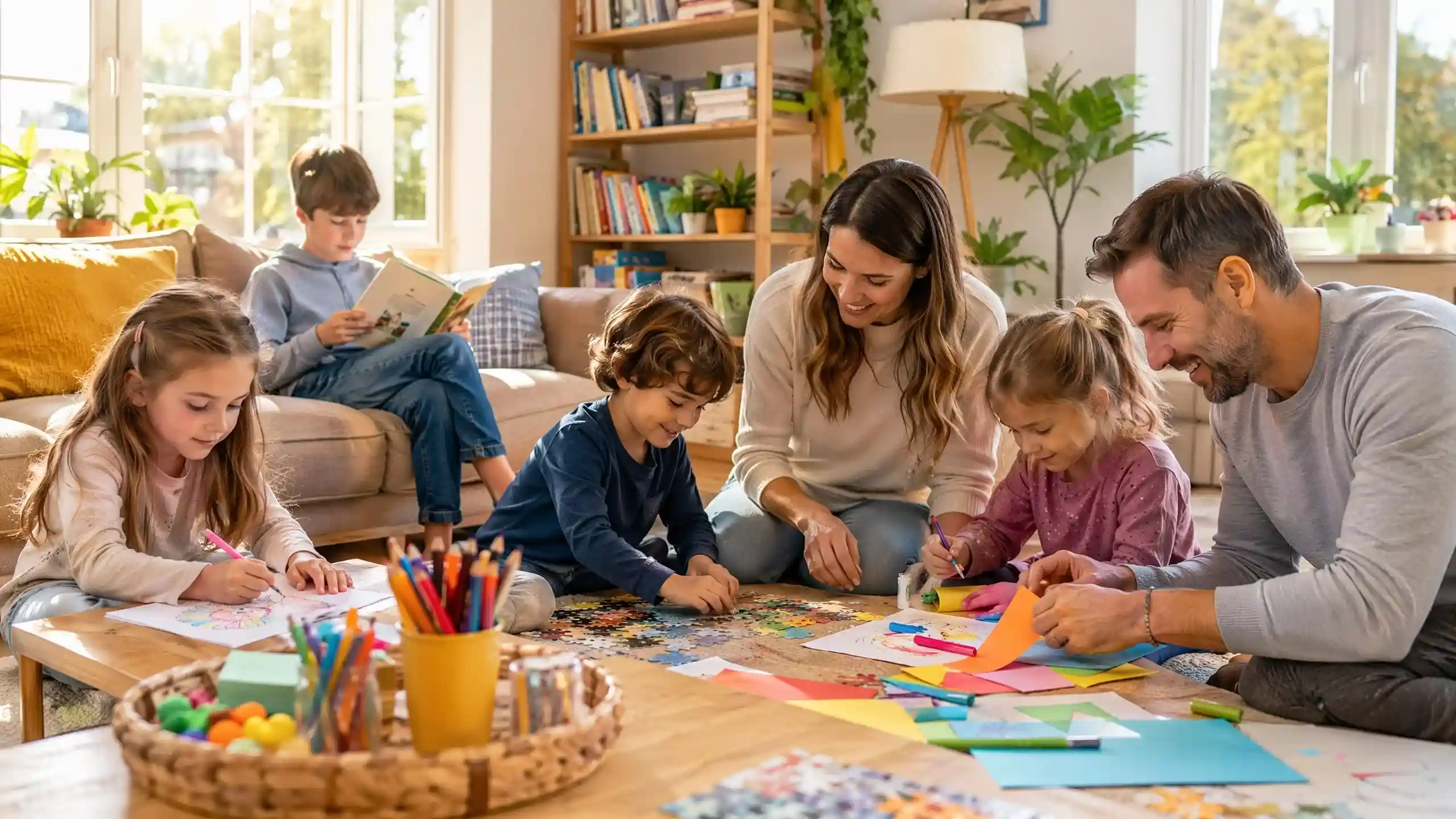
It’s 4 PM on a Tuesday. Your 6-year-old wanders into the kitchen, sighs dramatically, and asks what there is to do, for the third time this hour. The tablet is sitting right there on the counter. It’s easy. Five minutes of peace sounds really good right now.
But you’ve read the headlines. You know what too much screen time does to sleep, attention spans, and social skills. Offering something better is the goal. The trouble is that you don’t always know what that looks like on a tired Tuesday afternoon.
You’re not alone in that, and you’re not failing as a parent.
Meanwhile, screen-free parenting is having a real moment in 2026. Australia’s ban on social media for under-16s took effect in December 2025, and it has pushed families everywhere to rethink device habits. So has the TikTok analog bag trend, where people pack a tote with offline activities to reach for instead of their phones. Hashtags tied to the trend grew sharply through 2025, according to Axios. In short, parents everywhere are searching for the same thing: simple, practical, offline ideas that actually work.
This guide gives you exactly that. Inside, you’ll find 35 screen-free activities for kids ages 2 to 12, sorted by age, with time estimates, difficulty ratings, and a materials list for each one. You’ll also get five practical strategies for cutting screen time and a checklist you can copy straight onto your fridge.
Now let’s look at 35 ways to make that happen.
Why Screen-Free Time Matters in 2026
Before the activity list, it helps to know what the research actually says. This isn’t about guilt. It’s about reminding you why the effort is worth it.
| What | Current Guidance | Source |
|---|---|---|
| Screen time under 18 months | Avoid, except video calls with family | American Academy of Pediatrics (AAP), 2026 guidance |
| Screen time, ages 2 to 5 | About one hour a day of high-quality content, watched together | American Academy of Pediatrics, 2026 guidance |
| Screen time, school-age kids | Quality and balance matter more than a strict hour count | American Academy of Pediatrics, 2026 guidance |
| Australia’s under-16 social media ban | Took effect December 2025; over 4.7 million underage accounts removed by January 2026 | eSafety Commissioner, Associated Press |
| The analog bag trend | TikTok hashtag activity around offline, screen-free habits grew sharply through 2025 and 2026 | Axios |
What the Research Shows
Importantly, the benefits go beyond hitting a number on a chart.
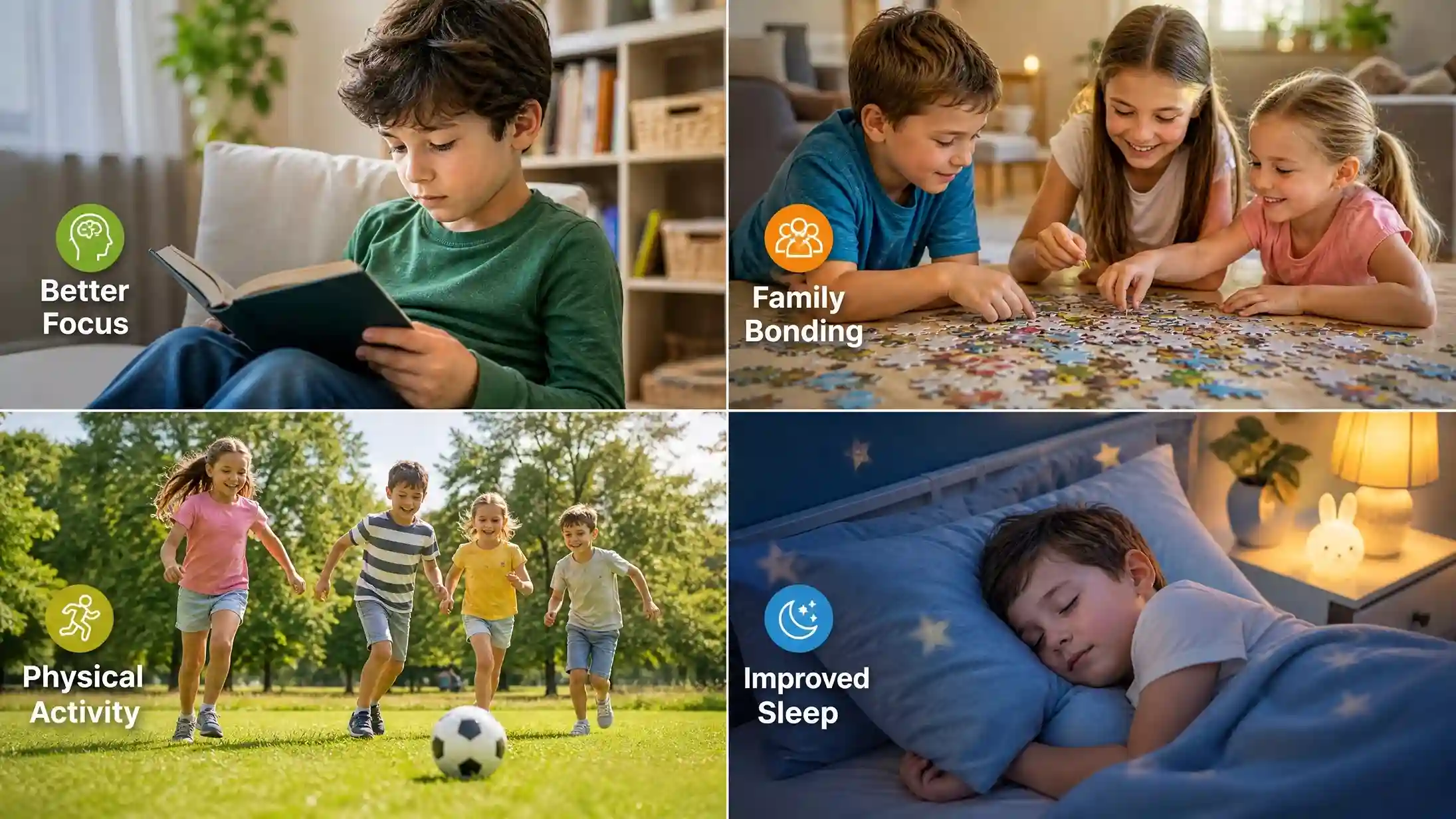
Obesity prevention. Hours in front of a screen mean hours not moving. Instead, regular screen-free play builds activity into the day without you having to schedule a workout.
Better sleep. Bright screens interfere with melatonin production. A device curfew two hours before bed makes a real difference in how fast kids fall asleep and how well they stay there.
Stronger focus. Screen-based entertainment is built to hold attention by constantly shifting scenes and rewards. By contrast, offline activities ask kids to sit with one thing longer, which builds the patience school, and life, actually require.
Emotional connection. Small, repeated moments of undivided attention build the kind of trust kids carry with them for years. If you want a deeper look at building that connection, How to Build a Strong Parent-Child Bond walks through it stage by stage.
Less stress, for everyone. Several research reviews link more unstructured, screen-free play time to better emotional regulation and lower stress, for kids and parents alike. To be sure, no single study has pinned that down to one universal number, but the pattern holds up across age groups. If you’re curious how stress affects kids long after childhood, Parental Stress Effects on Child DNA digs into the science.
The Bigger Picture in 2026
Taken together, hybrid schooling, AI chatbots, and social media age limits are reshaping parenting in 2026. All of it is pushing families back toward something simpler: real play. Here are 35 ways to do it.
Screen-Free Activities for Kids (Ages 2 to 5)
Best for: toddlers and preschoolers who need calm, hands-on engagement at home.
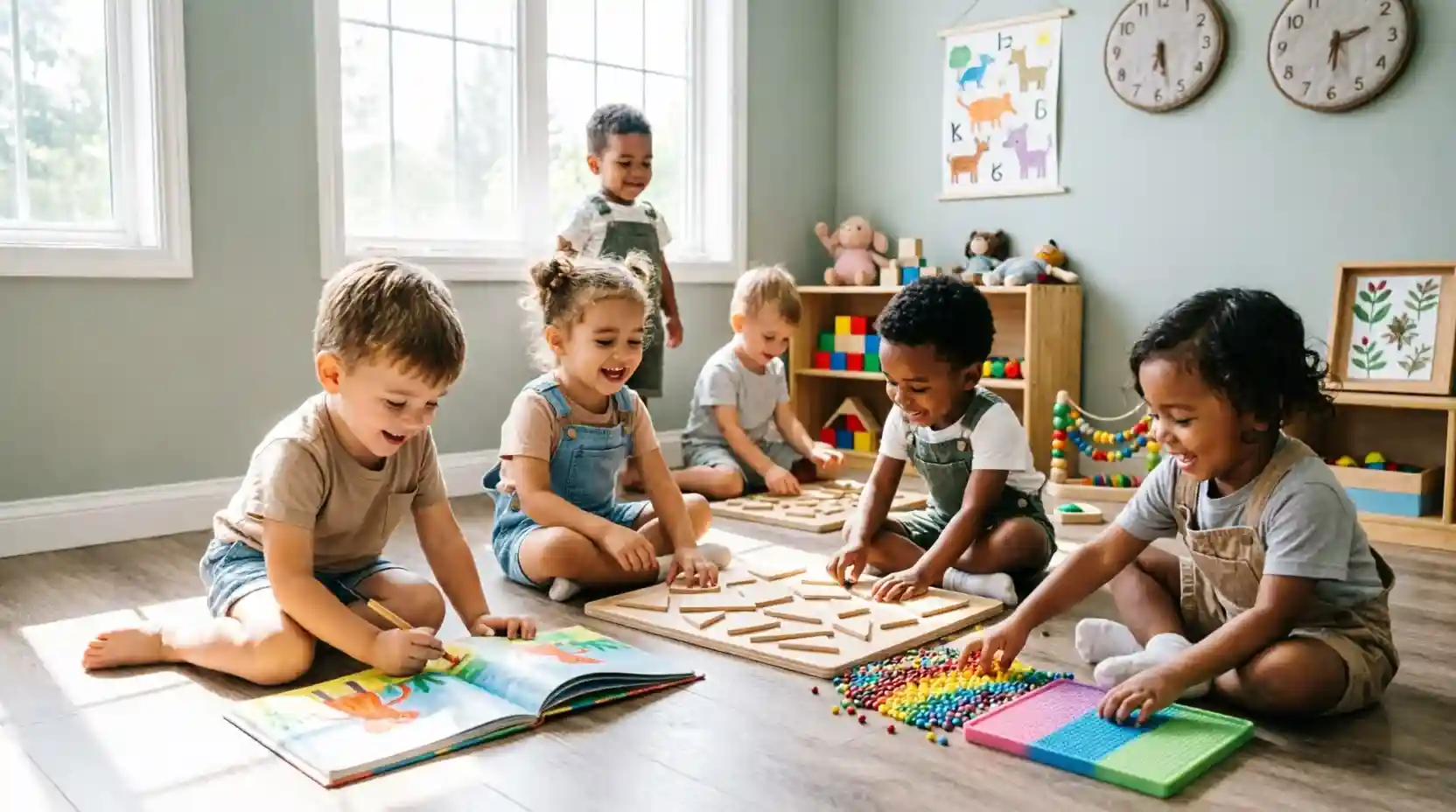
Activity Table — Ages 2 to 5 at a Glance
| # | Activity | Time | Difficulty | Materials Needed |
|---|---|---|---|---|
| 1 | Colouring & Drawing | 15–30 min | Easy | Crayons, paper |
| 2 | Alphabet Tracing Worksheets | 20 min | Easy | Printables, pencil |
| 3 | Colour by Number | 20–30 min | Easy | Printed sheets |
| 4 | Reading Picture Books | 15–45 min | Easy | Library books |
| 5 | Puzzles | 20–40 min | Medium | Age-appropriate puzzles |
| 6 | Board Games | 30–60 min | Medium | Candy Land, simple games |
| 7 | Indoor Movement Games | 15–30 min | Easy | Just space to move |
| 8 | Sensory Bag | 20 min | Easy | Water, food coloring, natural items |
| 9 | Origami Animals | 30 min | Hard | Square paper |
| 10 | Puppet Theatre | 45 min | Hard | Cardboard box, socks, markers |
Five Favorites, Explained
Colouring and drawing. This one never gets old, and for good reason. It builds fine motor skills and lets kids create without any pressure to perform. For example, keep a craft box stocked with crayons, markers, and paper somewhere they can reach themselves. Age range: 2 to 5.
Alphabet tracing worksheets. These support early literacy and motor skills at the same time. Free printables are easy to find on sites like education.com. Print a stack, keep them in a folder, and you’ve got a reliable quiet-time activity. Age range: 3 to 5.
Indoor movement games. Freeze dance, animal walks, and simple obstacle courses burn energy without needing any equipment. Clear a small space, put on some music, and let them move. In fact, it’s one of the easiest activities to start with zero prep.
Sensory bag. Fill a zip-top bag with water, food coloring, and small items like leaves or petals. Seal it tight with tape. Kids can squish and explore it without making a mess. Plus, it’s genuinely calming for toddlers.
Puppet theatre. Cut a stage opening into a cardboard box and let kids decorate it. Old socks become puppets, and suddenly you have a full show in the living room. It builds storytelling and confidence for almost no cost. Age range: 4 to 5.
Expert tip: accordingly, child development specialists consistently recommend limiting and supervising screen time for young kids, with hands-on, play-based activities as the foundation, not the backup plan.
Screen-Free Activities for Kids (Ages 6 to 9)
Best for: elementary-age kids ready for more creative and skill-building challenges.

Activity Table — Ages 6 to 9 at a Glance
| # | Activity | Time | Difficulty | Materials |
|---|---|---|---|---|
| 11 | Cook Dinner Together | 45 min | Medium | Ingredients |
| 12 | Make Music | 30 min | Medium | Tambourine, keyboard, ukulele |
| 13 | Board Game Family Night | 60 min | Medium | Monopoly, Uno |
| 14 | Put on a Play | 60 min | Hard | Scripts, costumes |
| 15 | Arts & Crafts Projects | 45 min | Medium | Art supplies |
| 16 | Holiday Ornament Crafts | 40 min | Medium | Craft materials |
| 17 | Read Aloud Together | 30 min | Easy | Books |
| 18 | DIY Science Experiments | 45 min | Hard | Kitchen pantry items |
Five Worth Trying in Detail
Cook dinner together. This is one of the most underrated activities on this list. Specifically, it’s real math (measuring cups, fractions), real responsibility, and teamwork, all in one task. Let younger kids rinse fruit or tear salad greens, and let older kids stir, measure, and follow steps. They’ll be more likely to eat what they helped make.
Make music. Your kids probably know how to stream a playlist. Can they make music themselves? Start with something accessible, like a tambourine, a small keyboard, or a ukulele, and skip formal lessons for now. Just let them explore sound. Age range: 6 to 9.
Board game family night. Swap one movie night a week for a board game session. Granted, it’s simple, but it teaches real social skills: taking turns, handling losing, reading the room. Match the game to the age, from Candy Land around 6 to Monopoly closer to 9.
Put on a play. Pick a simple script, or let the kids write their own. Pull costumes together from whatever’s in the closet. Admittedly, it takes longer to set up than most activities here, but it pays off in confidence once the show starts.
DIY science experiments. A baking soda volcano or a homemade lava lamp uses things you already have in the pantry. Kids get a real, hands-on lesson in cause and effect, and as a bonus, you get thirty minutes of focused attention. Fair warning, though: expect a little mess.
Screen-Free Activities for Kids (Ages 10 to 12)
Best for: older kids who want independence and real skill development.
Activity Table — Ages 10 to 12 at a Glance
| # | Activity | Time | Difficulty | Materials |
|---|---|---|---|---|
| 19 | Advanced Origami | 45 min | Hard | Complex patterns |
| 20 | Write a Story | 60 min | Medium | Notebook, pen |
| 21 | DIY Home Decor | 90 min | Hard | Craft supplies |
| 22 | Learn a New Language | 30 min | Medium | Books, flashcards |
| 23 | Bake Something | 75 min | Medium | Recipe, ingredients |
| 24 | Journaling | 20 min | Easy | Journal |
Deeper Dive Into Five Picks
Write a story. Give a 10-year-old a blank notebook and a prompt, and you might be surprised by what comes out. Start with something grounded, like “write about something funny that happened this week.” Then let them branch into fiction if they want to.
DIY home decor. Let them redecorate a shelf, a corner of their room, or a single wall with things they make themselves. It takes longer than most activities here, closer to 90 minutes, but it gives kids real ownership over their space.
Learn a new language. Surprisingly, a few flashcards and 30 minutes a day go further than you’d expect at this age. Pick something they’re curious about, not something you think they should learn, and let that curiosity do the work.
Bake something. Put simply, baking is cooking with more precision. It teaches patience, careful instruction-following, and real-world math. Cookies, muffins, or a simple cake are good starting points, and the result is something they can be proud of.
Journaling. Over time, even five minutes a day builds self-awareness and emotional processing skills. Keep it low pressure and skip the prompts if your kid doesn’t need them. The habit matters more than the content.
Oscar Wilde once wrote that children judge their parents as they grow, and sometimes forgive them. That said, it’s worth keeping in mind when you think about the screen habits you’re modeling right now. For more reflections like this, 100 Inspiring Parenting Quotes for a Happy Life is worth a look.
Screen-Free Outdoor Activities for Kids
Best for: physical activity, fresh air, and nature connection, for ages 2 to 12.
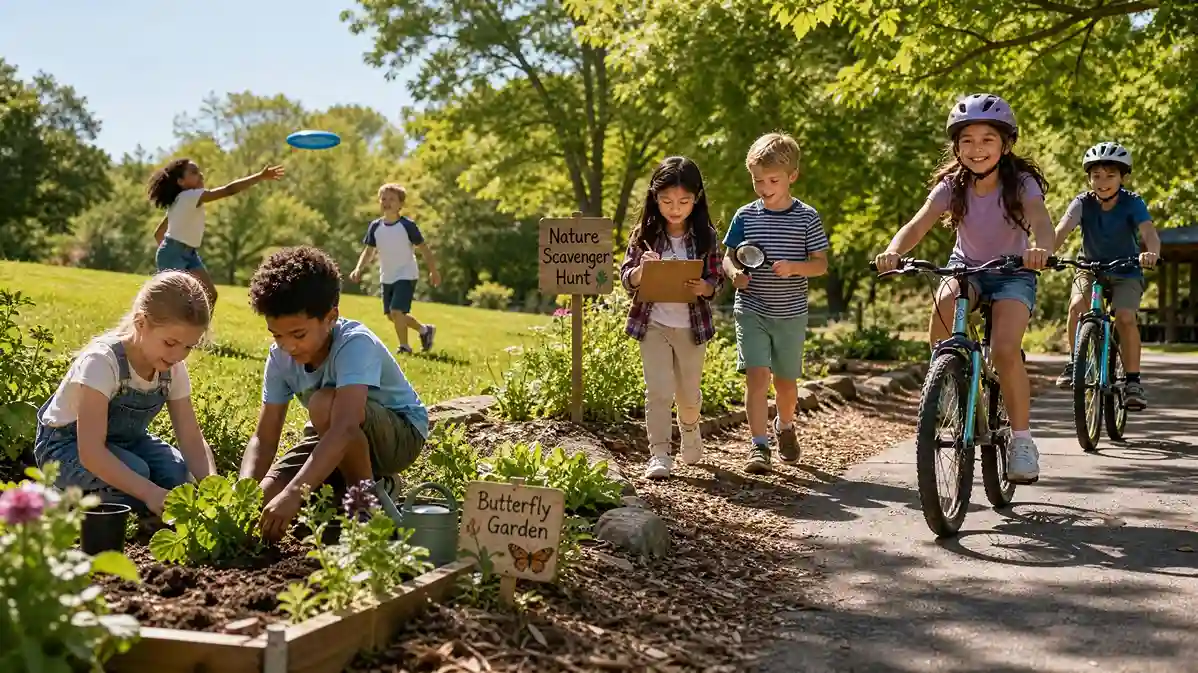
Outdoor Activity Table — All Ages
| # | Activity | Time | Age | Materials |
|---|---|---|---|---|
| 25 | Go for a Walk | 30 min | 2–12 | None |
| 26 | Toss a Frisbee | 30 min | 4–12 | Frisbee |
| 27 | Plant a Garden | 60 min | 6–12 | Seeds, tools |
| 28 | Water Play (Hose) | 45 min | 2–10 | Garden hose |
| 29 | Visit the Library | 60 min | 4–12 | None |
| 30 | Backyard Camp Out | 120 min | 6–12 | Tent, marshmallows |
| 31 | Hula Hoop Games | 30 min | 4–12 | Hula hoop |
| 32 | Jump Rope | 30 min | 5–12 | Jump rope |
| 33 | Neighborhood Bike Ride | 45 min | 7–12 | Bikes |
| 34 | Nature Scavenger Hunt | 45 min | 4–12 | List, bag |
| 35 | Outdoor Leaf Printing | 40 min | 3–10 | Paper, paint, leaves |
Our Top Five Outdoor Picks
Go for a walk. It sounds almost too simple, but a 20-minute walk after dinner does more for mood and connection than most structured activities. No equipment, no prep. Just go.
Plant a garden. Beyond the obvious, gardening teaches kids where food actually comes from and how to care for something over time. Start with easy wins, like tomatoes, carrots, or sunflowers. Kids who grow food are usually more willing to eat it too. Age range: 6 to 12.
Visit the library. What many parents don’t realize is that libraries have quietly become one of the best family resources around. Beyond books, many run story hours, craft sessions, and summer reading programs. Check your local branch calendar; there’s usually more going on than you’d expect.
Backyard camp out. You don’t need to drive anywhere for this one. Pitch a tent in the yard, roast marshmallows, and tell stories under the stars. Best of all, kids remember nights like this for years, and it costs almost nothing. Age range: 6 to 12.
Nature scavenger hunt. Make a simple list (a smooth rock, a red leaf, something that smells good) and send kids off to find it all. It works in a backyard, a park, or on a trail, and it turns a regular walk into a mission.
5 Strategies to Cut Screen Time
Knowing the activities is one thing. Building the habit around them is another. Here’s what actually works for real families.
| Strategy | How to Start | What to Expect |
|---|---|---|
| Offer visible alternatives | Keep a craft box, board games, and puzzles out and within reach | Kids reach for activities before reaching for a screen |
| Set screen-free routines | No screens at the dinner table; a two-hour device curfew before bed | Better sleep and more actual conversation |
| Model it yourself | Put your own phone away first, consistently | Kids follow what you do more than what you say |
| Create screen-free zones | No devices in bedrooms, for anyone in the house | Better sleep quality across the whole family |
| Try an analog bag | Pack a tote with books, cards, and craft supplies for the car or waiting rooms | A ready-made alternative when boredom hits |
That said, most of these strategies work best when they come from warmth, not control. Setting a clear, consistent rule and holding it kindly is most of what authoritative parenting looks like in practice, and screen time is one of the easiest places to start.
Your Four-Week Starter Plan
1: Start with one screen-free meal a day. Just dinner. Keep it low stakes.
2: Add a two-hour device curfew before bed, for kids and parents both.
3: Put together a craft box with easy-to-grab supplies: crayons, paper, scissors, stickers, clay.
4: Build your own analog bag. Fill it with a small book, a deck of cards, a sketchpad, and whatever your kid actually loves. Use it for car trips, waiting rooms, and quiet afternoons.
Additionally, if you’re parenting alongside a partner, getting aligned on these routines matters more than people expect. 10 Secrets to Parenting as Partners covers how to get on the same page without it turning into an argument.
Your Quick-Reference Activity Checklist
Copy this list, print it, or just keep this tab open. Check things off as you try them.
Toddlers & preschoolers (2 to 5): colouring and drawing, alphabet tracing worksheets, colour by number, reading picture books, puzzles, board games, indoor movement games, sensory bag, origami animals, puppet theatre.
Ages 6 to 9: cook dinner together, make music, board game family night, put on a play, arts and crafts projects, holiday ornament crafts, read aloud together, DIY science experiments.
Tweens (10 to 12): advanced origami, write a story, DIY home decor, learn a new language, bake something, journaling.
Outdoor, ages 2 to 12: go for a walk, toss a frisbee, plant a garden, water play with a hose, visit the library, backyard camp out, hula hoop games, jump rope, neighborhood bike ride, nature scavenger hunt, outdoor leaf printing.
FAQs
Best Activities for Toddlers Ages 2 to 3
Colouring, sensory bags, simple wooden puzzles, reading picture books together, and indoor movement games like freeze dance are all excellent starting points. Keep it short. At this age, fifteen to twenty minutes is plenty.
How Much Screen Time Is Healthy
The American Academy of Pediatrics recommends avoiding screens before 18 months, except for video calls with family. For ages 2 to 5, aim for about an hour a day of high-quality, co-viewed content. Beyond that, the AAP’s current guidance focuses less on a strict number and more on making sure screens don’t crowd out sleep, physical activity, and family time.
What if My Child Refuses Screen-Free Activities
Start with just 15 minutes. Offer two choices instead of one open-ended option: “Do you want to draw or do a puzzle?” Also, remove the screen option during that time; out of sight, out of mind really does help. And sit down and do the activity with them. That changes things more than any rule does.
Are Screen-Free Activities Better for Learning
Indeed, research consistently links hands-on, unstructured play with stronger focus, creativity, and emotional regulation. It’s hard to pin that down to one universal number, but the pattern shows up across multiple studies and age groups. Active play builds skills that passive screen time simply doesn’t reach.
How Do I Start Screen-Free Week
Screen-Free Week is an annual campaign you can find at screenfree.org, with pledge cards and activity ideas for planning a full week. Use this guide to mix indoor and outdoor activities across the week so things stay varied.
Benefits of Outdoor Screen-Free Play
Outdoor play supports physical development, reduces obesity risk, improves sleep, and builds social skills through unstructured play with other kids. On top of that, time in nature is consistently linked to lower anxiety and better mood in children.
Where to Find More Screen-Free Resources
The Screen Smart Program at thekids.org.au offers free, practical resources, especially useful for Australian families navigating the new social media rules. HealthyChildren.org, run by the AAP, and screenfree.org are both solid starting points for research-backed guidance.
Start Small and Build From There
Screen-free parenting isn’t about throwing the tablet in the bin. It’s about making sure it isn’t the default answer every time your kid is bored, tired, or stuck in the back seat of a car.
Hopefully, the 35 activities above give you real options, sorted by age and sized for real life. Start with one or two. Build from there.
Top picks by age:
- Ages 2 to 5: sensory bags, colouring and drawing, puppet theatre
- Ages 6 to 9: cooking together, board game night, making music
- Ages 10 to 12: writing stories, baking, gardening
Small, repeated moments of attention add up. A 20-minute walk. One board game after dinner. A cardboard box puppet theatre on a rainy Saturday. These are the moments kids remember years later. Of course, if some days still feel hard even with all of this in your back pocket, that’s normal too. Parenting Gets Harder (If You’re Doing It Right) is a good reminder of why.
You don’t have to do all 35. You just have to start somewhere.
Which activity will you try first?

