
Here’s something most “best quotes” lists get wrong: when people picture the wittiest line ever delivered, they almost always picture a man saying it. Twain, Churchill, Wilde — the usual suspects. But some of the sharpest, most quotable lines in history came from women, and most of them never make the list.
The gap isn’t because women weren’t funny. It’s because a clever woman’s best lines got remembered as “sassy” instead of brilliant, or got quietly reattributed to whatever man was standing nearby. Consider this your correction.
Below you’ll find the funniest quotes from history’s greatest women — across entertainment, politics, literature, and activism — along with the story behind each and a takeaway you can use.
Why Do the Funniest Quotes Come from History’s Greatest Women?
For many of these women, humor wasn’t a personality trait. It was a tool — sometimes the only one available. In rooms where they were interrupted, underestimated, or told to sit down, a perfectly timed line did what arguing couldn’t: it landed, spread, and made the room remember who won the exchange.
That’s why these quotes hit differently from your average inspirational poster. They’re not just funny — they’re strategic. A joke can say the unsayable thing without giving anyone a clean way to push back. Almost every quote here does double duty: making you laugh and making a point.
Which Women in Entertainment Delivered the Sharpest One-Liners?
Entertainment is where most “funny women” lists start and stop, but even within this lane, the range is wider than people remember — silver-screen icons, TV legends, and musicians who all understood that a great line outlives a great performance.
“I generally avoid temptation unless I can’t resist it.” — Mae West
West built an entire persona out of double entendres at a time when women on screen were expected to be demure. This line is peak her: self-aware, unbothered, and engineered to make censors nervous. Takeaway: owning your contradictions is funnier — and more disarming — than pretending you don’t have any.
More entertainment lines worth knowing at a glance:
- Lucille Ball: “I’m not funny. What I am is brave.” She said this after decades of being called America’s funniest woman — proof that even comedy legends got reduced to “cute” instead of “skilled.”
- Betty White: “Why do people say ‘grow some balls’? Balls are weak and sensitive. If you wanna be tough, grow a vagina. Those things can take a pounding.” Delivered well into her 80s on national television.
- Joan Rivers: “I succeeded by saying what everyone else is thinking.” Rivers built a career on voicing the thing nobody else would admit out loud.
- Bette Davis: “If you’ve never been hated by your child, you’ve never really been a parent.” Delivered with the same dry precision she used in her films — context-free, it reads like a threat.
- Katharine Hepburn: “If you obey all the rules, you miss all the fun.” Hepburn wore trousers in an era when that alone was scandalous. This wasn’t a throwaway line — it was her whole philosophy.
- Dolly Parton: “It costs a lot of money to look this cheap.” Parton has spent fifty years getting ahead of the joke before anyone else can make it at her expense — the single best example of self-deprecation as armor on this list.
- Cher: “My mom said to me, ‘Someday you’ll settle down with a nice rich man.’ And I said, ‘Mom, I am a nice rich man.'” Funny first, a quiet flex second.
What Made Mae West the Original Queen of Wit?
West deserves a closer look because she invented the template every quotable woman after her would use: say the bold thing, smile, and let everyone else figure out whether to laugh or clutch their pearls.
Beyond the temptation line, she’s credited with “When I’m good, I’m very good. But when I’m bad, I’m better” and “You only live once, but if you do it right, once is enough.
Both work the same angle — confidence delivered as comedy, making it nearly impossible for critics to attack her without looking humorless.
Which Women Leaders Turned Humor into Political Power?
Politics is a far higher-stakes stage than a movie set. These weren’t off-the-cuff jokes — they were calculated lines, deployed in rooms where one wrong word could end a career.
“A woman is like a tea bag — you cannot tell how strong she is until you put her in hot water.” — Eleanor Roosevelt
Roosevelt said this while reshaping what a First Lady was allowed to be — holding her own press conferences, writing a syndicated column, traveling solo to war zones. The line sounds gentle and lands like a warning.
“If you want something said, ask a man. If you want something done, ask a woman.” — Margaret Thatcher
Thatcher deployed this kind of line constantly in an overwhelmingly male Parliament. It got quoted, it got laughed at nervously, and it made her point without raising her voice.
“I ask no favor for my sex. All I ask of our brethren is that they take their feet off our necks.” — Ruth Bader Ginsburg, paraphrasing abolitionist Sarah Grimké, a line RBG returned to so often it became closely associated with her own voice
RBG used dry humor in oral arguments and dissents because a joke could carry an argument that a straightforward objection couldn’t. Hard to dismiss a justice for being “shrill” when she’s making the room laugh.
“I would rather lie on the rack than allow my mind to be imprisoned by the will of others.” — Queen Elizabeth I
Less a joke than a verbal mic drop — the kind of line Elizabeth I used to remind advisors trying to marry her off that the throne, and the wit, were both hers alone.
“There is a special place in hell for women who don’t help other women.” — Madeleine Albright
Part warning, part punchline, this line has outlived most policy speeches from the same era. Albright also noted her “only competition is myself” — the self-assurance of a woman who set her own standards in rooms that tried to set them for her.
Which Women Writers Made Words Cut Sharper Than Knives?
Writers don’t get a live audience’s laughter to confirm the joke landed. They have to nail it on the page, alone — which makes the precision here even more striking.
“If you want to know what God thinks of money, just look at the people he gave it to.” — Dorothy Parker
This might be the sharpest quote on the entire list. Parker built a career on lines exactly this size: short, devastating, and impossible to argue with because there’s no argument in them — just an observation too true to deny.
A couple more from Parker, because one quote barely scratches the surface: “I require only three things of a man: he must be handsome, ruthless, and stupid,” and the famously brutal book review line, “This is not a novel to be tossed aside lightly. It should be thrown with great force.” Same skill both times — economy. Parker never used ten words when three would do more damage.
“If I am not good to myself, how can I expect anyone else to be good to me?” — Maya Angelou. Warmer than Parker’s humor, but no less sharp; she used it to make hard truths about resilience easier to swallow.
“Insomnia is one of the great certainties of life amongst the heartbroken.” — Nora Ephron, who turned heartbreak into one of the most quotable bodies of work in modern writing by refusing to take her own misery too seriously on the page.
“If you have any doubts, sit on the porch and look at the stars.” — Zora Neale Hurston — typical of how she used plainspoken wit to undercut the hardships she wrote about.
“I do not want people to be very agreeable, as it saves me the trouble of liking them.” — Jane Austen, by way of Mr. Bennet in Pride and Prejudice but unmistakably her voice. Proof that this kind of wit predates the modern era entirely.
These writers used humor as an entry point into subjects — heartbreak, inequality, grief — that were otherwise too heavy to approach directly.
Which Rule-Breaking Women Used Laughter as Rebellion?
This group wasn’t trying to be charming. These women used a joke the way you’d use a crowbar — to pry open a system that wasn’t built to let them in.
“My life didn’t please me, so I created my life.” — Coco Chanel
Chanel said this about building her fashion house from nothing in a male-dominated industry. It reads as a quiet brag, and it’s earned.
“You live but once; you might as well be amusing.” — Coco Chanel
Not the unsourced door quote floating around the internet, but this one — well documented and more her: a whole life philosophy in eight words.
“I don’t pay attention to what critics say; I don’t have an enemy who has praised me.” — Frida Kahlo
Kahlo lived with chronic pain her entire adult life and still managed this level of dismissal. The joke isn’t really about critics — it’s about refusing to let anyone else’s opinion live in her head.
“Adventure is worthwhile in itself.” — Amelia Earhart, who treated the real danger of her flights with a shrug, because taking the risk too seriously would have meant admitting how afraid she should have been.
“I don’t think of myself as a poor, deprived ghetto girl who made good. I think of myself as somebody who from an early age knew I was responsible for myself, and I had to make good.” — Oprah Winfrey. Less a punchline than a flex, delivered with the same confidence she’s used to build an empire out of being underestimated.
“The truth will set you free, but first it will piss you off.” — Gloria Steinem
Steinem’s activism ran on humor — partly because it made hard truths easier to swallow, and partly because a laugh travels further than a lecture.
The Funniest Women in History at a Glance
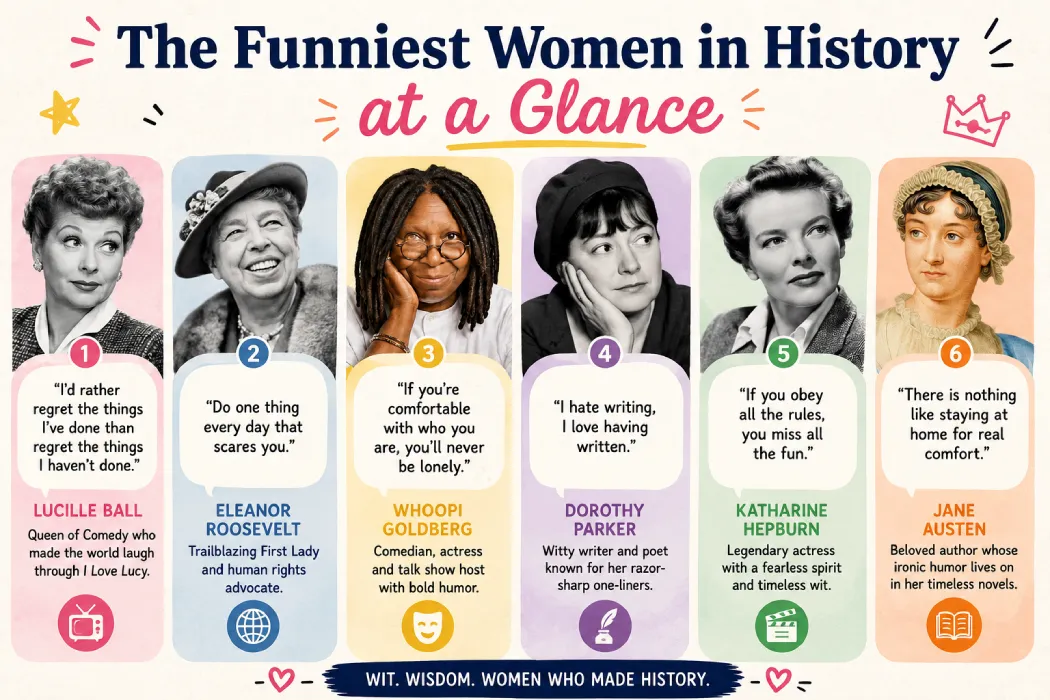
| Woman’s Name | Field/Era | Funniest Quote (Short) | Key Trait |
|---|---|---|---|
| Mae West | Entertainment, 1930s | “I generally avoid temptation unless I can’t resist it.” | Self-aware confidence |
| Lucille Ball | Entertainment, 1950s | “I’m not funny. What I am is brave.” | Reframing |
| Betty White | Entertainment, modern | On “growing some balls” vs. resilience | Fearlessness |
| Joan Rivers | Entertainment, 1970s–2010s | “I succeeded by saying what everyone else is thinking.” | Bluntness |
| Bette Davis | Entertainment, 1930s–80s | On the hardest job: being hated by your own kid | Dry delivery |
| Katharine Hepburn | Entertainment, 1930s–90s | “If you obey all the rules, you miss all the fun.” | Rule-breaking |
| Dolly Parton | Entertainment/Music | “It costs a lot of money to look this cheap.” | Self-deprecation as armor |
| Cher | Entertainment/Music | The “nice rich man” comeback to her mom | Quick wit |
| Eleanor Roosevelt | Politics, 1930s–40s | The tea bag in hot water line | Quiet strength |
| Margaret Thatcher | Politics, 1980s | “Ask a man… ask a woman.” | Strategic bluntness |
| Ruth Bader Ginsburg | Politics/Law, modern | “Take their feet off our necks.” | Dry persistence |
| Queen Elizabeth I | Royalty, 1500s | On refusing to be imprisoned by others’ will | Unshakeable resolve |
| Dorothy Parker | Literature, 1920s | The God-and-money line | Economy of words |
| Nora Ephron | Literature, modern | On insomnia and heartbreak | Self-aware humor |
| Coco Chanel | Fashion/Activism, 1920s | “You might as well be amusing.” | Reinvention |
| Frida Kahlo | Art/Activism, 1930s–50s | On not having enemies who praised her | Defiance |
| Gloria Steinem | Activism, 1960s–70s | “The truth will set you free, but first it will piss you off.” | Confrontational honesty |
What Can You Learn From These Quotes Today?
Strip away the eras and the headlines, and four lessons surface again and again.
- Humor is confidence in disguise. Almost every quote here works because the woman saying it refused to sound apologetic. The joke lands when you mean it.
- Wit is intelligence moving fast. None of these lines were accidental. Parker’s reviews, Thatcher’s parliamentary one-liners, RBG’s dissents — all required precision, not just a quick tongue.
- Laughter survives where complaints don’t. A complaint gets forgotten. A great line gets repeated for decades — which is why we’re still quoting Mae West and Dorothy Parker generations later.
- Speaking up is always worth it, even when it’s risky. Every woman on this list said something bold in a room or an era that would have preferred silence. The line outlived the discomfort it caused.
The throughline connecting all the funniest quotes from history’s greatest women: humor wasn’t the opposite of being taken seriously. For these women, it was the surest way to be remembered at all.
A few of the quotes above have disputed origins or attribution (noted where relevant). Sourcing is murky for lines repeated online for decades. Where accuracy is uncertain, that’s been flagged rather than glossed over.

