
You’ve probably read one of those “50 facts about love” lists — the ones where fact #12 repeats fact #3, and half sound made up because they are. This isn’t that.
Here’s what you’ll get: real psychological facts about love, crushes, attraction, and relationships, each tied to published research or a named psychologist. Some will confirm what you’ve suspected about your own love life. A few will surprise you. Others will explain feelings you’ve never had words for — why heartbreak physically hurts, or why you can’t stop checking your phone mid-crush.
Let’s start with what’s happening in your brain when you fall for someone.
What Are Psychological Facts About Love?
Psychological facts about love are findings from social psychology, neuroscience, and behavioral research that explain why humans bond, attract, and attach the way they do. Unlike relationship advice, they describe what’s biologically and behaviorally happening — backed by studies, brain scans, and decades of observed patterns.
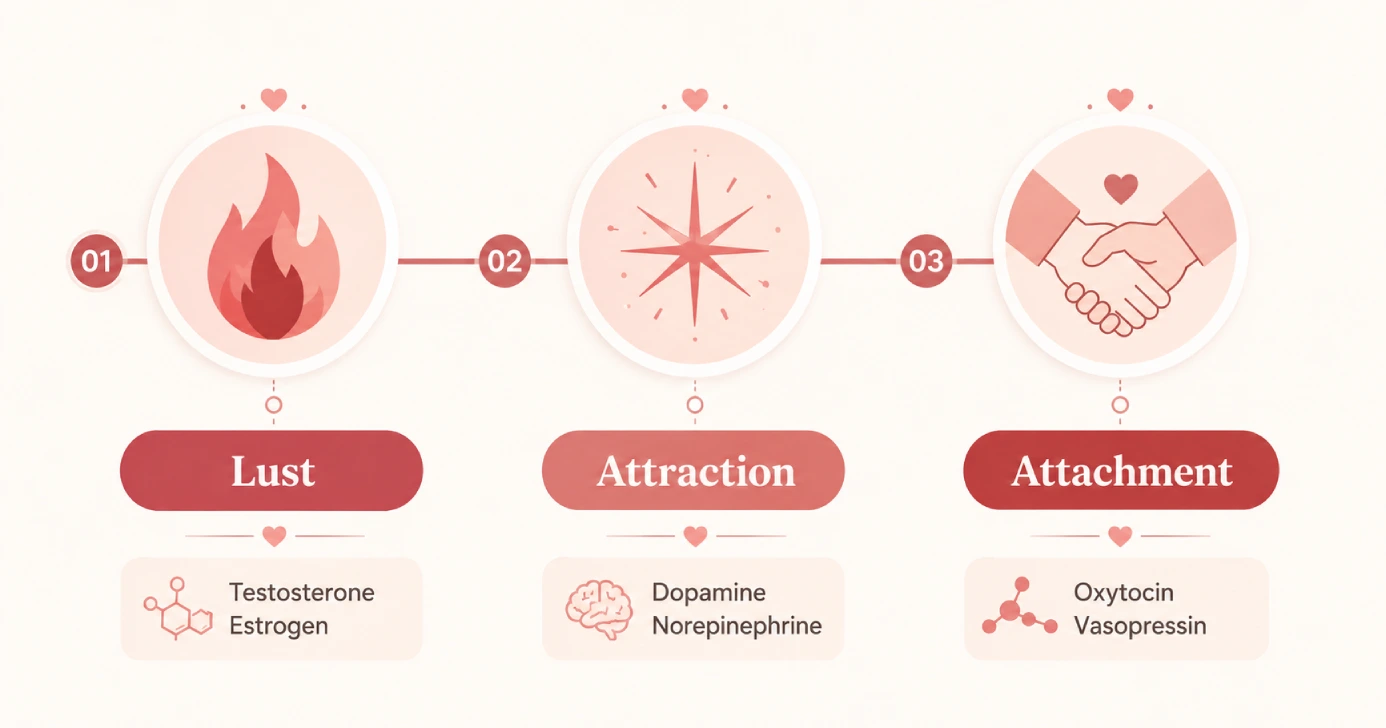
Biological anthropologist Helen Fisher, one of the most cited researchers in this space, breaks romantic love into three overlapping systems: lust, attraction, and attachment. Each runs on different hormones and activates different brain regions — mainly the prefrontal cortex, hypothalamus, and pituitary gland. That’s the framework much of what follows falls under.
Here’s what most “love facts” articles get wrong: they treat every claim as equally solid. Some of what follows is well-replicated research. Other findings come from a single study that hasn’t been repeated. I’ll flag the difference where it matters.
Human Psychology of Love and Attraction: The Core Facts
This is where most people start — the “why am I like this” section. Attraction isn’t random, even when it feels that way.
- Kindness outperforms looks over time. People perceived as generous or considerate rank higher as long-term partners, even without strong physical attractiveness — the brain gradually weighs character signals more heavily than appearance.
- Kindness can alter perceived physical attractiveness. Studies show that people rated as warm and compassionate are often scored as more physically appealing than they otherwise would be — your personality changes how your face reads to someone.
- Familiarity breeds affection. The mere exposure effect: people develop preferences for things they encounter repeatedly, which is part of why office crushes and “we met in college” stories are so common.
- Love and addiction share circuitry. Romantic attachment activates the same neural pathways as addiction — falling in love triggers reward systems linked to craving, and when a relationship ends, the brain reacts similarly to withdrawal.
- A little friction can be healthy. Moderate conflict increases engagement and curiosity between partners — the relationship isn’t fragile; it’s active.
- You may be drawn to faces resembling your parents. Facial feature or coloring similarities appear more often than chance predicts, triggering comfort and trust without conscious awareness.
- Similar personalities aren’t the secret. A study in Personality and Individual Differences found that matching personality traits have no significant link to relationship satisfaction — aligning on core values matters more.
- Altruism is genuinely attractive. Research in Evolutionary Psychology found that women prefer long-term partners who are altruistic, and men who combined attractiveness with altruism scored highest in desirability.
- Humor signals problem-solving ability. Research in Personality and Social Psychology Bulletin found that a good sense of humor is read as an indicator of creative problem-solving — not just entertainment value.
- You mimic people you’re attracted to. Unconscious mimicry — matching posture, tone, or gestures — is a well-documented sign of rapport and attraction.
- Eye contact accelerates closeness. Psychologist Arthur Aron’s study found that roughly four minutes of sustained eye contact creates intense closeness between strangers, part of why his “36 Questions” experiment became so well known.
- Attraction follows a matching pattern. People tend to pursue partners at roughly the same perceived attractiveness level — a pattern researchers call “assortative mating.”
Psychological Facts About Love and Crushes
Crushes have their own psychology, separate from established relationships — and they can feel more intense precisely because nothing’s confirmed yet.
- Uncertainty intensifies a crush. Research suggests people feel more drawn to someone when they’re unsure how that person feels back. Psychologists call this the “uncertainty of reciprocity” effect, and it’s a big part of why early-stage crushes feel consuming.
- This overlaps with “limerence.” Psychologist Dorothy Tennov coined the term limerence to describe the involuntary, intrusive-thought state of early infatuation — not intrusive in a harmful way, just the “why do I keep thinking about them” way.
- Your pupils give you away. When you’re drawn to someone, pupil dilation increases noticeably — an involuntary response, which is part of why “the eyes don’t lie” isn’t just a saying.
- Novelty amplifies dopamine. Early crush energy is partly a dopamine effect tied to newness, not the person specifically — which is why that feeling fades as things become familiar, even when the relationship is going well.
- Crushes distort critical judgment. When you’re crushing, the brain can suppress activity in regions responsible for critical assessment — the neuroscience behind “love is blind” in the early stages.
- Men often report falling faster. Several studies on early-stage romantic feelings suggest men report falling for someone sooner than women do, though women often report falling harder once it happens.
Here’s what most people miss about crushes: the intensity you feel isn’t a reliable predictor of compatibility. It’s mostly a chemical response to novelty and uncertainty — which is why so many crushes fade once the mystery clears.
Dark Psychology Facts About Love You Should Actually Know
Not every love-related psychological pattern is warm and fuzzy. This section matters because manipulative relationship dynamics get mistaken for “passion” — and knowing the difference can protect you.
- Love bombing is a manipulation tactic, not romance. Excessive early affection, gifts, and declarations of love — moving fast to create dependency — is a documented pattern among people with narcissistic or manipulative traits, not a sign of an unusually strong connection.
- Intermittent reinforcement keeps people hooked. Unpredictable affection (warm one day, cold the next) triggers the same reward-seeking loop as a slot machine, which is why unhealthy on-again-off-again relationships are so hard to leave.
- Jealousy isn’t proof of love. Genuine attachment can come with mild jealousy, but controlling or possessive jealousy is more often linked to insecurity or dark triad traits (narcissism, Machiavellianism, psychopathy) than to depth of feeling.
- Dark triad traits can be initially attractive. Traits like confidence and charisma — often present in people high in narcissism — can appeal short-term, even though they predict worse relationship outcomes long-term.
- Gaslighting exploits trust, not just honesty. It works by leveraging the human tendency to doubt our own perception before doubting someone we love — which is why it’s effective and so difficult to name while you’re inside it.
- Trauma bonding is real and measurable. Cycles of abuse followed by affection create strong attachment through the same stress-hormone pathways involved in other trauma responses — not because the person “just loves too much.”
If any of this sounds familiar, that’s worth sitting with — not as a diagnosis, just as information worth paying attention to.
Psychology Facts About Guys in Love vs. Girls in Love: Real Patterns, Not Stereotypes
Gendered differences in love exist on average, but they’re patterns with significant overlap — not rules. Treat these as tendencies, not a horoscope.
| Pattern | What Research Suggests | Worth Noting |
|---|---|---|
| Speed of falling | Men often report falling in love faster than women | Women often report falling more intensely once attached |
| Saying “I love you” first | Women say it first in roughly two-thirds of relationships, per surveyed couples data | Contradicts the common assumption that men lead emotionally |
| First impressions | Body language and posture heavily shape a woman’s first impression of a man | Nonverbal cues often outweigh what’s actually said |
| Processing a breakup | Men are often slower to process heartbreak emotionally | Women tend to report more intense initial grief but recover measurably faster over time |
| Jealousy triggers | Men more often report distress over physical infidelity | Women more often report distress over emotional infidelity |
- Men may show love through action more than words. Attachment researchers note that men are somewhat more likely to express commitment through consistent behavior — showing up, providing, problem-solving — than verbal affirmation. This sometimes gets misread as emotional distance.
- Women are typically more attuned to relationship “temperature.” Relationship research suggests women, on average, pick up on subtle shifts in relationship satisfaction earlier than their male partners — useful context, not a compliment or criticism either way.
- Both sexes benefit equally from secure attachment. Despite the patterns above, what actually predicts relationship satisfaction — trust, responsiveness, emotional safety — applies identically regardless of gender.
What Does Lack of Intimacy Do to a Woman?
This question comes up frequently, and it deserves a direct answer.
Intimacy — physical and emotional — plays a measurable role in wellbeing. A prolonged lack of it can show up as increased irritability or emotional distance, lower self-esteem tied to feeling undesired or unseen, reduced oxytocin-driven closeness and calm, and a quiet resentment that builds precisely because it’s never named.
To be clear: this isn’t universal, and it isn’t about blame. Some women are far more affected by low emotional intimacy than low physical intimacy, and vice versa. Journal of Family Psychology’s research on “empathic accuracy” — how well partners understand what the other is actually feeling — found this ability matters most during the shift from new relationship to long-term partnership, which tracks with when intimacy gaps tend to open.
If this resonates, the fix usually isn’t more effort — it’s more specificity. Naming which kind of intimacy (physical, emotional, or both) feels missing gets further than vague complaints about “distance.”
Can Love Exist Without Romance?
Yes — and this is one of the more useful things psychology has to say on the topic.
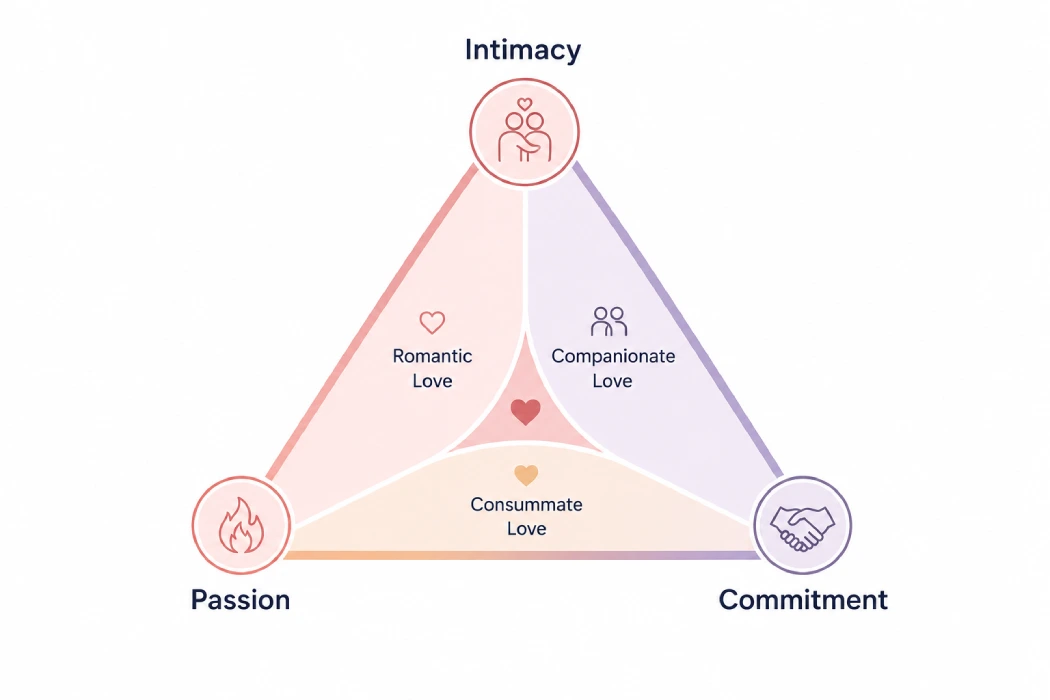
Psychologist Robert Sternberg’s Triangular Theory of Love breaks love into three components: intimacy, passion, and commitment. Different combinations produce different kinds of love, and romance specifically depends on passion. Remove passion but keep intimacy and commitment, and you get what Sternberg calls “companionate love”: the deep, stable bond in long-married couples, close family relationships, or lifelong friendships.
Love without romance is not only possible — it’s the form most people live in for most of their lives. Romance burns brightest early on; companionate love is what lasts.
What Is the 777 Rule of Love?
You’ve probably seen this one on social media. The 777 rule is a relationship maintenance framework: every 7 days, go on a date; every 7 weeks, take a night or weekend away; every 7 months, take a proper trip together.
It went viral after reports that actress Amy Nuttall had asked her husband to follow it after an alleged affair, and it’s been circulating ever since as relationship-advice shorthand.
Is it backed by psychology? Sort of. Clinical psychologist Sabrina Romanoff points out that the name feels new, but it’s a traditional relational concept repackaged — the underlying idea is that relationships require novelty, quality time, and consistent investment to stay fulfilling. Logan Ury, a dating coach and relationship scientist at Hinge, appreciates the intent but cautions against rigid formulas, since they create pressure or guilt when life doesn’t cooperate.
The Gottman Institute — among the most research-backed names in relationship science — takes a similar view: the 777 rule is fine scaffolding, but it tells you when to show up, not how. John Gottman’s decades of couples research point to turning toward your partner’s bids for connection and managing conflict without contempt as the real predictors of relationship success. The 777 rule just gives you a calendar to practice them on.
Psychological Facts About Love in a Relationship (Long-Term)
Everything above mostly covers the beginning. Here’s what psychology says about love once the initial rush fades — because this is the stage most “love facts” lists skip, and it’s arguably the most useful part.
- Love changes chemically, not just emotionally. Research on newlywed partners found that oxytocin, dopamine, and vasopressin are the three brain chemicals most involved in bonding, with romantic love maintained largely through their ongoing release.
- Secure partners feel calmer, not just happier. Research consistently shows that security — built on trust, reliability, and emotional stability — matters more for long-term satisfaction than early-stage excitement.
- Relationships protect health. Decades of research show strong, close relationships influence health, emotional balance, and long-term satisfaction more reliably than income or job status.
- Physical pain and heartbreak share brain real estate. The same brain region that processes physical pain also lights up during social rejection and heartbreak — the neuroscience behind “it hurts.”
- Loving relationships can speed physical healing. Positive, secure relationships are associated with lower stress and better mood, which measurably supports faster wound healing and immune function.
- Looking at your partner’s photo can reduce pain perception. Studies found a measurable analgesic effect from simply viewing a photo of a loved one, tied to the brain’s reward and attachment circuitry.
- Long-term love and lust use different brain pathways. Lust activates the brain’s pleasure centers, while sustained romantic love activates areas tied to reward and long-term behavior. A fading spark doesn’t mean the love is gone — a different system has taken over.
- Empathic accuracy predicts relationship success. The ability to read what your partner is actually feeling — not what you assume they’re feeling — is one of the strongest predictors of relationship satisfaction identified in family psychology research.
- Shared values beat shared hobbies. Couples don’t need identical interests to thrive, but they do better long-term when they align on values, ethics, and life priorities.
- Time perception shifts when you’re in love. People in the early stages of love commonly report that time feels faster, tied to heightened focus and emotional engagement.
- Attention narrows toward your partner. Being in love measurably shifts what the brain prioritizes — thoughts related to your partner get processed with more focus and salience than they otherwise would.
Now, this is where it gets interesting: most of these long-term facts point to the same truth. The chemistry of early love and the chemistry of lasting love aren’t the same system — which means a relationship that’s lost its early spark hasn’t necessarily lost anything real. It’s running on a different, quieter engine.
FAQs
What are psychological facts about love?
Research-backed findings — from psychology, neuroscience, and behavioral science — that explain how and why humans experience attraction, attachment, and long-term bonding. They differ from relationship advice: they describe what’s happening biologically and behaviorally.
What does lack of intimacy do to a woman?
It can lead to emotional distance, lower self-esteem tied to feeling undesired, and reduced oxytocin-driven closeness. Effects vary significantly by person, and whether physical or emotional intimacy is missing matters more than the general label of “lack of intimacy.”
Can love exist without romance?
Yes. Robert Sternberg’s Triangular Theory of Love shows that intimacy and commitment can produce a deep, lasting bond — “companionate love” — without passion. This is common in long-term marriages, family relationships, and close friendships.
What is the 777 rule of love?
A date every 7 days, a night or weekend away every 7 weeks, and a trip together every 7 months. Not a clinically validated framework, but the underlying principle — protecting consistent quality time — aligns with what relationship researchers like the Gottman Institute have found matters.
Do men or women fall in love faster?
Research suggests men report falling faster, while women more often report falling more intensely once attached. Both patterns have plenty of individual exceptions.
Is love at first sight psychologically real?
Something real happens — an intense, immediate attraction response — but psychologists generally consider it closer to strong initial attraction than the deeper attachment that defines lasting love, which takes time to build.
Why does heartbreak physically hurt?
Social rejection and physical pain activate overlapping brain regions. Heartbreak isn’t just a metaphor — it produces a genuine physical ache.
Conclusion
- Attraction is patterned, not random — kindness, familiarity, and shared values predict long-term connection better than looks or personality-matching.
- Not every intense feeling is healthy love. Love bombing, intermittent reinforcement, and trauma bonding can mimic passion while actually being manipulation — knowing the difference matters.
- Love without romance is psychologically legitimate. Companionate love — intimacy plus commitment — is what most long-term relationships run on.
- Frameworks like the 777 rule aren’t magic, but the instinct behind them — protecting consistent quality time — is backed by relationship science.
- The chemistry of falling in love and staying in love are two different systems. Losing the early spark doesn’t mean losing the relationship.
The biggest thing I’d want you to walk away with: most “facts about love” content treats love like a mystery to decode. It’s not — it’s a set of biological and behavioral patterns researchers have studied for decades. Understanding them doesn’t make love less magical. Knowing why your brain does what it does when you’re falling for someone — or grieving losing them — makes the experience less disorienting and easier to trust yourself through.
Which of these surprised you most? If you’re in the crush phase, the “in a relationship” section, or somewhere in the messier middle, drop where you landed — it’s usually more universal than it feels in the moment.

