

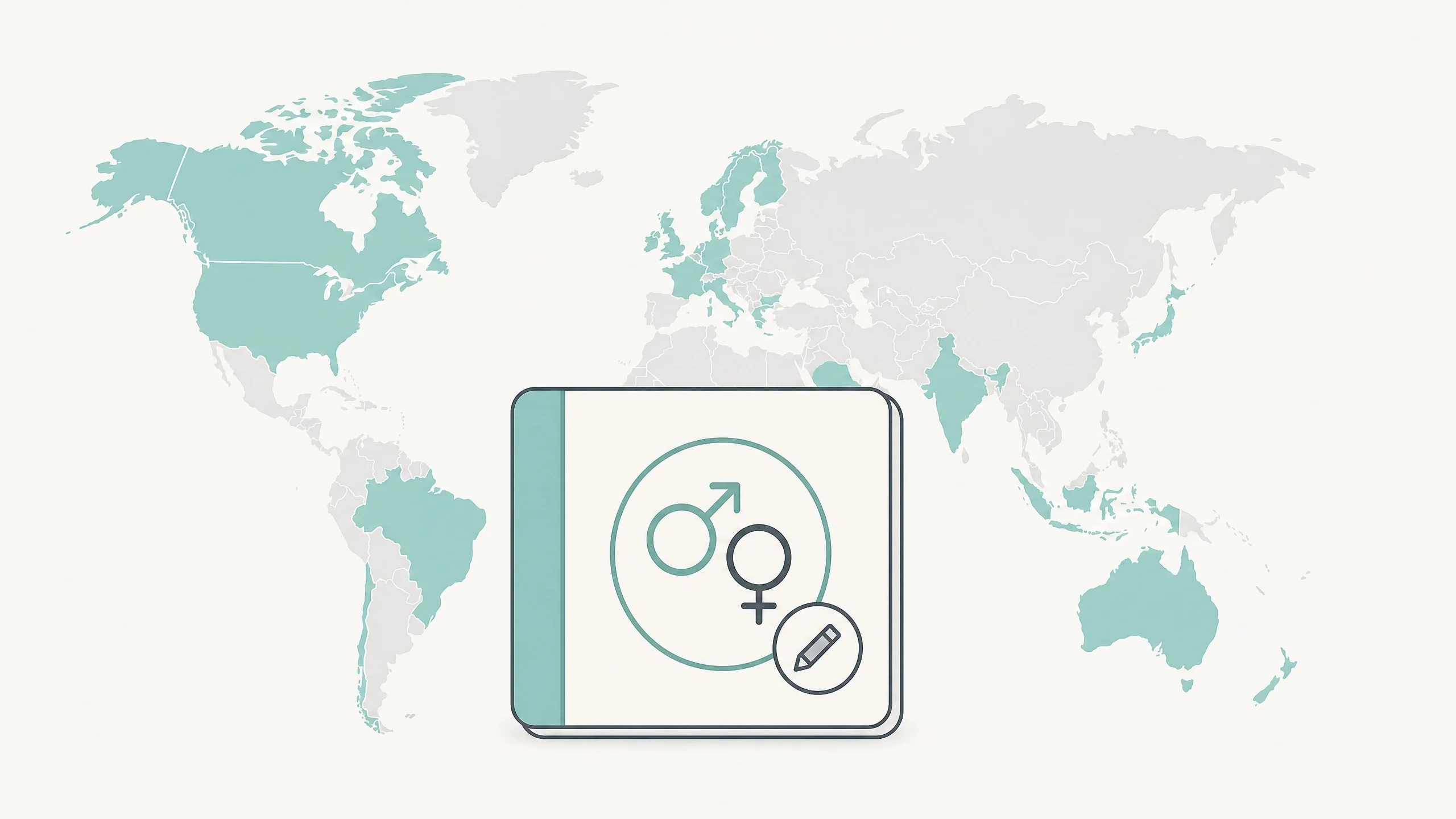
Imagine walking into a government office, signing a single form, and walking out with an updated ID — one that reflects who you are. No surgery. No psychiatrist’s letter. No court hearing. In Argentina, this has been possible since 2012. In Germany, since November 2024. In Cuba, since 2025.
Yet cross into a neighboring country, and no legal pathway may exist at all.
Legal gender recognition is one of the fastest-changing areas of human rights law in the world right now. What was true five years ago is often not true today — and what’s true in one country may be completely different in the country next door.
This guide explains what “legal gender change” actually means, which countries allow it without surgery, what the process looks like in different parts of the world, and what the common misconceptions are — all based on current 2026 data.
What Does “Legal Gender Change” Actually Mean?
Legal gender change refers to updating the gender marker on official government documents — such as a national ID card, passport, or birth certificate. It is an administrative or legal process. It is separate from any medical procedure, personal identity, or social transition.
When we say a country “allows” legal gender change, it means the government has a formal procedure through which a person can update the gender listed on their records. What that procedure looks like — and whether it requires medical steps, court approval, or just a simple declaration — varies widely.
There are three broad categories most countries fall into:
- Self-declaration — A person can update their gender marker by signing a declaration. No surgery, no diagnosis, no court required.
- Medical input required (but not surgery) — A doctor’s letter, psychiatric assessment, or hormone therapy documentation may be needed, but surgery is not.
- Surgery required or no legal pathway at all — Some countries still require sex reassignment surgery. In others, no formal process exists.
The Direct Answer: Can You Change Your Gender Legally Without Surgery?
Yes — in more than 30 countries.
As of early 2026, over 23 countries have enacted laws allowing gender self-identification without requiring any judicial or medical approval. When you include countries that allow changes with some medical input (but no surgery), the number rises to more than 40 nations worldwide.
The number has grown significantly in recent years:
- 2012 — Argentina became the first major country to pass self-ID legislation
- 2015 — Ireland introduced self-declaration
- 2021 — New Zealand passed landmark self-ID law
- 2024 — Germany’s Selbstbestimmungsgesetz took effect in November
- 2025 — Cuba passed self-declaration legislation; Sweden updated its law to remove the gender dysphoria diagnosis requirement
This is an area of law that is actively evolving.
Country-by-Country Breakdown: Three Categories
Category 1 — Self-Declaration (No Surgery, No Diagnosis Required)
These countries allow people to update their gender marker through a simple signed statement or administrative form.
Europe: Argentina led the way globally, and Europe has since become the region with the most self-ID countries. As of 2026, self-declaration is available in Belgium, Denmark, Finland, Germany, Iceland, Ireland, Luxembourg, Malta, Norway, Portugal, Spain, and Switzerland — with Austria joining the list in late 2025.
South America: The Inter-American Court of Human Rights’ 2018 ruling that gender identity document updates are protected under the American Convention on Human Rights has driven reform across the continent. Argentina, Uruguay, Bolivia, Brazil, Chile, Colombia, and Ecuador all allow self-declaration.
Asia and Pacific: Nepal (2024), Pakistan (2023 recognition), New Zealand (2023), and South Korea (2020) are among the countries in this region with no-restriction policies on gender marker changes.
Africa: Botswana has allowed no-restriction gender marker changes since 2017, making it notable in a region where legal pathways are rare.
Cuba (2025): Cuba’s National Assembly passed landmark legislation in 2025 allowing transgender Cubans to update gender markers on national identity documents through a straightforward administrative declaration — no surgery or judicial approval required.
Category 2 — Medical Input Required, But Not Surgery
Some countries don’t require surgery but do ask for some form of medical involvement.
Israel significantly eased its process — surgery was required until 2015, and by 2020, both the surgery requirement and the hormone replacement therapy requirement were removed. Some medical certification still applies.
Australia allows gender marker changes without surgery, though the process varies by state and may involve medical documentation.
France and Greece — often listed as requiring court approval — have evolved. Greece updated its law in 2017 and France in 2018 to allow changes with significantly reduced requirements compared to before, though some judicial involvement may still apply in certain circumstances.
Category 3 — Surgery Required or No Legal Pathway
Several countries still require sex reassignment surgery as a precondition for legal gender change. These include China, Taiwan, and Singapore.
Japan has historically required surgery, though recent court rulings have begun challenging this. The Supreme Court issued a ruling in 2023 questioning the constitutionality of the surgery requirement — legal reform is possible in the near future.
In many parts of Central Asia, Western Asia, East Africa, and North Africa, no legal gender recognition framework exists at all. In some of these regions, being transgender is criminalized. The United Nations Office of the High Commissioner for Human Rights has stated that requiring forced medical procedures as a precondition for legal gender recognition violates international human rights standards.
Quick Reference Table: Notable Countries
| Country | Status | Year Established |
|---|---|---|
| Argentina | Self-declaration, no surgery | 2012 |
| Uruguay | Self-declaration | 2009 |
| Ireland | Self-declaration | 2015 |
| Colombia | Self-declaration | 2015 |
| Denmark | Self-declaration | 2014 |
| Norway | Self-declaration | 2016 |
| Belgium | Self-declaration | 2018 |
| Portugal | Self-declaration (from age 16) | 2018 |
| New Zealand | Self-declaration | 2023 |
| Germany | Self-declaration (Selbstbestimmungsgesetz) | Nov 2024 |
| Sweden | No surgery, no dysphoria diagnosis required | July 2025 |
| Cuba | Self-declaration | 2025 |
| Pakistan | Self-perceived gender on all official documents | 2018 |
| Canada | No surgery required | 2017 |
| Israel | No surgery, no HRT required | 2020 |
| China | Surgery required | — |
| Singapore | Surgery required | — |
| Japan | Surgery historically required; under legal review | — |
| United States | Varies by state | — |
The United States: A Fragmented Picture
The US has no single federal standard for legal gender change. Laws differ dramatically by state.
Some states — like California, New York, and Minnesota — allow gender marker changes without surgery or medical requirements. Others have passed legislation restricting or banning the process entirely.
At the federal level, the situation is complex. A 2025 executive order directed federal agencies to recognize only biological sex on government documents, affecting passports and other federal ID. This has created a conflict between federal and state-level policies that is ongoing in 2026.
A total of 74 anti-trans bills became law in the United States in 2025, spanning areas from healthcare access to document policies and sports participation.
Why Do Laws Differ So Much?
There is no international standard or treaty that governs how countries must handle legal gender recognition. Each country sets its own rules based on its legal traditions, political environment, healthcare systems, and human rights commitments.
Human rights organizations — including ILGA (the International Lesbian, Gay, Bisexual, Trans and Intersex Association) — track these laws globally. Their ILGA World Database on Legal Gender Recognition is the most comprehensive global resource for current country-by-country status.
The 2018 Inter-American Court of Human Rights ruling was a significant turning point in the Western Hemisphere. It established that updating official documents to reflect gender identity is protected under the American Convention on Human Rights — influencing reforms across South America and Central America.
In Europe, the Council of Europe and ECHR have played a similar role. A 2017 ECHR ruling found that requiring sterilization before legal gender recognition constitutes a human rights violation — this has since pushed several European countries to remove such requirements.
Common Misconceptions Cleared Up
“Legal gender change requires surgery.” This was true in many countries historically. It is no longer true in more than 40 countries, and the number continues to grow.
“The rules are the same everywhere.” They are not. The process in Ireland can take days. In other countries, it requires years of medical documentation. In some countries, no process exists at all.
“Countries with self-declaration have no rules.” Even self-ID countries typically have age requirements, waiting periods, or parental consent rules for minors. Germany’s 2024 law, for example, allows those aged 16–18 to make the change with parental involvement, and parents can initiate the process for younger children.
“A legal gender change in one country is recognized everywhere.” Not automatically. Legal recognition in one country does not guarantee recognition in another. Someone who changed their gender marker in Ireland may still need to go through a separate legal process in another country.
“Non-binary recognition is the same as binary gender change laws.” These are often separate issues. Some countries that allow binary gender changes (M or F) still do not legally recognize non-binary or third-gender options. The availability of a third gender marker varies and is more limited globally.
Frequently Asked Questions
What does “self-declaration” mean in gender recognition law?
It means a person can legally update their gender marker by declaring their gender identity in an official statement or form — without surgery, a medical diagnosis, or a court decision. Countries like Denmark, Ireland, Argentina, and Germany currently offer this.
How many countries allow legal gender change without surgery?
As of 2026, more than 40 countries allow legal gender recognition without surgery. Of those, at least 23 use full self-determination — meaning no medical or judicial involvement is needed.
Can minors legally change their gender marker?
In some countries, yes — with conditions. Sweden’s updated law, effective July 2025, allows gender marker changes from age 16 without requiring a gender dysphoria diagnosis. Germany’s 2024 law allows those 16–18 to make the change with parental involvement. Rules on this vary significantly by country.
Do all countries recognize legal gender changes made abroad?
No. Legal recognition in one country does not automatically transfer. A person who changed their gender marker in New Zealand, for example, may not have that change recognized in another country without a separate local process.
What happens in countries with no legal pathway?
People in those countries have no formal way to update gender on official documents. In some cases, they may face legal consequences simply for how they identify or present.
Is legal gender change the same as gender-affirming medical care?
No. Legal gender recognition — updating a document — is a separate process from medical gender affirmation (such as hormone therapy or surgery). In countries with self-declaration, a person does not need any medical care to update their ID.
Key Takeaway
Legal gender recognition without surgery is no longer rare. It is now available in more than 40 countries and growing. The process varies — from a single-form declaration in Ireland to more involved steps in other nations — but the global direction of travel has been consistent over the past decade: toward removing medical and surgical requirements, and toward faster, more accessible processes based on self-determination.
Laws in this area change frequently. A country that required surgery five years ago may have removed that requirement. A country that had no pathway may have passed legislation. Always verify the current rules through official government sources or the ILGA World Database for the most accurate, up-to-date information.
This article is for informational purposes only and does not constitute legal advice. Laws around legal gender recognition change regularly. For country-specific guidance, consult official government sources or qualified legal professionals in the relevant jurisdiction.

