

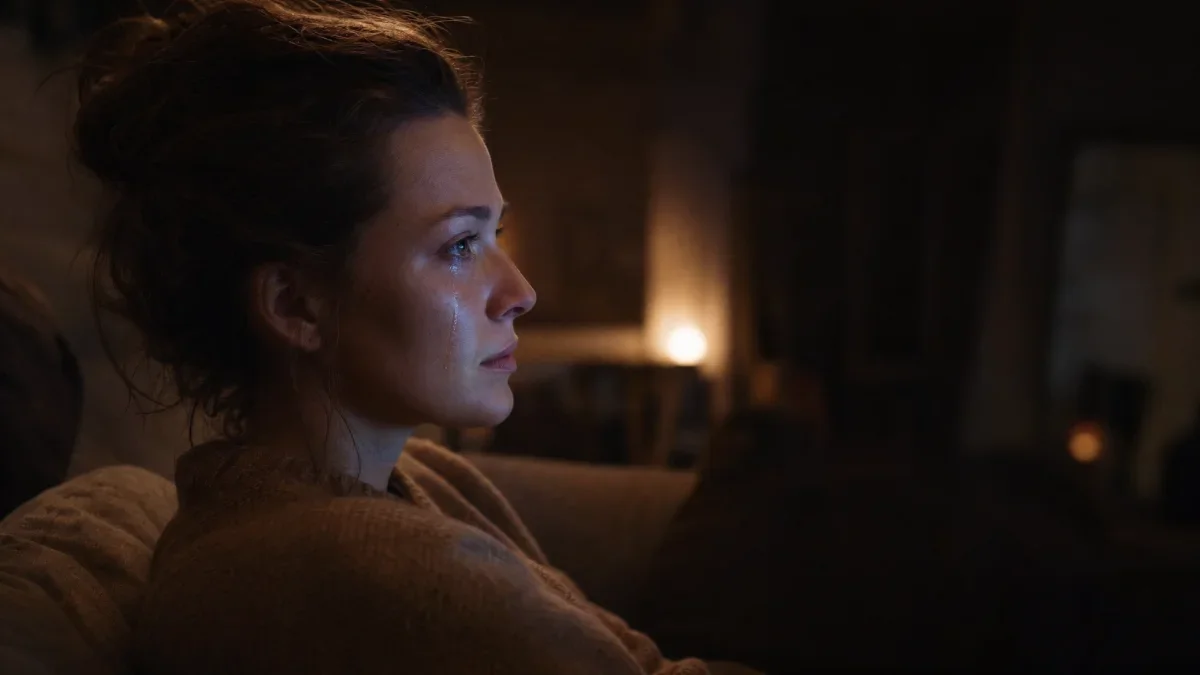
You Held It Together All Day. Then One Movie Scene Broke You.
You survived the meeting. Handled the bad news. Kept it together on the packed train home. Then you fired up a film—and 20 minutes in, you were crying over an animated fish. Or a soldier who never came home. Or a dog that waited at a station.
I’ve been there. Last month, I watched a documentary about a penguin. A single piano note hit, the penguin lost its mate, and I was done. Sobbing. Into my noodles.
Sound like you? You’re not weak. And you’re definitely not alone. There’s a real, science-backed reason we cry so easily during movies—often more freely than in our own lives.
Why We Cry During Movies — The Short Answer
Why we cry during movies isn’t complicated. Films hand you a safe emotional space, free of real-world stakes. No one needs you to solve the problem. No one’s going to judge you if your eyes leak. So your guard comes down, and feelings you’ve been stashing all day finally get air. That’s it. You’re not a mess—you’re human.
Why Movies Feel More Emotional Than Real Life
Think about a genuinely awful moment in your day. The phone rings. Someone needs a decision. You’re crafting a reply while checking the time. There’s a tightness in your chest, but you push it down because the grocery list needs doing and the dog needs a walk.
Now contrast that with curling up on the couch, headphones on, The Farewell playing on the screen. Nothing’s urgent. Nobody’s watching. All you have to do is follow the story. That’s when the dam breaks.
When you watch a film, three things happen at once:
- No pressure — there’s nothing to fix, no reply to craft.
- No judgment — even if someone sees you cry, odds are they’re already damp-eyed too.
- Full immersion — the screen owns your attention; no scrolling, no pings.
That combination is practically a luxury in daily life. Movies manufacture the ideal conditions for emotional release—and your brain says thank you.
What’s Happening in Your Brain When You Cry at a Film
Your brain isn’t great at separating “that’s happening to someone else” from “that’s happening to me.” Not a bug—a feature. It’s how we’ve built empathy over millennia.
Blame mirror neurons, first discovered by Italian neuroscientist Giacomo Rizzolatti and his team in the 1990s. These brain cells fire both when you do something and when you watch someone else do it. So when an on-screen character grieves, your own brain simulates a little echo of that grief. You’re not just observing. You’re feeling, on a subtle physiological level.
Emotional contagion piles on. This is the unconscious transfer of feelings from one person—or one screen—to another. Psychologist Elaine Hatfield’s work shows that we automatically mimic facial expressions, postures, and vocal tones, which in turn trigger the corresponding emotion inside us. Movies exploit that relentlessly.
And then there’s the personal stuff. A father-daughter scene might yank up your own unspoken grief. A breakup story lands differently if you’re nursing a wound. The film isn’t just telling a story; it’s picking a lock you forgot was there.
How Films Are Built to Make You Feel
Filmmakers are emotional architects. They don’t stumble into your tears; they blueprint them.
Music Does the Heavy Lifting
Before any character speaks, the score has already told your limbic system what to feel. A slow cello line? Sadness is coming. A crescendo of horns? Something big is about to land. That’s not magic—it’s science. Studies in music psychology (like Juslin & Västfjäll, 2008) show that features such as slow tempo, minor key, and rising melodic contours reliably trigger emotions. Hans Zimmer, John Williams, Ennio Morricone—they’re masters because they know emotion rides sound faster than words. I’m pretty sure I’ve cried at a theme tune before the opening logo even faded.
Close-Ups Force Connection
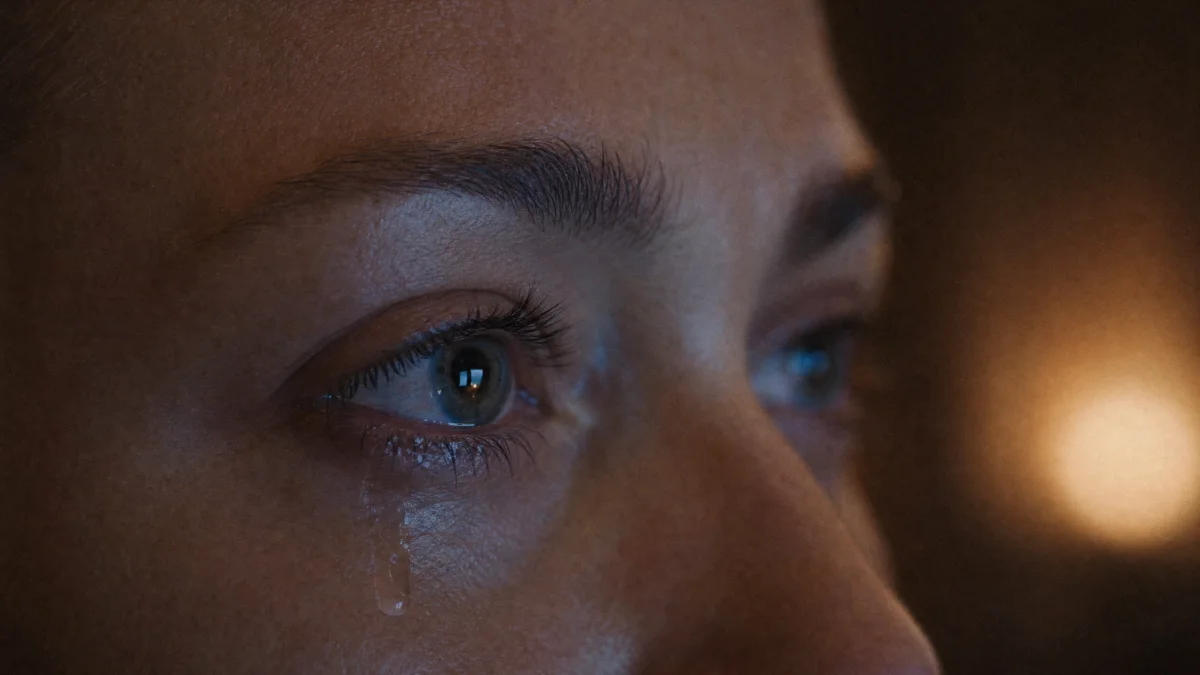
When a camera pushes in tight on an actor’s face, you’re basically forced into emotional intimacy. Your mirror neurons fire, registering every micro-expression—the slight tremble of a lip, the eyes glistening before the first tear falls. You feel it before you’ve even figured out why.
Story Buildup Creates Emotional Investment
You’ve spent 90 minutes with these characters. You know their fears, their losses, their small victories. When the emotional payoff arrives, you’re not reacting to a stranger. You’re reacting to someone you’ve come to care about—exactly what great storytelling is designed to do. Psychologists call this narrative transportation, and the American Psychological Association notes that emotional investment in fictional characters is a normal, healthy function of human cognition.
Why We Don’t Cry the Same Way in Real Life
I once sat stone-faced through a funeral, then wept at a Subaru ad two days later. Confused? I wasn’t broken—I was just finally in a space where I could let go.
In real life, emotional expression gets filtered through a dozen layers of social policing. From childhood, we learn when tears are “appropriate” (spoiler: almost never). At work, you choke it down because vulnerability can be career kryptonite. In public, you’re aware of eyes. Even with family, you might bite back tears to avoid worrying them.
Then there’s the to-do list. Grief in real life arrives with logistics—phone calls, insurance forms, who’s picking up the kids. You don’t get to just sit and feel. You have to function.
Movies hit pause on all of that. Permission granted. The lights dim, the story takes over, and you’re finally allowed to just feel without the usual adulting tax.
Why Crying at Movies Is Actually Good for You
Crying isn’t weakness; it’s a pressure valve. When you tear up over a film, you’re often releasing emotions you haven’t had bandwidth to process all week. And science backs the relief you feel.
A 2014 study led by Asmir Gračanin in Frontiers in Psychology found that crying activates the parasympathetic nervous system—your body’s “rest and digest” mode. Emotional tears also flush out stress hormones and trigger the release of oxytocin and endorphins, natural painkillers that promote bonding and calm. So that lighter, wrung-out-but-okay feeling after a weepy movie? Not your imagination. You just gave your nervous system a legit workout.
Crying researcher Dr. Lauren Bylsma from the University of Pittsburgh notes that crying in response to fiction can serve as a safe practice ground for processing real-life emotions. It’s a psychological function, not a guilty pleasure. So next time someone says you’re “too sensitive” because you cried during Coco, tell them your parasympathetic nervous system was just doing its job.
5 Things You Probably Didn’t Know About Crying at Movies
- Editors weaponize the beat. They often cut precisely on a musical swell—a technique called “phrasing” that syncs your emotional peak with what’s happening on screen. Try watching a tearjerker scene on mute; it feels almost hollow.
- Music carries most of the feels. One analysis in the journal Psychology of Music found the score can account for a significant chunk of a scene’s emotional impact—up to half, some researchers claim. I once tested this with the opening of Up without sound: the images were sweet, but I stayed dry. Add Michael Giacchino’s piano, and I’m toast.
- Fictional safety is the secret sauce. Your subconscious knows you can pause, walk away, or just close your laptop. That exit sign is exactly what lets you dive deeper emotionally than you’d dare in a real crisis.
- Crying is contagious—even in the dark. Collective sobbing in theaters is a real thing. A 2016 study in the journal Emotion found that emotional synchrony in audiences can amplify individual reactions. So if you start tearing up, the person next to you is probably right behind you.
- The ending hits hardest. You’re not just mourning a character; you’re releasing two hours of accumulated tension. The buildup has nowhere to go but out, often through your tear ducts. It’s like a pressure cooker with a cinematic timer.
Real Life vs. Movie Emotions
| Factor | Real Life | During a Movie |
| Social judgment | High — eyes are everywhere | Low — context makes it acceptable |
| Pressure to act | High — you need to respond | None — you’re just a viewer |
| Distraction level | High — tasks, notifications, noise | Low — full sensory immersion |
| Permission to feel | Often suppressed | Fully granted by the environment |
| Emotional buildup | Fragmented across days/weeks | Concentrated in 90–120 minutes |
| Physical safety | Varies | Complete — you’re in a seat |
Key Takeaways
- Movies create a safe emotional space that your daily life rarely offers.
- Your brain mirrors fictional emotions through the same systems that process real ones.
- Music, close-ups, and narrative investment are deliberate tools filmmakers use to trigger tears.
- Social norms suppress emotional expression in real life—films temporarily remove those norms.
- Crying at films is a healthy form of emotional release, not a sign of oversensitivity.
FAQs
Why do movies make us cry so easily?
In a word: safety. Films remove the social and practical pressures that keep our emotions on lockdown. With nothing to fix and no one judging you, your brain lets the tears come.
Is crying during movies normal?
Absolutely. Crying at fiction isn’t a sign you’re fragile—it’s a sign your empathy circuits are firing. Psychologists consider it a perfectly healthy, normal human response.
Why don’t we cry the same way in real life?
Real life comes with an audience and a to-do list. Movies ditch both. They give you a consequence-free zone where you can finally let go of all the feelings you’ve been gripping all day.
Are emotional movies good for mental health?
Yes, in moderation. Crying can lower stress, release oxytocin, and help you process buried emotions. But if you’re using sad films to dodge real life entirely, it’s worth a closer look. Otherwise, think of it as an emotional car wash—you come out cleaner.
Sometimes, It’s Not Just the Movie
“Sometimes, it’s not just the movie. It’s everything you’ve been holding in.”
That scene that broke you? It probably wasn’t really about the characters on screen. It was about the call you didn’t make. The grief you’ve been side-stepping. The apology that’s stuck in your throat.
Movies give us an honest room. Two hours where the world stops demanding things of you, and every emotion you’ve been managing, postponing, and swallowing finally gets its moment in the air.
Last month, a film about a hamster got me. (Yes, a hamster.) I was suddenly weeping about a friendship I’d lost years ago. The hamster was just the usher. Let it come. That’s not a weakness. It’s your mind repairing work it’s been begging to do.
Let it.

