


Authoritative parenting is a style characterised by high responsiveness (warmth, support) and high demandingness (clear boundaries, age-appropriate expectations). Developed by developmental psychologist Diana Baumrind in the 1960s, it is consistently linked to the most positive child outcomes across dozens of peer-reviewed studies.
If you have ever wondered whether you are being too strict or not strict enough, you are not alone. Many parents find themselves caught between wanting to set firm limits and wanting to raise happy, emotionally healthy children. Authoritative parenting resolves this false choice. It holds both standards simultaneously.
This guide provides research-backed definitions, real scripts for toddlers through teenagers, and a step-by-step transition plan—plus troubleshooting when it feels like nothing is working.
Defining Authoritative Parenting (The 2‑Dimension Framework)
Authoritative parenting combines high demandingness (control, boundaries, expectations) with high responsiveness (warmth, support, attunement). In plain language: you hold your child to clear, consistent expectations while simultaneously providing emotional warmth and explaining the “why” behind rules.
Diana Baumrind, a clinical and developmental psychologist at the University of California, Berkeley, originally identified three parenting styles in the 1960s through observational studies of preschool-aged children. Later researchers Maccoby and Martin expanded this to four styles by splitting Baumrind’s original “uninvolved” category.
Unlike authoritarian parents who demand obedience without explanation, authoritative parents explain the reasoning behind rules. Unlike permissive parents who avoid conflict, authoritative parents hold boundaries firmly but kindly.
The Two Core Dimensions
Demandingness (control, boundaries, expectations): This dimension covers the rules, expectations, and consequences you set. High demandingness means having age-appropriate standards for Behavior, chores, homework, and respect. It does not mean harsh punishment, rigidity, or emotional coldness.
Responsiveness (warmth, support, attunement): This dimension covers how you connect with your child emotionally. High responsiveness means listening, validating feelings, showing affection, and adapting your approach to your child’s individual temperament. It does not mean giving in to every request or avoiding difficult conversations.
Neither dimension works well alone. High demandingness without warmth becomes authoritarian (fear-based compliance). High responsiveness without boundaries becomes permissive (entitlement or anxiety).
Why Both Dimensions Must Be High (The “Goldilocks” Principle)
Children need to know that rules exist for a reason—not just for adult control. When you combine clear limits with warmth, your child internalises two truths: “My parent expects a lot from me because they believe in me,” and “My parent is on my side even when I make mistakes.”
This combination builds internalised self-regulation rather than fear-based compliance. A 1991 longitudinal study by Laurence Steinberg and colleagues found that authoritative parenting predicted higher academic achievement even into college, independent of socioeconomic status. The mechanism is clear: children adopt the family’s values as their own because they trust the parent, not because they fear punishment.
Authoritative vs. Other Parenting Styles (Visual Comparison)
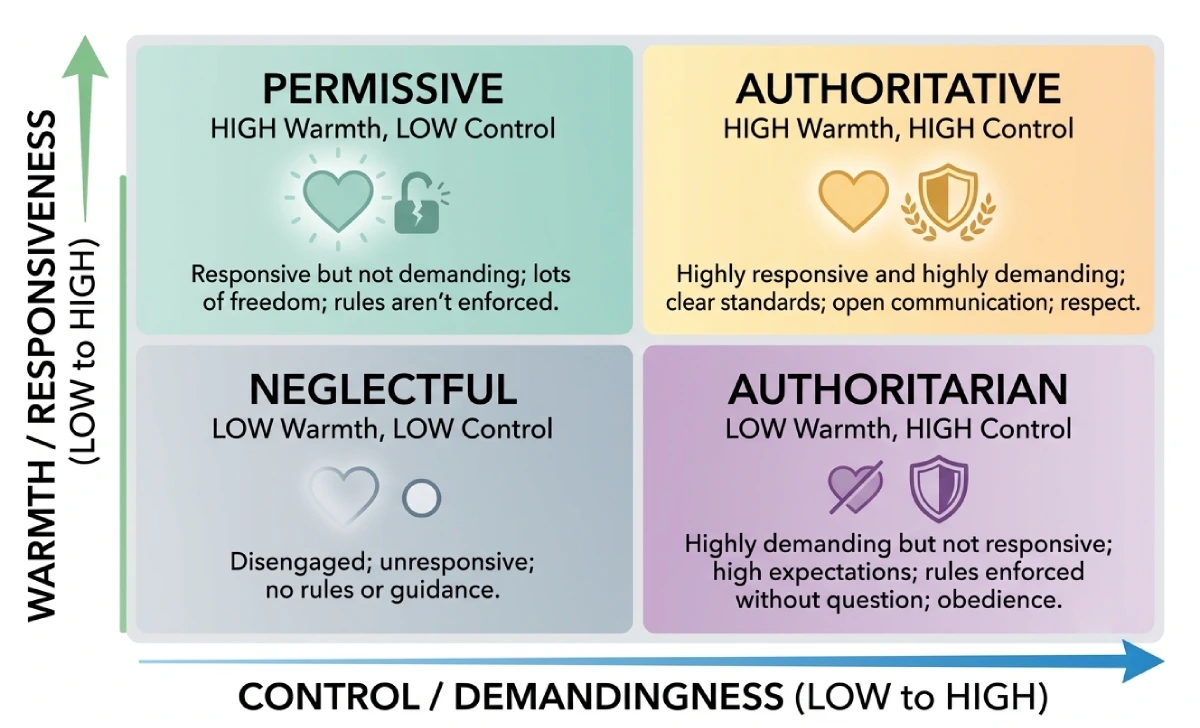
To fully understand authoritative parenting, you need to see how it differs from the other three main styles. The differences become clear when you look at two questions: How much warmth does the parent show? and how much control does the parent demand?
The 4 Parenting Quadrants (Baumrind / Maccoby & Martin)
| Parenting Style | Warmth/Responsiveness | Control/Demandingness | Typical Parent Phrase |
|---|---|---|---|
| Authoritative | High | High | “I understand you are angry, but hitting is not allowed. Let’s take a break and talk.” |
| Authoritarian | Low | High | “Because I said so. Do not ask again.” |
| Permissive | High | Low | “I know you want candy for breakfast. Fine, just stop crying.” |
| Neglectful/Uninvolved | Low | Low | “I do not care what you do.” |
Authoritative vs. Authoritarian: 5 Key Differences at a Glance
| Authoritative Parent | Authoritarian Parent |
|---|---|
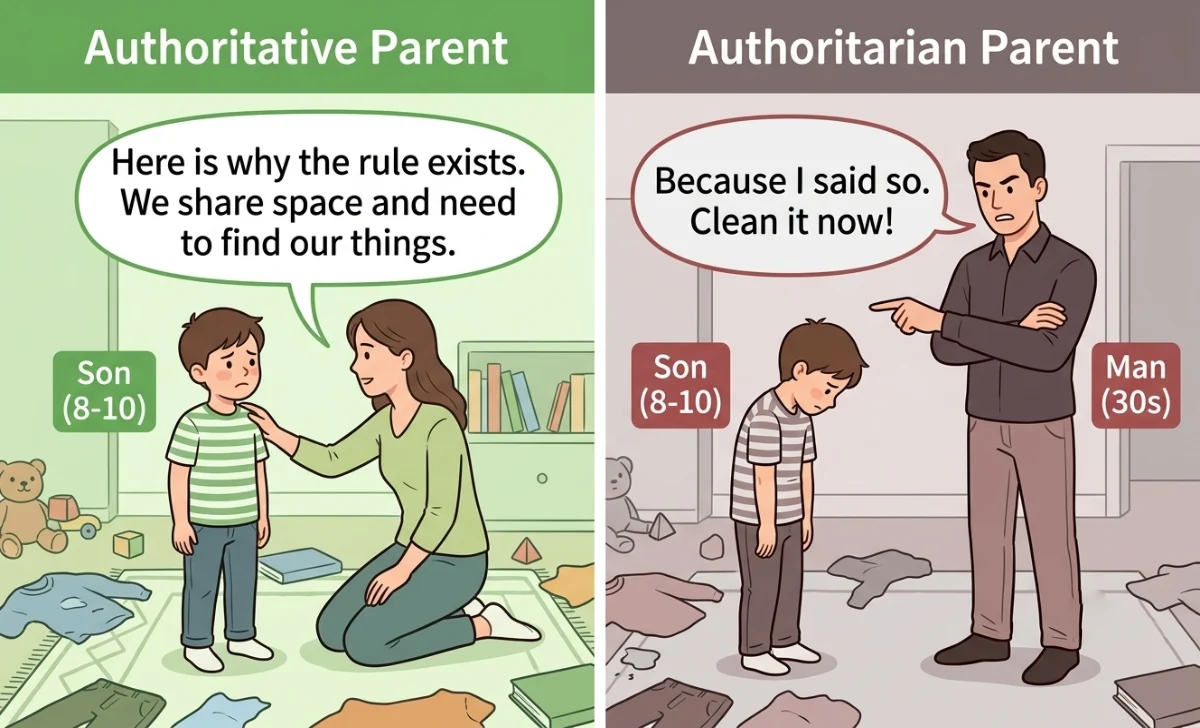
| Explains the reason behind rules | Demands obedience without explanation |
| Uses logical consequences | Uses punishment, shaming, or withdrawal of love |
| Validates emotions while holding boundaries | Dismisses emotions (“stop crying”) |
| Seeks obedience through respect and trust | Seeks obedience through fear |
| Encourages autonomy within safe limits | Restricts autonomy to maintain control |
One-sentence difference: Authoritarian says “because I said so”; authoritative says “here is why the rule exists, and I am holding it because I love you.”
Authoritative vs. Permissive (Where “Gentle Parenting” Can Go Wrong)
Permissive parents are warm and loving but avoid setting or enforcing limits. Some parents mistake permissiveness for “gentle parenting,” but without boundaries, warmth alone creates anxiety and entitlement.
- Permissive parent: “I hate seeing my child upset, so I let them quit when things get hard.”
- Authoritative parent: “I see this is frustrating. You are capable of hard things. We will finish this together, then take a break.”
The difference is loving leadership versus loving avoidance. Authoritative parenting is truly gentle and structured.
Real‑World Examples of Authoritative Parenting (By Age)
Theory is useful. Scripts are better. Here is exactly what authoritative parenting sounds like at different developmental stages.
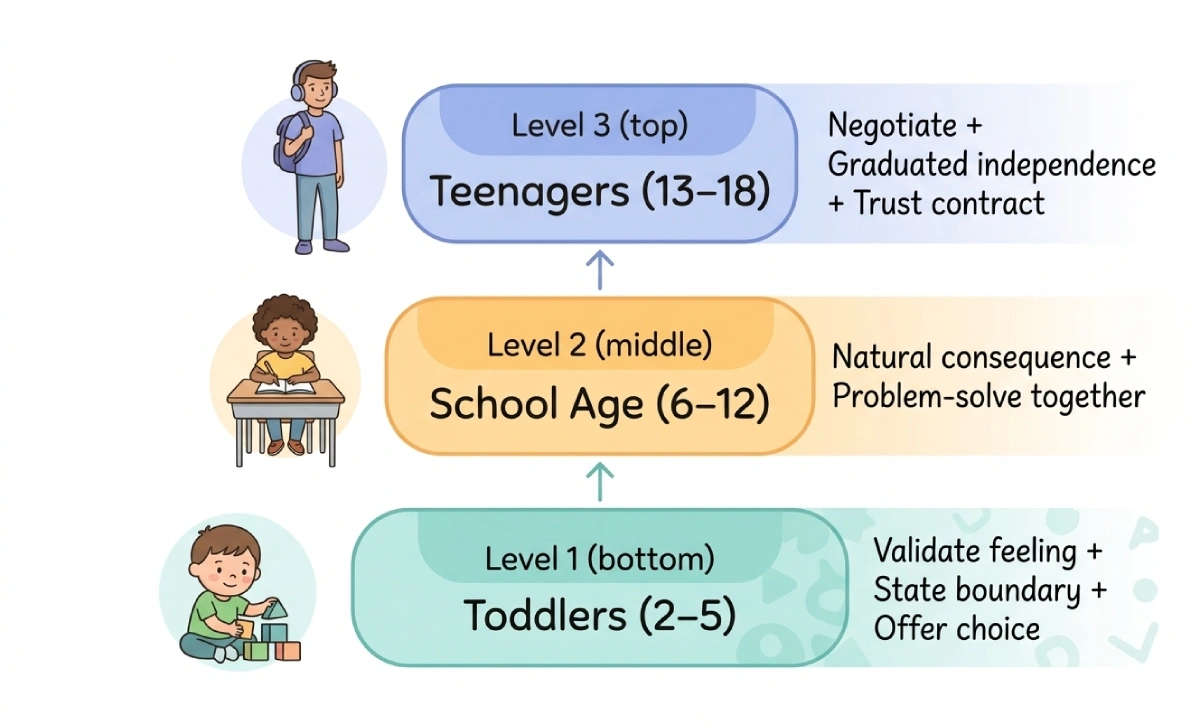
Toddlers (Ages 2–5): Boundaries + Simple Explanations
Toddlers test limits because they are learning how the world works. Authoritative parenting meets that exploration with calm, consistent responses.
Scenario: Your toddler has a tantrum in the grocery store because you said no to cookies.
Authoritative script: “I see you are really upset about the cookies. You wanted them, and I said no. That is frustrating. But we do not scream in the store. You can take a deep breath with me, or we can leave the cart and try again tomorrow.”
Takeaway: Validate the feeling first, then state the boundary, then offer a choice.
School Age (Ages 6–12): Logical Consequences + Autonomy
School-aged children can understand cause and effect. Authoritative parents use natural and logical consequences, not arbitrary punishment.
Scenario: Your child forgot their homework at home after you reminded them twice.
Authoritative script: “You forgot your homework, and that means your teacher will mark it late. That is disappointing. Let’s talk about what you can do differently tomorrow. Should we put a sticky note on the door? Do you want me to check with you before you leave?”
Takeaway: Allow the natural consequence (late mark) to do the teaching. Then problem-solve with the child, not for them.
Teenagers (Ages 13–18): Negotiation + Graduated Independence
Teenagers need autonomy, but they also need safety rails. Authoritative parenting shifts from directing to coaching. Research by Grey & Steinberg (1999) found that authoritative parenting during adolescence is associated with lower rates of substance use, delinquency, and early sexual activity—primarily because teens feel safe disclosing problems to parents.
Scenario: Your teenager wants a later curfew on weekends.
Authoritative script: “You are asking for a midnight curfew instead of 10 p.m. That tells me you want more freedom. I am open to it, but I need to trust that you will follow through. Let’s try 11 p.m. for two weeks. You check in when you leave, and you are home on time. If that works, we talk about midnight.”
Curfew & Trust Contracts (Example Script)
Write down the agreement. “We agree to a Saturday curfew of 11 p.m. You will text me when you leave the party and when you arrive home. If you are late without a call, we return to 10 p.m. for one month. Sign here.”
Takeaway: Negotiate boundaries upward based on demonstrated responsibility. Never negotiate away safety.
Developmental Outcomes of Authoritative Parenting
Research indexed in the NIH, ERIC, and PubMed databases is unusually consistent: across dozens of studies, children raised with authoritative parenting show better outcomes across multiple domains.
Academic & Executive Function Outcomes
Children of authoritative parents tend to earn higher grades, complete more homework, and demonstrate stronger self-control. Steinberg’s 1991 longitudinal study of over 6,000 adolescents found that authoritative parenting predicted higher academic achievement even after controlling for socioeconomic status and ethnicity.
Sociologist Annette Lareau called this “concerted cultivation” —an intentional parenting approach that builds institutional advantage through reasoning, negotiation, and active involvement in children’s education. This stands in contrast to “accomplishment of natural growth” (common in authoritarian or neglectful homes), where children are given fewer opportunities to develop verbal negotiation skills.
Emotional Regulation & Social Competence
Authoritative parenting teaches children how to manage emotions, not just suppress them. By validating feelings while holding boundaries, parents model that all emotions are acceptable but not all behaviours are acceptable.
These children tend to have better peer relationships, higher self-esteem, and lower rates of anxiety and depression. The mechanism is rooted in secure attachment (Bowlby, Ainsworth): when a child knows that a parent will respond with warmth and structure even during conflict, the child develops a secure base for exploring the world.
How Authoritative Parenting Affects Brain Development
Repeated experiences of being calmly reasoned with—rather than threatened or ignored—help build neural pathways for self-regulation in the prefrontal cortex. Fear-based parenting (authoritarian) activates the amygdala (threat centre), leading to chronic stress responses. Authoritative parenting engages the prefrontal cortex (reasoning centre), building the child’s capacity for impulse control and decision-making.
Reduced Risky Behaviour in Adolescence
A 1999 study by Grey and Steinberg found that adolescents raised with authoritative parenting were significantly less likely to engage in heavy drinking, marijuana use, and delinquent behaviour compared to peers from authoritarian or permissive homes. The protective factor was not fear of punishment—it was a strong parent-teen relationship where the teen felt safe disclosing problems.
Limitations & Cultural Considerations
Most authoritative parenting research has been conducted in Western, individualistic cultures (primarily the United States and Western Europe). In collectivist cultures where family hierarchy and group harmony are highly valued, some expressions of authoritative parenting may look different.
For example, in Japan, parental warmth remains high, but the expression of autonomy may involve non-verbal negotiation and deference to elders rather than explicit verbal reasoning. In Latin American cultures, “respeto” (respect for parental authority) coexists with high emotional warmth, producing a blend that looks closer to authoritative than authoritarian. The core balance of warmth + appropriate expectations likely translates universally, but specific parenting behaviours should be adapted to cultural context.
How to Transition to an Authoritative Parenting Style
If you recognise yourself as more authoritarian or more permissive, do not panic. Parenting styles are not permanent diagnoses. You can shift toward authoritative parenting starting today.
Step 1: Audit Your Automatic Reactions
For one week, notice your first response to a child’s misbehaviour. Do you immediately threaten punishment? Do you give in to avoid conflict? Write down your default reactions without judgment. Awareness is the first change.
Step 2: The “Connect Then Redirect” Script
Before you correct behaviour, connect emotionally. That takes five seconds.
Script: “I see you are [feeling]. The rule is [rule]. Here is what we do instead: [alternative behaviour].”
Example: “I see you are angry that your brother took the toy. Hitting is not allowed. You can use your words to say ‘my turn,’ or you can ask me for help.”
Step 3: Family Rules vs “Because I Said So”
Sit down together and write 3–5 family rules that everyone agrees on. For each rule, state the reason behind it.
Example:
- Rule: “We speak respectfully to each other.”
- Reason: “So everyone feels safe at home.”
When a rule is broken, refer back to the shared reason, not your authority.
Step 4: The Repair Script (When You Yell or Make a Mistake)
You will lose your temper. Every parent does. Authoritative parenting does not demand perfection. It demands repair.
Repair script: “I yelled at you a few minutes ago. That was not okay. I was frustrated, but I should not have yelled. I am sorry. You did not deserve that. Next time, I will take a breath before I speak. Can we try again?”
This script models accountability, emotional regulation, and respect—all key outcomes you want your child to learn.
When Authoritative Parenting Doesn’t Seem to Work
Sometimes parents try calm, reasoned boundaries and feel like nothing changes. Here is why—and what to do.
Problem: The behaviour gets worse before it gets better (extinction burst).
Solution: Your child is testing whether the new boundary is real. Hold it consistently for 7–10 days before evaluating.
Problem: You are calm, but you forget to follow through on consequences.
Solution: Authoritative parenting requires both warmth and firmness. Calm without follow-through is permissive. Write down the consequence and post it on the fridge.
Problem: Your child is neurodivergent (ADHD, autism, anxiety).
Solution: Add visual schedules, explicit warning before transitions, and sensory breaks. Hold the same boundary but scaffold the path to compliance. For example: “First homework, then screen time” becomes a visual chart, not just a verbal rule.
Problem: Your co-parent uses a different style.
Solution: Have a private conversation away from the children. Share one research finding from this guide. Agree on one small change for one week (e.g., both using the “connect then redirect” script). Change often starts with one parent modelling the alternative.
Conclusion
Authoritative parenting is not a magic formula. It is hard work. It requires you to regulate your own emotions, hold boundaries when it would be easier to give in, and explain yourself when you would rather pull rank.
But the research is detailed. Children raised with high warmth and high expectations develop into adults who trust themselves, respect others, and make better decisions—not because they are afraid, but because they understand why rules exist and know their parents are on their side.
Start small. Pick one script from this guide and try it tomorrow. Then repair when you mess up. Then try again. That is authoritative parenting in action.
FAQs
What is authoritative parenting in simple words?
Authoritative parenting means having clear rules AND explaining them with warmth. You are in charge, but you listen. You hold boundaries, but you also hug.
How is authoritative different from authoritarian?
Authoritarian parents demand obedience without explanation. Authoritative parents explain rules and respect the child’s perspective while holding the boundary.
Is authoritative parenting the same as gentle parenting?
Not exactly. Gentle parenting sometimes avoids boundaries to prevent tears. Authoritative parenting always holds boundaries—with kindness, but firmly. Think of it as gentle with structure.
What are the 4 types of parenting styles?
Authoritative (high warmth + high control), authoritarian (low warmth + high control), permissive (high warmth + low control), and neglectful (low warmth + low control).

