

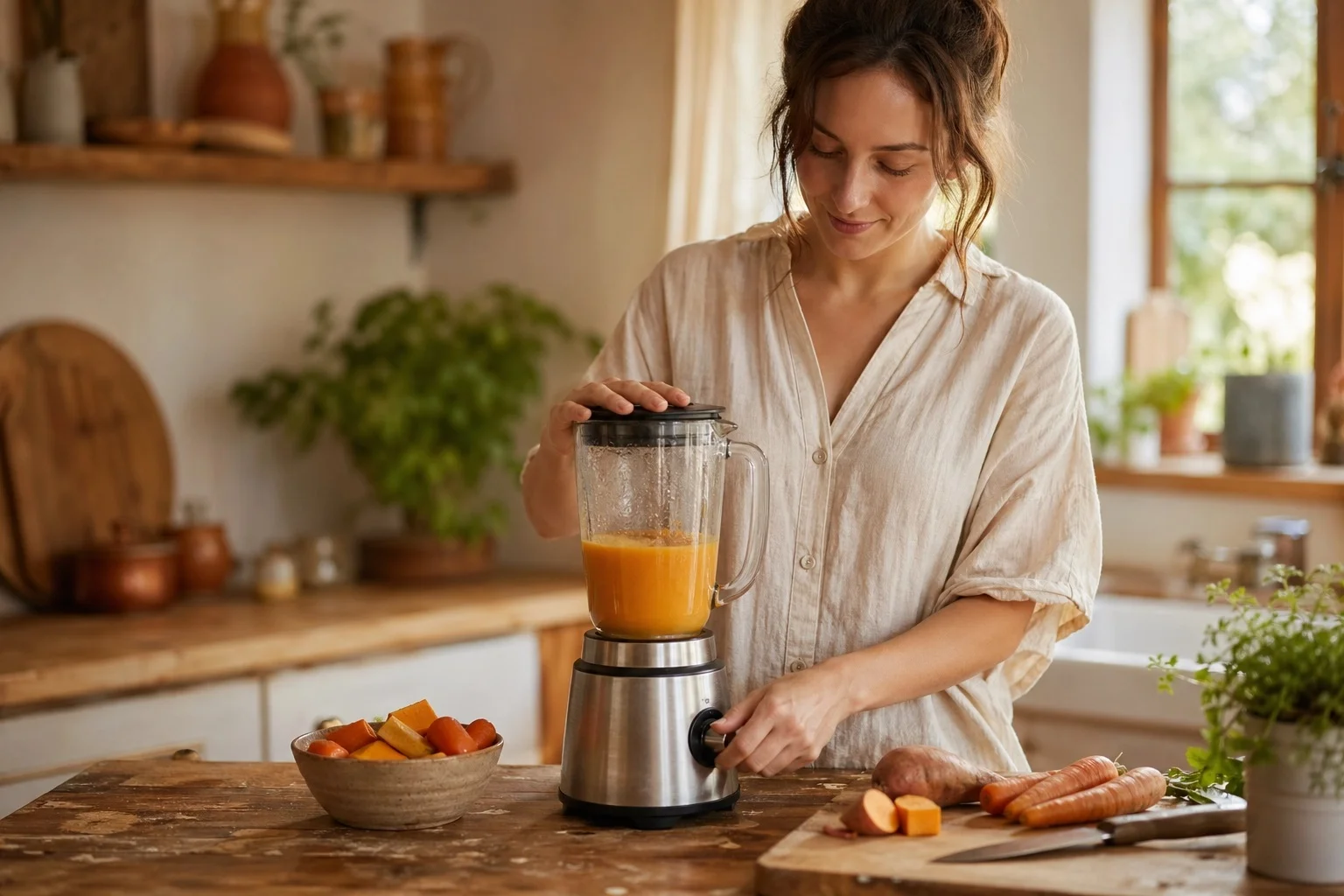
You don’t need the $200 machine with sixteen attachments. Here’s how to buy the right one — and skip everything else.
It was 10 p.m. on a Tuesday. Sweet potatoes were bubbling on the stove, the baby was finally asleep, and I was standing in my kitchen staring at my phone — scrolling through baby food processors with the desperation of someone defusing a bomb.
One had a steam function. One had a “nutrient preservation system.” One came with a dedicated recipe app. And another cost as much as my first car payment.
I just wanted to make some pureed carrots. Why was this so hard?
How to choose a baby food processor without overbuying: Focus on three things — batch size (how much you’ll make at once), ease of cleaning, and whether you need steaming built in. Most parents do well with a mid-range blender or a basic combo steamer-blender. You rarely need all the features being advertised.
- Decide: dedicated baby processor vs. regular blender
- Check bowl/jar capacity against how often you’ll batch cook
- Prioritize dishwasher-safe parts — always
- Steam attachment is nice but not mandatory
- Skip proprietary accessories that cost more than the machine
The Overwhelm Is Real — And It’s By Design
Baby gear marketing is built around one emotion: parental anxiety. The moment you’re pregnant, algorithms start serving you ads for products that promise to make you a better, safer, more prepared parent. Baby food processors are no exception.
Walk into any baby store and you’ll see machines with names like “NutriSteam Pro” and “PureBaby Chef Elite.” They promise to lock in vitamins, prevent oxidation, and produce restaurant-quality purées. And honestly? They know you’re sleep-deprived and just want to do right by your kid.
But here’s the real truth most parents discover around month four of the solids journey: a $25 immersion blender can do almost everything a $180 baby food processor can do. The question isn’t which machine is best — it’s which machine is right for your actual life.
“The best baby food processor isn’t the one with the most features. It’s the one you’ll actually use at 6 a.m. when you’re half asleep and running late.”
What a Baby Food Processor Actually Needs to Do
Before you buy anything, it helps to strip the decision down to basics. A baby food processor needs to do exactly three things:
- Blend food to the right texture for your baby’s stage (smooth purée for beginners, chunky mash for older babies)
- Be easy to clean — because you’ll be cleaning it constantly
- Fit into your actual kitchen routine, not the aspirational version of it
That’s it. Everything else — the timer presets, the built-in scales, the color-coded lids — is a bonus at best and clutter at worst.
The American Academy of Pediatrics recommends introducing solid foods around 6 months, starting with smooth, single-ingredient purées. At that stage, your machine doesn’t need to be complicated. Your life is already complicated enough.
The Four Types of Baby Food Processors (And Who Each One Is For)
1. Dedicated Baby Food Steamers + Blenders
These all-in-one machines steam the food and blend it in the same bowl. Brands like Beaba and Babymoov fall into this category. They’re compact, often dishwasher safe, and genuinely convenient — especially if counter space is tight and you want one appliance that does both jobs.
Best for: First-time parents who want simplicity and don’t mind paying a premium for it. Also great if you live in a small apartment with a cramped kitchen.
Watch out for: Small batch sizes. Many dedicated baby blenders hold less than 2 cups, which means you’ll be running multiple cycles to batch cook for a week.
2. Regular High-Powered Blenders
A Vitamix, Blendtec, or even a mid-range Ninja can pulverize food to a perfectly smooth purée. They handle larger batches, work for the whole family, and last for years after your baby is done with purées.
Best for: Parents who already cook a lot, families with multiple kids, or anyone who wants a machine they’ll use long-term.
Watch out for: The jar can be hard to scrape clean when you’re making small amounts. Some parents use a separate small bowl attachment for baby-sized portions.
3. Immersion (Stick) Blenders
Possibly the most underrated option. You steam or boil the food in a pot, then blend it directly in the pot with the stick blender. Minimal cleanup, maximum flexibility. You can adjust texture on the fly, add water or breast milk easily, and store the blended food right from the pot.
Best for: Practical, no-fuss parents. Also great for parents who already batch cook for the whole family and want to easily adapt meals for the baby.
Watch out for: Less powerful than countertop blenders, so very fibrous foods (like certain greens) may need more cooking time first.
4. Food Mills
Old-fashioned, manual, and surprisingly effective. A food mill grinds cooked food through a mesh disc, producing a smooth purée without electricity. They’re inexpensive, easy to travel with, and produce zero noise — which matters at 5 a.m.
Best for: Minimalist parents, families on a budget, or anyone who wants a backup tool for travel.
Watch out for: Manual effort, and they’re slower for larger batches.
Three Questions to Ask Before You Buy Anything
Ask yourself honestly:
- How often will I batch cook? If you plan to make a week’s worth of food on Sunday, get something with a large capacity. If you’ll cook daily or every few days, a small dedicated machine works fine.
- Do I need a steam function? If you already steam or boil vegetables for the rest of the family, you don’t need steam built in. But if you want a single-step process with minimal pots, a combo unit saves real time.
- What does my cleanup situation look like? Dishwasher access changes everything. If you’re washing by hand, fewer parts means less pain. Prioritize machines with smooth, simple bowls over ones with crevices and complicated blade assemblies.
The Real Reason Parents Overbuy Baby Gear
Here’s something worth naming: a lot of baby gear overbuying isn’t really about the gear. It’s about the mental load that comes with keeping a small human alive.
When you’re exhausted and anxious and desperately want to do everything right, buying the “best” version of something feels like buying security. It feels like one less thing to worry about. If you’re the parent carrying most of that invisible weight — researching, planning, making the decisions — the pressure to not mess up the purchase is enormous.
But the best baby food processor won’t solve that imbalance. That’s a conversation worth having with your partner about parenting as partners — sharing the mental load that comes with feeding decisions, research, and the daily chaos of the solids stage.
No appliance replaces a co-parent who’s actually co-parenting.
Common Mistakes Parents Make When Buying Baby Food Processors
- Buying for Instagram, not real life. That beautiful glass-bowl processor looks stunning in flat lays. It’s also fragile, heavy, and a nightmare to clean when you’ve got formula on your hands and a screaming baby on your hip.
- Ignoring batch capacity. Parents who plan to batch cook on weekends are consistently disappointed by dedicated baby blenders that hold only 1–2 cups. Do the math before you buy.
- Falling for proprietary accessories. Some brands design machines that only work with their own accessories — extra bowls, special lids, storage cups. These cost money and create dependency. Check before buying.
- Buying “future-proof” too early. You don’t need a blender that handles steak at 6 months. Start with what you need now and upgrade only if the need arises.
- Undervaluing the immersion blender. Genuinely one of the most practical baby food tools. Parents who own one consistently report wishing they’d started there instead of the fancy countertop machine gathering dust in the cabinet.
7 Quick Wins: What to Do Right Now
- Check your existing appliances first. A good blender or food processor you already own may be all you need.
- Set a budget ceiling before opening any tabs. Decide on your max spend before research starts — it prevents feature creep.
- Read reviews specifically from parents of babies the same age as yours. A 4-month parent’s needs are very different from a 10-month parent’s.
- Prioritize dishwasher-safe parts above all else. This matters more than any feature at 11 p.m. after a long day.
- Buy a silicone ice cube tray for freezing purées. This costs $8 and is the best baby food “hack” most parents wish they’d known sooner.
- Start simple and upgrade if needed. An immersion blender or food mill for the first month costs almost nothing and tells you what you actually need.
- Don’t buy in third trimester panic mode. You have at least 6 months before solids begin. Wait until you understand your actual cooking rhythm.
Frequently Asked Questions
Do I really need a dedicated baby food processor, or can I use my regular blender?
In most cases, a regular blender works perfectly well. A high-powered blender like a Ninja or Vitamix can produce silky smooth purées. The main advantage of a dedicated baby processor is its all-in-one steam-and-blend function, which reduces dishes. If you already own a good blender and a steamer basket, you likely don’t need to buy anything new.
What capacity do I need if I batch cook once a week?
For weekly batch cooking, look for at least a 3–4 cup (750ml–1 liter) bowl capacity. Many dedicated baby processors hold only 1–2 cups, which means multiple rounds to fill a week’s worth of storage cubes. A standard blender jar handles larger batches much more efficiently.
Is the steam function worth it?
It’s genuinely convenient if you don’t want to use a separate pot — especially for quick single-vegetable purées. But if you already cook the family’s vegetables on the stove, you’re adding an extra step to steam separately. For parents who batch cook large amounts, the small steam chamber in most baby processors becomes a bottleneck.
How long will I actually use a baby food processor?
Most parents use purée-stage food for 3–5 months, from around 6 months until baby moves to finger foods and soft table food at 9–12 months. A dedicated baby processor has a narrow use window. A good general blender, by contrast, stays useful for years. That’s worth factoring into the price math.
What’s the easiest baby food processor to clean?
Anything fully dishwasher safe with minimal crevices. Machines with removable blades that detach cleanly and flat bowl surfaces (no ridges or grooves) are significantly easier. Avoid machines with complex blade assemblies that trap food.
Can I just buy pre-made baby food pouches instead?
Absolutely — and many parents do, at least some of the time. Pouches are convenient for travel, daycare, and busy days. Homemade food gives you more control over ingredients and is generally cheaper. Most families do a mix of both, which is perfectly healthy and reasonable.
You’ve Got This
“Good enough gear plus a rested parent beats perfect gear plus an exhausted one.”
You are not failing your baby if you don’t own the most expensive processor on the market. You’re not doing it wrong if you use a $15 immersion blender or a food mill your mom handed down. What matters is that your baby is being fed with love, by a parent who’s still standing.
Buy the thing that fits your life. Keep it simple. Keep it clean. And give yourself credit for doing the research in the first place — that already tells you everything about the kind of parent you are.
You’ve got this.

