

Most people ask this question right after a run, not before one. You finish a jog, glance at your watch, and wonder if your pace is normal compared to everyone else.
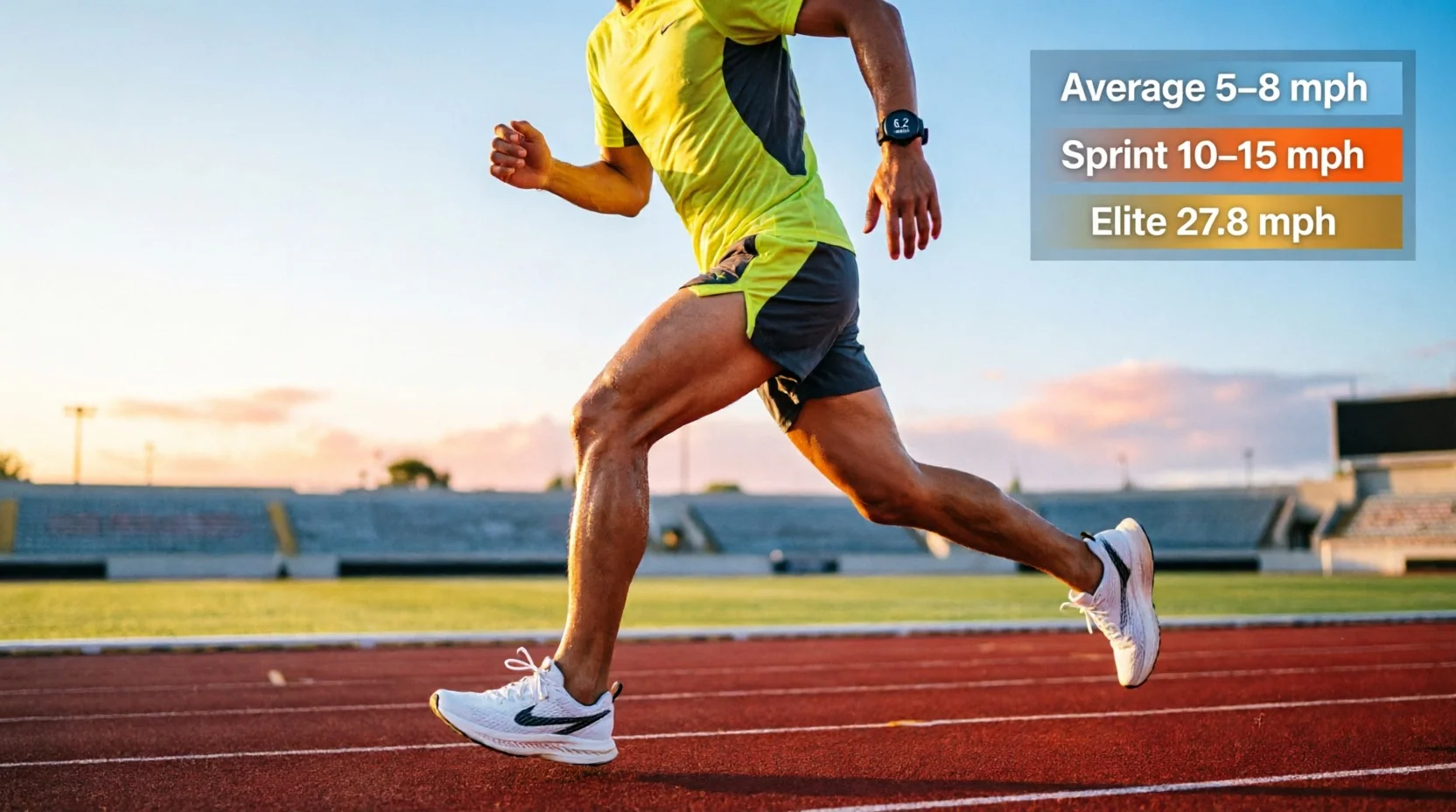
Here’s the short answer: the average person runs at about 5 to 8 mph (8–13 km/h) during a normal run. In a short, all-out sprint, most healthy adults can reach 10 to 15 mph for a few seconds. Your exact number depends on your age, fitness level, and how far you’re running.
This guide breaks everything down by speed type, distance, age, and gender, with a simple chart and a few easy ways to get faster. By the end, you’ll know exactly where your own pace fits in, and what it would take to move up a level.
Quick Answer
- Casual jog: 4–6 mph (about 10–15 min/mile)
- Steady run: 6–8 mph (about 7.5–10 min/mile)
- Short sprint: 10–15 mph for a few seconds
- Elite sprinters: Over 20 mph, with Usain Bolt peaking near 27.8 mph
Keep reading for the full picture, including how pace changes by distance, age, and training level.
How Fast Can the Average Person Run, Really?
Here’s the tricky part. There’s no one official record that tracks how every adult on earth runs. Most of the numbers you’ll find online come from running apps, race results, or fitness tests. People in those groups already run, so they tend to be fitter than the general population.
For example, large datasets from running apps like Strava, cited by Healthline, show men averaging close to 9 minutes per mile and women averaging just over 10 minutes per mile. That works out to roughly 6.6 mph for men and 5.8 mph for women. But again, that’s based on people who log their runs regularly, not the full adult population.
Here’s how a few real benchmarks stack up against each other:
| Benchmark | Pace | Speed |
|---|---|---|
| Average logged male run | 9:03/mile | 6.6 mph |
| Average logged female run | 10:21/mile | 5.8 mph |
| Military fitness test, men 17–21 (top 50%) | 8:18/mile | 7.2 mph |
| Military fitness test, women 17–21 (top 50%) | 9:51/mile | 6.1 mph |
| Men’s mile world-record pace | 3:43/mile | 16.1 mph |
These come from completely different groups, logged app runs, military fitness standards, and a world record, which is exactly why a single “average” number tells you so little on its own.
So when someone asks “how fast can the average person run,” the honest answer depends on what you actually mean:
- Someone who jogs once in a while
- A regular recreational runner
- Or a person sprinting flat out for a few seconds
Each one has a different “average.” Let’s look at them one at a time.
Average Running Speed by Type
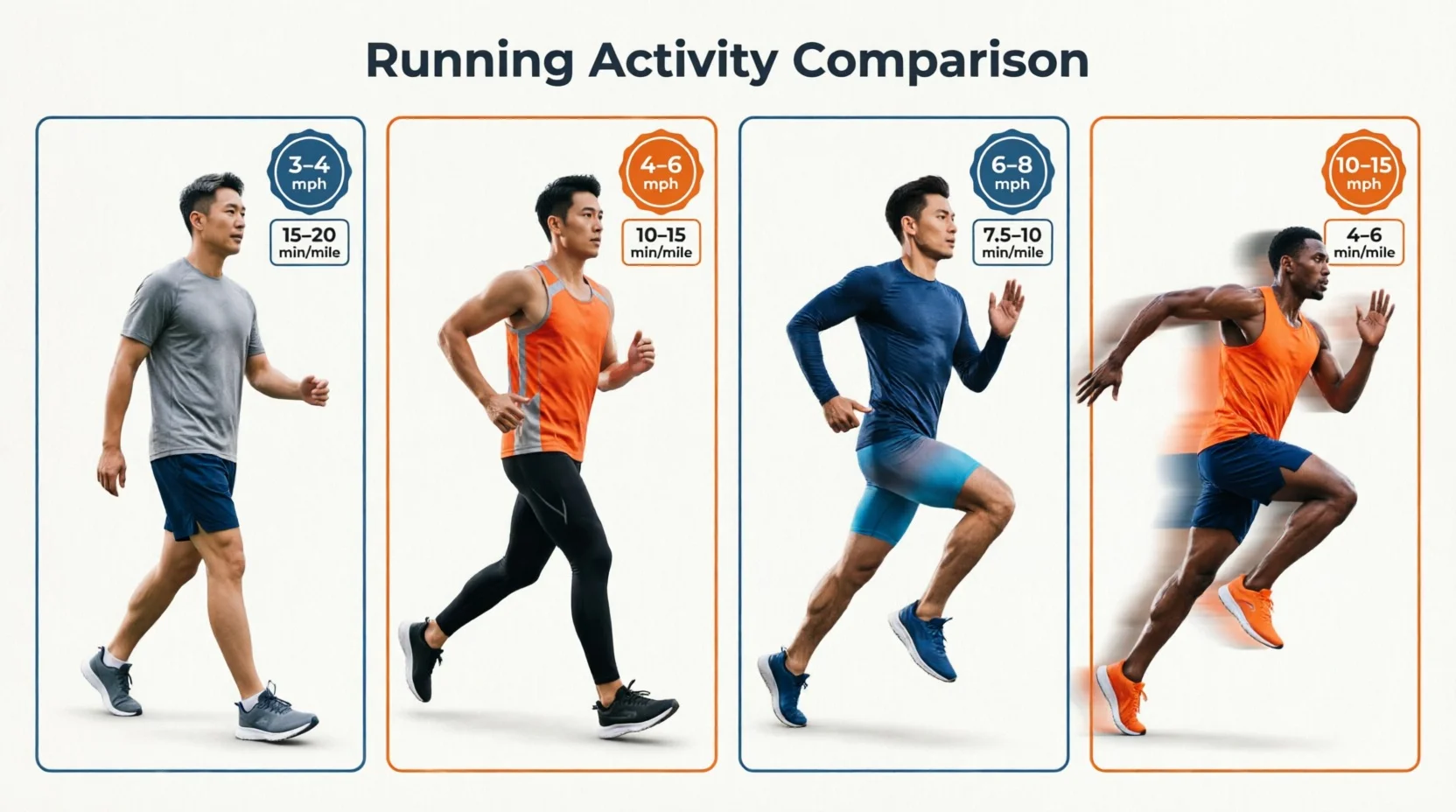
Not every run feels the same. Here’s how speed changes depending on effort:
| Type | Speed (mph) | Pace (min/mile) | What It Feels Like |
|---|---|---|---|
| Walking | 3–4 | 15–20 | Easy, no real effort |
| Jogging | 4–6 | 10–15 | You can talk in full sentences |
| Steady running | 6–8 | 7.5–10 | Breathing gets noticeably harder |
| Sprinting | 10–15 | — (short burst only) | Maximum effort, lasts seconds |
If you can chat the whole way through a run, you’re jogging. Once conversation turns choppy, you’ve moved into a real running effort. Sprinting is its own category — it’s about top speed, not how long you can hold it.
For sprinting specifically, there’s also a gender gap. Untrained men typically top out around 12 to 15 mph, while untrained women usually land closer to 10 to 13 mph. That gap mostly comes down to average muscle mass, not effort or willpower.
It’s also worth knowing that solid data on sprint speed is much harder to find than data on steady running pace. Most fitness research focuses on distance running, not max speed. One review of sprint-testing methods found no agreed-upon distance or split time for everyday athletes, though many practical tests use 20 to 40 meters. So treat any “average sprint speed” number as a rough estimate, not a precise measurement.
Why the Words “Jog,” “Run,” and “Sprint” Matter
These words get used loosely, but they describe very different efforts. A jog is something you could hold for an hour without much strain. A run pushes your heart rate up and asks more from your lungs. A sprint is something your body can only sustain for a handful of seconds before it has to slow down.
This matters because comparing your jogging pace to someone else’s sprint pace will always make you feel slower than you actually are. Stick to comparing like with like.
Pace and Speed Are the Same Thing, Just Measured Differently
If minutes-per-mile feels confusing, here’s the simple rule: a lower pace number always means a higher speed. A 10:00 mile works out to 6 mph. An 8:00 mile is about 7.5 mph. Once you know one, you can always work out the other.
Average Running Pace by Distance
The farther you run, the slower your average pace gets. Your body simply can’t hold a 100-meter speed for 26 miles. Here’s a realistic look at common race distances among recreational runners, not elite athletes:
| Distance | Average Time (Men) | Average Time (Women) |
|---|---|---|
| 1 mile | 9–10 min | 10–11 min |
| 5K | 31–34 min | 35–38 min |
| 10K | 65–72 min | 72–78 min |
| Half marathon | 2:20–2:40 | 2:40–3:00 |
| Marathon | 4:50–5:30 | 5:20–6:10 |
These numbers represent people who train and race regularly. If you counted every adult, including people who can’t yet run a full mile without stopping, the true population average would be slower. A large share of adults fall into that group, and that’s completely normal if you’re just starting out.
What Counts as a “Good” Pace at Your Level?
“Average” isn’t very useful if you’re just starting out, since it mixes total beginners with people who’ve run for years. A better way to look at it is by experience level:
| Level | Mile Pace | What It Means |
|---|---|---|
| Beginner | 10–12 min/mile | Building basic endurance, run-walk is fine |
| Intermediate | 8–10 min/mile | Comfortable running for 30+ minutes straight |
| Advanced | Under 8 min/mile | Regular structured training |
If you’re in the beginner range, a 5K finish under 30 minutes is already a solid sign of fitness. There’s no need to compare yourself to a 6-minute mile if you only started running last month.
See How These Paces Compare
This chart lines up a few real benchmarks side by side, from typical logged runs to world-record mile pace. Lower bars mean a faster pace.
How Age and Gender Affect How Fast You Can Run
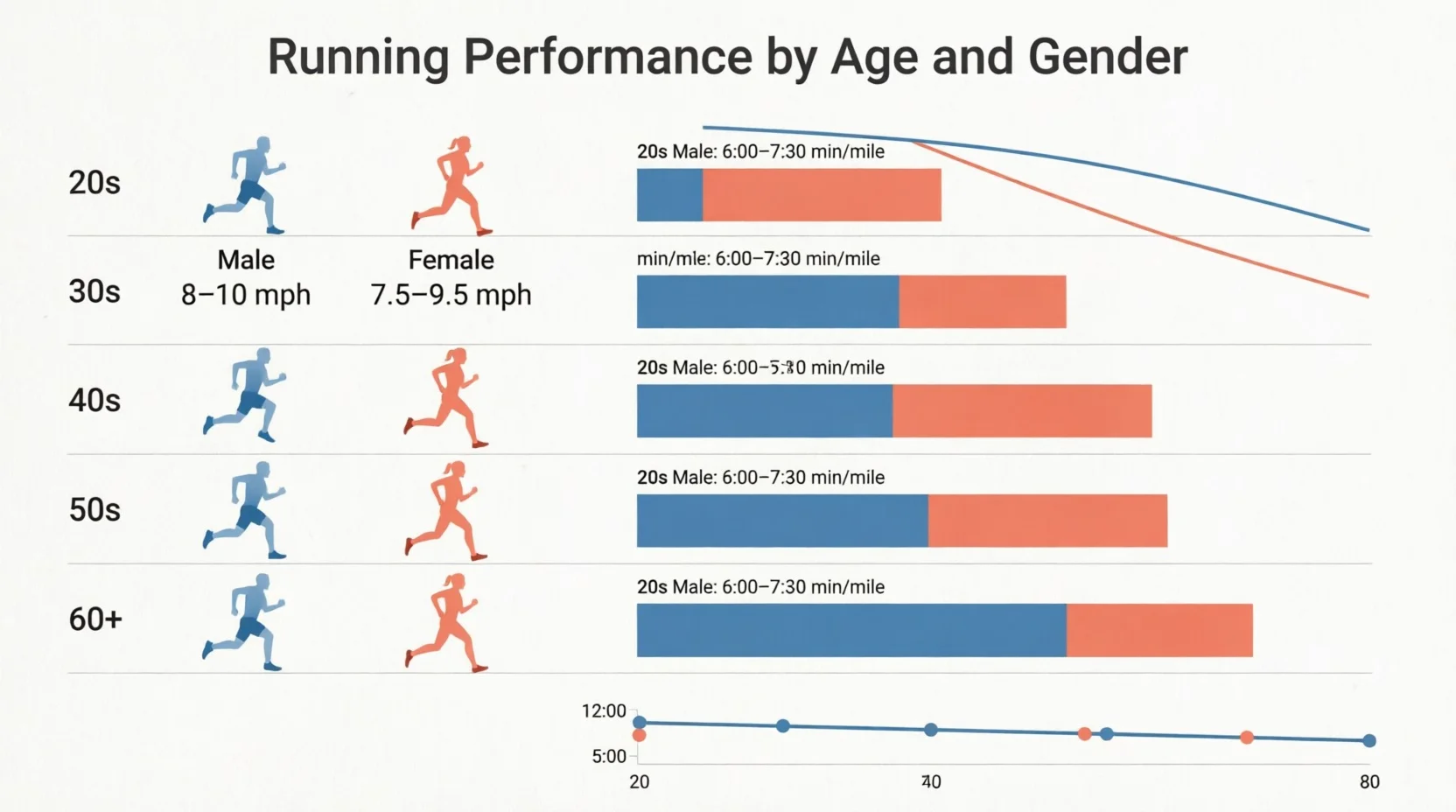
Yes, in a fairly predictable way. Running speed tends to peak in your 20s and slowly decline after 30, especially if you stop training.
| Age Group | Male Mile Time | Female Mile Time |
|---|---|---|
| 20–29 | 8:30–9:30 | 9:30–10:30 |
| 30–39 | 9:00–10:00 | 10:00–11:00 |
| 40–49 | 9:30–10:30 | 10:30–12:00 |
| 50–59 | 10:00–11:30 | 11:30–13:00 |
| 60+ | 11:30–13:30 | 13:00–15:00 |
Men are usually a little faster than women at the same fitness level. This mostly comes down to biology, like average muscle mass and cardiovascular differences. But there’s a lot of overlap between individuals, and for most people, training matters far more than gender ever will.
How Does the Average Person Compare to Elite Runners?
This is where the gap gets surprising.
| Event | Average Person | Elite Athlete |
|---|---|---|
| 100m sprint | ~15 sec | ~10 sec |
| 1 mile | ~9:30 | ~4:00 |
| 5K | ~33 min | ~13 min |
| Marathon | ~5 hours | ~2:10 |
An elite marathoner holds a pace that’s faster than most recreational runners can sprint for even a quarter mile. That gap is the result of years of specific training, plus a fair bit of natural talent.
There’s also a difference between peak speed and average race speed. Usain Bolt’s top speed during his 100m world record hit about 27.8 mph, but his average speed across the full race was closer to 23.35 mph. Florence Griffith-Joyner, the women’s 100m record holder, averaged about 21.32 mph over her run. Average speed always comes in lower than peak speed, since no one holds their fastest instant for an entire race.
What Affects How Fast You Can Run?
A handful of factors set your natural speed limit:
- Age – Speed usually peaks in your 20s to early 30s, then drops off gradually.
- Body weight – Extra weight raises the energy cost of every single stride.
- Training history – Consistent runners build stronger lungs, legs, and running form over months and years.
- Genetics – Muscle fiber type and limb length matter, especially for sprinting.
- Terrain and weather – Hills, heat, and humidity all slow you down, even on a day you feel strong. Running uphill alone can cost you 10 to 30 seconds per mile depending on the grade.
- Altitude – Less oxygen at higher elevations makes the same pace feel noticeably harder.
- Shoes and clothing – Lighter, well-fitted shoes and gear can shave small amounts off your effort, especially over longer distances.
None of these are fixed in stone. Training can shift your personal average a lot, even though genetics set the outer ceiling.
Treadmill vs. Outdoor Pace
If you’ve ever felt faster on a treadmill than outside, you’re not imagining it. There’s no wind resistance, and the moving belt gives your legs a small assist. A 10-minute mile on a treadmill can feel closer to a 10:20 mile outdoors at the same effort. It’s a small difference, but worth keeping in mind if you’re comparing your treadmill numbers to a road race time.
How to Measure Your Own Pace
Forget the averages for a second. The most useful number is your own pace, tracked over time. Here’s how to get a real baseline:
- GPS watch or running app: Apps like Strava or a basic GPS watch track your speed and pace automatically.
- A standard track: A 400-meter track gives you the most accurate distance without relying on tech.
- Treadmill: Easy to use, but usually feels a touch easier than running outside, since there’s no wind resistance.
Warm up, run one mile at a hard but controlled effort, and write down your time. Repeat that test every few weeks. That’s a far better measure of progress than comparing yourself to a stranger’s average.
How to Run Faster
If you want to improve your pace, these steps actually work:
- Build your base first. Run 3–4 times a week at an easy, conversational pace for a few weeks before adding any speed work.
- Add one speed session a week. Intervals, like four rounds of 800 meters at a hard effort with rest in between, train your body to handle faster paces.
- Mix in tempo runs and hills. A tempo run, holding a comfortably hard effort for 20 to 30 minutes, raises the pace you can sustain. Hill repeats build the same strength without much extra impact.
- Work on your cadence. Aim for quick, light steps instead of long, heavy strides. This cuts down on injury risk too.
- Strength train. Squats, lunges, and deadlifts build the power behind every stride.
- Be patient. Most people can shave a few minutes off their 5K time within a year of steady, consistent training.
FAQs
How fast can a normal person run a mile?
Most adults who run regularly finish a mile in 9 to 11 minutes. Beginners often need 12 minutes or more, while trained runners can dip under 8 minutes.
Is 20 mph fast for a human?
Yes. Most untrained adults top out around 12 to 15 mph in a short sprint. Hitting 20 mph takes real sprint training, and only well-trained athletes can reach it.
How fast do Navy SEAL candidates run a mile?
SEAL training standards expect candidates to hold a strong, sustained pace, often well under 9 minutes per mile, which is noticeably faster than the typical recreational runner.
Final Thoughts
There’s no single number that defines “average.” A casual jogger, a weekend racer, and a sprinter all have completely different baselines, and that’s normal. Age, training history, body weight, and even the weather all shape where you land on any given day.
The most useful number isn’t someone else’s average. It’s your own pace, tracked over time. Run a mile today, run it again in a month, and let that comparison guide your progress. Small, steady improvements add up far more than chasing someone else’s number ever will.

