


Hearing your baby cry triggers a near-primal stress response—heart racing, mind scrambling, a desperate need to make it stop. That reaction is human. But before you try to “fix” the crying, you need to understand it.
Crying is normal. It’s healthy. Newborns typically cry between one and four hours a day—not a sign that you’re doing something wrong or that your baby is difficult. Babies have no words; their voice is their only communication tool.
Most babies peak in crying around six to eight weeks of age, then become significantly calmer by three to four months. This pattern is predictable and well-documented. Knowing it’s temporary won’t make 3 AM easier, but it gives you perspective.
Your job isn’t to stop all crying. It’s to understand what your baby is communicating and respond accordingly.
The Most Common Causes of Crying
Babies often cry for more than one reason at once. Check the most common causes in this order:
1. Hunger
The most common reason newborns cry. Before a full cry, watch for early cues: rooting (turning toward anything touching the cheek), lip-smacking, bringing hands to mouth, or fussy sounds. Offer milk—even if they just ate. Growth spurts at 2–3 weeks, 6 weeks, 3 months, and 6 months can temporarily increase hunger.
2. Dirty or Soiled Diaper
Some babies demand an immediate change; others barely notice. Either way, check it early.
3. Temperature
Babies struggle to regulate body temperature. Feel the back of the neck or chest—not the hands or feet, which naturally run cooler. Aim for 68–72°F (20–22°C) and add or remove a layer as needed.
4. Overstimulation
Loud noises, bright lights, new environments, and large gatherings can overwhelm a developing nervous system. Signs include looking away, head-turning, jerky movements, or escalating crying. Move to a quiet, dimly lit room.
5. Overtiredness
Newborns manage only 45–60 minutes of awake time; by 3 months, that extends to roughly 1.5–2 hours. Watch for tired cues—eye-rubbing, yawning, jerky limb movements—and put the baby down before they tip into overtired territory.
6. Gas or Digestive Discomfort
Immature digestive systems trap air easily. Try burping in multiple positions—over the shoulder, sitting upright, or across your lap—and bicycle leg movements to help pass gas.
7. Need for Sucking
Some babies need non-nutritive sucking for comfort. A pacifier, clean finger, or breast can provide this.
8. Teething (3+ Months)
Signs include drooling, chewing on hands, and red or swollen gums. A chilled teething toy or gentle gum massage can help.
Start with the basics: feed, change, check temperature, and burp. Nine times out of ten, one of these is the answer.
What the Research Says Actually Works
The Science of Soothing: The “Transport Response”
Why does walking calm a crying baby almost instantly, while sitting and holding them not? In 2022, Dr Kumi Kuroda and her team at the RIKEN Centre for Brain Science published findings on what they called the “transport response”—a calming reflex shared by many mammals.
The research showed:
- Walking for five minutes significantly reduced crying in most babies.
- Sitting while holding a crying baby produced no lasting calming effect—the reflex stopped almost immediately.
- The effective sequence: walk for 5 minutes, then sit and hold for 8 minutes before putting the baby down. Transferring too early often restarts the crying.
When a caregiver carries a baby and walks, it triggers a physiological response that slows the heart rate and quiets the cry. It’s not habit or bad behaviour—it’s biology.
Once you’ve covered the basics, try the walk-and-hold method: walk for five minutes, then sit and hold for eight before transferring to the crib.
The 5 S’s Method: A System for Soothing
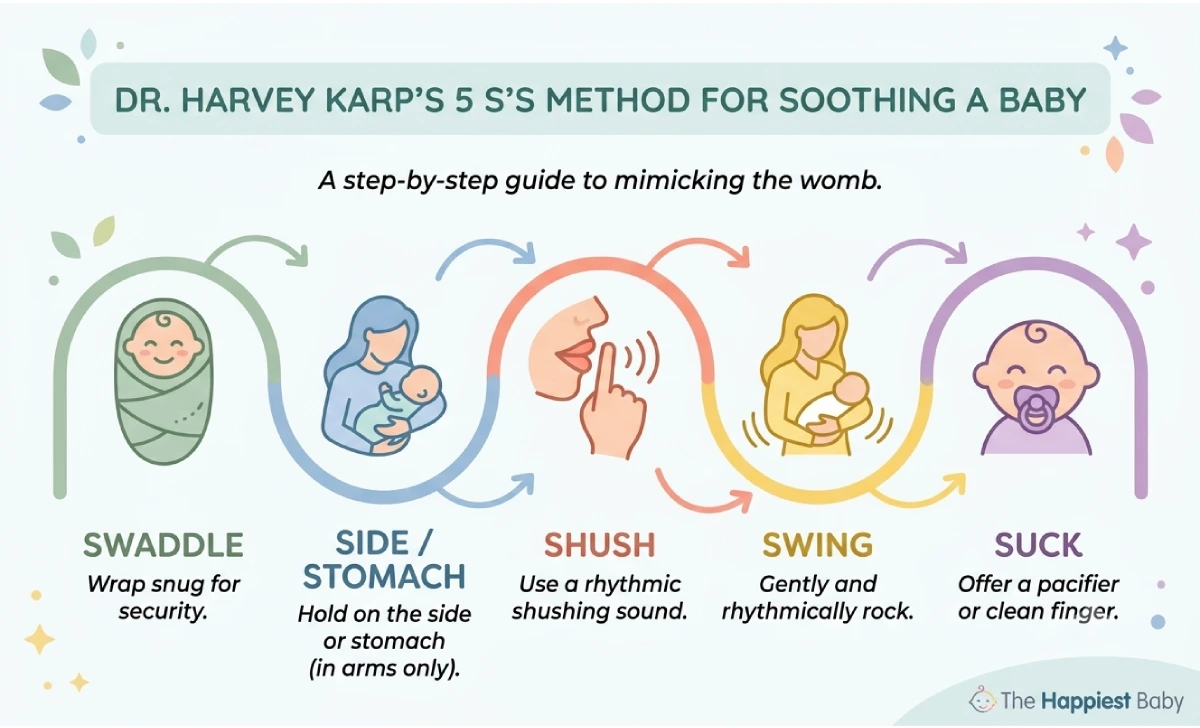
Dr Harvey Karp, a paediatrician and author of The Happiest Baby on the Block, developed the 5 S’s to recreate the comforting environment of the womb. These five techniques work best together—treat them as a combined approach, not a checklist of separate fixes.
1. Swaddle
Swaddling recreates the snug security of the womb and suppresses the startle reflex that wakes babies. Use a lightweight blanket or swaddle sack—wrap the arms snugly while leaving room for the hips to move (the “frog leg” position). Once your baby shows signs of rolling, typically at 2 to 4 months, it’s time to stop.
2. Side / Stomach (Awake Only)
Holding your baby on their side or stomach while awake triggers the calming reflex. Never place a baby on their side or stomach to sleep. Back-sleeping reduces SIDS risk.
3. Shush
The shushing sound mimics the constant noise babies hear in the womb. It should match your baby’s cry in volume—louder than most parents expect—then gradually soften as the baby calms. Use your voice or a white noise machine set to 50–60 dB, placed at least 7 feet from the crib.
4. Swing
Gentle, rhythmic motion activates the calming reflex. Small, jiggly movements work best—not large rocking arcs. Sway using your whole body, not just your arms. Never shake a baby.
5. Suck
Sucking is deeply calming for babies. Offer a pacifier, clean finger, or breast. If breastfeeding, wait 3 to 4 weeks before introducing a pacifier to reduce nipple confusion. Pacifier use during sleep actually lowers SIDS risk.
Use all five together for the strongest effect. They’re designed to work as a system.
A Step-by-Step Troubleshooting Flowchart
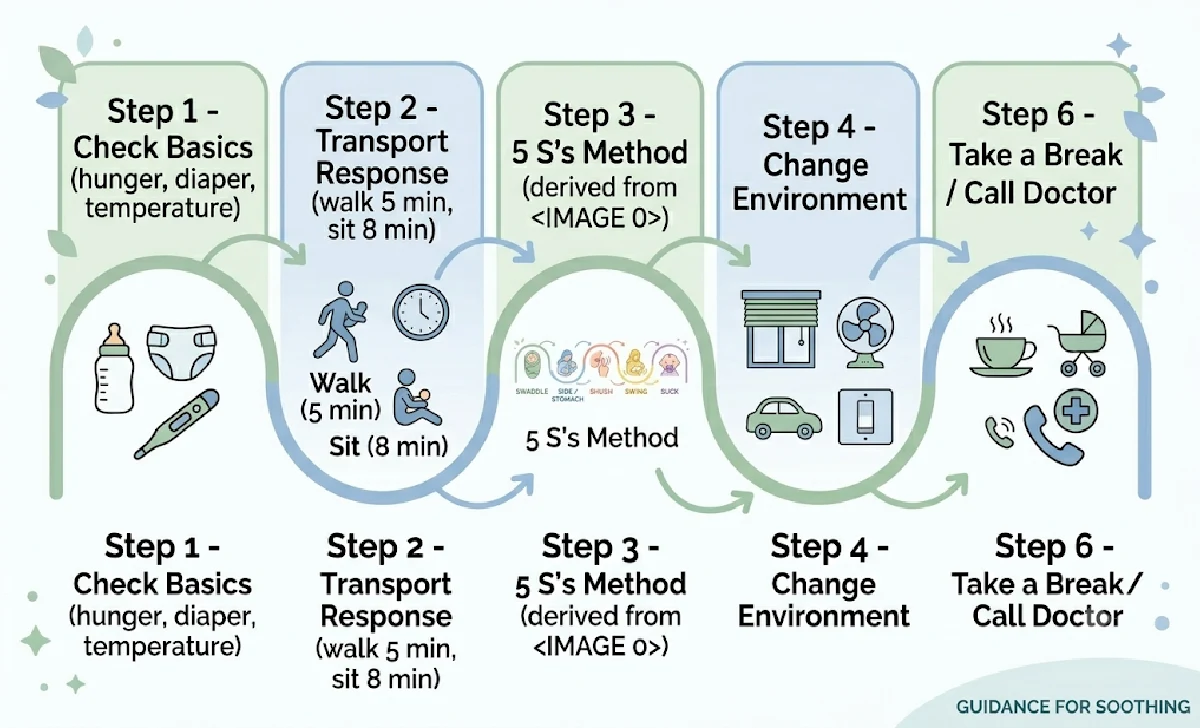
If you’ve checked the basics and the crying continues, follow this path in order:
1: Check the Basics
- Is the baby hungry? Look for rooting, lip-smacking, or hand-to-mouth movement.
- Is the diaper wet or soiled? Change it.
- Is the baby too hot or too cold? Adjust clothing or room temperature.
- Does the baby need burping? Try different positions.
- Does the baby need to suck? Offer a pacifier or finger.
Spend 2–3 minutes on each. If the crying continues, move on.
2: Try the Transport Response
- Pick up your baby and walk with them held close to your chest.
- Walk for 5 minutes.
- Sit down and continue holding for 8 minutes.
- After the crying stops, hold for at least 8–10 minutes before slowly placing them in the crib.
This works best for newborns up to 3–4 months. Older babies may respond better to the 5 S’s first.
3: Use the 5 S’s
- Swaddle snugly (hips loose, arms snug).
- Hold on the side or stomach (awake only).
- Shush loudly, matching the volume of the cry.
- Swing with small, rhythmic movements.
- Offer a pacifier or finger for sucking.
4: Change the Environment
- Move to a different room.
- Dim the lights and reduce noise.
- Try a baby carrier or wrap for closeness and motion.
- Experiment with a different hold—upright, over the shoulder, or tummy across your forearm.
5: Try a Car Ride or Stroller Walk
A moving car or stroller triggers the same calming reflex as walking. Continue until the baby reaches a deep sleep before stopping.
6: When Your Baby Won’t Stop Crying
If nothing has worked, ask yourself:
- Is the baby showing signs of illness—fever, lethargy, or difficulty feeding?
- Could this be colic?
- Could this be reflux or another medical issue?
Take a break. If you’re overwhelmed, place the baby safely in the crib, step into another room, and take 5 minutes. It’s safe for a baby to cry briefly while you reset.
Never shake a baby. Shaking causes brain damage, blindness, or death. If you feel like you’re losing control, put the baby down and walk away. Call for help if you need to.
What Is Colic? Understanding Severe Crying
Some babies cry far more than others. When the crying becomes excessive and unexplained, healthcare providers may diagnose colic, defined by the clinical “Rule of 3s”:
- Crying for 3+ hours per day
- 3+ days per week
- For 3+ weeks
The keyword is unexplained. Colicky babies are otherwise healthy—feeding well, gaining weight, no other symptoms. Colic is a diagnosis of exclusion: doctors rule out other causes first.
It typically starts at 2 to 3 weeks, peaks at 6 weeks, and resolves on its own by 3 to 4 months. A related concept is the Period of PURPLE Crying—a model that helps parents understand normal infant crying patterns in early infancy. Both describe the same phenomenon: crying that’s predictable, temporary, and not caused by anything you’re doing wrong.
Evidence-Based Strategies for Colic Relief
- Soothing techniques – The 5 S’s and transport response are your first line of defence. They won’t cure colic, but they can reduce the intensity and duration of episodes.
- Upright positioning – Hold baby upright during and after feeds to help prevent reflux and gas.
- Paced bottle-feeding – Hold the bottle horizontally. Let the baby pause and breathe, and burp after every ounce to prevent overfeeding and reduce swallowed air.
- Baby massage – A gentle clockwise tummy massage using warm oil can move trapped gas.
- Probiotics – Some research suggests specific probiotics reduce colic symptoms. Speak with your paediatrician before starting any supplement.
- Babywearing – Carriers keep the baby close, provide constant motion, and free your hands. The movement alone can calm colicky babies.
Advanced Soothing Techniques
If the 5 S’s and basic troubleshooting aren’t enough, these additional approaches can help:
Baby Massage
Massage calms your baby’s nervous system, eases digestive discomfort, and supports bonding. Use a warm, safe oil—coconut or sunflower works well. Stroke the tummy clockwise, then move to the legs, back, and arms. A warm bath beforehand deepens the effect.
Skin-to-Skin Contact (Kangaroo Care)
Holding your baby against your bare chest regulates their heart rate, breathing, and temperature simultaneously. Undress the baby from the diaper, place them on your chest, and cover both of you with a blanket. Rest and let your body do the work.
Babywearing
Carriers and wraps keep baby close while providing gentle, continuous motion—and they block overstimulating sights and sounds. Most fussy babies settle within minutes of being worn.
Koala Hold for Reflux
This upright hold supports the baby’s weight while keeping them vertical, reducing the chance of milk coming back up. Particularly useful if your baby has reflux.
White Noise
Womb sounds, fan noise, rainfall, or steady heartbeat rhythms all work. Use a device with adjustable volume and continuous play, set to 50–60 dB and placed at least 7 feet from the crib.
Pre-Cry Cues: Stop Crying Before It Starts
Reading Early Warning Signs
Most parents wait until their baby is crying before responding—but by then, the distress has already escalated. Babies signal discomfort before a full cry:
- Frowning or furrowing the brow
- Fussy sounds—whining, grunting, or low-level complaining
- Jerky, squirming movements
- Rooting—turning the head toward a touch on the cheek
- Staring away with a glazed look
Catching these early often prevents a full crying episode.
Different Types of Cries
As you spend time with your baby, you’ll begin to distinguish between cries:
- Hunger cry: Low-pitched, rhythmic, repeated—often sounds like “neh”
- Pain cry: High-pitched, sudden, and piercing—intense from the start
- Tired cry: Whiny, escalating—usually paired with eye-rubbing
- Angry cry: Forceful and demanding—more intense than distressed
- Bored or overstimulated cry: Begins with fussiness, then escalates
Watch your baby, not just listen. Respond to early cues and you’ll have a calmer baby—and a calmer day. For foundational guidance on your baby’s early weeks, check out our newborn care basics guide.
When to Call the Doctor
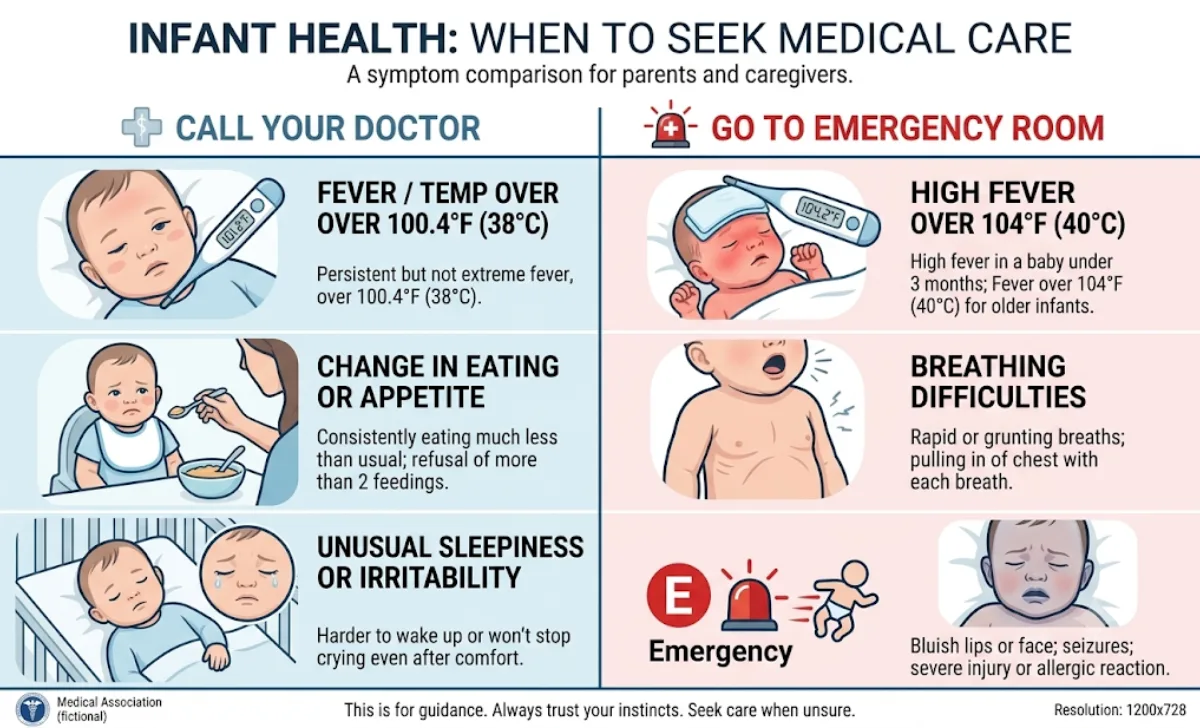
Recognizing Red Flags
Most crying is normal. But some cries signal a medical issue that needs attention.
Call your paediatrician immediately if your baby has:
- Fever of 100.4°F (38°C) or higher in a baby under 3 months
- A high-pitched or unusual cry
- Lethargy—difficulty waking
- Poor feeding or refusal to eat
- Forceful or green vomiting
- Difficulty breathing
- Rash or skin changes
- A bulging soft spot
- Inconsolable crying for more than 2 hours
- Arching the back or pulling the legs toward the tummy
- Blood in the stool
- Skin colour changes—blue, pale, or very red
Call the Doctor vs. Go to the ER
- Call your doctor: Fever under 100.4°F in babies 3+ months, persistent crying without other symptoms, feeding changes, mild rash, possible reflux or gas.
- Go to the ER: Fever of 100.4°F+ in a baby under 3 months, difficulty breathing, lethargy, blue or pale skin, seizure, repeated forceful vomiting, or head injury.
Trust your instincts. You know your baby best. If something feels off, call your paediatrician—it’s never the wrong move. These guidelines align with recommendations from the American Academy of Paediatrics (AAP), HealthyChildren.org, and Nationwide Children’s Hospital.
Taking Care of Yourself

The Emotional Toll of a Crying Baby
Hearing your baby cry relentlessly triggers a real physiological stress response—heart racing, muscles tensing, patience wearing thin. That’s not a weakness. That’s human.
What to Do When You’re Overwhelmed
- Place your baby safely in the crib.
- Step into another room.
- Take 5 to 10 minutes to calm yourself.
- Return when you’re ready.
A baby can safely cry for a few minutes while you reset. A calm parent is the most effective soothing tool you have.
Never Shake a Baby
Shaken Baby Syndrome causes brain damage, blindness, permanent disability, or death. If you feel yourself reaching a breaking point, put the baby down and walk away. Call a partner, friend, or crisis line.
Building a Support System
You don’t have to do this alone. Involve your partner, lean on family and friends, talk to your healthcare provider about postpartum depression or anxiety, and connect with support groups. Reach out to the National Child Abuse Hotline (1-800-4-A-CHILD) or Postpartum Support International (1-800-944-4773) if you need extra support.
Taking care of yourself isn’t optional. It’s one of the most important things you can do for your baby.
Conclusion
No one enjoys hearing their baby cry. But crying isn’t a sign of failure—it’s a sign that your baby is communicating in the only way they know how.
When you’re in the thick of it, work through the steps:
- Start with the basics—hunger, diaper, temperature, and gas.
- Use the 5 S’s for fast, effective calming.
- Apply the transport response—walk for 5 minutes, then sit for 8.
- Watch for pre-cry cues and respond before the crying escalates.
- Call your doctor if you see red flags. Trust your instincts.
- Take care of yourself. A calm parent calms a baby.
Parenting is hard. You’re doing better than you think. The fact that you’re here, reading this, shows how much you care. The crying will pass—and you have everything you need to get through it.

