
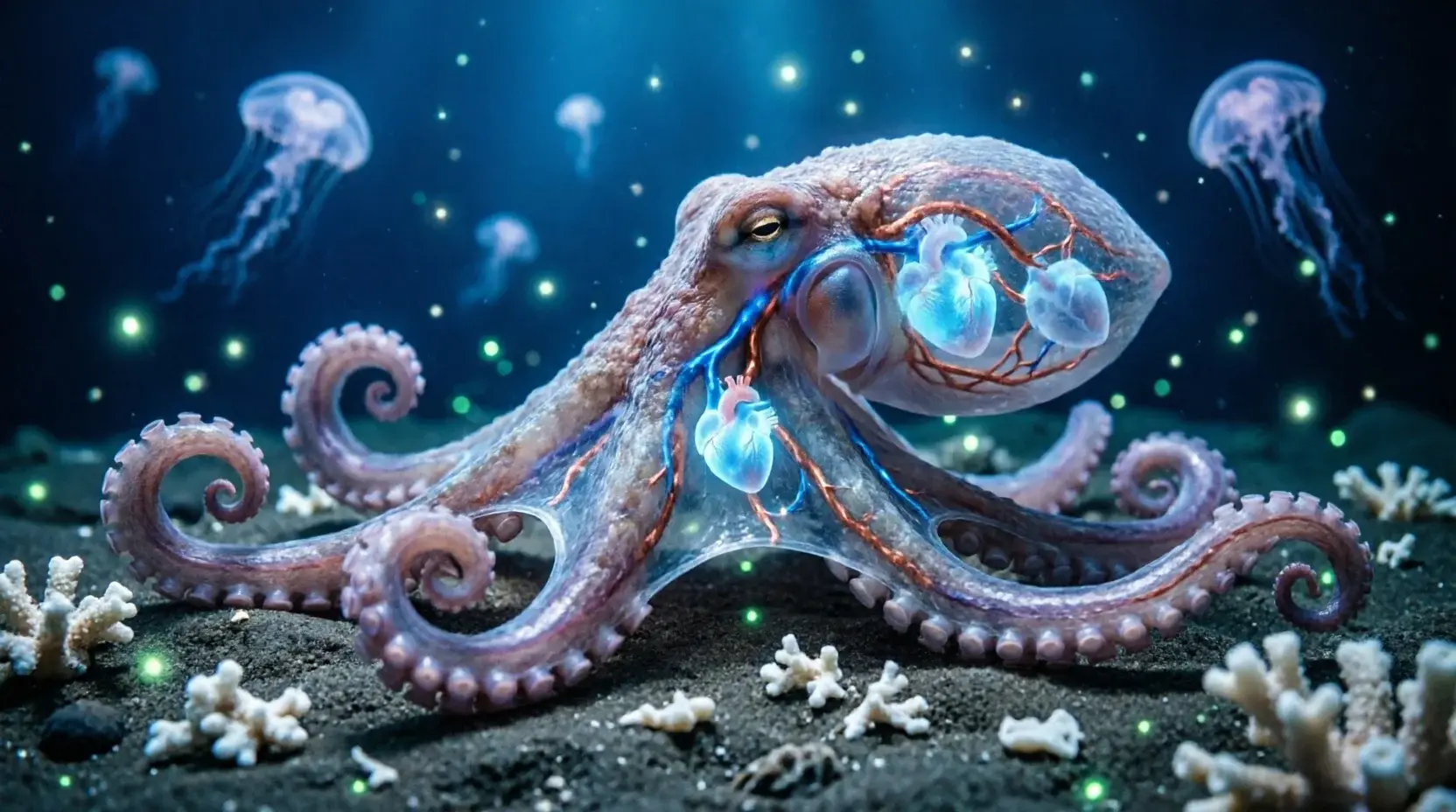
The octopus has three hearts, blue blood that runs on copper instead of iron, and two hearts that shut off every time it swims. None of this is random — each trait is a survival tool shaped by millions of years in the ocean. Its circulatory system splits the pumping job across three hearts because octopus blood carries oxygen less efficiently than ours does.
And when the animal swims, the force of jet propulsion presses down on its main heart hard enough to stop it, which is exactly why an octopus spends most of its life crawling instead.
Here’s how the three-heart system works, why one heart stops mid-swim, and what makes this animal one of the strangest creatures in the ocean.
The Three Hearts and What They Do
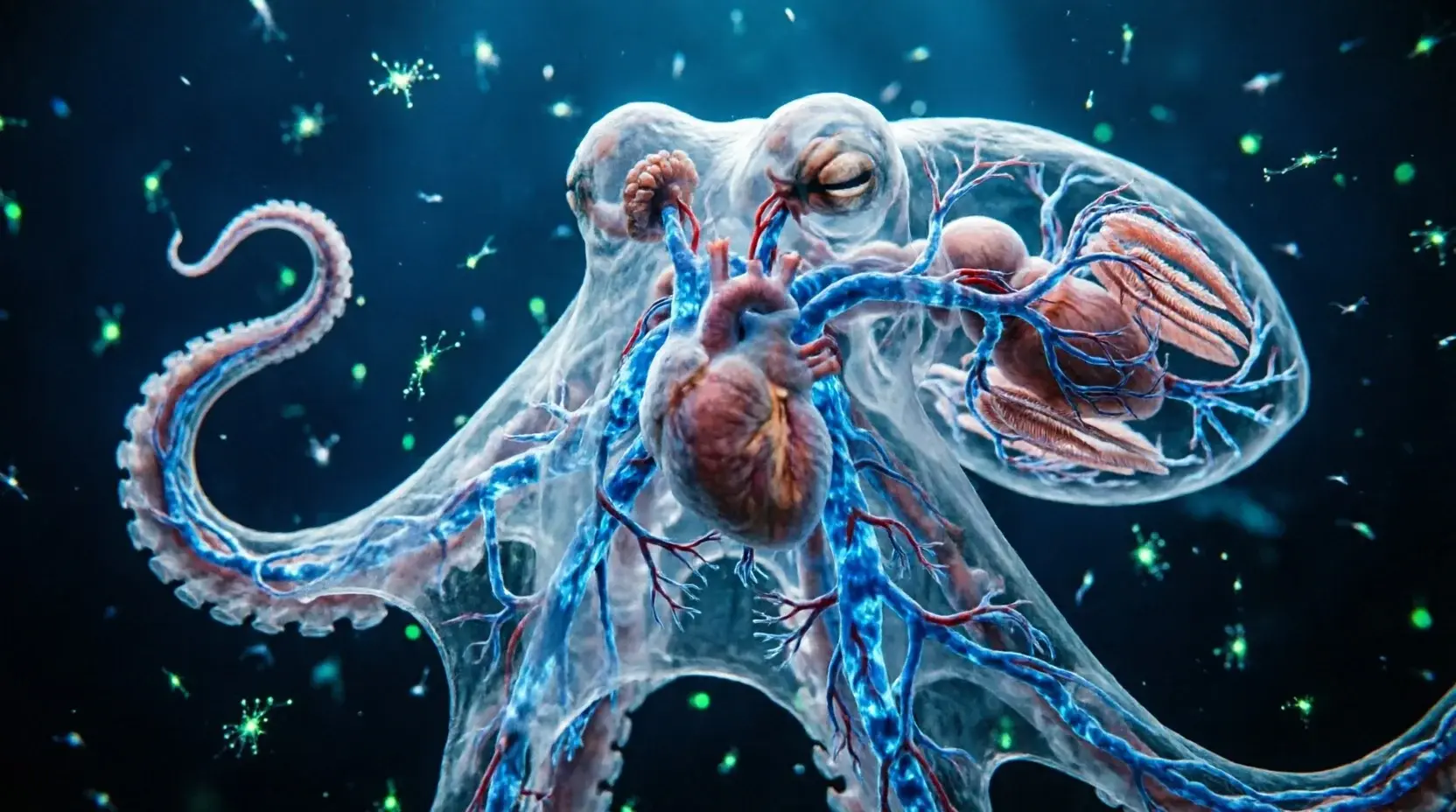
Most animals get by with a single heart. You have one. So does a dog. So does an elephant. An octopus needs three, and each one has a distinct job.
Octopuses belong to a group called cephalopods, along with squid and cuttlefish. According to the Smithsonian Ocean portal, every modern cephalopod shares this three-heart design.
- Two branchial hearts (BRANK-ee-ul) sit near the gills. Their only job is pushing blood through the gills, where it drops off carbon dioxide and picks up fresh oxygen from the seawater — dedicated oxygen-loading stations that stock the blood before it goes anywhere else.
- One systemic heart (sis-TEM-ik) is the main pump. It takes the oxygen-rich blood from the branchial hearts and sends it out to the rest of the body — the arms, the brain, the stomach, everything.
The three hearts don’t work in a simple line; they run more like a relay. The branchial hearts contract first, pushing oxygenated blood toward the systemic heart, which then pumps it out to the body. It’s a tightly coordinated system packed into a boneless, soft-bodied animal.
Why Does an Octopus Need Three Hearts?
Octopus blood simply isn’t as good at carrying oxygen as ours is, so the body compensates with extra pumping power.
Human blood is red because of a protein built around iron. Octopus blood is blue, thanks to a protein called hemocyanin (hee-mo-SY-a-nin), which uses copper instead. Copper turns the blood blue the same way iron turns ours red.
Hemocyanin works, but it’s less efficient at binding oxygen, and octopus blood is thicker and slower-moving than ours. A single heart would struggle to push that heavy blood through eight long, flexible arms — some species stretch beyond 14 feet — especially when the animal is hunting or fleeing and needs oxygen fast.
Splitting the workload solves the problem. Two hearts handle only the gills; one heart handles the rest of the body. That division keeps oxygen moving without interruption.
There’s a second reason for the setup. Blood loses pressure as it passes through the tiny vessels of the gills, the same way water loses force squeezing through a kinked garden hose. With only one heart, blood would leave the gills too weak to reach the arms and organs in useful amounts. The branchial hearts solve this by acting as a second pumping stage, rebuilding pressure before the systemic heart sends the blood onward.
What Happens When an Octopus Swims?
This is the part that surprises most people: when an octopus swims, its main heart stops beating. It isn’t a malfunction — it’s simply how the body is built to respond.
Octopuses swim using jet propulsion. They pull water into the soft, sack-like mantle and force it back out through a narrow siphon, shooting themselves forward like a rocket. But producing that thrust takes a powerful muscular contraction of the mantle.
That contraction generates enough internal pressure to squash the systemic heart, which can’t fill with blood properly and simply stops. The two branchial hearts keep running, still loading the blood with oxygen at the gills — but the systemic heart, the one that actually delivers that oxygen to the rest of the body, goes offline for the duration of the swim.
Why Octopuses Prefer to Crawl
This is why an octopus crawls almost all the time. Moving slowly along the seafloor keeps all three hearts active, so oxygen keeps flowing steadily and the animal can sustain the effort for long stretches without tiring.
Swimming buys speed at the cost of shutting down the main oxygen supply. Crawling is slower but far more sustainable, which suits an animal that spends its days hunting crabs and working its way into rocky crevices.
Octopuses still swim when they have to — jet propulsion is the go-to escape move if a predator like a shark shows up, and they’ll cross open water when needed. But crawling remains their default, because it’s the only mode that keeps the whole circulatory system running.
Blue Blood and the Deep Sea
The copper-based blood that seems like a disadvantage on land turns out to be an asset in cold, low-oxygen water. In the deep, dark environments where some octopus species live, hemocyanin actually outperforms iron-based blood at capturing available oxygen.
The dumbo octopus is a good example. It lives thousands of feet down, where oxygen is scarce, and its blue blood combined with three hearts is what makes survival there possible.
Warm water tells a different story. It holds less dissolved oxygen to begin with, so hemocyanin works less effectively, and octopuses in warmer seas tend to be less active, leaning even harder on crawling to conserve energy. Water temperature effectively sets the pace of their entire lifestyle.
How It Compares to Your Heart
Your heart handles two jobs in one organ: the right side sends blood to the lungs for oxygen, and the left side sends that oxygen-rich blood out to the body. An octopus splits these same two jobs across separate organs — the branchial hearts standing in for your heart’s right side, the systemic heart for the left.
Because the hearts are physically separate, jet propulsion can shut one down without affecting the others. A human heart stopping during exertion would cause someone to faint; an octopus just slows down. It’s a level of physiological flexibility no human body has.
Octopuses back this up with real intelligence — they can solve mazes, open jars, and recall solutions for weeks afterward, with memory that some researchers compare to an eidetic memory. They also appear to recognize individual people and other octopuses, which is a striking amount of cognitive ability for an animal with no backbone.
Common Myths — Busted
Myth: The hearts are malfunctioning when they stop during swimming.
Truth: The stop is a normal, expected response to the pressure of jet propulsion. It isn’t a health issue, and the heart restarts as soon as swimming ends.
Myth: Three hearts mean the octopus has unlimited stamina.
Truth: For swimming, it’s the opposite. Taking one heart offline forces the animal to stop and recover — three hearts don’t add up to endless energy.
Myth: Octopuses are slow because they’re weak.
Truth: They crawl to keep all three hearts running. It’s an energy-management strategy, not a physical limitation.
Quick Questions and Answers
How many hearts does an octopus have?
Three — two branchial hearts near the gills and one systemic heart.
Why do the hearts stop when an octopus swims?
The pressure from jet propulsion squeezes the main heart until it stops. The gill hearts keep working throughout.
Is it true that two of an octopus’s hearts stop when it swims?
No — that’s a common mix-up. Only the systemic (main) heart stops during swimming. The two branchial hearts near the gills keep beating the whole time, continuing to push blood through the gills for oxygen.
Is octopus blood really blue?
Yes. It runs on hemocyanin, a copper-based protein that turns blue while carrying oxygen.
How many brains does an octopus have?
Technically one — a central, donut-shaped brain wrapped around its esophagus. But each of its eight arms has a dense cluster of nerve cells called a ganglion, capable of sensing and moving on its own. That’s why people often say an octopus has nine brains, even though it’s really one brain plus eight semi-independent nerve centers.
Do octopuses ever have heart problems from this?
No — the stopping and starting during swimming is a normal, healthy part of how their body works.
Final Thoughts
The octopus’s circulatory system isn’t a fluke. It’s the product of millions of years of adaptation to life underwater — three hearts, blue blood, a body built for crawling, and a genuinely sharp mind, all working together.
Next time you see an octopus gliding across a rock, remember: all three hearts are beating, blue blood is moving through its body, and it’s living exactly the way its biology intends.

