
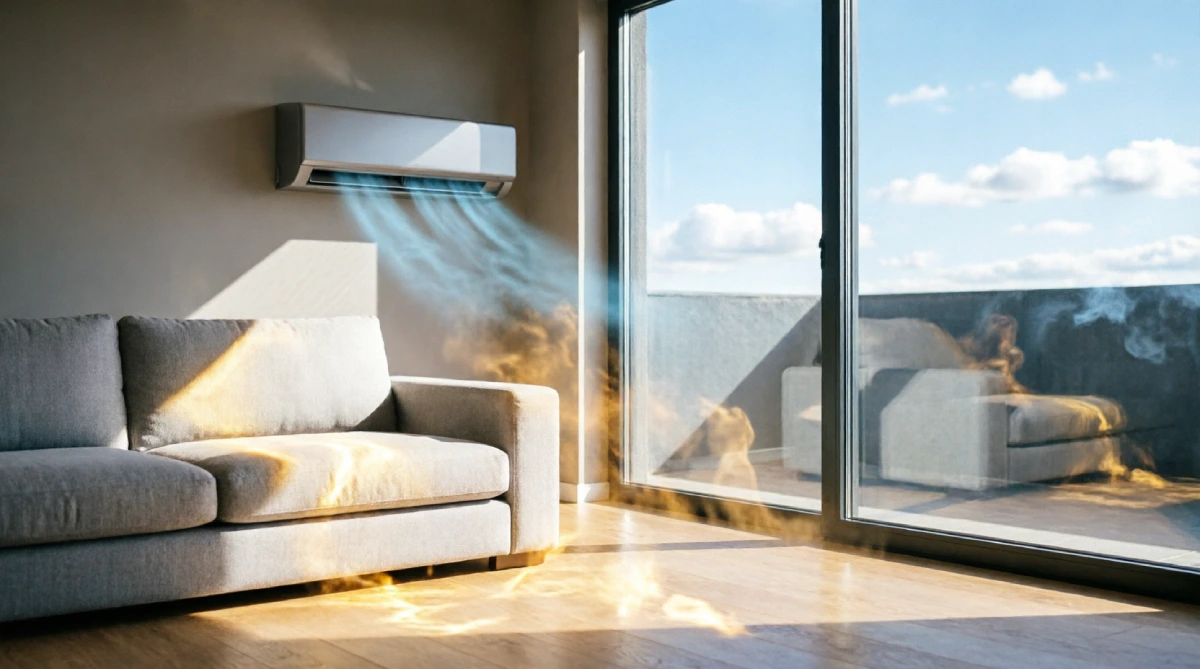
If your room is not cooling with AC even after running it for hours, you are not alone — and your AC is probably not the real problem.
You turned on the unit two hours ago. It’s humming. The vents are blowing cool air. But you’re still sweating.
You check the thermostat. Nothing seems wrong. You wonder if the AC needs a service call. Maybe it’s too small for the room. Maybe it’s broken.
Before you spend money on a technician or a new unit — stop.
The real culprit is likely sitting right in front of you. It’s your window.
The Hidden Reason Your Room Won’t Cool Down
Most people think of windows as just glass. But during a sunny afternoon, your window acts more like a heat collector.
Here’s what’s happening:
Sunlight passes through the glass and heats everything inside — your floor, your walls, your furniture. That heat builds up in the room. Your AC works hard to remove it, but more heat keeps pouring in through the glass every minute the sun shines.
This is called solar heat gain. And it’s one of the most common — and most overlooked — reasons why a room is not cooling with AC, even when the unit is running full blast.
Think about it this way. Imagine you’re trying to fill a bathtub, but someone keeps pulling out the plug. No matter how fast the water flows in, the tub never fills up. Your AC is the water. The sun coming through your window is the open plug.
What Is Solar Heat Gain? (Simple Version)
Solar heat gain is the heat that enters your room because of sunlight.
Glass does a poor job of blocking heat. In fact, untreated glass lets in over 75% of the solar energy that hits it. That energy turns into heat the moment it enters your room.
South-facing and west-facing windows are the worst offenders. These windows get direct sunlight in the afternoon — exactly when temperatures are at their peak.
According to the Florida Solar Energy Center, the Solar Heat Gain Coefficient (SHGC) of untreated glass is typically high, meaning a large portion of the sun’s energy passes straight through. A good window film can bring that number down significantly, making a real difference in how cool your room feels.
Signs Your Windows Are the Problem
Not sure if the windows are causing your hot room? Check these signs:
- The room gets hotter in the afternoon when the sunlight hits the window directly
- If you place your hand near the glass on a sunny day, it feels noticeably warm or hot
- Rooms on the sunny side of your home are always hotter than others
- Your AC runs for hours, but the temperature barely drops — a classic sign your room is not cooling with AC due to window heat gain
- Furniture or flooring near the window has started to fade
If even two or three of these apply, your windows are very likely the main problem.
The $7 Fix: UV Reflective Window Film
You don’t need to replace your windows. You don’t need a bigger AC unit. You don’t need to spend hundreds of dollars.
A simple UV reflective window film can block a significant portion of solar heat before it even enters the room.
Here’s how it works: The film sticks directly to your existing glass. When sunlight hits the window, the film reflects the heat outside instead of letting it pass through. The room stays cooler naturally, and your AC doesn’t have to work as hard.
The results are real. Reflective window films can block up to 70–80% of solar heat gain. Some quality films block up to 99% of harmful UV rays as well, protecting your furniture from fading.
You can find basic UV reflective window film at any hardware store or online for as little as $7 for a small window. Even for larger windows, a good roll rarely costs more than $15–$25.
Step-by-Step: How to Install UV Reflective Window Film
This is a beginner-friendly DIY job. You do not need any special skills. Most people finish one window in 20–30 minutes.
What You Need:
- UV reflective window film (measure your window size before buying)
- A spray bottle filled with soapy water (a few drops of dish soap in water)
- A squeegee or a credit card wrapped in a soft cloth
- A sharp utility knife or scissors
- A measuring tape
- A clean cloth or paper towels
Step 1 — Clean the Window Thoroughly
Clean the glass with a damp cloth and remove any dust, grease, or fingerprints. Even small dirt particles can cause bubbles. This step makes a big difference in how well the film sticks.
Step 2 — Measure and Cut the Film
Measure the height and width of the glass area (not the frame). Cut the film about 1 inch larger on each side. You will trim it perfectly after applying.
Step 3 — Spray the Window with Soapy Water
Generously spray the entire glass surface with your soapy water solution. This keeps the film from sticking instantly and lets you reposition it.
Step 4 — Peel the Backing Off the Film
Most window films have a clear plastic backing. Carefully peel it away. As you peel, spray the adhesive side with more soapy water so it doesn’t curl or stick to itself.
Step 5 — Apply the Film to the Glass
Place the wet adhesive side of the film against the wet glass. Start from the top and gently smooth it downward. Do not press hard yet — just position it.
Step 6 — Squeeze Out the Water and Air Bubbles
Using your squeegee or wrapped credit card, start from the center and push outward toward the edges. Work in overlapping strokes. This removes water and air trapped under the film.
Take your time with this step. Most bubbles come from rushing.
Step 7 — Trim the Edges
Use your utility knife to carefully trim the excess film around the edges. A ruler or straight edge helps keep the cut clean. Leave about 1–2 millimeters of space from the frame.
Step 8 — Final Squeegee Pass
Do one final pass with the squeegee to make sure everything is flat and smooth. Wipe the edges dry with a clean cloth.
Step 9 — Let It Cure
Do not touch or clean the film for 24–48 hours after installation. During this time, any small remaining bubbles will disappear on their own as the film fully bonds to the glass.
How to Avoid Bubbles and Peeling
These are the most common problems beginners face. Here’s how to avoid them:
Bubbles:
- Always use enough soapy water — the glass and film should be very wet
- Work slowly with the squeegee
- Small bubbles after installation are normal and disappear within a few days
- Large bubbles mean the film was not wet enough, or the squeegee was not used properly
Peeling at edges:
- Make sure the glass is very clean before applying
- Trim the film a couple of millimeters from the frame — not right against it
- Avoid cleaning the film with harsh chemicals after installation; use plain water
UV Reflective Film vs. Thermal Curtains
Many people use thick curtains to block heat. This works to some extent. But there are some important differences.
| Feature | UV Reflective Film | Thermal Curtains |
|---|---|---|
| Blocks heat | Yes — before it enters | Partially — after it enters |
| Natural light | Mostly preserved | Blocked |
| View outside | Maintained | Lost |
| Cost | $7–$25 | $20–$80+ |
| Installation | 30 minutes, one-time | Easy, but must open/close |
| Effectiveness | Blocks up to 70–80% solar heat | Reduces heat, but less precise |
The main advantage of window film is that it blocks solar heat before it enters the room. Curtains trap heat that has already come in through the glass. For best results, you can use both together on the most sun-exposed windows.
Before vs. After: What to Expect?
You will not feel an instant difference the moment you apply the film. The room needs a day or two to show the full effect.
Here is what most people report after installing UV reflective window film:
- The glass itself feels noticeably cooler to the touch on a sunny day
- The room temperature drops by 5–15°F (3–8°C) during peak sun hours
- The AC reaches the set temperature faster and cycles off sooner
- Electricity bills typically drop by 10–30% over time
- Furniture and flooring near the window stop fading as quickly
The difference is most noticeable in rooms that face south or west, where direct afternoon sunlight is strongest.
Common Mistakes to Avoid
1. Not cleaning the glass properly first.
Dust and grease under the film cause bubbles and early peeling.
2. Cutting the film too small.
Always cut it a little larger than needed. You can always trim — you cannot add back.
3. Not using enough soapy water.
This is the single biggest cause of poor results. Soak the glass well.
4. Rushing the squeegee step.
Work slowly and methodically from the center to the edges.
5. Buying the wrong film for your window type.
If you have double-pane windows, check the film instructions — some films are not recommended for sealed double-pane glass as they can cause thermal stress. Look for films labeled safe for double-pane or insulated glass.
Quick Tips for Even Better Cooling
- Install film on all windows that receive direct sunlight, not just one
- Add a white or light-colored window shade as a second layer for the hottest windows
- Keep interior doors open to allow cool air to circulate
- Use a ceiling fan along with AC — the fan makes the cool air feel colder
- Check door and window seals for any gaps that let hot air in
FAQs
Will window film make my room too dark?
No. Most UV reflective films are lightly tinted and allow 40–70% of natural light to pass through. The room will still feel bright. You will mostly notice the heat reduction, not a dark effect.
Can I apply the film myself, or do I need a professional?
You can absolutely do this yourself. The process takes about 20–30 minutes per window. Many homeowners do it without any prior experience.
How long does window film last?
Good quality films last 10–15 years or more. Some high-end brands like 3M offer documented cases of films lasting over 25 years.
Will it look like a mirror from the outside?
Lightly reflective films have a subtle look from the outside. Highly reflective films do have a more mirror-like appearance. Choose based on how much heat you need to block and the look you prefer.
Can I remove the film later if I want to?
Yes. Most window films can be peeled off without damaging the glass. They can be removed cleanly, especially within the first few years of installation.
The Bottom Line
If your room stays hot even after running the AC for hours, there is a good chance the sun is entering through your windows and overworking your cooling system.
A UV reflective window film is one of the cheapest and most effective ways to fix this problem. It takes less than 30 minutes to install, costs as little as $7, and can reduce solar heat gain by up to 70–80%.
You do not need to buy a new AC. You do not need to call a technician. You just need to stop the heat at the source — your window.

