

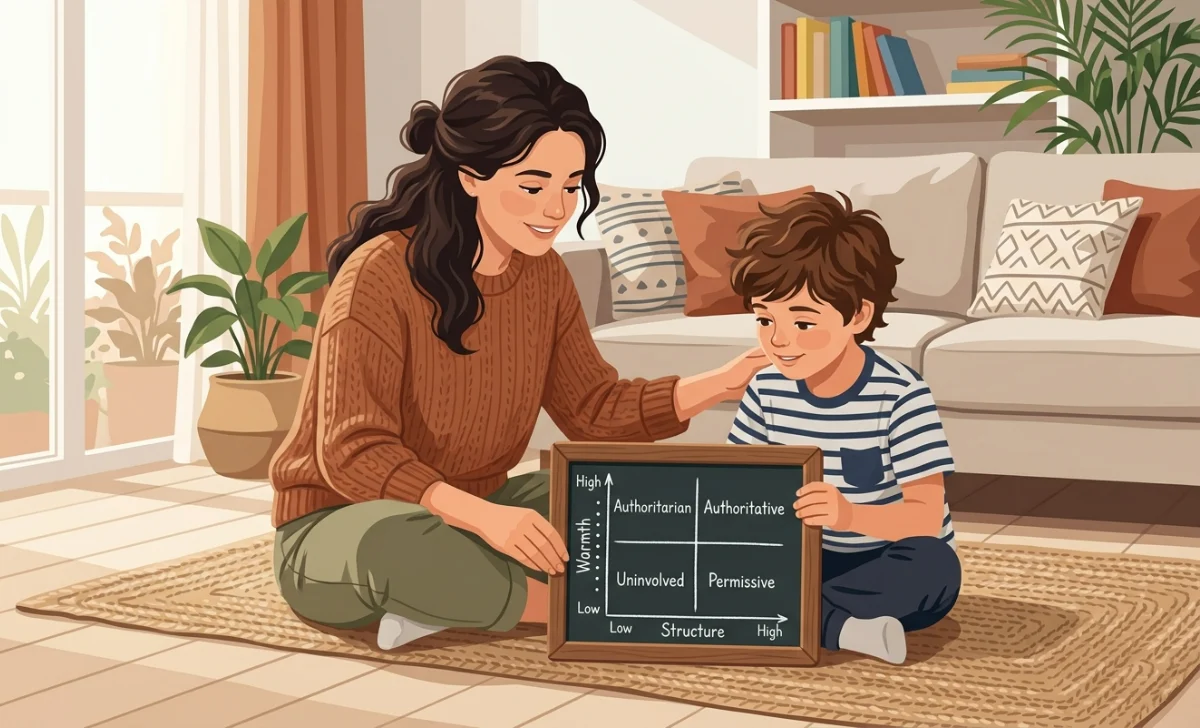
The four parenting styles are Authoritative (warm + firm), Authoritarian (cold + firm), Permissive (warm + weak boundaries), and Uninvolved (cold + weak boundaries). This framework, developed by psychologist Diana Baumrind in the 1960s, helps parents understand how their approach affects child development.
Every parent wants to raise a happy, resilient, and capable child. But how much warmth should you show? How much discipline is too much? Psychologist Diana Baumrind spent decades studying these exact questions and identified four distinct parenting styles that still shape how we understand child development today.
In this guide, you’ll learn each style’s characteristics, see real‑world examples, understand the research‑backed outcomes for children, and discover how modern labels like “gentle parenting” fit into the picture. You’ll also find a simple self‑assessment to identify your dominant style and a step‑by‑step plan to make positive changes. And if parenting ever feels heavier than expected, know that parenting gets harder when you’re doing it right — a sign you’re paying close attention, not failing.
What Are the 4 Parenting Styles?
Diana Baumrind’s Framework (1966–1971)
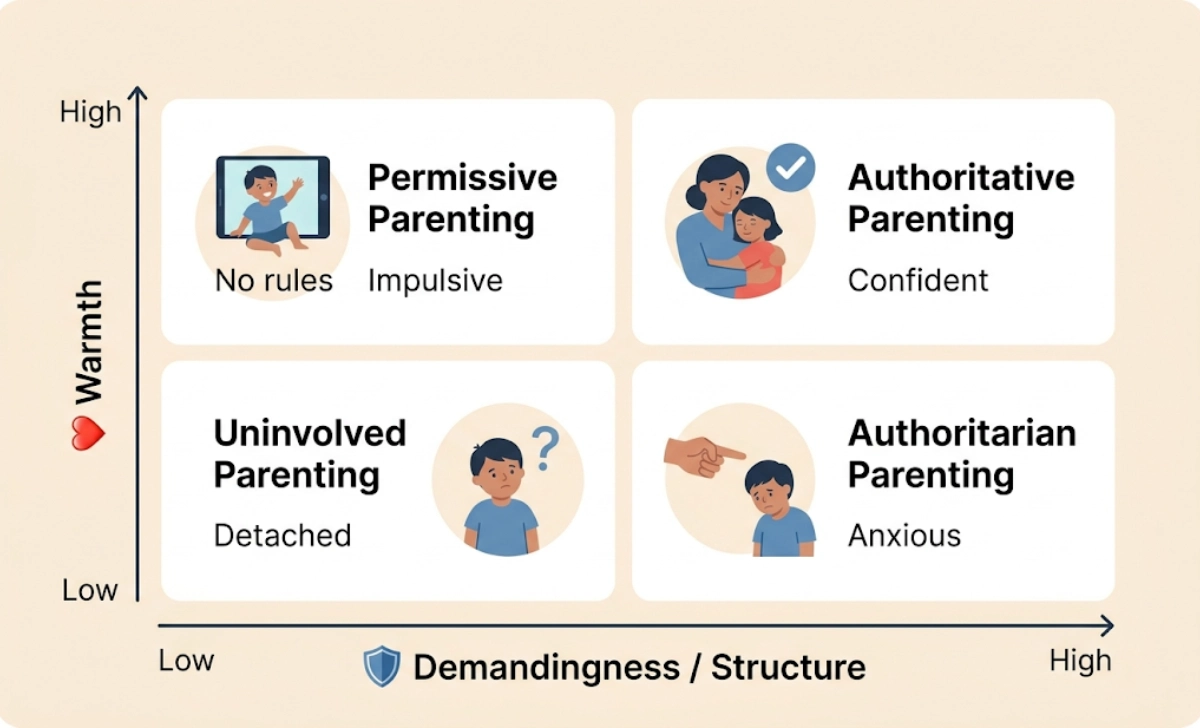
In the 1960s, Baumrind observed preschool children and their parents. She noticed that parenting behaviours clustered around two key dimensions: demandingness (how much control, rules, and expectations parents set) and responsiveness (how much warmth, affection, and support they show). By combining high and low levels of each dimension, she created three original styles. Later, researchers Eleanor Maccoby and John Martin (1983) added a fourth: uninvolved parenting.
The Two Core Dimensions (Demandingness & Responsiveness)
- Demandingness (also called “structure” or “control”): Setting boundaries, enforcing rules, expecting mature behaviour.
- Responsiveness (also called “warmth”): Showing affection, listening to the child’s needs, and explaining decisions.
When you cross these two dimensions, you get four distinct parenting styles.
The 2×2 Matrix (Quick Reference)
| Style | Warmth | Demandingness (Structure) | Example Phrase |
|---|---|---|---|
| Authoritative | High | High | “I know you’re angry, but hitting isn’t allowed. Let’s talk about what happened.” |
| Authoritarian | Low | High | “Because I said so. Go to your room now.” |
| Permissive | High | Low | “It’s okay if you don’t want to clean up right now.” |
| Uninvolved | Low | Low | (No response; child is left to figure things out alone) |
The 4 Parenting Styles Defined (Core Section)
1. Authoritative Parenting (High Warmth, High Structure)
Authoritative parents set clear rules and explain the reasons behind them. They listen to their child’s perspective but ultimately hold the boundary. Discipline is firm, fair, and consistent. They use positive discipline techniques (natural consequences, problem‑solving discussions) rather than punishment.
Real‑Life Examples:
- “You have a 7 pm bedtime because your body needs rest to grow strong. If you finish your routine early, you can read one book with me.”
- When a child breaks a rule: “You chose to throw your toy after I asked you not to. Now you’ll put the toy away for 10 minutes. After that, we can try again.”
- Asking: “What could you do differently next time?” instead of yelling.
Research‑Backed Outcomes on Children
Long‑term studies, including a 2022 meta‑analysis published in the Journal of Child and Family Studies (DOI: 10.1007/s10826‑022‑02345‑X), show that children raised with authoritative parenting tend to have higher self‑esteem, better academic performance, fewer behavioural problems, and stronger social skills. They learn self‑regulation without fear of rejection.

2. Authoritarian Parenting (Low Warmth, High Structure)
Authoritarian parents demand obedience without explanation. Rules are absolute; questioning is seen as disrespect. Punishment is often strict, and affection may be conditional on compliance. Researchers distinguish behavioural control (setting rules) from psychological control (using guilt, shame, or withdrawal of love). Authoritarian parents rely heavily on psychological control.
Real‑Life Examples:
- “You’ll eat what I put on your plate. Don’t complain.”
- “Stop crying right now, or you’ll get a spanking.”
- No negotiation; the parent’s word is final.
Research‑Backed Outcomes on Children
Children from authoritarian homes often become obedient and proficient at following rules, but they may struggle with anxiety, lower self‑esteem, and difficulty making independent decisions. A 2019 longitudinal study in Child Development found that psychological control predicts adolescent depression and rebellious behaviour.
3. Permissive Parenting (High Warmth, Low Structure)
Permissive parents are warm and accepting but set few rules or expectations. They avoid confrontation and may act more like a friend than a parent. Consequences are rarely enforced.
Real‑Life Examples:
- “I know you don’t feel like doing your homework. That’s okay, we can try later.”
- A child throws a tantrum at bedtime; the parent lets them stay up another hour to keep the peace.
- No regular chores or consistent limits on screen time.
Research‑Backed Outcomes on Children
Children raised permissively often have high self‑esteem initially, but they may struggle with self‑control, respect for authority, and frustration tolerance. Academic performance can suffer, and they may be more prone to risky behaviours because boundaries are unclear.
4. Uninvolved / Neglectful Parenting (Low Warmth, Low Structure)
Uninvolved parents provide basic physical needs (food, shelter) but remain emotionally detached and offer little guidance, supervision, or affection. In extreme cases, this crosses into neglect.
Real‑Life Examples:
- A child asks for help with homework; the parent says, “I’m busy” and doesn’t follow up.
- No consistent mealtimes, bedtimes, or rules about digital use.
- The child’s emotional needs go unnoticed for days.
Research‑Backed Outcomes on Children
This style consistently shows the worst outcomes: low self‑esteem, poor academic achievement, emotional withdrawal, and higher risk of substance use and delinquency. These children often struggle to form secure attachments later in life (Ainsworth, 1978; Bowlby, 1988).
Long‑Term Outcomes by Parenting Style
| Outcome Area | Authoritative | Authoritarian | Permissive | Uninvolved |
|---|---|---|---|---|
| Emotional regulation | Excellent | Poor (anxiety, suppression) | Poor (impulsivity) | Very poor |
| Academic performance | High | Medium‑high (compliance) | Low‑medium | Very low |
| Social skills | Strong | Weak (fear of authority) | Weak (entitlement) | Very weak |
| Mental health risk | Low | Moderate‑high | Moderate | High |
| Resilience | High | Low | Low | Very low |
Practical tip for parents of infants: Parenting styles matter from the very first months. For parents navigating the early stages — including the often‑overwhelming world of homemade baby food — learning how to choose a baby food processor without overbuying can save time, money, and stress.
Which Parenting Style Is Best for Child Development?
Why Research Generally Favours Authoritative Parenting
Decades of studies consistently find that authoritative parenting produces the most positive outcomes across diverse populations. Children learn self‑discipline without losing emotional security. They internalise rules because they understand the “why,” not just fear punishment.
Quick answer: Authoritative parenting is the most effective style for the majority of families, according to a 2023 meta‑analysis of over 1,200 studies (Lansford et al., Child Development Perspectives).
Self‑Esteem, Academic Success, Mental Health
Authoritative parenting is linked to higher GPA, lower dropout rates, and greater resilience in young adults. They report lower levels of anxiety and depression compared to their authoritarian or permissive peers. That said, no style is perfect for every child or every situation.
How Do They Fit Into the 4 Main Styles?
Gentle Parenting → Authoritative (When Done Correctly) vs. Permissive (When Boundaries Are Missing)
Many parents confuse gentle parenting with permissiveness. True gentle parenting uses empathy, respect, and natural consequences – that’s authoritative. If you never say “no” or enforce limits, you’ve drifted into permissive territory. The key difference: authoritative, gentle parents hold boundaries kindly; permissive parents avoid boundaries altogether.
Helicopter / Snowplough Parenting → Authoritarian Distortion
Helicopter parents constantly intervene – choosing friends, doing homework, and solving every problem. This is authoritarian parenting driven by anxiety, not coldness. The parent controls excessively, but the child feels suffocated rather than supported. Snowplough parents remove every obstacle. Both styles prevent children from developing resilience and decision‑making skills. Example: A helicopter parent calls the teacher to change a grade instead of letting the child learn from a poor test result.
Free‑Range Parenting → Permissive With an Independence Focus
Free‑range parents give children unusual freedom (walking to the park alone, making their own meals). This is permissive on the demandingness scale – but it’s intentional and can be healthy for older, responsible children. When combined with warmth, free‑range parenting works well for building self‑reliance. Example: A free‑range parent lets a 10‑year‑old bike to a friend’s house without adult supervision, after teaching road safety.
Attachment Parenting → High Responsiveness, Variable Structure
Attachment parenting emphasises constant physical closeness and immediate response to crying. Structure depends on the parent; some attachment parents also set firm boundaries (authoritative), while others struggle with limits (permissive). The style itself is not a separate category – it maps onto authoritative or permissive based on how consistently rules are enforced.
Is Authoritative Parenting Always Best?
What Research Says About Cultural Specificity
In collectivist cultures (e.g., many East Asian, Latin American, and African societies), authoritarian parenting may correlate with academic success and respect for elders – not anxiety. For example, Chao (1994) found that Chinese American parents’ strictness is often interpreted by children as “training” and care, not rejection. Similarly, Deater‑Deckard & Dodge (1997) reported that authoritarian physical discipline was less harmful in African American families when delivered within a warm community context.
Examples of Authoritarian or Permissive Being Positive in Some Cultures
- Chinese and Korean families: High demandingness with emotional restraint is seen as loving (“guan” – to govern and care). Children often achieve high academic results without the anxiety seen in Western authoritarian homes.
- Italian or Greek families: Permissive indulgence toward young children is culturally normal and not linked to negative outcomes when combined with strong family cohesion.
Why One Size Does Not Fit Every Family
The best style adapts to your child’s temperament, your community’s norms, and your values. Authoritative is an excellent starting point, but don’t force it if your child needs more structure or more warmth. What matters most is the combination of consistency and affection.

Parenting Style Quiz: Identify Your Dominant Style
Answer these five questions honestly. Give yourself 1 point for each “yes” to the warmth‑related questions (1, 2, 4, 5) and 1 point for each “yes” to structure‑related questions (1, 2, 3). Then see the scoring guide.
| # | Question | Yes / No |
|---|---|---|
| 1 | Do you regularly tell your child “I love you” and show physical affection? | |
| 2 | When your child breaks a rule, do you explain the consequence calmly before enforcing it? | |
| 3 | Are bedtime, homework, and screen time rules consistently enforced? | |
| 4 | Does your child feel safe disagreeing with you respectfully? | |
| 5 | Do you know your child’s current worries and close friends? |
Scoring guide:
- 4‑5 “yes” to warmth AND 4‑5 “yes” to structure → Authoritative (warm + firm)
- 0‑2 “yes” to warmth AND 4‑5 “yes” to structure → Authoritarian (low warmth, high rules)
- 4‑5 “yes” to warmth AND 0‑2 “yes” to structure → Permissive (warm, few rules)
- 0‑2 “yes” to warmth AND 0‑2 “yes” to structure → Uninvolved
Most parents show a mix. The goal is to move toward authoritative most of the time.
What If You and Your Partner Have Different Parenting Styles?
One parent sets an 8 pm bedtime; the other says, “Let them stay up.” Children quickly learn to play parents against each other, leading to power struggles and confusion.
Practical Co‑Parenting Strategies:
- Agree on non‑negotiables together (bedtime, safety rules) away from the children.
- Present a united front, even if you internally disagree. Debrief later.
- Use “I notice” statements instead of blame: “I noticed you let them skip homework. I’m worried about consistency.”
- If styles clash severely, consider a few sessions with a family therapist.
If arguments about parenting dominate your relationship, or if your child shows signs of anxiety, defiance, or withdrawal, a child psychologist can help you align strategies.

Can You Change Your Parenting Style?
Signs That Change May Be Beneficial
- Your child frequently lies to avoid punishment.
- You feel guilty after most discipline encounters.
- Teachers report that your child struggles with authority or self‑control.
- You feel emotionally distant from your child.
Step‑by‑Step Transition Guide
- Pick one small rule to change this week. For example, instead of yelling for a missed curfew, calmly ask “What happened?” and listen.
- Add one warm behaviour daily. A hug, a compliment, or five minutes of undivided attention.
- Explain the “why” behind a rule before enforcing it.
- Allow natural consequences when safe. If they forget their lunch, they get hungry once.
- Apologise when you overreact – this models emotional intelligence and repairs trust.
Change takes months, not days. Be patient with yourself. Even small shifts toward authoritative parenting produce measurable improvements in child behaviour within weeks (Journal of Clinical Child & Adolescent Psychology, 2020).
Conclusion
Parenting isn’t about perfection – it’s about being present, warm, and consistent. The four parenting styles give you a map, not a prison. Authoritative parenting (high warmth, high structure) delivers the best outcomes for most children in most situations, but your culture, your child’s temperament, and your own upbringing all matter.
Start by identifying your dominant style using the quiz above. Pick one small change – more explanation, a consistent bedtime, or an extra hug – and practice it for one week. You don’t have to be a perfect parent; you just have to be a thoughtful one.
For days when you need a little extra encouragement, browse this collection of 100 inspiring parenting quotes for a happy life — small reminders that can make a big difference.
FAQs
What are the 4 parenting styles in simple terms?
Authoritative (warm + firm), Authoritarian (cold + firm), Permissive (warm + weak rules), Uninvolved (cold + weak rules).
What is the difference between authoritative and authoritarian parenting?
Authoritative explains rules and listens to the child. Authoritarian demands obedience without explanation and uses punishment or psychological control to enforce compliance.
Which parenting style is best for children with anxiety?
Authoritative – the combination of clear expectations and emotional support reduces uncertainty, which fuels anxiety. Avoid authoritarianism, which increases anxiety.
Is gentle parenting the same as permissive parenting?
No. True gentle parenting uses boundaries and natural consequences; it’s authoritative. Permissive parenting avoids boundaries entirely.
Can a parent use more than one parenting style?
Yes. Many parents shift styles depending on the child’s age, mood, or situation. The goal is to lean predominantly authoritative.

