

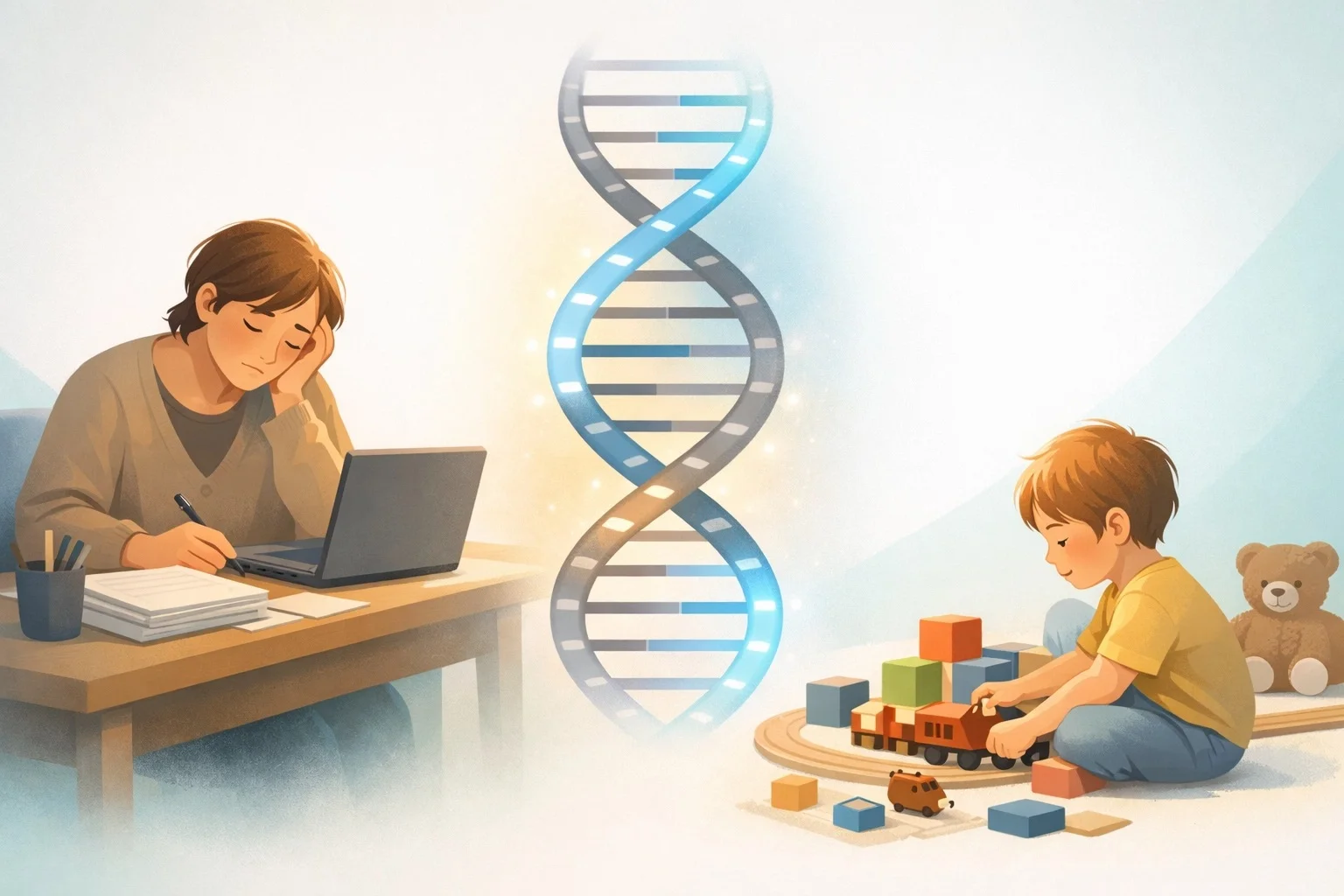
Every parent feels stressed sometimes. The bills pile up, work deadlines hit, and kids still need attention at the end of a long day. But here’s a question that many parents quietly worry about: does your stress affect your child in ways you can’t see?
The answer involves a fascinating area of biology called epigenetics. And the first thing you need to know is this — parental stress effects on child DNA are not what most people think. Stress does not rewrite your child’s genetic code. What it can do is influence how certain genes behave. That distinction matters enormously, and it’s actually good news.
Let’s break this down clearly — no jargon, no fear, just what the science actually shows.
Parental stress can influence how a child’s genes work through a process called epigenetics, but it does not change the DNA sequence itself. These changes affect gene activity — not the genetic blueprint. The good news is that many of these effects are reversible with a healthy, supportive, and low-stress environment over time.
What Is Epigenetics? A Simple Explanation
Think of your DNA as a recipe book. Every cell in your child’s body contains the same book — the same instructions. But not every recipe gets cooked every day. Epigenetics is the process that decides which recipes get used and which stay on the shelf.
The main mechanism is called DNA methylation. Tiny chemical tags (methyl groups) attach to specific spots on DNA and act like volume knobs — turning certain genes up or down. This changes how much of a particular protein gets produced, which affects how the body and brain function.
Crucially: the text of the recipe book never changes. Your child’s DNA sequence — the actual genetic code — remains exactly the same. Epigenetics only affects the reading of that code. This is verified by decades of research published in peer-reviewed journals at the National Institutes of Health (National Institutes of Health — ncbi.nlm.nih.gov).
What Stress Actually Does in the Body
When you experience stress, your body triggers the HPA axis — a communication system between your brain and adrenal glands. This releases cortisol, your primary stress hormone. Cortisol is useful in short bursts. It sharpens focus, boosts energy, and helps you respond quickly to challenges.
But when stress is chronic — meaning it’s present most days, week after week — cortisol levels stay elevated for longer than the body was designed for. Research shows that sustained high cortisol can influence DNA methylation patterns on key genes, including the NR3C1 gene, which controls how the body responds to cortisol itself.
According to a 2024 review in Clinical Epigenetics, prenatal and early childhood stress exposure is linked to changes in methylation patterns that affect the brain’s stress-response system. These changes don’t appear overnight, and they don’t happen from a bad week. They emerge from sustained, prolonged stress in the child’s environment.
Important: Most everyday parenting stress — deadlines, arguments, tiredness — does not reach the threshold that produces lasting epigenetic changes. The research focuses primarily on chronic, severe, or prolonged stress.
How Children Are Affected
Children’s brains and bodies are still developing. This makes them more sensitive to their environment than adults — for better and for worse. When a child lives in a high-stress household long-term, a few things can happen at the biological level.
Stress Response Sensitivity
Research from the American Psychological Association (apa.org) and multiple peer-reviewed studies shows that children raised in consistently stressful environments can develop a more reactive stress response system. Their bodies may release cortisol more quickly, and take longer to return to calm.
Emotional and Behavioral Changes
Some studies link early stress exposure to increased emotional sensitivity, difficulty self-regulating, and heightened anxiety responses. These are not fixed outcomes — they are tendencies that can shift with the right support. If you’re concerned about how these patterns manifest, you might find identifying signs of bad parenting helpful in breaking harmful cycles.
Learning and Memory
The hippocampus — the brain region central to memory and learning — is particularly sensitive to cortisol. Prolonged stress can affect how this region develops. But here’s the key: the brain is highly plastic, especially in childhood. It responds to positive change.
The Good News: Epigenetics Works Both Ways
This is the part most articles skip — and it’s the most important part.
If stress can shift gene expression patterns, so can warmth, stability, and care. Research on maternal care and child development has found that positive, consistent parenting is associated with protective epigenetic changes — changes that support healthy stress regulation, not undermine it.
A major study published in the International Journal of Developmental Neuroscience (2025) found that increased maternal care was linked to thousands of differentially methylated regions in ways that support resilience — not vulnerability. More care produced more biological protection.
The brain’s ability to reorganize itself in response to new experiences — called neuroplasticity — is especially strong in children. A child’s brain under age 10 is not a fixed system. It’s actively rewiring based on what happens day to day. A calmer, warmer environment doesn’t just feel better. It produces real, measurable biological change.
“The emphasis on interpersonal relationships expressed in maternal care was conceived as an environmental event that can produce epigenetic changes related to the biological bases of vulnerability to stress.” — Research review, International Journal of Developmental Neuroscience, 2025.
Simple Ways to Reduce the Impact of Parental Stress
You don’t need to eliminate all stress from your life — that’s not realistic and not what the research demands. What matters is the overall pattern of your child’s environment. Here are practical, science-backed steps.
1. Repair, Don’t Avoid
Research consistently shows that what matters most is not whether conflict happens, but whether parents repair after it. A calm conversation after a tense moment teaches the child’s nervous system that stress is manageable and temporary.
2. Build Predictable Routines
Predictability lowers background cortisol in children. Regular mealtimes, bedtime routines, and consistent responses to behavior create a sense of safety that the child’s biology registers. It doesn’t have to be rigid — it just has to be reliable enough to feel consistent.
(For more on establishing routines, consider reading about sleep loss in first year baby).
3. Manage Your Own Stress Visibly
Children co-regulate with their caregivers. When you take slow breaths, speak calmly after frustration, or step away briefly and return composed, you’re modeling stress regulation. The child’s nervous system mirrors yours. This is one of the most powerful tools available.
(To understand how your own upbringing might influence your approach, see parenting style shaped by your parents).
4. Prioritize Physical Safety and Warmth
Warmth doesn’t mean permissiveness. It means physical affection, eye contact, and being genuinely present during interactions. Research shows that warm, responsive caregiving is directly linked to protective epigenetic patterns in children.
5. Seek Support Early
If you’re experiencing chronic stress, anxiety, or depression, getting help is not just for you — it’s one of the most direct ways to protect your child’s development. The World Health Organization (who.int) recognizes parental mental health as a core component of child health. Therapy, peer support, and medication (when appropriate) all reduce chronic stress — and the downstream biological effects that come with it.
(For insights on effective co-parenting, explore 10 secrets to parenting as partners).
Science Facts Worth Knowing
- Genes can switch on and off throughout your lifetime based on environment, behavior, diet, and relationships — this is normal biology.
- Children under age 10 have especially high neuroplasticity, meaning their brains reorganize more readily than adult brains.
- Studies show that positive parenting — warm, responsive, consistent — produces measurable changes in children’s stress-response biology.
- Epigenetic changes from early stress are not a life sentence. Research has documented reversal of stress-related methylation patterns when environments improve.
- Even small daily habits — calm bedtime routines, brief moments of genuine connection — accumulate into the stable environment that protects development.
Myth vs. Fact
| Myth | Fact |
|---|---|
| Parental stress permanently damages a child’s DNA. | Stress affects how genes are expressed — the DNA sequence itself stays the same. |
| Epigenetic changes are fixed and can’t be undone. | Many epigenetic changes are reversible. A stable, warm environment can shift gene expression patterns over time. |
| Only extreme trauma causes epigenetic changes. | Everyday chronic stress can also influence gene expression — but so can everyday warmth and consistency. |
| You have to be a perfect parent to protect your child. | Good enough, consistent, caring parenting is what research actually supports. Perfection isn’t the goal — presence is. |
Key Takeaways
- Parental stress affects gene expression — not the DNA sequence itself.
- The primary mechanism is DNA methylation, which acts like a volume control on specific genes.
- Chronic, prolonged stress has the most impact. Ordinary daily stress does not rewrite your child’s biology.
- Epigenetic effects are often reversible. A stable, caring environment shifts things in a positive direction.
- Warm, consistent, responsive parenting produces protective epigenetic patterns — not just good feelings.
- Your child’s brain is highly adaptable. Improvement is always possible, at any stage.
Frequently Asked Questions
Can parental stress really affect a child’s DNA?
It affects how genes are expressed — not the DNA sequence itself. Stress changes which genes are “turned on” through a process called epigenetics. The underlying genetic code stays the same. This is an important distinction: your child’s DNA blueprint doesn’t change, but the reading of it can shift based on environment.
Is epigenetics permanent?
Not always. Many epigenetic changes are reversible. Scientific research shows that improving a child’s environment — reducing chronic stress, increasing warmth and stability — can shift gene expression patterns back in a healthier direction. The earlier the change happens, the more responsive the system tends to be.
Can positive parenting reverse the effects of early stress?
Research supports exactly this. Studies on maternal care and child development show that warm, consistent, responsive caregiving is linked to protective epigenetic changes. The brain’s neuroplasticity — its ability to rewire — means that positive experiences genuinely alter biology, not just mood.
How can parents reduce the impact of their stress on their children?
Focus on repair after conflict, predictable daily routines, visible calm behavior, physical warmth and presence, and seeking support for your own mental health when needed. The overall pattern of the child’s environment matters more than individual stressful moments.
Does this mean I’ve already damaged my child by being stressed?
No. The research focuses on chronic, severe, sustained stress — not typical parenting pressures. If you’ve had a stressful period, that doesn’t produce lasting biological harm. And even when stress has been prolonged, the evidence shows that improvement in environment produces biological improvement in the child. You have more influence going forward than you might think.
Final Word
The science of epigenetics is sometimes reported in a way that frightens parents. That misses the point entirely. Yes, stress influences how your child’s genes behave. But warmth, stability, and care do exactly the same thing — in the other direction.
You don’t have to be a perfect parent. No such thing exists, and the research doesn’t support that standard anyway. What it does support is this: a caring, consistent, emotionally present environment gives your child’s biology the conditions it needs to develop well. That’s within reach — even on hard days.
If you’ve been stressed, that’s not a reason for guilt. It’s a reason to focus forward. The brain adapts. Genes respond to environments. And the relationship between you and your child is one of the most powerful biological forces in their development.

