



If you feel like you haven’t slept properly since your baby was born — you’re not imagining it. You’re not being dramatic. And you’re not alone. Sleep loss in first year baby is one of the most universal and least talked-about realities of early parenthood.
Sleep loss in first year baby is very common. Newborns wake frequently due to short sleep cycles and constant feeding needs, which means parents rarely get the deep, uninterrupted rest their bodies need. This can feel completely overwhelming in the early weeks. But research is clear: sleep patterns improve steadily as your baby grows, and most parents see real improvement by the time their child reaches 6 months.
Sleep loss during a baby’s first year happens because newborns have short sleep cycles — around 45 to 60 minutes — and need frequent feeds throughout the night. Parents may feel exhausted, but this phase is temporary. As babies grow and develop a natural circadian rhythm, their sleep stabilises, and parents gradually recover better rest.
Why Babies Wake So Much: The Simple Science
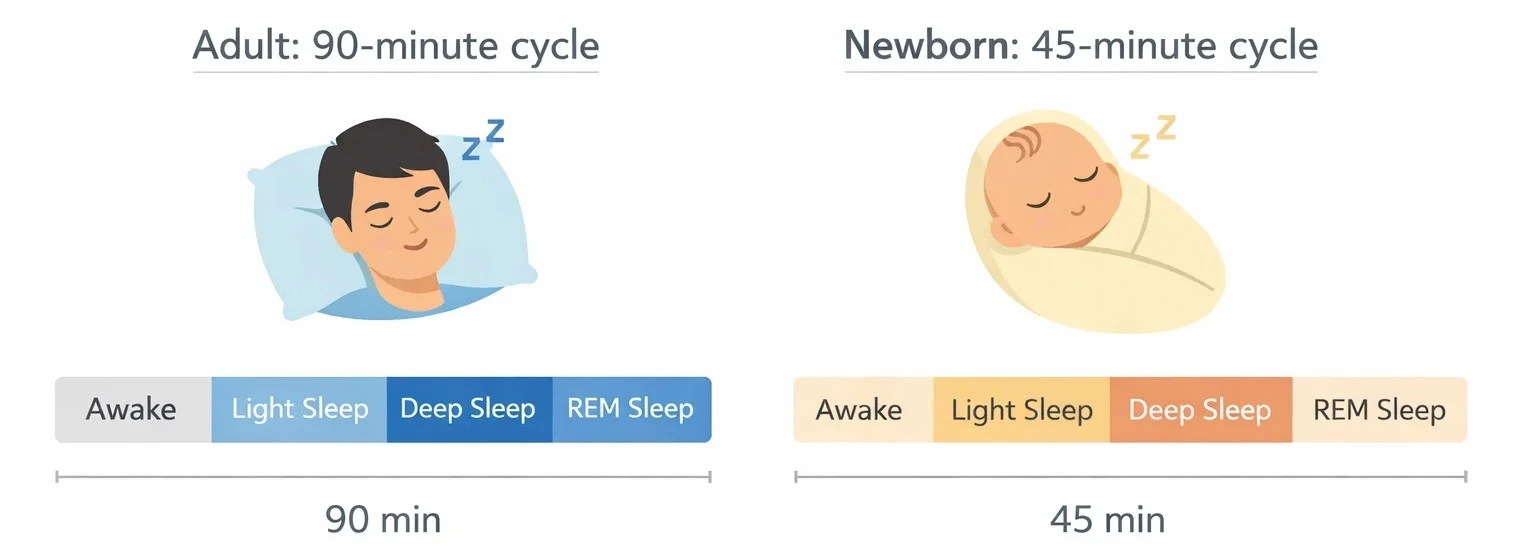
Newborns aren’t waking to test your patience. Their brains genuinely aren’t built for long sleep stretches yet. Here’s why:
Short Sleep Cycles
An adult sleeps in 90-minute cycles. A newborn’s cycle lasts just 45 to 60 minutes, according to the Sleep Foundation. Babies spend roughly 50% of that time in active REM sleep — far more than the 20% adults experience. REM is a lighter, more alert stage. That’s why your baby stirs, twitches, and wakes so easily. It’s not a problem — it’s a developing brain doing its job.
No Circadian Rhythm Yet
Newborns don’t have a body clock at birth. Their internal rhythm — the signal that separates day from night — doesn’t start forming until around 6 to 8 weeks, and doesn’t fully develop until about 3 to 4 months. Until then, they cycle through sleep and waking around the clock, regardless of whether the sun is up.
Constant Feeding Needs
Newborns have tiny stomachs and digest breast milk or formula quickly. Most need to feed every 2 to 3 hours, including overnight. This is biologically normal and essential for healthy growth — even when it feels relentless at 3 a.m.
What the Research Actually Says About Sleep Loss
The numbers are sobering, but knowing them helps. You’re not imagining the exhaustion — it’s documented.
- A survey of 1,300 parents by Snuz found that 7 in 10 parents lose around 3 hours of sleep per night during their baby’s first year. That adds up to roughly 133 nights of lost sleep before the first birthday.
- A separate Silentnight study found new parents lose the equivalent of over two months of sleep in the first year, with nearly 975 night wakings across that period.
- According to a 2010 study in Pediatrics, babies’ sleep improves rapidly in the first months. By a baby’s first birthday, 85% of parents reported consistently uninterrupted nights.
- A German study tracking over 4,600 parents found that while it can take up to six years to fully recover previous sleep quality, the steepest drop happens in the first year — and improvement begins from around 3 to 6 months.
One important detail: total sleep hours matter less than sleep fragmentation. Waking four times a night is more damaging than simply going to bed an hour late. That’s why new parents feel so depleted even on nights when they technically get 6 or 7 hours of rest. While physical tiredness is expected, it’s also important to watch for other patterns; for instance, some parents worry if their frustration leads to signs of bad parenting, but usually, it’s just the exhaustion talking.
Why Mothers Feel It More
Both parents lose sleep — but mothers consistently report worse disruption. This isn’t weakness. There are biological and practical reasons behind it.
- Hormonal wiring: Oxytocin and prolactin (both elevated during breastfeeding) make mothers highly sensitive to infant cues. The same hormones that support bonding also trigger lighter sleep, so mums wake more easily to sounds and movement.
- Night feeding: Breastfeeding mothers handle most or all overnight feeds. Even mothers who bottle-feed often take on more night duty during extended maternity leave.
- Harder to get back to sleep: The Silentnight study found that 70% of fathers felt they’d slept well after a nighttime waking, compared to just 44% of mothers. That difference compounds night after night.
- Mental load: Mothers often remain on alert even when not actively feeding — monitoring breathing, anticipating the next wake, or simply unable to switch off. This hypervigilance is a real physiological state, not an attitude problem.
The Real Effects of Sleep Deprivation (Without the Panic)
Sleep deprivation has genuine effects. It’s worth naming them honestly — not to alarm you, but to validate why you feel the way you do. These effects are well-documented and temporary:
- Mood changes: Irritability, emotional sensitivity, and low patience are among the earliest signs of sleep loss. This doesn’t mean you’re struggling with parenthood — it means your brain is running low on rest.
- Concentration and memory: Fragmented sleep affects short-term memory and decision-making. Pouring milk on the counter or walking into a room and forgetting why — these are textbook symptoms, not signs of losing your mind.
- Physical fatigue: Your body repairs itself during deep sleep. Less of it means more aches, slower immune response, and that bone-deep tiredness that coffee can’t fix.
- Postpartum mood: Chronic sleep loss is closely linked to postpartum depression and anxiety. If you’re feeling persistently low, not just tired, speak to your doctor or midwife.
The stress of this period can even have deeper biological implications. Research suggests that parental stress effects on child DNA are a real area of study, though most everyday stress doesn’t reach that threshold. Understanding this can help parents prioritize their own well-being during the first year.
The Good News: Sleep Does Get Better
This is the part that matters most, and it’s backed by evidence. Here’s roughly how the trajectory looks:
- 0–3 months: The toughest stretch. Babies feed every 2–3 hours overnight, their circadian rhythm isn’t formed yet, and sleep feels fractured around the clock.
- 3–6 months: A meaningful shift. Most babies start developing a circadian rhythm, melatonin begins cycling naturally, and longer stretches of 4 to 6 hours become possible.
- 6–12 months: Many babies can sleep 8 to 9 hours at night without feeding. The Pediatrics study found that by 12 months, 85% of parents reported uninterrupted nights — not occasionally, but consistently.
As you navigate these shifts, you might reflect on how your own upbringing influences your reactions. It’s common to find your parenting style shaped by your parents, especially when you’re functioning on low sleep and relying on instinct.
Practical Tips That Actually Help

No single tip magically solves newborn sleep deprivation. But small adjustments stack up, and some of them genuinely help.
Nap When the Baby Naps — Seriously
Even a 20-minute nap improves alertness for hours. Research by sleep scientist William Dement found that a 45-minute nap could sustain improved cognitive function for up to six hours afterward. The dishes can wait.
Split the Night Shifts
If you have a partner, divide the night into blocks. One person takes 10 p.m. to 2 a.m., the other takes 2 a.m. to 6 a.m. Both of you get at least one 4-hour uninterrupted stretch, which is far more restorative than fragmented hours all night. Learning to coordinate like this is one of the 10 secrets to parenting as partners that can save your sanity.
Keep Nighttime Interactions Quiet and Dim
Bright lights and conversation at 3 a.m. signal ‘daytime’ to your baby’s developing brain. Use a dim light for feeds, keep interactions calm and quiet, and it helps reinforce the night-vs-day pattern your baby is working to build.
Say Yes to Help
When someone offers to hold the baby, cook a meal, or take the older kids for a few hours — say yes. Accepting help is not a sign that you’re struggling. It’s a sign that you understand your own limits and care enough about your baby to rest properly.
5 Things Worth Knowing About Baby Sleep
- Newborns sleep up to 18 hours a day — just not in one block. Their total sleep is actually higher than yours.
- Waking between sleep cycles is completely normal infant behaviour, not a sign that something is wrong.
- A baby’s sleep cycle gradually lengthens from 45 minutes at birth to closer to 90 minutes by age 5.
- White noise mimics the sounds of the womb and can help some babies settle between cycles.
- Sleep ‘training’ approaches generally aren’t developmentally appropriate before 4 to 6 months.
Myth vs. Reality
| Myth | Reality |
|---|---|
| A ‘good’ baby sleeps through the night by 6 weeks. | Most babies physically can’t sleep through until 3–6 months. Early waking is biological, not behavioural. |
| Formula-fed babies sleep longer than breastfed ones. | Research doesn’t consistently support this. Both feeding types result in overnight waking. |
| If you’re exhausted, you’re doing something wrong. | Exhaustion is an expected, documented outcome of newborn care. It reflects the biology of infant sleep, not your parenting. |
| You’ll catch up on sleep in a few weeks. | Sleep debt can’t be fully ‘caught up’ overnight, but your quality of sleep does improve meaningfully around 3–6 months. |
Frequently Asked Questions
How much sleep do parents lose in the first year?
Studies vary, but multiple surveys suggest parents lose around 44 to 68 days’ worth of sleep across the first year — roughly 3 to 4.5 hours of sleep per night compared to their pre-baby baseline.
When does baby sleep get better?
Most babies begin sleeping 6-hour stretches by 3 to 6 months, as their circadian rhythm establishes and feeding intervals lengthen. By 12 months, the majority of babies can sleep through the night.
Is it normal to feel completely exhausted as a new parent?
Completely. Exhaustion is a documented, expected response to the level of sleep disruption that comes with newborn care. It doesn’t mean you’re failing or that something is wrong.
Key Takeaways
- Sleep loss in the first year is universal — not a sign of failure.
- Newborn sleep cycles are short (45–60 minutes) and biologically driven.
- Mothers typically experience more disruption due to hormonal and practical factors.
- Meaningful improvement happens around 3–6 months for most babies.
- Small, consistent habits — napping, splitting duties — genuinely reduce the impact.
This Phase Won’t Last Forever
If you’re reading this at 3 a.m., rocking a baby who won’t settle, running on two hours of broken sleep — this is for you. What you’re doing is hard. The tiredness you feel is real, documented, and shared by almost every parent who has walked this road.
The science says it gets better. Most babies are sleeping in longer stretches by 3 to 6 months. By 12 months, most parents are sleeping through the night. The fog lifts. The exhaustion eases. And the tiny person currently keeping you awake will eventually sleep — soundly, consistently, often past the time you wish they’d get up.
Hold on. Rest when you can. Ask for help without guilt. And know that the season of sleep loss in first year baby life is finite — even when it doesn’t feel that way at midnight.