
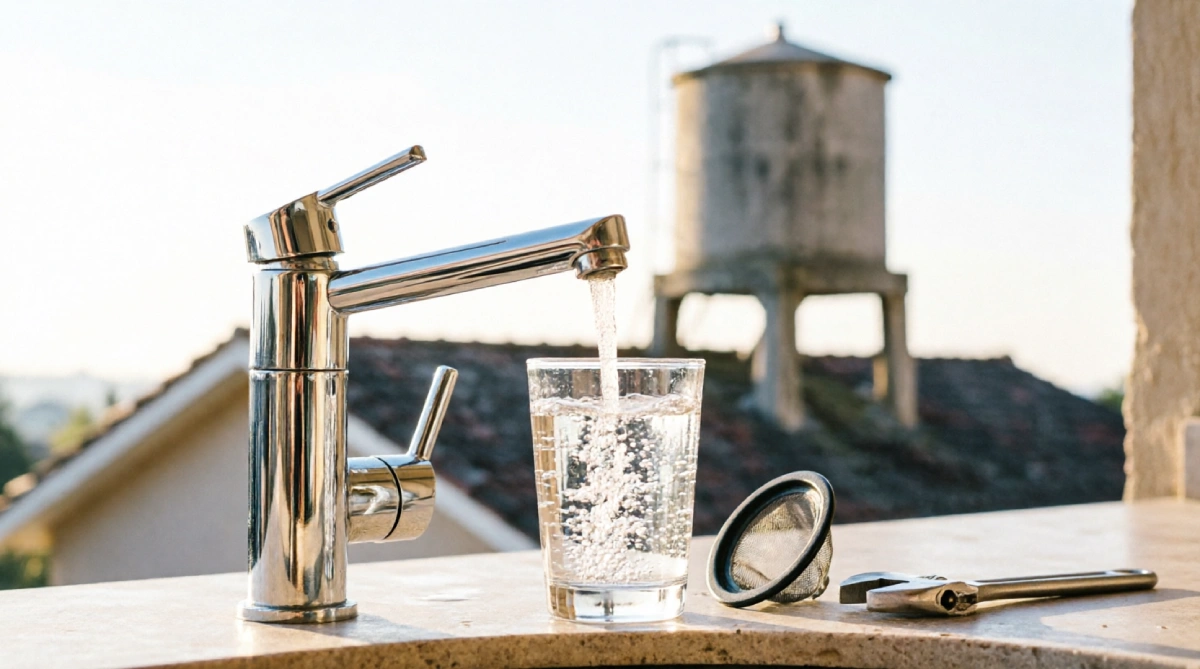
Muddy water from your overhead tank is one of the most alarming things you can see coming out of a tap. You fill a glass, hold it to the light — it’s brown, murky, with tiny particles floating around. Your first thought: the tank must be filthy. Time to drain everything and scrub it out.
Stop. That’s probably not the problem.
In most homes, muddy water from an overhead tank has one specific, easy-to-fix cause — the outlet strainer is either missing, broken, or blocked. This small piece of mesh sits inside your tank’s outlet pipe and stops sediment from getting through. When it fails, dirt flows straight into your home’s water supply.
You don’t need to drain and scrub the entire tank. You need a $5 fix and 45 minutes of your time.
Why Your Tap Water Looks Muddy
Muddy water from an overhead tank almost always traces back to one point — the outlet pipe and what’s (or isn’t) sitting in front of it. Your overhead tank collects water from the main supply or a borewell. Over time, fine dust, rust flakes, algae particles, and general sediment settle at the bottom of the tank. This is normal — every tank accumulates some level of sediment over months of use.
Here’s the thing: that sediment stays at the bottom as long as nothing stirs it up. Your tank’s outlet pipe sits near the bottom of the tank wall, where water exits and flows to your taps. When the strainer on that outlet is intact, it acts as the last barrier — blocking debris from entering the pipe. Water passes through. Sediment stays in the tank.
When the strainer is gone or cracked, nothing is stopping that debris. The moment water rushes toward the outlet (especially after the tank refills and creates turbulence), sediment gets pulled straight in. That’s what comes out of your tap.
What Is an Outlet Strainer?
An outlet strainer is a small mesh filter — usually made of nylon or stainless steel — that attaches to or sits inside the tank’s outlet fitting. Think of it like the mesh at the bottom of a kitchen sink drain, but smaller and built for a water pipe.
Its job is simple: let water through, block everything else.
Most overhead tanks come with one installed at the factory. But strainers can crack, corrode, or fall apart after 2–3 years. In older homes, the strainer may have been removed during a repair and never replaced. Either way, the result is the same — an open pipe with no filter.
How to Know If the Strainer Is the Problem
Before you spend money on a professional cleaning, check these signs first:
- Water at your taps looks muddy or brownish, especially right after the tank fills up
- You see tiny particles or grit settling at the bottom of a glass after a few minutes
- The problem got worse recently after any tank work, pump replacement, or roof repairs
- The water clears up slightly if you let the tap run for 30–60 seconds (debris flushes through, then fresh water follows)
- Water in the tank itself looks clear when you check it directly
If your water looks muddy only when it comes out of the tap, but the tank water appears clean, your strainer is almost certainly the issue.
What You’ll Need for the Fix
This is a cheap, beginner-friendly repair. Pick these up from any hardware or plumbing supply store:
- Fine nylon mesh (150–200 micron mesh size — available in small sheets or rolls)
- PVC end cap that fits your outlet pipe diameter (usually ½ inch or ¾ inch)
- A drill with a small drill bit (or a sharp nail and hammer)
- Zip ties or a hose clamp
- Scissors
- Optional: a PVC union fitting for easier reinstallation
Total cost: under $8 in most markets.
Step-by-Step Fix: Retrofitting a Nylon Mesh Strainer
Step 1 — Close the supply valve
Locate the ball valve on the outlet pipe below your tank and close it. This stops water from flowing while you work. If there’s no valve, tie off the float valve inside the tank temporarily to stop refilling.
Step 2 — Access the tank outlet
Most overhead tanks have an access point at the top or side. Open it and locate where the outlet pipe connects to the tank wall — it’s usually a threaded PVC or brass fitting screwed into the tank body.
Step 3 — Remove the existing fitting or strainer
Use a wrench or your hand to unscrew the outlet fitting from inside the tank. If there was a strainer, you’ll see it here — or you’ll see nothing, confirming it’s missing. Inspect the fitting for cracks.
Step 4 — Make your mesh strainer
Cut a circle of nylon mesh slightly larger than the diameter of your PVC end cap. Drill or punch 8–12 small holes in the end cap to allow water flow. Place the mesh over the open end of the cap and secure it tightly with a zip tie or hose clamp. The mesh should sit flat and tight with no gaps around the edges.
Step 5 — Attach the strainer to the outlet fitting
Slip your mesh-covered end cap over the inlet end of the outlet fitting (the end that faces inside the tank). Secure it with another zip tie or clamp. The mesh now faces the interior of the tank — it will catch sediment before it enters the pipe.
Step 6 — Reinstall the fitting
Screw the outlet fitting back into the tank wall. Hand-tight is usually enough for plastic fittings — don’t over-torque or you’ll crack the tank body. Like many DIY repairs, small hardware mistakes can create much bigger structural problems later.
Step 7 — Reopen the valve and test
Open the supply valve slowly. Let water run at a tap for 60 seconds to flush out any loose debris that entered before the fix. Fill a clean glass and hold it to the light.
The water should be clear.
Before vs. After: What to Expect
Before the fix, a glass of water from your tap will show visible particles settling within 1–2 minutes. The water may look yellowish or brown.
After installing the nylon mesh strainer, that same glass should be clear. No particles. No sediment. The strainer is doing exactly what it’s supposed to — holding the debris inside the tank where it can be cleaned periodically, not sending it into your pipes.
If the water is still slightly discolored after the fix, run all your taps fully open for 3–5 minutes — similar to how some home systems can keep underperforming even after running continuously for hours. This flushes existing debris from the pipes themselves. Most homeowners see completely clear water within one fill cycle of the tank.
Common Mistakes to Avoid
- Using a mesh that’s too coarse — A mesh that’s too open lets fine particles through. Go with 150–200 micron nylon mesh — it filters sediment without restricting water flow.
- Skipping the hose clamp — A zip tie alone can loosen over time with water pressure. Use a small stainless steel hose clamp for a secure, long-lasting seal.
- Not checking the fitting for cracks — If the PVC outlet fitting itself is cracked or broken, a new strainer won’t solve the problem. Replace the entire fitting while you have it removed.
- Cleaning the tank but ignoring the strainer — Many homeowners clean the tank, put everything back, and get muddy water again within weeks — because the strainer was never replaced. Always reinstall or replace the strainer when cleaning.
Quick Maintenance Tips
- Inspect the strainer every 6 months. Remove it, rinse it under running water, and check for tears.
- Clean your tank fully every 12–18 months, regardless of water clarity.
- After any repair to your inlet pipe, float valve, or tank cover, check the strainer — debris often gets knocked in during maintenance work, and small overlooked issues after repairs can sometimes create much bigger household problems later.
- If you’re on a borewell supply, consider a double filter setup: a coarse mesh strainer at the tank outlet and an inline sediment filter on the main supply pipe. Preventing dirty water issues early also helps reduce long-term moisture-related damage inside the home.
For additional guidance on water tank maintenance standards, the World Health Organization’s safe water storage guidelines cover best practices for keeping stored water clean and safe for household use.
FAQs
Can I just clean the whole tank instead of fixing the strainer?
You can, but it won’t solve the problem. If the strainer is broken or missing, sediment will re-enter your pipes the moment you refill the tank. Fix the strainer first — then decide if a full clean is still needed.
How often do outlet strainers fail?
Plastic strainers typically last 2–4 years before cracking. Stainless steel mesh lasts longer but can still corrode, especially in hard water or borewell supply areas. Check yours at least once a year.
My tank water looks clean, but the tap water is still muddy. Why?
This strongly points to the outlet strainer. The tank itself is fine — debris is entering the pipe at the outlet point. The fix in this article directly addresses this scenario.
Do I need a plumber for this repair?
No. This is a beginner-level DIY job. You need basic tools, about 45 minutes, and materials that cost less than $10. No soldering, no complex fittings, no professional skills required.
What if the problem continues after I install the new strainer?
Check two things: first, confirm the mesh is properly secured with no gaps. Second, check whether sediment has already built up inside your outlet pipe. If so, disconnect the pipe briefly and flush it with water from a hose before reconnecting.
Written by Michael Reed — Michael covers home improvement, plumbing repairs, and renovation tips for everyday homeowners. He focuses on practical, low-cost fixes that get results without unnecessary professional fees.

